
From Agency to Architecture: Embedding Leadership Transitions into Organizational Routines
Target Journals: The Leadership Quarterly, Journal of Organizational Behavior, Organization Science
Abstract
The transition from directive to empowering leadership represents a primary failure point for founders of craft-intensive micro-enterprises. While Empowering Leadership is a validated construct, the “implementation gap”—the mechanism by which a leader safely de-bottlenecks themselves—remains under-theorized. This paper introduces the Coetzee Convergence Framework (CCF) to propose a shift from Leadership as Agency (behavioral) to Leadership as Architecture (structural). By synthesizing Empowerment Science with Organizational Routine Theory, we demonstrate how leadership intent can be embedded into the “ostensive” and “performative” aspects of firm habits. Through the use of blockchain as a digital artifact to verify routine fidelity, the framework provides the psychological safety necessary to sustain autonomy in high-stakes environments and high power distance cultural contexts.
I. Introduction: The Agency-to-Architecture Shift
In the lifecycle of an artisan micro-enterprise, the founder is typically the “central agency”—the source of all quality control, directive energy, and intellectual capital. This creates a “Founder Bottleneck” that prevents scaling and ensures fragility. Traditional leadership shifts (e.g., Transformational or Situational) often fail here because they require the continuous intentional behavior of the founder to sustain. This paper proposes that true transition occurs only when leadership is “encoded” into the organizational fabric—moving from a person-dependent model to a system-dependent architecture.
II. Beyond Construct Redundancy: The Implementation Gap
Leadership science is saturated with constructs like Empowering Leadership (Ahearne et al., 2005). However, meta-analyses (Kim et al., 2018) show that the success of these styles is highly moderated by the environment. In micro-enterprises, the “cost of failure” is so high that founders often revert to directive styles (Diminishers) despite their best intentions.
The CCF occupies the gap at the intersection of Leadership Science and Organizational Routine Theory (Feldman & Pentland, 2003). We argue that leadership is not merely a dyadic exchange but a “Routine Dynamic.” By designing routines that carry the leader’s standards, the founder moves from managing people to managing the architecture that governs the work.
III. The Mechanism: Embedding Intent in Routine Dynamics
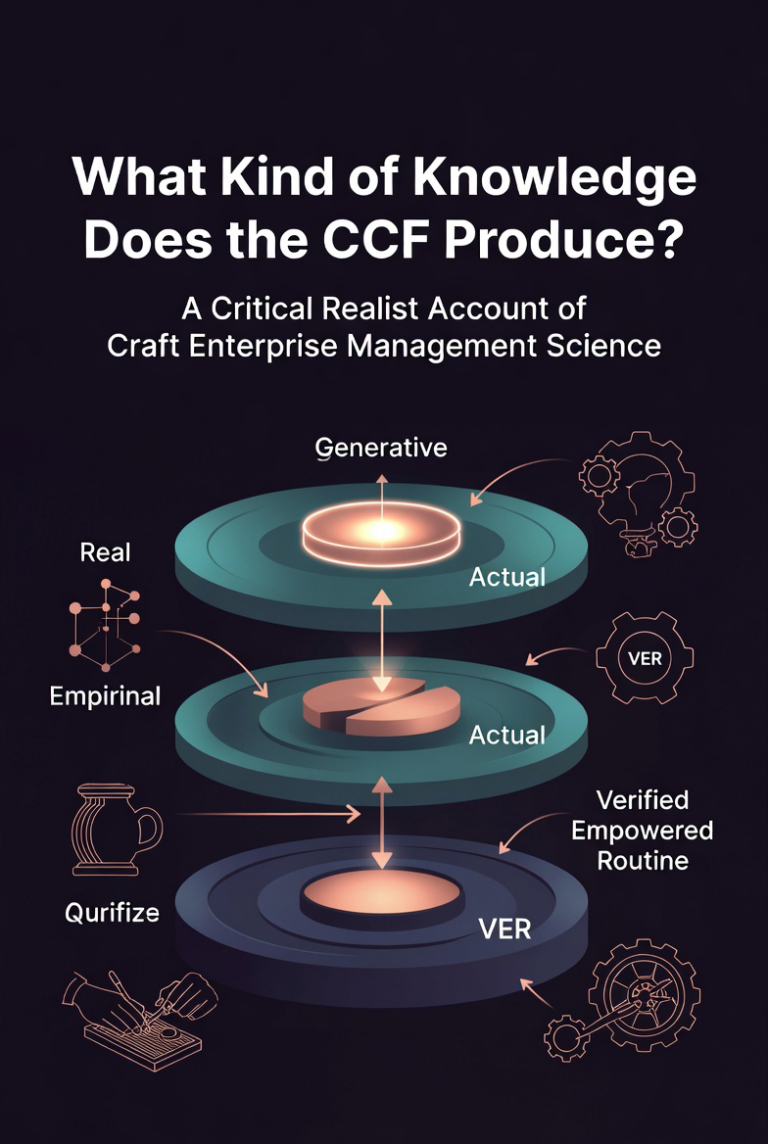
Following Feldman and Pentland (2003), we distinguish between the ostensive (the abstract rule) and the performative (the actual practice) of a routine. The CCF operationalizes this for leadership transition:
- Pillar 1 (Empowerment): Establishes the psychological readiness of the artisan to accept agency.
- Pillar 2 (Habit Architecture): Codifies the leader’s quality standards into the “ostensive” routine. As the team performs these habits, the leader’s intent is executed in their absence.
- Pillar 3 (Blockchain): Provides the “Digital Artifact” that verifies the performative aspect. This ledger acts as a structural surrogate for the leader’s oversight, allowing for “High-Fidelity Autonomy.”
IV. Culturally Adaptive Empowerment
A significant barrier in the global jewelry industry is the prevalence of High Power Distance (HPD) cultures (e.g., India, Thailand, South Africa). In these contexts, unstructured empowerment is often perceived as a lack of leadership, leading to anxiety (Kirkman et al., 2009). The CCF solves this via “Structured Autonomy.” By embedding empowerment within a rigid Habit Architecture, the routine itself becomes the “Authority.” This allows artisans to exercise agency without the social friction of violating traditional hierarchical expectations.
V. Conclusion
The shift from a “Diminisher” to a “Multiplier” is ultimately a move from agency to architecture. By embedding leadership transitions into organizational routines, the CCF provides a sustainable, scalable model for artisan firms. This ensures that the firm’s integrity and quality are not a variable of the founder’s presence, but a constant of the firm’s design.
Key References
- Ahearne, M., et al. (2005). “To empower or not to empower…” Journal of Applied Psychology.
- Dionysiou, D. D., & Tsoukas, H. (2013). “Understanding the Co-creation of Routines…” Academy of Management Review.
- Edmondson, A. (1999). “Psychological Safety and Learning Behavior…” Administrative Science Quarterly.
- Feldman, M. S., & Pentland, B. T. (2003). “Reconceptualizing Organizational Routines…” Administrative Science Quarterly.
- Kim, M., et al. (2018). “Employee responses to empowering leadership: A meta-analysis.” Journal of Leadership & Organizational Studies.
- Kirkman, B. L., et al. (2009). “Individual power distance orientation…” Academy of Management Journal.
- Rerup, C., & Feldman, M. S. (2011). “Routine Dynamics…” Academy of Management Journal.
- Winter, S. G. (2013). “Habits, Routines, and Evolutionary Economics.” Journal of Institutional Economics.