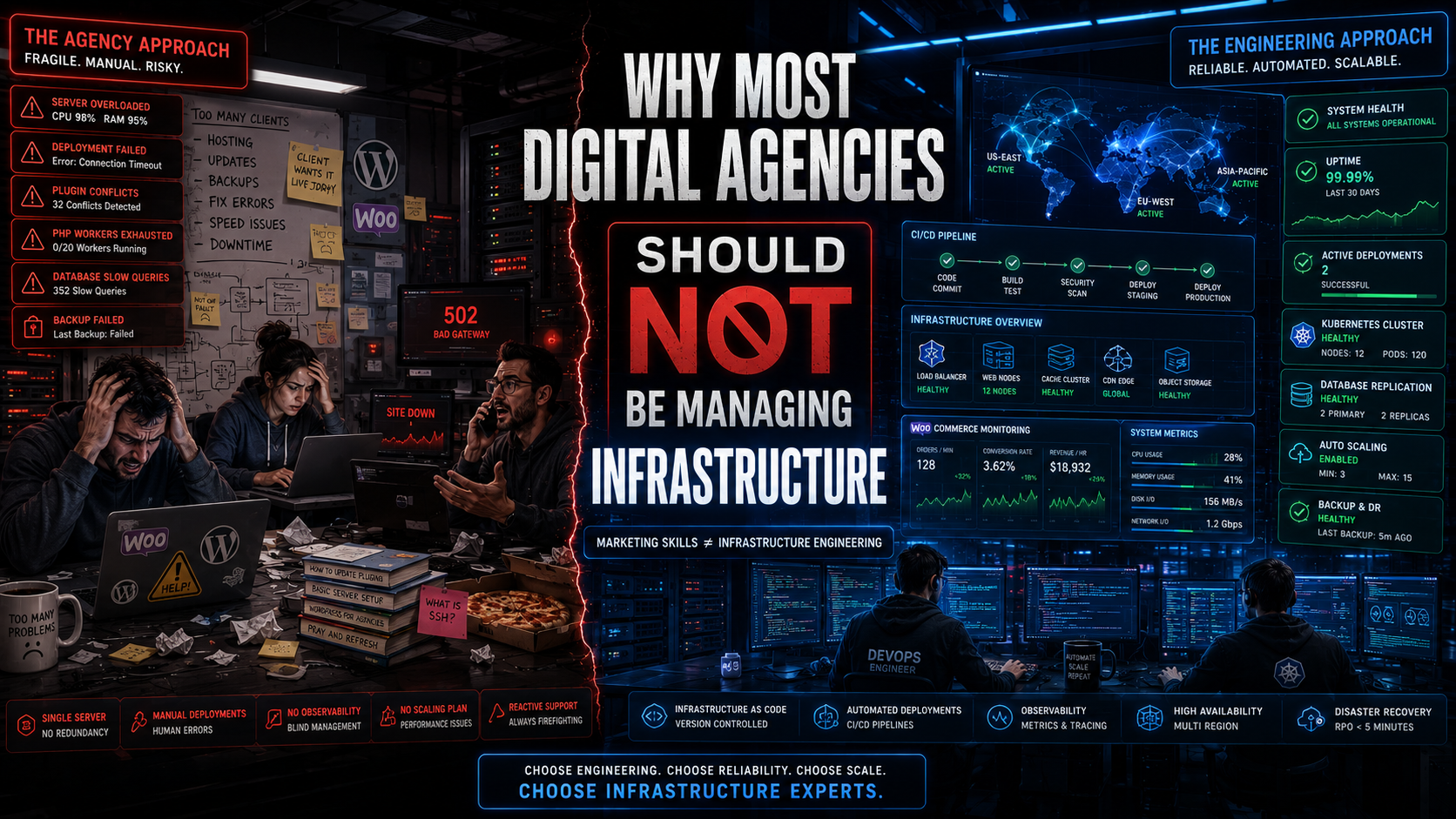
Why Most Digital Agencies Should Not Be Managing Infrastructure
The WordPress ecosystem has changed dramatically over the past decade.
What was once a relatively simple website platform has evolved into a highly complex operational environment supporting:
- enterprise WooCommerce systems
- global API ecosystems
- real-time transactional processing
- cloud-native infrastructure
- distributed caching layers
- automated deployment pipelines
- multi-region traffic delivery
Yet despite this evolution, many digital agencies still manage production hosting environments using workflows and operational practices designed for a far simpler internet.
In 2026, this creates serious risk.
Many agencies continue offering:
- “managed hosting”
- WooCommerce hosting
- VPS management
- deployment handling
- server administration
without dedicated infrastructure engineering expertise.
The result is often:
- fragile hosting environments
- failed deployments
- scaling instability
- weak disaster recovery
- poor observability
- infrastructure bottlenecks
- operational outages
The issue is not that agencies lack talent. The issue is specialization.
Modern infrastructure engineering has become its own discipline requiring deep operational expertise in:
- cloud architecture
- Linux systems engineering
- Kubernetes orchestration
- deployment automation
- database engineering
- observability systems
- security hardening
- scalability engineering
- incident response
At Diamond Stack, we view infrastructure engineering as mission-critical operational architecture rather than a side service attached to web design or marketing retainers.
This article explores why most digital agencies should not be managing infrastructure at scale, especially for enterprise WordPress and WooCommerce environments.
The Evolution of WordPress Infrastructure
Modern WordPress infrastructure is fundamentally different from the environments agencies managed ten years ago.
From Simple Websites to Distributed Systems
Traditional WordPress hosting involved:
- a single web server
- a MySQL database
- basic PHP execution
- static content delivery
Modern WordPress environments increasingly operate as distributed systems involving:
- multiple application nodes
- Redis clusters
- CDN edge layers
- container orchestration
- database replication
- API gateways
Infrastructure complexity has increased exponentially.
WooCommerce Complexity
WooCommerce transformed WordPress into a transactional application platform.
Modern WooCommerce environments process:
- payments
- inventory synchronization
- shipping calculations
- customer sessions
- ERP integrations
- CRM synchronization
- real-time order workflows
This introduces infrastructure requirements far beyond traditional agency hosting environments.
API Ecosystems
Most enterprise WordPress environments now integrate with:
- payment gateways
- marketing automation systems
- warehouse software
- accounting platforms
- AI services
- search engines
- analytics platforms
API dependency management has become a critical operational challenge.
Cloud-Native Infrastructure
Cloud-native infrastructure models increasingly rely on:
- containers
- Kubernetes
- infrastructure-as-code
- GitOps
- distributed orchestration
This is a completely different operational discipline compared to traditional VPS management.
Deployment Automation
Modern infrastructure depends heavily on:
- CI/CD pipelines
- automated testing
- deployment validation
- rollback orchestration
Manual deployment workflows are increasingly dangerous at scale.
Why Traditional Agency Hosting Models Break at Scale
Many agency hosting environments work adequately for low-traffic brochure websites.
The problems emerge when:
- traffic grows
- WooCommerce scales
- integrations increase
- uptime expectations rise
Oversold VPS Hosting
Many agencies resell generic VPS infrastructure with:
- insufficient redundancy
- weak resource isolation
- poor scalability planning
This creates:
- noisy neighbor problems
- CPU throttling
- unstable performance
Single-Server Environments
Single-server hosting remains extremely common in agency environments.
This introduces:
- single points of failure
- weak failover capability
- limited scalability
Modern enterprise infrastructure should never rely on a single production node.
Manual Deployments
Many agencies still deploy changes through:
- FTP uploads
- direct production edits
- WordPress admin updates
These workflows dramatically increase deployment risk.
Poor Observability
Infrastructure observability is frequently absent in agency-managed environments.
Without observability:
- bottlenecks remain hidden
- incidents go undetected
- troubleshooting becomes reactive
Infrastructure Bottlenecks
Poorly engineered infrastructure often suffers from:
- PHP worker exhaustion
- Redis misconfiguration
- database congestion
- CDN inefficiency
- cache inconsistency
These problems compound under traffic growth.
Lack of Redundancy
Many agency environments lack:
- database replication
- failover infrastructure
- backup validation
- geographic redundancy
Operational resilience remains weak.
The Difference Between Web Design and Infrastructure Engineering
One of the largest misconceptions in the WordPress ecosystem is that infrastructure management is simply an extension of web development.
It is not.
Frontend Development vs Systems Architecture
Frontend development focuses on:
- UI design
- UX workflows
- accessibility
- branding
- user interaction
Infrastructure engineering focuses on:
- scalability
- uptime
- redundancy
- traffic orchestration
- deployment automation
These are entirely different disciplines.
Visual Design vs Operational Resilience
A beautiful website can still fail catastrophically under infrastructure stress.
Operational resilience requires:
- redundancy engineering
- failover orchestration
- observability systems
- disaster recovery planning
Marketing Workflows vs DevOps Workflows
Marketing agencies optimize:
- campaigns
- conversion funnels
- content delivery
DevOps engineering optimizes:
- deployment pipelines
- infrastructure automation
- scalability systems
- operational continuity
The skill sets rarely overlap deeply.
Deployment Engineering
Deployment engineering requires understanding:
- CI/CD orchestration
- rollback systems
- container management
- infrastructure state consistency
This is specialized operational engineering.
Infrastructure Observability
Observability involves:
- telemetry systems
- tracing platforms
- performance analytics
- infrastructure monitoring
Without observability, infrastructure management becomes guesswork.
The Hidden Risks of Agency-Managed Infrastructure
The risks of poorly engineered infrastructure often remain invisible until a major incident occurs.
Failed Deployments
Improper deployment workflows frequently cause:
- downtime
- broken checkouts
- corrupted sessions
- API failures
Backup Failures
Many agencies assume backups are functional without testing restoration procedures.
Untested backups create false confidence.
Security Vulnerabilities
Infrastructure security requires:
- patch management
- secrets management
- network segmentation
- access control hardening
Weak operational security creates major exposure.
Scaling Failures
Infrastructure that performs adequately under low traffic may collapse during:
- promotions
- product launches
- viral campaigns
DNS Outages
DNS infrastructure is often poorly managed in agency environments.
A DNS outage can render an entire business unreachable instantly.
Database Corruption
Poor deployment practices may:
- corrupt databases
- break transactional integrity
- disrupt order synchronization
Plugin Conflicts
WooCommerce ecosystems often contain:
- payment integrations
- ERP connectors
- shipping systems
Improper infrastructure management increases plugin instability risk.
Performance Degradation
Infrastructure bottlenecks often degrade gradually until:
- conversions drop
- Core Web Vitals decline
- customer experience suffers
WooCommerce Is Not a Normal Website
This is one of the most important realities agencies underestimate.
Transactional Systems
WooCommerce environments process:
- payments
- orders
- customer authentication
- inventory changes
This introduces transactional complexity.
Payment Processing
Payment infrastructure requires:
- session consistency
- transactional integrity
- API resilience
Failures directly impact revenue.
Inventory Synchronization
WooCommerce often synchronizes with:
- warehouses
- suppliers
- POS systems
- marketplaces
Infrastructure instability disrupts synchronization workflows.
API Integrations
Enterprise WooCommerce environments may depend on dozens of APIs simultaneously.
API orchestration requires operational maturity.
Concurrency Management
Traffic spikes create concurrency pressure across:
- PHP workers
- databases
- caches
- queues
Concurrency engineering becomes critical.
Infrastructure Scaling
WooCommerce scaling requires:
- distributed infrastructure
- autoscaling systems
- queue orchestration
- caching architecture
Why Infrastructure Requires Dedicated Engineering Expertise
Infrastructure engineering is now its own specialized profession.
Linux Systems Engineering
Production infrastructure requires deep Linux expertise including:
- kernel optimization
- filesystem management
- networking
- process orchestration
Kubernetes Orchestration
Modern cloud-native infrastructure increasingly relies on Kubernetes for:
- workload orchestration
- autoscaling
- self-healing infrastructure
Cloud Networking
Cloud networking involves:
- load balancing
- VPC architecture
- traffic routing
- edge optimization
Database Engineering
Databases require:
- query optimization
- replication management
- failover orchestration
- transactional protection
CI/CD Pipelines
CI/CD engineering includes:
- deployment automation
- testing orchestration
- rollback systems
- artifact management
Monitoring Systems
Modern observability requires:
- metrics aggregation
- distributed tracing
- telemetry systems
- anomaly detection
Incident Response
Operational incidents require:
- root cause analysis
- escalation workflows
- recovery orchestration
- forensic troubleshooting
The Operational Maturity Problem
Many agencies simply lack the operational maturity required for enterprise infrastructure.
Lack of Recovery Testing
Disaster recovery plans are often undocumented or untested.
Missing Observability
Without observability:
- failures remain hidden
- bottlenecks remain unidentified
- recovery slows dramatically
Weak Rollback Systems
Rollback systems are frequently:
- incomplete
- manual
- unreliable
Undocumented Infrastructure
Infrastructure knowledge often exists only in individual engineers’ memory.
This creates operational fragility.
Poor Change Management
Uncontrolled infrastructure changes increase:
- deployment risk
- configuration drift
- operational instability
The Real Cost of Infrastructure Failure
Infrastructure failure impacts far more than uptime.
Revenue Loss
Every minute of WooCommerce downtime may result in:
- abandoned carts
- lost transactions
- failed conversions
Customer Trust Damage
Customers experiencing:
- payment failures
- outages
- checkout instability
often lose confidence rapidly.
SEO Impact
Infrastructure instability damages:
- crawl consistency
- Core Web Vitals
- search visibility
Operational Disruption
Outages frequently affect:
- warehouses
- support teams
- fulfillment operations
Recovery Costs
Recovery efforts may require:
- emergency engineering
- forensic analysis
- infrastructure rebuilding
Legal and Compliance Risks
Data breaches and infrastructure failures may create:
- compliance exposure
- legal liability
- customer data risk
What Enterprise Infrastructure Engineering Actually Looks Like
Enterprise infrastructure engineering is fundamentally different from traditional agency hosting.
Infrastructure as Code
Infrastructure configurations should exist as version-controlled code.
This improves:
- consistency
- repeatability
- disaster recovery
Immutable Infrastructure
Immutable infrastructure eliminates manual server modification.
New environments replace old ones during deployments.
Autoscaling
Enterprise infrastructure scales dynamically during:
- traffic spikes
- deployment events
- operational surges
Load Balancing
Load balancers distribute workloads intelligently across infrastructure nodes.
Distributed Systems
Enterprise infrastructure increasingly operates as distributed systems rather than centralized servers.
High Availability Architecture
High-availability systems include:
- redundancy
- failover orchestration
- multi-node clustering
Observability Platforms
Modern observability platforms provide:
- telemetry
- distributed tracing
- infrastructure analytics
The Rise of Cloud-Native WooCommerce Infrastructure
WooCommerce infrastructure is rapidly becoming cloud-native.
Kubernetes
Kubernetes enables:
- orchestration
- autoscaling
- workload recovery
Containerized Hosting
Containers improve:
- deployment consistency
- scalability
- isolation
GitOps
GitOps workflows treat infrastructure as version-controlled operational state.
Distributed Deployment Systems
Modern deployments increasingly rely on:
- rolling releases
- canary deployments
- blue-green environments
Edge Infrastructure
Edge infrastructure improves:
- latency
- resilience
- geographic performance
Self-Healing Architecture
Cloud-native systems increasingly self-recover automatically during incidents.
When Agencies Should Outsource Infrastructure
Agencies should recognize operational specialization boundaries.
Operational Specialization
Infrastructure engineering deserves dedicated expertise.
Infrastructure Partnerships
Partnering with infrastructure specialists improves:
- scalability
- resilience
- operational maturity
Managed DevOps
Managed DevOps providers focus specifically on:
- deployment systems
- infrastructure automation
- observability
Scalability Requirements
High-growth WooCommerce environments require infrastructure expertise most agencies cannot provide internally.
Enterprise Hosting Demands
Enterprise environments demand:
- compliance
- uptime guarantees
- recovery systems
- operational rigor
Building a Proper Infrastructure Strategy for WooCommerce
Modern WooCommerce infrastructure requires strategic engineering.
Infrastructure Assessments
Assessments should evaluate:
- bottlenecks
- scalability
- redundancy
- operational risk
Deployment Engineering
Deployment systems should include:
- CI/CD automation
- rollback orchestration
- deployment observability
Disaster Recovery Planning
Recovery planning should include:
- backup validation
- failover systems
- restoration testing
Operational Resilience
Resilience engineering focuses on:
- survivability
- redundancy
- recovery speed
Continuous Monitoring
Infrastructure should remain continuously observable.
Scalability Engineering
Scalability planning must account for:
- traffic growth
- concurrency pressure
- operational expansion
Real-World Infrastructure Failure Scenario
Consider a WooCommerce store managed by a traditional agency hosting environment.
The store experiences rapid growth after a successful product launch.
Traffic spikes expose hidden weaknesses:
- PHP workers saturate
- Redis memory exhausts
- database queries queue
- deployment pipelines fail
- backups prove incomplete
During an attempted emergency deployment:
- payment sessions corrupt
- checkout APIs fail
- inventory synchronization breaks
The agency lacks:
- observability systems
- rollback automation
- failover infrastructure
Recovery takes hours.
Revenue losses escalate rapidly.
This scenario is increasingly common in under-engineered WordPress hosting environments.
Infrastructure Engineering Is Becoming Its Own Discipline
The WordPress and WooCommerce ecosystem is evolving rapidly toward enterprise-grade operational complexity.
Modern infrastructure now requires expertise in:
- distributed systems
- DevOps engineering
- cloud orchestration
- deployment automation
- operational resilience
- observability
- scalability architecture
These are not side skills.
They are specialized engineering disciplines.
Digital agencies remain extremely valuable for:
- branding
- UX
- marketing
- frontend development
- content strategy
But enterprise infrastructure engineering increasingly requires dedicated operational specialists.
At Diamond Stack, we engineer infrastructure ecosystems built for scalability, resilience, performance, and operational continuity. Our infrastructure engineering approach combines managed DevOps, WooCommerce scalability architecture, Kubernetes orchestration, CI/CD automation, disaster recovery engineering, observability systems, and enterprise-grade operational resilience designed specifically for modern high-performance WordPress environments.
If your business or agency requires enterprise infrastructure engineering, managed DevOps, deployment architecture, WooCommerce scalability consulting, or operational resilience engineering, Diamond Stack can help design infrastructure systems built for the realities of modern digital operations in 2026 and beyond.