
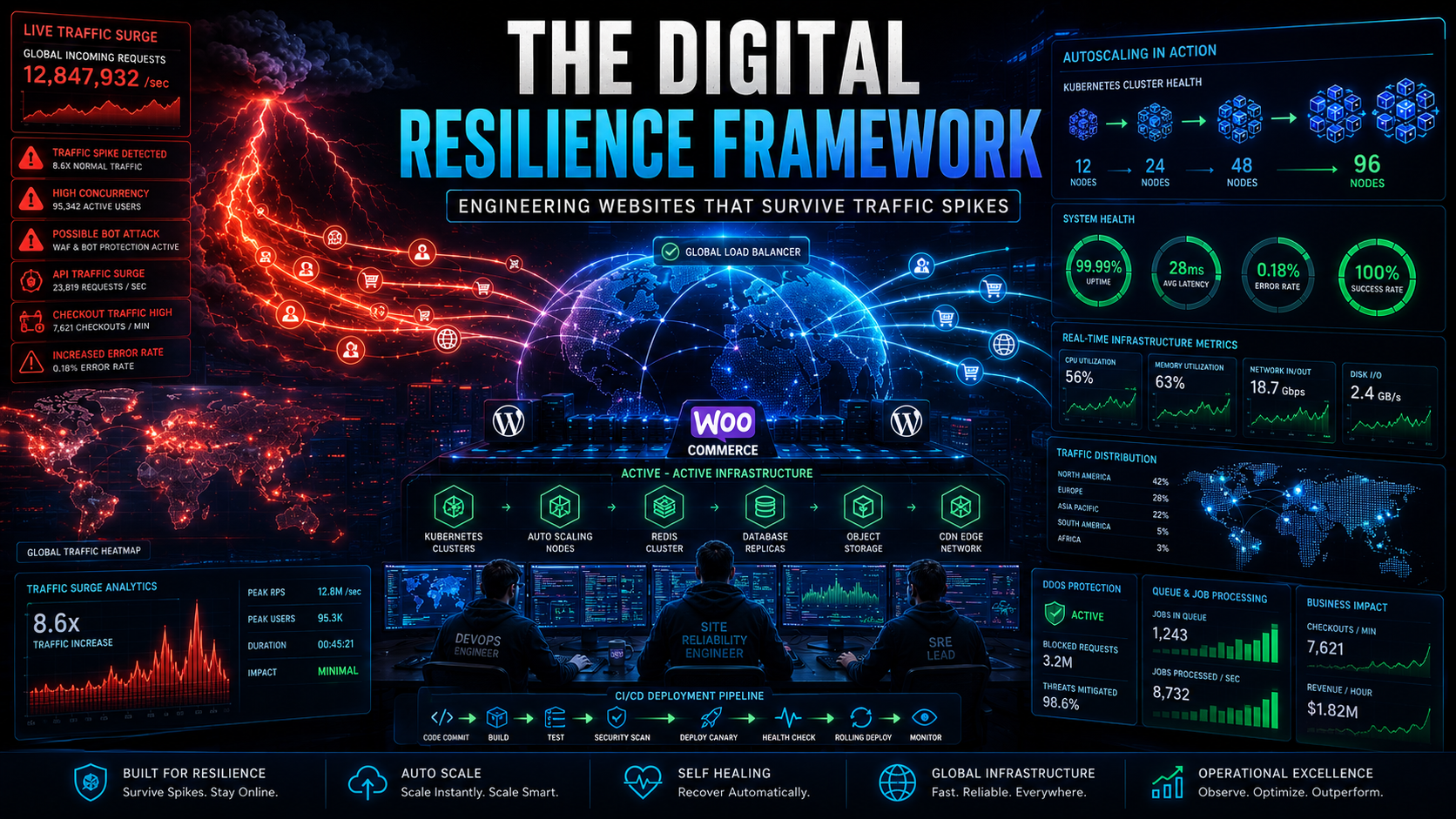
The Digital Resilience Framework: Engineering Websites That Survive Traffic Spikes
Modern websites operate in an environment of continuous operational stress.
Traffic patterns are no longer predictable. Infrastructure loads no longer scale gradually. Customer expectations no longer tolerate downtime, checkout instability, or slow application performance.
Today’s WordPress and WooCommerce environments must survive:
- viral traffic surges
- Black Friday spikes
- influencer-driven campaigns
- API traffic explosions
- bot attacks
- infrastructure failures
- deployment incidents
- regional cloud outages
Unfortunately, most websites are not engineered for resilience.
Many WordPress and WooCommerce environments still rely on:
- single-server hosting
- fragile VPS infrastructure
- manual scaling
- weak observability
- incomplete failover systems
- reactive operational management
These environments often appear stable under normal conditions but collapse rapidly under operational stress.
At Diamond Stack, we approach digital resilience as a systems engineering discipline focused on survivability, scalability, fault tolerance, and operational continuity. Resilient infrastructure is not simply “fast hosting.” It is an intentionally engineered ecosystem designed to remain stable during extreme conditions.
This article explores the Digital Resilience Framework and explains how enterprise-grade WooCommerce and WordPress infrastructure should be engineered to survive unpredictable traffic spikes and operational failures in 2026.
What Digital Resilience Actually Means
Digital resilience is far more than uptime monitoring or backup systems.
It is the engineering discipline focused on ensuring infrastructure remains operational under adverse conditions.
Operational Continuity
Operational continuity means applications continue functioning despite:
- infrastructure failures
- deployment incidents
- traffic surges
- partial outages
Resilient systems degrade gracefully rather than failing catastrophically.
Fault Tolerance
Fault-tolerant systems assume failures will occur.
Infrastructure should continue operating even when:
- servers fail
- APIs become unavailable
- containers crash
- databases experience latency spikes
Scalability
Scalability is a core resilience characteristic.
Infrastructure must absorb:
- concurrency spikes
- unpredictable workloads
- sudden traffic increases
without operational collapse.
Redundancy
Redundancy eliminates single points of failure.
This includes redundancy across:
- compute infrastructure
- databases
- networking
- DNS systems
- CDN providers
Survivability Engineering
Survivability engineering focuses on maintaining core functionality during partial system degradation.
Examples include:
- preserving checkout functionality
- prioritizing transactional traffic
- reducing non-essential workloads during stress events
Infrastructure Resilience
Resilient infrastructure combines:
- redundancy
- observability
- automation
- scalability
- recovery orchestration
into a cohesive operational system.
Why Most Websites Fail During Traffic Spikes
Most WordPress environments fail because they are engineered for average traffic rather than peak operational stress.
PHP Worker Exhaustion
PHP workers process application requests.
During traffic spikes:
- request concurrency increases rapidly
- workers become saturated
- request queues build
This leads to:
- elevated latency
- timeout failures
- checkout instability
WooCommerce environments are especially vulnerable because transactional workloads are dynamic and resource-intensive.
Database Bottlenecks
Databases often become the first major infrastructure bottleneck.
Traffic spikes amplify:
- slow queries
- lock contention
- connection exhaustion
- write amplification
Poorly optimized databases collapse under sustained concurrency pressure.
Redis Saturation
Redis object caching reduces database load significantly.
However, Redis itself becomes vulnerable during traffic surges if:
- memory allocation is insufficient
- cache invalidation fails
- transient storage explodes
CDN Misconfiguration
Improper CDN architecture creates:
- cache misses
- origin overload
- edge propagation failures
CDNs only improve resilience when engineered correctly.
Autoscaling Failures
Autoscaling systems frequently fail because:
- thresholds are poorly configured
- workloads scale too slowly
- startup latency becomes excessive
Infrastructure may fail before autoscaling completes.
Queue Congestion
Background processing systems often experience hidden congestion during traffic spikes.
Affected systems include:
- webhooks
- email queues
- inventory synchronization
- payment processing callbacks
Single-Server Limitations
Single-server environments remain extremely fragile under traffic surges.
Resource exhaustion affects:
- CPU
- memory
- storage I/O
- database throughput
without redundancy or failover protection.
Understanding Modern Traffic Patterns
Traffic behavior has changed dramatically.
Viral Traffic
Social media virality creates:
- explosive concurrency spikes
- sudden geographic traffic shifts
- unpredictable request surges
Traditional hosting environments rarely survive these events reliably.
Black Friday Spikes
Black Friday introduces:
- sustained high concurrency
- elevated transactional activity
- intense checkout pressure
WooCommerce infrastructure must be specifically engineered for these workloads.
Product Launches
High-profile launches create:
- API overload
- inventory synchronization pressure
- elevated session creation
Influencer Campaigns
Influencer-driven traffic often arrives in massive bursts rather than gradual waves.
This stresses:
- autoscaling systems
- caches
- databases
- CDN layers
API-Driven Traffic
Modern websites increasingly depend on:
- headless architectures
- mobile applications
- third-party integrations
This multiplies backend infrastructure complexity.
Bot Traffic
Bots generate substantial infrastructure load through:
- scraping
- vulnerability scanning
- fake account creation
- abusive API requests
Global Traffic Surges
Global audiences require:
- edge optimization
- geographic routing
- multi-region infrastructure
Autoscaling Infrastructure Engineering
Autoscaling is central to modern resilience architecture.
Horizontal Scaling
Horizontal scaling adds additional infrastructure instances during load increases.
This improves:
- concurrency handling
- redundancy
- workload distribution
Kubernetes Autoscaling
Kubernetes enables dynamic workload scaling through:
- Horizontal Pod Autoscaling
- node autoscaling
- workload orchestration
Infrastructure expands automatically based on:
- CPU usage
- memory pressure
- custom telemetry metrics
Container Orchestration
Container orchestration platforms manage:
- workload placement
- failover
- scaling
- recovery
This dramatically improves operational resilience.
Workload Distribution
Distributed workloads reduce infrastructure concentration risk.
Applications should distribute traffic across:
- multiple nodes
- multiple regions
- multiple availability zones
Dynamic Scaling Policies
Scaling policies should account for:
- traffic growth rate
- request concurrency
- queue depth
- response latency
Scaling Thresholds
Improper scaling thresholds create:
- delayed scaling
- oscillating infrastructure states
- operational instability
Load Balancing and Traffic Distribution
Load balancing is foundational to resilient infrastructure.
Application Load Balancing
Application load balancers distribute requests intelligently across workloads.
This improves:
- redundancy
- throughput
- failover capability
Geographic Routing
Traffic should route intelligently based on:
- user location
- infrastructure health
- latency optimization
Edge Networking
Edge infrastructure reduces:
- latency
- origin server load
- regional bottlenecks
Session Persistence
WooCommerce environments require careful session persistence engineering during traffic distribution.
Active-Active Infrastructure
Active-active infrastructure distributes live traffic across multiple operational environments simultaneously.
Benefits include:
- fault tolerance
- geographic resilience
- traffic survivability
Database Resilience Architecture
Databases remain the most critical infrastructure component for WooCommerce resilience.
Read Replicas
Read replicas distribute query load across multiple database nodes.
This improves:
- scalability
- query throughput
- reporting performance
Query Optimization
Poor queries amplify dramatically during traffic spikes.
Optimization includes:
- indexing
- query profiling
- schema tuning
Database Clustering
Clustered databases improve:
- redundancy
- failover capability
- operational continuity
Failover Systems
Database failover systems automatically promote secondary nodes during incidents.
Transactional Consistency
WooCommerce systems require strict transactional consistency during:
- payments
- inventory updates
- checkout workflows
WooCommerce Order Protection
Order integrity must remain protected even during:
- failovers
- replication lag
- traffic surges
Caching and Edge Resilience
Caching systems dramatically improve resilience when engineered correctly.
Redis Clustering
Redis clustering improves:
- scalability
- memory distribution
- cache redundancy
CDN Architecture
CDNs reduce:
- latency
- bandwidth usage
- origin server pressure
Edge Caching
Edge caching improves survivability during traffic surges by offloading:
- assets
- static pages
- API responses
Object Caching
Object caching reduces database pressure substantially.
Cache Invalidation
Cache invalidation remains one of the most difficult operational challenges.
Improper invalidation creates:
- stale content
- inconsistent sessions
- broken checkouts
Global Content Delivery
Global delivery infrastructure reduces regional performance bottlenecks significantly.
Queue Systems and Asynchronous Processing
Asynchronous architecture improves resilience dramatically.
Message Queues
Message queues decouple infrastructure workloads.
This improves:
- scalability
- fault tolerance
- operational stability
Job Orchestration
Background jobs should process independently from customer-facing workloads.
Background Processing
WooCommerce environments frequently process:
- inventory syncs
- email generation
- webhook delivery
- analytics updates
asynchronously.
WooCommerce Async Workloads
Async architecture reduces frontend latency significantly.
Webhook Resilience
Webhook delivery systems require:
- retry logic
- queue durability
- failure handling
API Queue Management
Queue systems protect APIs from overload during traffic surges.
Deployment Resilience
Deployment engineering is central to operational resilience.
Zero Downtime Deployments
Zero downtime deployment architecture prevents:
- checkout interruption
- service instability
- deployment outages
Rolling Deployments
Rolling deployments gradually replace workloads while traffic continues flowing.
Blue-Green Infrastructure
Blue-green systems maintain separate production environments for safer releases.
Canary Releases
Canary deployments expose only small traffic percentages to new releases initially.
Deployment Rollback Systems
Rollback systems should restore stable infrastructure rapidly during failures.
Observability and Real-Time Monitoring
Observability is essential for resilience engineering.
Telemetry Systems
Telemetry provides visibility into:
- infrastructure behavior
- workload performance
- traffic patterns
Distributed Tracing
Distributed tracing identifies:
- bottlenecks
- API latency
- infrastructure dependencies
Infrastructure Monitoring
Monitoring systems track:
- CPU utilization
- memory pressure
- queue depth
- database latency
Anomaly Detection
Machine learning increasingly improves:
- incident prediction
- operational diagnostics
- abnormal traffic detection
Real-Time Alerting
Alerting systems should detect:
- elevated latency
- scaling instability
- traffic anomalies
- degraded application health
Incident Response Systems
Resilient operations require mature incident response workflows.
Security and DDoS Resilience
Traffic resilience must include security resilience.
Web Application Firewalls
WAF systems protect infrastructure from:
- malicious requests
- exploit attempts
- abusive traffic
DDoS Mitigation
Distributed Denial-of-Service attacks remain a major threat.
Mitigation systems should include:
- traffic filtering
- rate limiting
- edge protection
Rate Limiting
Rate limiting protects:
- APIs
- login systems
- checkout workflows
from abuse.
Bot Management
Bot management systems identify:
- malicious crawlers
- scraping activity
- credential stuffing
Traffic Filtering
Advanced filtering systems remove harmful traffic before it reaches origin infrastructure.
Edge Security Systems
Edge security improves:
- survivability
- traffic filtering
- regional resilience
Disaster Recovery and Failover Engineering
Recovery systems are essential for resilience architecture.
Geographic Redundancy
Multi-region infrastructure protects against:
- cloud outages
- regional failures
- network instability
Backup Systems
Enterprise backup systems require:
- immutability
- automation
- restoration testing
Automated Failover
Failover orchestration should activate automatically during infrastructure incidents.
Disaster Recovery Orchestration
Recovery systems must coordinate:
- databases
- caches
- workloads
- traffic routing
Business Continuity
Business continuity planning ensures operational survival during major incidents.
The Role of Cloud-Native Infrastructure
Cloud-native architecture fundamentally improves resilience.
Kubernetes
Kubernetes enables:
- autoscaling
- self-healing infrastructure
- workload orchestration
Containerized Hosting
Containers improve:
- consistency
- deployment reliability
- operational portability
Immutable Infrastructure
Immutable systems eliminate:
- configuration drift
- manual modification risk
GitOps Workflows
GitOps improves:
- infrastructure traceability
- deployment consistency
- operational visibility
Self-Healing Infrastructure
Cloud-native systems increasingly recover automatically from:
- container crashes
- node failures
- workload instability
Building a Digital Resilience Strategy for WooCommerce
Resilience requires strategic engineering.
Infrastructure Assessments
Assessments identify:
- bottlenecks
- operational weaknesses
- scalability limitations
Scalability Planning
Scalability planning should account for:
- growth forecasts
- traffic volatility
- concurrency patterns
Resilience Testing
Infrastructure should undergo:
- load testing
- failover testing
- chaos engineering
Chaos Engineering
Chaos engineering intentionally introduces failures to validate operational resilience.
Operational Maturity
Operational maturity includes:
- observability
- documentation
- recovery procedures
- incident workflows
Continuous Optimization
Resilience engineering is continuous rather than static.
Real-World WooCommerce Traffic Spike Scenario
Consider a WooCommerce store during a viral product launch.
Traffic surges from:
- social media campaigns
- influencer promotion
- international traffic spikes
A traditional hosting environment experiences:
- PHP worker exhaustion
- Redis saturation
- database congestion
- failed checkout sessions
The infrastructure collapses before manual intervention occurs.
A resilient cloud-native environment instead:
- autoscales workloads
- distributes traffic globally
- prioritizes checkout systems
- reroutes unhealthy traffic
- scales queues dynamically
- activates additional nodes automatically
The store continues operating despite extreme traffic conditions.
This is the difference between traditional hosting and resilience engineering.
Why Digital Resilience Matters in 2026
Modern digital infrastructure operates under continuous operational pressure.
Traffic patterns are increasingly unpredictable.
Infrastructure complexity continues increasing rapidly.
Customer tolerance for downtime continues decreasing.
In this environment, resilience is no longer optional.
Modern WooCommerce and WordPress environments require:
- autoscaling infrastructure
- distributed systems
- observability platforms
- deployment resilience
- failover orchestration
- disaster recovery engineering
- cloud-native operational architecture
Businesses relying on fragile infrastructure models will increasingly experience:
- outages
- scalability failures
- operational disruption
- revenue loss
At Diamond Stack, we engineer resilient infrastructure ecosystems built for survivability, scalability, uptime, and operational continuity. Our resilience engineering approach combines cloud-native architecture, Kubernetes orchestration, autoscaling systems, observability platforms, deployment automation, disaster recovery engineering, and enterprise-grade WooCommerce scalability solutions designed specifically for modern high-performance digital infrastructure.
If your business requires resilience engineering, high-availability WooCommerce infrastructure, autoscaling systems, deployment resilience, operational continuity architecture, or enterprise scalability consulting, Diamond Stack can help design infrastructure environments built to survive the realities of modern digital operations in 2026 and beyond.