
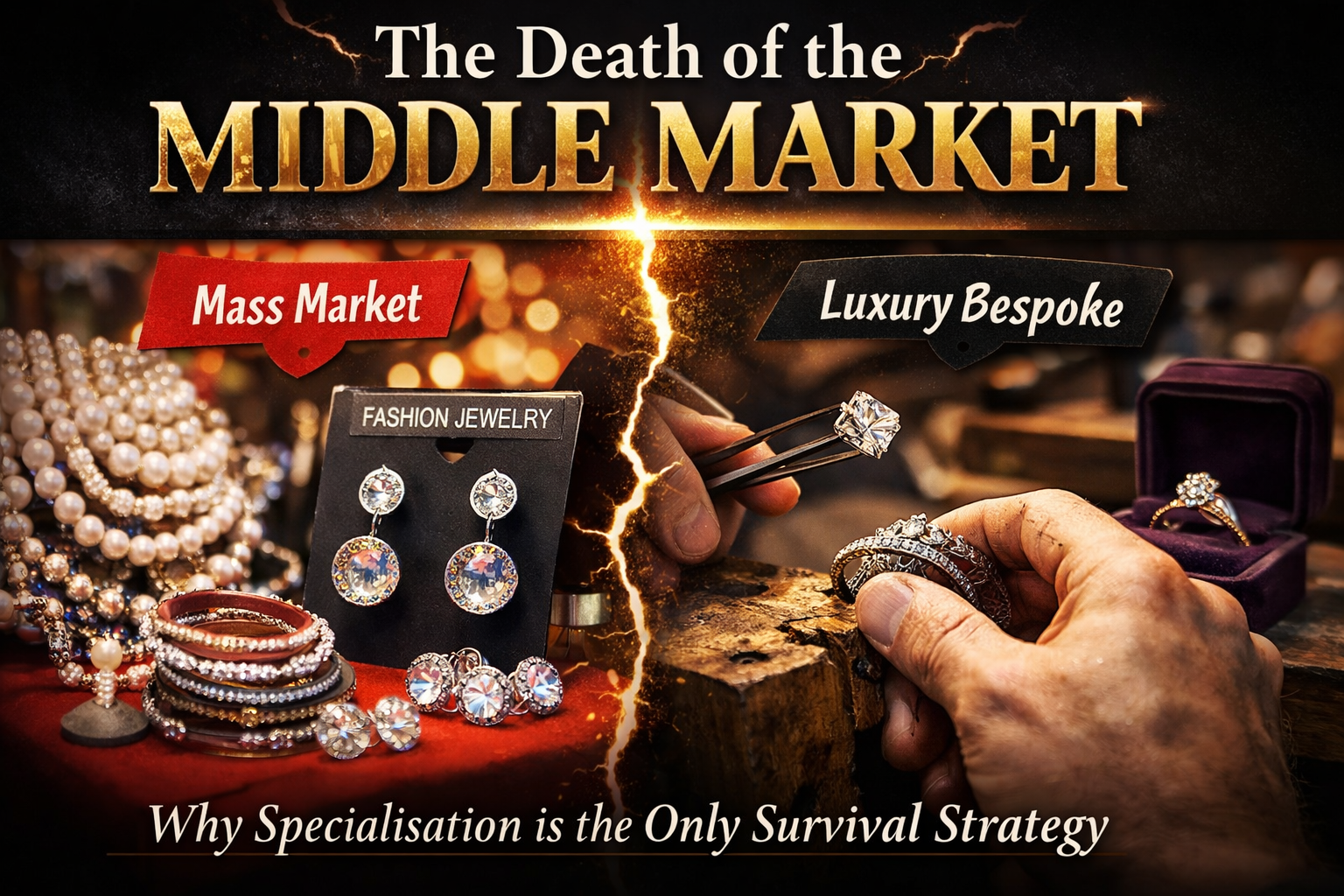
The Death of the Middle Market: Why Specialisation Is the Only Survival Strategy for South African Jewellers
For decades, the jewellery retail industry operated comfortably within a broad middle ground. A customer walked into a store with a budget of R15,000–R40,000, browsed a display case, selected a diamond ring or gold necklace, and left satisfied with a purchase that felt meaningful but not extravagant.
Today that market structure is collapsing.
Across the world — and increasingly in South Africa — consumer spending in jewellery is polarising into two extremes:
- Low-cost, high-volume fashion jewellery
- High-value, investment-grade pieces
What is disappearing is the traditional mid-tier jewellery purchase — the classic retail offering that once defined independent jewellers.
This phenomenon is not unique to jewellery. It reflects a broader economic shift described by consumer strategists like Michael J. Silverstein, who observed that modern consumers increasingly “trade up or trade down”, abandoning the middle of the market.
In jewellery retail, the implications are profound.
Mass-market brands are winning the price war. Ultra-luxury brands are winning the prestige war. Independent mid-tier retailers are increasingly squeezed between them.
For jewellers in South Africa — particularly those operating between R15,000 and R40,000 — the question is no longer whether the middle market is shrinking.
The real question is:
How do independent jewellers survive in a market where the middle is disappearing?
The answer lies in specialisation and bespoke craftsmanship.
The Hollowing Out of the Jewellery Market
The structural shift toward a bifurcated market has been building for over two decades.
The theory was first articulated by Michael J. Silverstein and his colleagues at Boston Consulting Group, who described a phenomenon known as “trading up and trading down.”
Consumers increasingly make two distinct purchasing decisions:
- For everyday products, they seek maximum affordability.
- For emotionally meaningful purchases, they seek exceptional quality and status.
What they avoid is the middle option that offers neither extreme value nor prestige.
In jewellery, this shift is even more pronounced because the product sits at the intersection of emotion, identity, and wealth signalling.
As a result, consumers are increasingly choosing between:
Costume jewellery
- inexpensive
- trendy
- disposable
or
Investment jewellery
- rare stones
- high craftsmanship
- long-term value.
The traditional jewellery store offering standard diamond rings in the R20,000 range now sits in a dangerously vulnerable position.
Why Mass Retail Wins the Price War
At the lower end of the market, large-scale brands dominate through industrial production and supply chain efficiency.
Companies like Pandora, Swarovski, and global e-commerce marketplaces can produce jewellery at scale that independent jewellers cannot compete with on price.
This advantage stems from several structural factors:
Manufacturing scale
Mass retailers operate enormous production facilities capable of producing thousands of identical pieces per day.
Supply chain integration
Large companies negotiate directly with global suppliers of metals and stones, securing pricing that small jewellers simply cannot match.
Marketing reach
Through global advertising campaigns and influencer marketing, mass-market jewellery brands shape consumer demand before a customer even enters a store.
E-commerce optimisation
Online jewellery marketplaces have dramatically increased price transparency. Consumers can now compare hundreds of similar products instantly.
The result is that price competition has become brutally efficient.
If a jeweller attempts to compete in the R3,000–R10,000 bracket, they are effectively competing against industrial-scale manufacturing.
That is a battle independent jewellers cannot win.
Why Luxury Always Wins the Status War
At the opposite end of the market, luxury brands dominate through perceived value rather than price efficiency.
Luxury strategist Jean-Noël Kapferer argues that luxury operates according to fundamentally different economic principles.
Luxury brands intentionally:
- increase prices
- restrict supply
- emphasise craftsmanship
- create scarcity.
This strategy works because luxury purchases are not purely functional. They serve as status signals and emotional investments.
When a customer buys a high-end diamond ring, they are not merely purchasing metal and stone.
They are purchasing:
- symbolism
- craftsmanship
- legacy
- exclusivity.
Luxury brands therefore avoid the middle market entirely. They either position above it or refuse to compete there at all.
Independent jewellers who attempt to mimic luxury branding without genuine craftsmanship often find themselves stuck in an uncomfortable middle ground — too expensive to compete with mass retail, but not distinctive enough to command luxury pricing.
The Rise of the “Invested Consumer”
Another critical shift is the emergence of what analysts call the invested consumer.
Luxury industry research from organisations like the Luxury Institute highlights that affluent consumers are increasingly choosing fewer, higher-quality purchases.
Rather than buying multiple mid-range items, they prefer to invest in a single meaningful piece.
This trend reflects broader cultural changes:
- growing interest in heirloom-quality objects
- increased awareness of gemstone value
- rising demand for ethical sourcing.
For example, many younger consumers now ask questions about:
- diamond certification
- origin of gemstones
- sustainable sourcing
- craftsmanship.
These questions are difficult for mass-market jewellery brands to answer convincingly.
They create a powerful opportunity for specialised jewellers who can demonstrate expertise and transparency.
The PESTEL Forces Reshaping Jewellery Retail
To fully understand the collapse of the middle market, it is helpful to examine the broader macroeconomic forces driving the shift.
A PESTEL analysis provides a useful framework.
Political Factors
Tourism plays a critical role in South Africa’s jewellery industry.
International visitors often purchase diamonds and Tanzanite while visiting Cape Town.
Government policies such as VAT refund schemes for tourists significantly influence jewellery purchasing behaviour.
Political stability and visa accessibility therefore directly affect the investment jewellery segment.
Economic Factors
South Africa is one of the most economically unequal countries in the world.
This inequality naturally produces bifurcated consumption patterns.
High-net-worth individuals continue to purchase luxury goods, while middle-income consumers face increasing financial pressure.
At the same time:
- global gold prices remain volatile
- diamond prices fluctuate
- exchange rates impact imported gemstones.
These economic realities make mid-tier jewellery purchases harder to justify for many households.
Social Factors
Cultural attitudes toward consumption are changing.
Younger consumers increasingly value:
- authenticity
- craftsmanship
- ethical sourcing
- individuality.
Generic jewellery designs are losing appeal.
Customers increasingly want pieces that feel personal and meaningful.
Technological Factors
Technology is radically reshaping jewellery retail.
Lab-grown diamonds, AI-powered search, and global e-commerce platforms have dramatically increased price transparency.
Consumers can now compare diamond prices across multiple international suppliers in seconds.
This transparency erodes the pricing power of traditional retail stores.
Environmental Factors
Environmental and ethical considerations are becoming central to jewellery purchasing decisions.
Consumers increasingly ask about:
- conflict-free diamonds
- responsible mining
- recycled metals.
Jewellers who can provide credible answers gain significant trust advantages.
Legal Factors
Certification standards for diamonds and gemstones continue to evolve.
Organisations such as the Gemological Institute of America have raised consumer awareness about gemstone grading and authenticity.
Customers now expect documentation and verification for high-value purchases.
This shift reinforces the importance of professional expertise in jewellery retail.
Why the R15k–R40k Segment Is the Most Vulnerable
When these macroeconomic forces combine, the mid-tier jewellery segment becomes structurally fragile.
This price bracket faces three fundamental challenges.
It is too expensive for fashion jewellery buyers
Consumers seeking trendy accessories can find far cheaper alternatives online or in fashion retailers.
It is not valuable enough for investment buyers
Customers looking for heirloom pieces often prefer to spend more for higher-quality stones.
It is easily price-compared online
Standard diamond rings within this bracket are often interchangeable.
Customers can quickly compare similar products across multiple retailers.
As a result, mid-tier jewellers find themselves competing almost entirely on price — a position that erodes margins and brand identity.
The Bespoke Moat
If competing on price is impossible, the alternative is differentiation through craftsmanship and personalisation.
This is where bespoke jewellery becomes a powerful strategic moat.
Bespoke jewellery shifts the conversation away from price comparison and toward design, story, and expertise.
Instead of selling a product from a display case, the jeweller collaborates with the customer to create something unique.
This process offers several advantages.
Emotional value
Custom pieces carry deep personal significance.
Price insulation
Unique designs are difficult to compare across retailers.
Relationship building
The design process creates a long-term client relationship rather than a single transaction.
Craftsmanship visibility
Customers witness the creative process, reinforcing the value of the final piece.
In economic terms, bespoke jewellery transforms the product from a commodity into a creative service.
Strategic Blueprint for Independent Jewellers
Independent jewellers who wish to survive the collapse of the middle market must embrace a new strategic model.
Several key principles define this approach.
Move away from inventory-heavy retail
Large display cases filled with generic designs tie up capital and invite price comparison.
Focus on design expertise
Customers should perceive the jeweller as a creative professional, not merely a retailer.
Educate customers
Explaining gemstone quality, craftsmanship, and sourcing builds trust.
Build a narrative
Every piece should tell a story about design, origin, and craftsmanship.
Invest in digital presence
Modern consumers often begin their jewellery journey online.
Content, educational resources, and design portfolios help establish authority.
Implications for South African Jewellery Studios
For jewellers operating in cities like Cape Town, the shift toward bespoke craftsmanship presents both challenges and opportunities.
Tourism provides access to international clients seeking unique jewellery experiences.
At the same time, local economic pressures reinforce the collapse of the mid-tier market.
Studios that embrace specialisation can position themselves as artisan creators rather than retail stores.
This positioning allows them to attract customers who value:
- craftsmanship
- authenticity
- storytelling
- expertise.
In a global marketplace dominated by mass production, true craftsmanship becomes increasingly valuable.
Conclusion: The Future Belongs to Specialists
The disappearance of the middle market is not a temporary trend.
It is the result of structural economic forces that are reshaping retail across industries.
In jewellery, these forces are particularly powerful because the product carries deep emotional and symbolic significance.
Mass-market brands will continue to dominate the low-cost segment.
Luxury conglomerates will continue to control the ultra-premium tier.
What remains is a space for independent jewellers who can offer something neither group can replicate:
authentic craftsmanship and personalised design.
For jewellers willing to embrace specialisation, the collapse of the middle market is not a threat.
It is an opportunity.
In a world of industrial production and globalised retail, the rarest commodity of all may be human craftsmanship.