
SEO for Carats: Why Ranking for “Engagement Rings” is a Waste of Your Budget
It is a scenario we see all too often in luxury digital marketing: A heritage jewelry brand invests tens of thousands of Rands into an SEO campaign with a singular, aggressive goal—to rank on page one of Google for the phrase “engagement rings.”
Months later, they achieve it. The traffic graph spikes upward. The digital agency celebrates the vanity metrics. But in the boardroom, the reality is stark: bounce rates are skyrocketing, conversion rates have flatlined, and those high-ticket, R100,000+ bespoke sales are nowhere to be found.
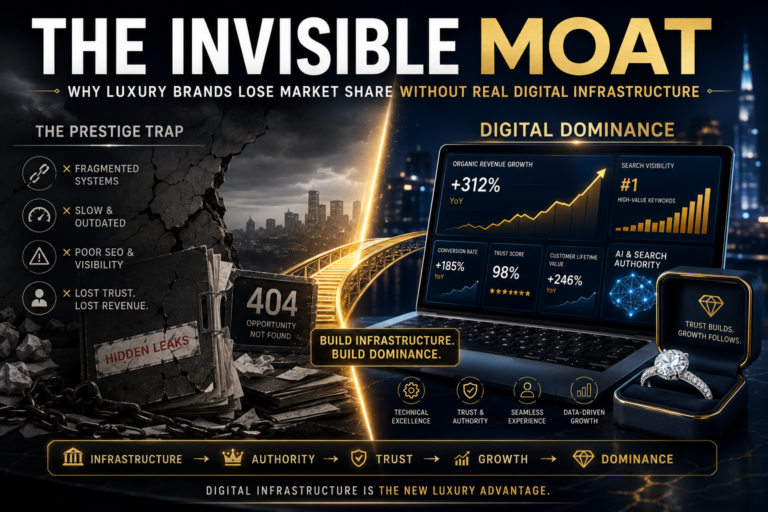
Why? Because ranking for broad, high-volume keywords is often the quickest way to burn through a marketing budget without generating actual revenue. In the high-end luxury market, there is a fundamental difference between a “browser” and a “buyer.” If your digital architecture is built to attract the former, you are actively ignoring the latter.
The Anatomy of a High-Value Search
To understand why broad keywords fail, we must dissect the psychology of a luxury buyer.
When a user searches for “engagement rings,” they are at the absolute beginning of their purchasing journey. They are looking for inspiration, generic pricing expectations, and Pinterest-style galleries. They are not ready to securely process a six-figure payment.
A high-value, high-intent buyer operates differently. They have already done their research. They know exactly what their partner wants, and they are now searching for the specific vendor who holds that exact inventory.
Instead of searching for “engagement rings,” the buyer searches for: “2-carat oval lab-grown diamond GIA platinum setting.”
This is a Long-Tail Keyword.
- Broad Keywords: High search volume, immense competition, incredibly low conversion rates.
- Long-Tail Keywords: Low search volume, targeted competition, exponentially higher conversion rates.
Focusing your budget on long-tail keyword strategies capturing specific diamond attributes—such as carat weight, certification (GIA/EGL), cut, and origin—is the actual engine of digital revenue. You don’t need 10,000 visitors who aren’t ready to buy; you need 10 visitors who have their credit cards in hand.
The Technical Engine: Product Schema and JSON-LD
Capturing those high-intent buyers requires more than simply writing the phrase “2-carat diamond” on a product page. It requires translating your luxury inventory into a language that Google’s search algorithms can perfectly understand.
This is achieved through Product Schema (JSON-LD structured data).
Schema markup is a highly technical form of microdata added directly to the backend code of your website. Without schema, Google’s web crawlers look at a product page and see a block of text and an image. They have to guess what the page is about.
When properly engineered schema is injected into the backend, you are feeding Google exact, categorized data points. You are explicitly telling the search engine:
- Product: Diamond Engagement Ring
- Attribute (Carat): 2.00 ct
- Attribute (Clarity): VVS1
- Price: R145,000
- Availability: In Stock
- Brand: [Your Heritage Brand]
By structuring your data with this level of technical precision, you are positioning your inventory to intercept the exact, long-tail queries that drive luxury conversions.
Winning the Click with Rich Snippets
The ultimate goal of implementing robust Product Schema is dominating the Search Engine Results Pages (SERPs) through Rich Snippets.
When a high-intent buyer searches for that specific 2-carat diamond, Google prefers to show results that provide immediate, verified answers. Because your structured data clearly communicates your inventory’s attributes, Google rewards your listing by enhancing it directly on the search page.
Instead of a plain blue link, your search result displays:
- A crisp, high-resolution thumbnail of the diamond.
- The exact price.
- A glowing 5-star aggregate review rating.
- A bold, green “In Stock” badge.
This achieves something critical: Pre-qualification. Before the user has even clicked onto your website, they know the price, they know you have the exact gemstone they want, and they see verified trust signals. You have won the click, and you have mathematically increased the likelihood of a high-value transaction.
The Business ROI: Data Over Vanity
Transitioning from a broad, traffic-chasing strategy to a highly technical, long-tail and schema-driven approach fundamentally transforms your business metrics.
- Lower Customer Acquisition Cost (CAC): By abandoning hyper-competitive vanity keywords, your SEO and ad spend is redirected toward highly efficient, lower-cost queries that actually convert.
- Higher Click-Through Rates (CTR): Rich snippets naturally draw the eye, stealing clicks away from competitors ranking above you who rely on unoptimized, plain-text listings.
- Protecting Brand Equity: You stop competing with discount retailers on broad search terms and start competing exclusively in the luxury arena where your specific, high-end diamonds belong.
Stop Chasing Traffic. Start Engineering Sales.
The era of “building links” and writing generic blog posts to rank for “engagement rings” is over. Today’s luxury e-commerce landscape is won in the backend architecture. It is won through data structuring, technical optimization, and an uncompromising focus on the end buyer.
At Diamond Stack, we build the digital infrastructure that exclusive jewelry brands need to dominate high-intent search.
If your digital presence is generating traffic but failing to generate revenue, it is time to pivot. Contact us today for an advanced Technical SEO and Schema Markup Audit. Let’s stop chasing vanity metrics and start targeting the precise searches that result in true, high-ticket conversions.