Global vs South African Jewellery Markets in 2026
Why Structural Divergence is Creating New Strategic Opportunities
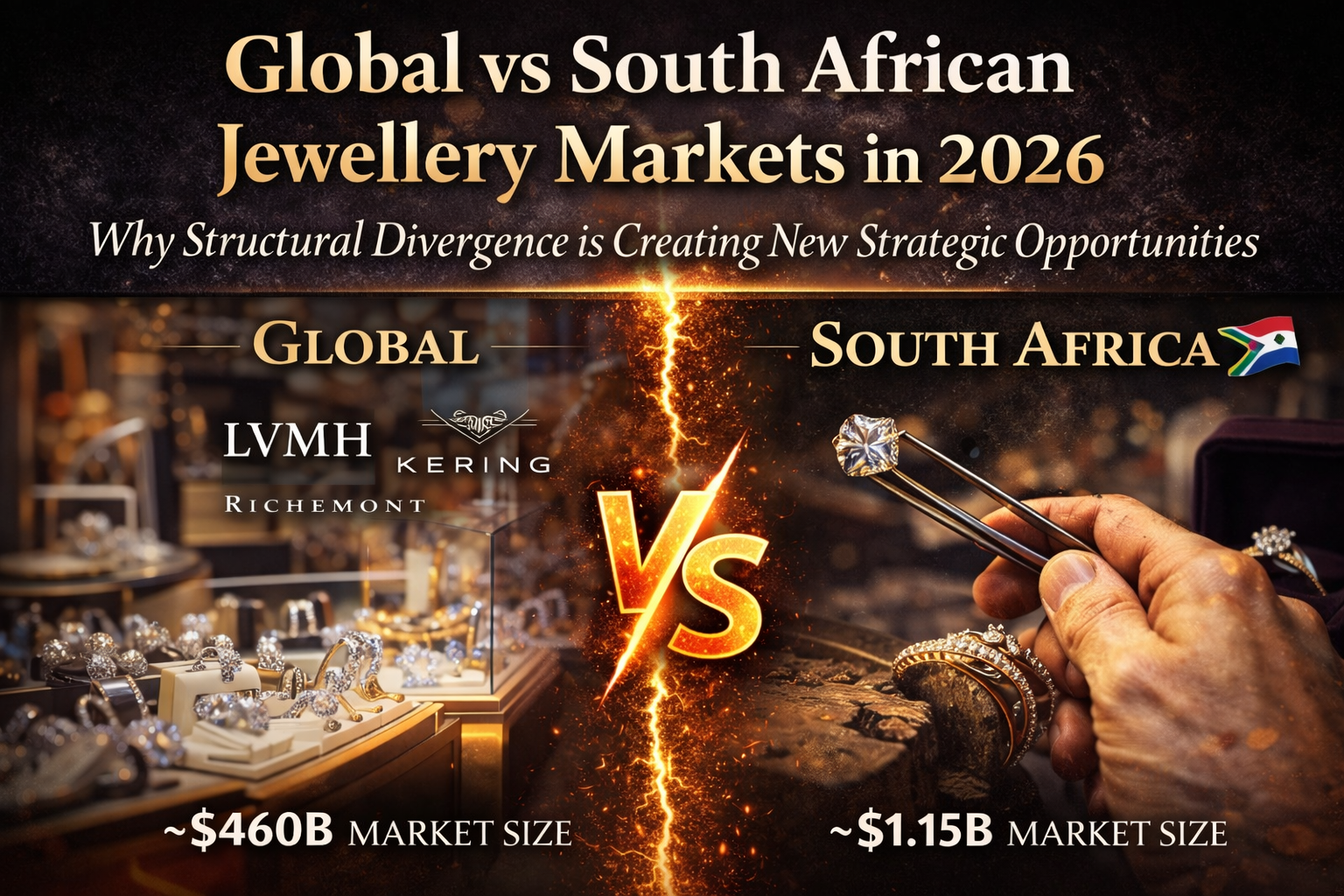
The global jewellery industry is entering a period of structural transformation. In 2026, the global jewellery market is valued at approximately $460 billion, driven by expanding luxury demand, technological innovation, and the growing influence of global conglomerates. By contrast, the South African jewellery market, projected to generate roughly $1.15 billion in revenue, operates within a vastly different economic environment defined by currency volatility, regulatory frameworks, and a unique advantage in raw material provenance.
Despite its smaller scale, South Africa sits at a strategic crossroads in the luxury value chain. The country remains one of the world’s most important sources of precious metals and diamonds, yet most value creation historically occurred abroad through international manufacturing and luxury branding.
In 2026, however, a set of converging trends—including AI-mediated commerce, the hollowing out of the middle market, and increasing demand for provenance transparency—is beginning to reshape the competitive landscape. These forces are creating a structural divergence between the global jewellery market and the South African jewellery sector.
The result is a paradox: while global luxury conglomerates continue to scale through technology and international distribution, South African jewellers may gain strategic advantage by moving in the opposite direction—toward craftsmanship, provenance, and bespoke design.
The Global Jewellery Market: Scale, Technology and Consolidation
At the global level, the jewellery industry is increasingly dominated by large luxury conglomerates such as LVMH, Richemont, and Kering. These organisations control some of the world’s most influential jewellery and watch brands and benefit from enormous economies of scale.
Their strategic advantage lies in three primary capabilities:
1. Global Distribution Infrastructure
Luxury conglomerates operate extensive global retail networks, combining flagship stores, duty-free outlets, and digital platforms. Omnichannel retail strategies allow these companies to maintain consistent brand experiences across continents.
Consumers can browse collections online, book in-store consultations, and receive after-sales services through integrated digital systems.
2. Product Innovation and Technology
Technology is playing an increasingly central role in global jewellery retail. Developments such as 3D design tools, augmented reality product visualisation, and digital product passports are transforming how luxury goods are produced and authenticated.
Digital product passports, in particular, allow consumers to verify gemstone origin, certification, and ownership history. These systems support the growing demand for transparency within luxury supply chains.
3. Lab-Grown Diamond Expansion
Lab-grown diamonds have become one of the fastest-growing segments in the global jewellery market. Advances in production technology have dramatically reduced costs, enabling luxury brands to introduce alternative product lines targeted at younger consumers.
While natural diamonds continue to dominate the high-end segment, lab-grown stones are increasingly used for fashion jewellery and entry-level luxury products.
Together, these developments illustrate a broader global trend: luxury jewellery is becoming increasingly technology-driven, scalable, and brand-centric.
The South African Jewellery Market: Provenance and Craftsmanship
The South African jewellery market operates within a very different strategic framework.
Rather than competing primarily through scale or technology, South Africa’s competitive advantage lies in resource proximity and craftsmanship. Few countries can claim such a direct connection between raw materials and finished jewellery.
This “mine-to-finger” supply chain proximity offers several advantages:
- access to locally mined diamonds and precious metals
- reduced transport and intermediary costs
- stronger provenance narratives for luxury consumers.
South Africa also possesses world-class refining infrastructure, allowing gold recovered from mines, recycled sources, and urban mining to be refined locally before being transformed into jewellery.
For international consumers, this proximity creates a powerful authenticity narrative. Jewellery produced close to the source of its materials carries a level of provenance that is difficult for offshore manufacturing hubs to replicate.
Additionally, South Africa benefits from strong tourism flows, particularly in cities such as Cape Town. International visitors often purchase jewellery as a luxury souvenir tied to the region’s mining heritage, creating opportunities for high-margin bespoke pieces.
In this context, South African jewellers increasingly position themselves as artisans and designers rather than retailers.
The Hollowing of the Middle
One of the most significant structural shifts affecting the South African jewellery market is the collapse of the mid-tier price segment, typically between R15,000 and R40,000.
This phenomenon mirrors trends observed globally but is particularly pronounced in South Africa due to economic pressures and income inequality.
The market is increasingly polarised between two extremes:
Mass-market jewellery
Low-cost fashion jewellery dominates the lower price range. These products are often imported and manufactured at industrial scale, making it extremely difficult for independent jewellers to compete on price.
Investment-grade jewellery
At the opposite end of the market, affluent consumers continue to purchase high-value diamond jewellery and bespoke pieces.
These purchases are often viewed as emotional investments or heirloom assets, reinforcing demand for craftsmanship and unique design.
The middle segment—once the backbone of traditional jewellery retail—has become structurally vulnerable. Mid-tier products are easily price-compared online and lack the prestige associated with high-end jewellery.
For independent jewellers, this shift reinforces the importance of specialisation and bespoke design as defensive strategies.
Agentic Commerce and the AI Recommendation Economy
Another transformative trend reshaping luxury retail is the emergence of agentic commerce—a model in which AI assistants act as intermediaries between consumers and brands.
Rather than conducting traditional search queries, consumers increasingly rely on AI systems to recommend products based on preferences, budgets, and values.
Industry forecasts suggest that by 2027, a majority of retail searches may occur through AI agents rather than conventional search engines.
For jewellery brands, this development has profound implications.
Success will depend not only on marketing visibility but also on structured data quality. AI systems must be able to verify and interpret product specifications, certification details, and provenance data.
Jewellery brands therefore face a new optimisation challenge:
Generative Engine Optimisation (GEO).
This approach focuses on ensuring that AI systems recognise a brand as a trustworthy source of product information.
For high-value jewellery purchases, where trust and verification are essential, brands that provide detailed technical data—such as diamond grading reports, sourcing documentation, and authenticity certificates—are more likely to be recommended by AI systems.
Strategic Implications for South African Jewellers
In light of these trends, South African jewellers face a clear strategic choice.
Attempting to compete with global conglomerates on price or scale is unlikely to succeed. Instead, the country’s most successful jewellery brands are likely to leverage structural advantages that global competitors struggle to replicate.
These advantages include:
Provenance
Consumers increasingly demand transparency regarding the origins of precious metals and gemstones. South African jewellers can provide detailed provenance narratives that connect jewellery directly to the region’s mining heritage.
Craftsmanship
Bespoke jewellery design emphasises artistry and individuality, qualities that cannot easily be replicated by industrial manufacturing.
Ethical sourcing
Local production and responsible sourcing practices resonate strongly with modern luxury consumers.
Tourism-driven luxury demand
International travellers often seek jewellery that reflects the cultural and natural heritage of their destination.
By combining these elements, South African jewellers can position themselves as provenance-driven luxury producers rather than conventional retailers.
Strategic Outlook 2026
Looking ahead, the jewellery industry will increasingly be shaped by the intersection of technology, authenticity, and craftsmanship.
Global luxury conglomerates will continue to dominate through scale, technological innovation, and brand power. Their investment in AI-driven retail, digital authentication systems, and global distribution networks will reinforce their influence across international markets.
At the same time, structural trends within the South African jewellery sector suggest a different strategic pathway.
Rather than competing directly with global luxury giants, South African jewellers have the opportunity to build brands around origin, craftsmanship, and narrative authenticity.
In a market where consumers increasingly seek meaningful purchases rather than disposable fashion, this positioning may prove highly effective.
The future of jewellery retail will not belong solely to the largest companies or the most technologically advanced platforms.
Instead, it will belong to those brands that successfully combine trust, storytelling, and technical excellence.
For South African jewellers willing to embrace this strategy, the coming decade may represent not a constraint—but a rare opportunity to redefine their place within the global luxury ecosystem.