The Engineer Buyer: Understanding the Jewellery Store’s Most Valuable — and Most Misunderstood — Target Audience
Author: Erwee Coetzee | SEO Gurus Series: Jewellery E-Commerce SEO Reading Time: ~18 minutes
The previous article in this series drew a strategic line between bespoke luxury and moissanite SEO — two markets, two buyer journeys, two content architectures. But both of those markets share a buyer type that most jewellery retailers either do not know exists, or know exists and do not know how to sell to.
Meet the engineer.
Not necessarily a person who holds an engineering degree. The engineer is a buyer archetype — a psychological orientation toward purchasing decisions that is defined by the following characteristics: they research exhaustively before contacting anyone, they distrust vague language, they make decisions based on specifications rather than emotion, they are deeply uncomfortable with incomplete information, and once they have made a decision they execute it with total conviction.
They are also, by a substantial margin, the highest-value customer a jewellery store can acquire. They do not return pieces because they did not understand what they were buying. They do not require post-purchase reassurance. They refer confidently because their recommendation is based on data rather than feeling. They spend more per transaction because they have done the research and they know what quality costs. And in the moissanite segment specifically, they are the dominant buyer type — the person who discovered moissanite not through a friend’s recommendation but through a three-hour research session that ended with a spreadsheet comparing refractive indices.
The reason most jewellery stores fail to acquire and convert engineer buyers is not price and not product. It is information architecture. The engineer arrives at a jewellery website looking for a specific kind of evidence and a specific quality of specification, and they leave when they do not find it — not to a competitor immediately, but back to their research. They open another tab. They go deeper. They return weeks later, or they do not return at all.
This article is about understanding exactly who the engineer is, how they move through the jewellery buying journey, and how every layer of your SEO, content, and on-page architecture needs to be rebuilt around serving them.
Defining the Engineer Archetype
Before applying the label to an SEO strategy, it is worth being precise about what the engineer archetype actually is — because it is not simply “someone who does research.” Most jewellery buyers do some research. The engineer is defined by the quality and depth of that research, the psychological drivers behind it, and the specific information deficits that stall or abort their purchase decision.
The Psychological Profile
The engineer buyer is motivated by a specific form of anxiety: the anxiety of making an irreversible decision with incomplete information. A diamond ring is not a sweater. You cannot return it to the shelf if it turns out to be wrong. The financial commitment is significant. The emotional significance is even greater. For the engineer, the way to manage this anxiety is not to feel more comfortable — it is to know more. Information is their risk management tool.
This has a direct consequence for how they respond to marketing language. Phrases like “exquisite craftsmanship,” “unparalleled quality,” and “timeless elegance” do not reduce their anxiety — they increase it. Vague superlatives communicate that the seller cannot or will not provide specific information, which the engineer interprets as evidence that the specific information would not be favourable. A jewellery website that leads with emotional language and withholds technical specifications is, from the engineer’s perspective, actively hiding something.
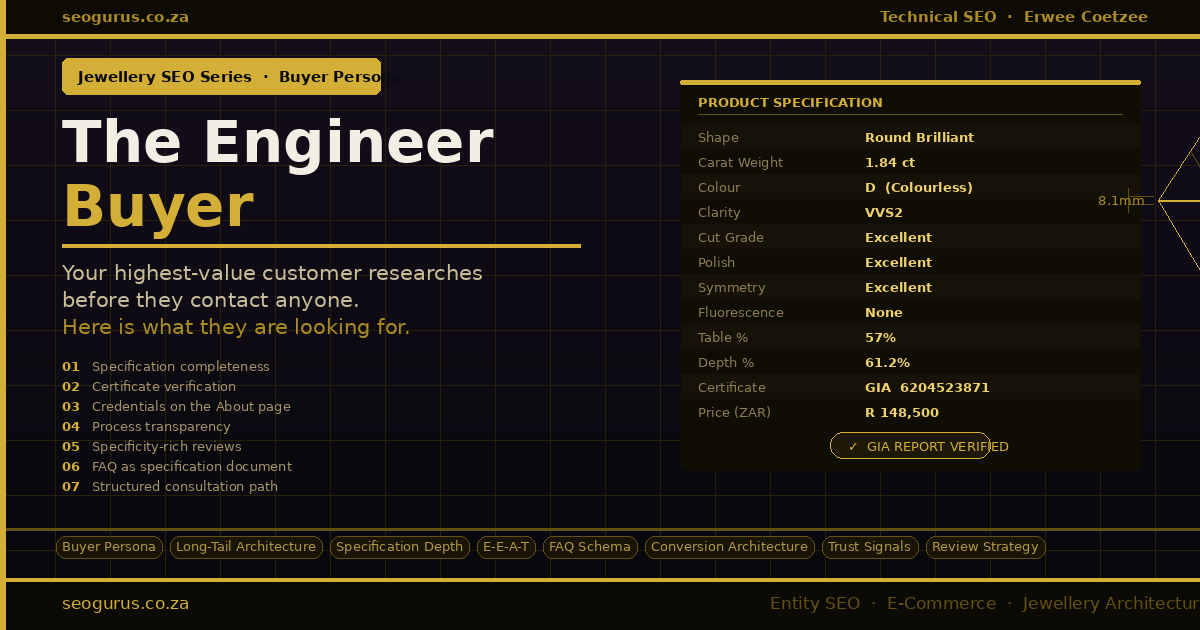
Compare this to the response they have to: “1.84ct D/VVS2 GIA-certified round brilliant, table 57%, depth 61.2%, no fluorescence, eye-clean confirmed.” This is not poetry. But for the engineer buyer, it is the most persuasive sentence on your website. It tells them that you know what you are selling, that you can be specific, and that you are not trying to charm them into a purchase they have not yet earned through their own verification.
The Research Behaviour Pattern
Engineer buyers exhibit a distinctive research pattern that is measurable in site analytics and recognisable in the types of queries that bring them to your site.
They enter through long-tail, specification-rich queries. The engineer does not arrive via “engagement rings Cape Town.” They arrive via “1.5ct D VS1 round brilliant GIA certified price South Africa” or “oval moissanite 9x6mm vs 10x7mm elongation ratio comparison.” Their search queries are not brand discovery queries — they are verification queries. They already know what they want; they are looking for the site that can confirm it exists and tell them exactly what it will cost.
They consume content in sequence, not randomly. The engineer reads the buying guide before the product page, the FAQ before the pricing page, and the about page before the contact page. They are building a mental model of your business and your products in parallel, and they need both tracks of information to complete before they make contact. A site that has excellent product pages but a thin about page, or a detailed process page but no transparent pricing guidance, leaves the engineer’s mental model incomplete — and an incomplete mental model does not convert.
They return multiple times before converting. Engineer buyers have an average consideration window that is significantly longer than emotional buyers. In the engagement ring category, consideration windows of four to twelve weeks are common among engineer-type buyers. They will visit your site three, four, or five times across this window, each visit going deeper into a different section of the site. Your analytics will show them as high-session, high-page-depth users with long time-on-site and multiple return visits before a goal event.
They validate externally. Before converting on your site, the engineer will have checked your Google reviews, your Trustpilot or HelloPeter rating if you have one, your social media presence for evidence of real work, and at least one forum or Reddit thread mentioning your business. They are triangulating. The content on your own site is necessary but not sufficient — the external validation layer is part of their due diligence process.
The Moissanite Engineer vs. The Bespoke Engineer
The engineer archetype appears in both jewellery market segments but with different information priorities.
The moissanite engineer is typically a younger buyer who has already done the category research — they know moissanite’s refractive index (2.65–2.69, higher than diamond’s 2.42), they know the VVS clarity equivalent of a well-cut moissanite, they know that Charles & Colvard’s Forever One is the benchmark quality tier. What they are now researching is: which specific stone and setting, which retailer, and at what price. Their residual anxiety is about the purchase execution, not the category choice. They need: exact specifications on every product, millimetre measurements, clear grade disclosure, and a returns policy that confirms the retailer stands behind the product.
The bespoke luxury engineer is often older, frequently male, and buying for a partner whose taste they understand intellectually but not instinctively. They have researched the 4Cs. They know that a D/IF diamond and a G/VS1 diamond at the same carat weight look virtually identical to the naked eye and differ enormously in price. They have read the Rapaport price list methodology. They are not trying to get a bargain — they are trying to ensure they are not being exploited, and they are trying to make a decision they can defend rationally to themselves. Their anxiety is about being taken advantage of, and the bespoke jeweller who speaks to them in technical language from the first interaction earns their trust in a way that no amount of emotional marketing can replicate.
How the Engineer Audits Your Website
This section is the one most jewellery retailers find uncomfortable, because it involves reading your own website through the engineer’s eyes — and most jewellery websites fail this audit in ways that are entirely fixable.
The engineer arrives at your website and conducts an implicit audit before they decide whether to continue engaging. The audit has approximately seven checkpoints, in roughly this order:
Checkpoint 1: Specification Completeness on Product Pages
The engineer goes straight to a product page. Not the homepage, not the about page — a product page, usually from a search result that matched a specific query. What they are looking for within the first ten seconds:
- The stone specification (carat, cut, colour, clarity, certification lab)
- The metal specification (type, purity, weight if available)
- The price, clearly stated in the relevant currency
- The availability status
If any of these four elements are absent or require a click, a scroll, or a “contact us for pricing” interaction to discover, a significant proportion of engineer buyers leave. “Contact us for pricing” communicates one of two things to an engineer: either you are not confident in your pricing and want to negotiate based on how much you think the customer will pay, or the price is embarrassingly high relative to the market and you are hoping to charm them before revealing it. Neither interpretation builds trust.
The fix is not complicated: put the full specification and the price on the product page, above the fold on desktop, and within one scroll on mobile. If you offer bespoke pricing where a genuine consultation is required, explain the pricing process in specific terms: “Settings start from R 8,500. Diamond selection adds R 12,000–R 85,000 depending on specification. A consultation produces a fixed quote before any commitment is required.” This is transparent. This is what the engineer needs.
Checkpoint 2: Certification and Verification
The engineer wants to verify the grading claims independently. For diamond products, this means a GIA report number that resolves on GIA’s report check tool. For moissanite, it means either a Charles & Colvard certificate or a clear statement of the grading standard used.
A product page that states “GIA certified” without a certificate number or a link to the GIA report is making a claim the engineer cannot verify. An unverifiable claim is, in the engineer’s framework, meaningless. A product page that includes the certificate number in the specification table, and optionally links to the GIA report check tool with a prefilled query, is making a claim the engineer can verify in thirty seconds — and verification that succeeds is the single most trust-building interaction possible on a jewellery product page.
Checkpoint 3: The About Page as a Credentials Document
Most jewellery about pages read like the opening paragraph of a brochure: “We are passionate about creating beautiful jewellery that celebrates life’s special moments.” The engineer closes the tab.
The about page that retains the engineer buyer functions as a credentials document:
- How long has the business been operating? A jeweller who has been on the same premises for 15 years is lower-risk than one who launched 18 months ago.
- What is the training and background of the jeweller? Apprenticeship institution, master craftsperson certification, years at the bench — these are the credentials the engineer values.
- What professional memberships or trade affiliations exist? Jewellery Council of South Africa, GIA alumni, national trade associations — each one is a credentialing signal.
- Where is the physical studio or store? The engineer wants to know you exist in physical space and can be visited. A real address, a real premises photograph, and ideally a Google Street View of the exterior reduces the perceived risk of transacting with an online jewellery business.
- What is the after-sales process? Warranty terms, resize policy, repair process, insurance valuation certificate provision — these are the questions the engineer is already asking. The about page or a dedicated policy page that answers them pre-emptively demonstrates that you have thought about the full ownership experience, not just the sale.
Checkpoint 4: Process Transparency
For bespoke retailers specifically, the process page is a critical conversion asset for the engineer buyer. They want to know: exactly what happens at each stage, how long each stage takes, what they are approving at each decision point, what they are financially committed to and when, and what recourse they have if something goes wrong.
The process page that converts engineers does not say “we work closely with you at every step.” It says:
“Step 1 — Initial Consultation (60 minutes, no obligation). We discuss your design vision, stone preference, and budget range. We provide a preliminary quote range before you leave. Step 2 — Design Proposal (7–10 business days). We produce 2–3 CAD renders based on the consultation. You select or request revisions. There is no charge at this stage. Step 3 — Stone Selection (by appointment). We present a curated selection of GIA-certified diamonds within your specified parameters. You have full access to the grading reports and we walk through the 4Cs comparison together. Step 4 — Deposit and Commencement (50% of quoted price). Manufacturing begins on receipt of the deposit. Step 5 — Wax Model Approval (optional, 15–20 business days into manufacturing). Step 6 — Completion and Delivery (6–10 weeks from deposit). We provide a GIA-registered valuation certificate on delivery.”
Every sentence in this kind of process description reduces the engineer’s uncertainty by one quantum. By the end of it, they know exactly what they are getting into and exactly what they are risking at each stage. That is not a sales pitch — it is the information they need to make a decision, and providing it is both a conversion optimisation strategy and the correct thing to do.
Checkpoint 5: Reviews with Specificity
Generic five-star reviews do not convert engineer buyers. “Absolutely loved my ring, highly recommend!” is not evidence — it is a social signal that could apply to any transaction. The review that converts engineers contains specific information: the product type, the service characteristic being praised, and ideally a technical detail that confirms the reviewer is a genuine customer with domain knowledge.
“Had my 1.2ct cushion cut moissanite ring made here. The stone quality is exactly as described — colourless, eye-clean, beautifully cut. The setting is tight with no play in the prongs. The whole process took eight weeks, exactly as quoted. Certificate was provided on collection.” This is the review the engineer reads and believes. It contains verifiable specifics. It references the process. It confirms the outcome matched the promise.
Actively cultivating reviews with this level of specificity requires asking the right questions in your post-purchase review request. Do not ask “how was your experience?” Ask “would you be willing to describe the product you received and whether it matched what was discussed at the consultation?” The specificity of the review follows from the specificity of the question.
Checkpoint 6: The FAQ as a Specification Document
Most jewellery FAQs answer the questions the retailer wishes customers would ask: “Do you offer free gift wrapping?” “Can I pay by credit card?” These are operational questions, not purchasing-decision questions.
The FAQ that serves the engineer buyer answers the questions they are actually researching:
- “What is the difference between GIA and IGI certification?” (answer with specifics, not with “both are reputable”)
- “How do I compare moissanite sizes to diamond sizes?” (provide the mm-to-carat table)
- “What does the clarity grade mean in real terms?” (explain FL through I3 with practical “what you actually see” language)
- “How is the price of a diamond ring calculated?” (explain the components: stone cost, setting cost, manufacturing, VAT)
- “What happens if the ring needs to be resized after delivery?” (specific terms, specific cost if any, specific timeframe)
- “What is included in the warranty and for how long?” (specific, not “we stand behind our work”)
Each FAQ answer is also a structured data opportunity. FAQPage schema implemented on the FAQ page (and on relevant product and category pages) places your answers in Google’s featured snippet layer — capturing the consideration-stage queries your engineer buyer is running before they ever visit your site.
Checkpoint 7: The Contact and Consultation Path
The engineer does not fill in a “get in touch” form with a text box that says “message.” They want to know: who specifically they are contacting, what information they should provide in order to get a useful response, and how long they will wait for that response.
A consultation request form designed for the engineer buyer has:
- Specific fields — stone type preference, approximate carat weight, design style (solitaire, halo, three-stone), metal preference, budget range (as a range selector, not a text box), preferred timeframe
- A named contact — “Your enquiry goes to [name], our design consultant. She responds within one business day.”
- Expectation setting — “In your initial response, we will confirm whether your brief is achievable within your budget and propose two or three consultation times.”
The specificity of the contact form signals that what follows will also be specific. The engineer who has made it through all six previous checkpoints has invested significant research time in your business. A generic contact form at the end of this journey is a jarring non-sequitur. A structured brief form confirms that the business they are about to contact is as methodical as they are.
The SEO Architecture That Serves the Engineer
Having established who the engineer is and how they audit a website, the SEO architecture implications follow directly. The engineer’s search behaviour, information requirements, and trust calibration process map onto a specific set of SEO decisions.
Long-Tail Query Architecture as Engineer-Specific Strategy
The engineer buyer’s search queries are, by definition, long-tail. They are specific, multi-attribute, and low in volume individually — but high in purchase intent. A site with 200 well-optimised product pages targeting specific attribute combinations (“2ct oval moissanite 9x6mm VS clarity 18ct white gold”) will outperform a site with 20 vague category pages (“moissanite rings”) among engineer buyers, even if the vague site has higher overall organic traffic.
This is not a contradiction of standard SEO practice — it is an extension of it. High-volume head terms bring awareness traffic; long-tail specification terms bring conversion traffic. For a jewellery retailer whose highest-value customer is the engineer, the long-tail is not a consolation prize for missing out on volume. It is the primary target.
Structured Data as Engineer Communication
Schema markup is typically discussed as a tool for influencing Google’s display of search results. For jewellery retailers targeting engineer buyers, it is also a direct communication channel — because engineers are the audience most likely to notice and trust rich results.
A product listing with star ratings, price, availability, and shipping information visible in the SERP is a product listing that has answered four of the engineer’s seven audit checkpoints before they even click. The CTR improvement from rich results is not uniform across buyer types — it is disproportionately high among engineer buyers, who are actively looking for the SERP listing that provides the most information before requiring a click.
Product schema with aggregateRating, Offer with priceValidUntil, shippingDetails, and hasMerchantReturnPolicy is not optional for jewellery retailers competing for engineer buyers. It is table stakes.
Content Depth as Trust Signal
Engineers trust depth. A buying guide that covers the GIA clarity scale with a table showing each grade, a practical description of what inclusions at each grade look like to the naked eye, and a recommendation matrix by budget range and use case is trusted more than a buying guide that covers the same topic in 300 words with a conclusion that says “contact us for expert advice.”
This is a direct implication for content length and density. The engineer buyer will read 3,000 words on diamond grading if every paragraph contains information they did not already have. They will abandon a 500-word article after the second paragraph if it is telling them things they already know. The measure of effective content for an engineer audience is not word count — it is information density. Every paragraph needs to earn its place by containing a specific, verifiable claim.
The SEO benefit of content that genuinely serves engineers follows from the engagement signals: high dwell time, low bounce rate, multiple page views per session, and high return visit rates. These are the behavioural signals that correlate with ranking improvements in competitive query spaces.
Site Speed as Engineer Respect
Engineers value their time precisely. A site that takes four seconds to load is a site that does not respect the engineer’s time. This is not an abstract concern — in user behaviour research, technically sophisticated users show measurably lower tolerance for page load times than general consumers. The engineer who has spent hours researching a purchase decision is not going to wait for your image carousel to finish loading. They have already moved on.
Core Web Vitals performance is, for jewellery retailers targeting engineers, a customer respect metric as much as a ranking metric. A sub-1.5 second LCP on product pages is not a nice-to-have. It is the minimum viable performance level for a site that intends to convert technically sophisticated buyers.
Building the Engineer-Centric Jewellery Site: The Practical Priorities
If the argument above is accepted — that engineer buyers are your highest-value customer segment and your current website architecture is not optimised for them — the practical question is where to start.
The priority sequence, ranked by impact-to-effort ratio:
1. Specification completeness on your ten highest-traffic product pages. Add every missing specification field. Add the certificate number. Confirm the price is visible without interaction. This is the highest-leverage single action available.
2. Rewrite your about page as a credentials document. Remove the brand language. Add the founding year, the jeweller’s background, the trade memberships, and the physical address with a map. This is a one-hour task with a disproportionate impact on engineer trust.
3. Build a specification-grade FAQ. Replace the operational questions with purchasing-decision questions. Implement FAQPage schema. Target the consideration-stage queries your engineer buyer is running before they visit your site.
4. Redesign your consultation request form. Add specific fields. Name the person who will respond. Set a response time commitment. This is the last checkpoint before conversion — it should be as specific as everything that precedes it.
5. Cultivate specification-rich reviews. Update your post-purchase review request email with specific questions that elicit technical detail. A review sequence that produces five new specification-rich reviews per month is a compounding trust asset.
6. Build the long-tail product page architecture. Create dedicated pages for your highest-intent specification combinations. Target the queries your engineer buyer is actually running, not the broad category terms that bring window shoppers.
7. Performance audit your product pages. Run your ten highest-traffic product pages through Google PageSpeed Insights on mobile. Every second of LCP above 2.5s is costing you engineer buyers who left before the page finished loading.
The Engineer’s Lifetime Value Calculation
There is a commercial argument for investing in the engineer buyer that goes beyond the individual transaction value, and it is worth stating explicitly.
The engineer buyer who converts becomes the engineer referrer. When a colleague, friend, or family member announces an engagement, the engineer in the group is the person who gets asked for advice — because they did the research. Their referral is not “I had a good experience, you should check them out.” Their referral is “I bought from [jeweller], here is the GIA certificate number for the stone I got, here is the price I paid, here is the process, and here is why I chose them over the other options.” This is a referral that converts at a dramatically higher rate than a generic recommendation, because the engineer has already pre-sold the credibility.
A jewellery marketing strategy that acquires engineer buyers is not just acquiring transactions. It is acquiring a distribution network of highly credible, technically fluent advocates who refer with the same rigour they buy.
The question for any jewellery retailer reading this is not whether the engineer buyer exists in your market. They do — in every market, at every price point, for both bespoke luxury and moissanite. The question is whether your website is currently giving them a reason to stay.
Closing
The previous article in this series argued that bespoke luxury SEO and moissanite SEO diverge at the content layer while sharing a technical foundation. This article adds a third dimension to that framework: the buyer archetype.
Engineer buyers exist in both markets. They are acquired through long-tail queries, retained through specification depth, and converted through process transparency. They are lost — quickly and silently — through vague language, incomplete product pages, and the experience of arriving at a website that cannot answer their questions without a phone call.
The jewellery store that serves the engineer serves itself. Every specification added to a product page, every FAQ question answered in technical depth, every credentials statement added to the about page makes the site more credible in ways that compound — in search rankings, in conversion rates, and in the quality of the referral network that grows from every engineer buyer who converted.
Build for the engineer. Everyone else will convert more easily as a result.