The Real Cost of Building Jewellery eCommerce Wrong: Why Most Tech Stacks Fail to Scale Revenue
Most jewellery businesses assume eCommerce performance is a marketing problem.
If sales are slow, the instinct is to:
- increase ad spend
- improve social media
- push more traffic
- “optimise campaigns”
But in high-ticket jewellery retail, that diagnosis is usually wrong.
The real issue sits deeper in the stack.
It is not traffic.
It is not branding.
It is not even product quality.
It is system architecture.
And when that architecture is wrong, the cost does not show immediately.
It compounds quietly.
Until growth becomes expensive, conversion becomes inconsistent, and scaling starts to break profitability instead of improving it.
Why Jewellery eCommerce Is Unforgiving by Design
Jewellery is structurally different from most eCommerce categories.
It carries three characteristics that fundamentally change system requirements:
1. High emotional weight
Engagement rings, gifts, and milestone purchases are not rational transactions. They are emotional decisions with financial consequences.
2. High financial risk perception
Even if the product is valuable, the customer perception of risk is high:
- “What if I choose wrong?”
- “Is this good value?”
- “Can I trust this quality?”
3. High configuration complexity
Unlike simple products, jewellery is often built from variables:
- diamond cut, clarity, colour
- metal type
- setting design
- size and personalisation
This creates a decision environment, not a product catalogue.
And that distinction matters:
jewellery eCommerce is not a product browsing problem—it is a decision engineering problem
The Hidden Cost of a Weak Jewellery Tech Stack
When a jewellery business builds its system incorrectly, the cost does not appear as a single failure point.
It appears as distributed inefficiency across the entire revenue system.
A. Conversion Leakage Cost
This is the most visible—but often misunderstood—cost.
It includes:
- visitors who browse but never enquire
- high-intent buyers who abandon before purchase
- configurator users who exit mid-process
- unclear pricing causing hesitation
The root cause is rarely traffic quality.
It is system clarity.
When users cannot:
- understand options
- visualise outcomes
- trust the decision process
They do not convert.
They leave.
B. Operational Inefficiency Cost
When systems are weak, humans compensate.
This leads to:
- manual WhatsApp handling of every enquiry
- fragmented customer tracking across tools
- sales teams repeating the same explanations
- inconsistent follow-ups
- no structured prioritisation of leads
At scale, this becomes expensive.
Because human time becomes the bottleneck for revenue.
C. Marketing Waste Cost
This is where most businesses misdiagnose the problem.
They assume:
“We need better ads”
But what is actually happening is:
- paid traffic enters a weak conversion system
- users experience friction or confusion
- leads drop off or stall
- conversion rates remain low
So the business responds by increasing spend.
But:
more traffic entering a broken system only increases inefficiency faster
Marketing becomes a compensation mechanism for structural failure.
D. Scaling Friction Cost
This is the long-term cost that kills growth potential.
As the business tries to scale, limitations emerge:
- cannot support advanced configurators
- performance degrades with complexity
- tool stack becomes fragmented
- integrations break under load
- customer journey becomes inconsistent
At this point, growth does not improve profitability.
It reduces it.
Why Most Jewellery Tech Stacks Fail
The failure is rarely technical.
It is architectural.
A. Platform-first thinking instead of system-first thinking
Most businesses start with:
- Shopify
- WooCommerce
- a theme
- a plugin stack
But they never define:
how customers actually make decisions
So the system is built around tools, not behaviour.
B. Static catalogue architecture
Most jewellery websites still behave like catalogues:
- product grids
- static listings
- fixed pricing displays
- passive browsing experience
But jewellery is not static.
It is configurable.
And when configuration is not supported properly:
customers are forced to imagine value instead of experiencing it
Imagination creates uncertainty.
Uncertainty kills conversion.
C. No behavioural intelligence layer
Most systems cannot answer:
- what users are repeatedly viewing
- where they hesitate
- which configurations they abandon
- what price range they actually engage with
Without this, businesses operate blind.
They optimise opinions, not behaviour.
D. Fragmented tool ecosystem
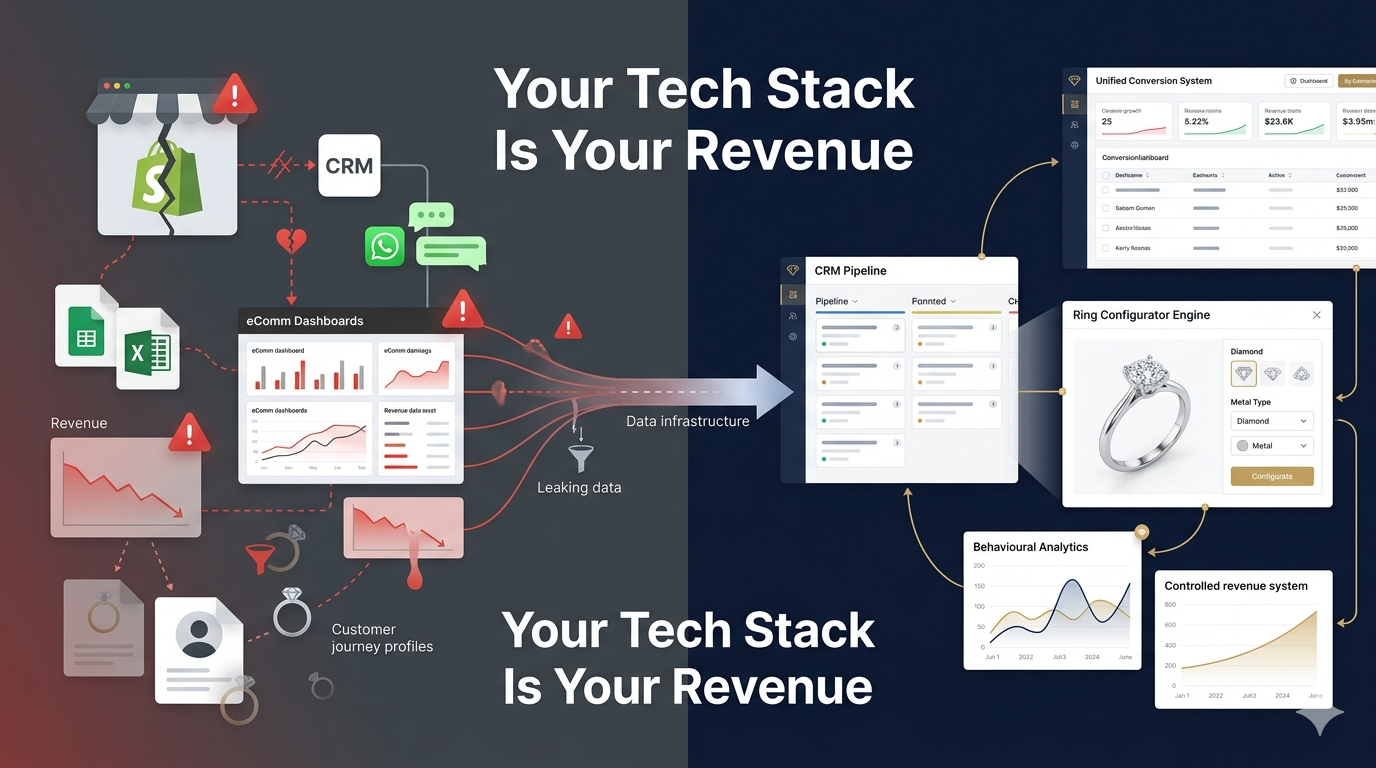
A typical jewellery stack often looks like:
- website platform (Shopify or similar)
- WhatsApp for communication
- spreadsheets for tracking
- separate CRM (if any)
- marketing tools disconnected from sales
Each system holds partial truth.
But no system holds the full journey.
So the business cannot see:
the complete path from interest to purchase
E. No guided decision flows
This is one of the most critical failures.
Customers are expected to:
- browse
- compare
- decide
- self-navigate complexity
But high-value jewellery decisions require structure.
Without guidance:
- users get overwhelmed
- options feel indistinguishable
- decision fatigue increases
- conversion stalls
The Compounding Effect of Bad Architecture
The most dangerous aspect of poor system design is not immediate failure.
It is scaling inefficiency.
At low traffic:
- problems are manageable
- manual effort compensates
At higher traffic:
- inefficiencies multiply
- sales teams become overloaded
- conversion rates stagnate
- marketing spend increases to compensate
At scale:
the system stops supporting growth and starts resisting it
This is why some businesses grow traffic but not revenue.
They are scaling friction, not conversion.
What a Scalable Jewellery Tech Stack Actually Looks Like
A properly designed jewellery system is not a website.
It is a layered conversion architecture.
1. Conversion Architecture Layer
This defines how users make decisions:
- guided buying journeys
- structured navigation paths
- reduced cognitive load UX
- decision-support interfaces
It replaces browsing with progression.
2. Configurator Layer
This is critical for modern jewellery sales:
- real-time ring builders
- diamond selection tools
- dynamic pricing engines
- visual product assembly
It removes guesswork from the buyer.
3. Intelligence Layer
This is where most systems are weakest.
It includes:
- behavioural tracking
- intent recognition
- lead scoring
- engagement depth analysis
This turns user behaviour into actionable data.
4. CRM and Automation Layer
This manages revenue flow:
- pipeline visibility
- structured follow-ups
- automated lead nurturing
- priority-based sales routing
It ensures no high-intent lead is lost due to timing or human delay.
5. Marketing Integration Layer
Marketing is not separate—it feeds the system.
A strong stack ensures:
- ad traffic enters structured journeys
- attribution connects to CRM outcomes
- campaigns are optimised for conversion, not clicks
Why Rebuilding Later Is More Expensive Than Building Correctly Early
Many businesses delay system investment because early-stage setups “work well enough.”
But as the business grows:
- replatforming becomes expensive
- historical data is lost or fragmented
- integrations break
- staff must be retrained
- customer experience is disrupted
The cost is not just financial.
It is operational disruption plus lost conversion momentum.
And in jewellery retail:
lost conversion at scale is significantly more expensive than initial system investment
Strategic Insight: Jewellery eCommerce Is an Architecture Problem, Not a Website Problem
The biggest misconception in jewellery eCommerce is that success comes from:
- better design
- better marketing
- better platforms
But in reality:
websites are just interfaces—performance comes from system architecture underneath
Two businesses can use the same platform and produce completely different outcomes.
Because:
- one is built around browsing
- the other is built around decision engineering
Conclusion
The real cost of building jewellery eCommerce wrong is not immediately visible.
It does not appear as a failed launch.
It appears as:
- inconsistent conversions
- rising marketing costs
- operational inefficiency
- sales team overload
- inability to scale profitably
And by the time it is recognised, it is already embedded into the business structure.
The key insight is simple:
the cost of bad architecture is not paid once—it is paid continuously as lost conversion
In jewellery eCommerce, success is not determined by how the website looks or how much traffic it receives.
It is determined by:
how effectively the system turns intent into structured, guided, and confident decisions
Because in this category:
the biggest expense is not building the system—it is building it wrong and scaling it.