Tuning Your Studio: Unlock Momentum with the Coetzee Resonance Protocol
The quarterly empowerment measurement tells the founder whether the scores are moving in the right direction. The annual fidelity assessment tells them whether the three pillars are still simultaneously operational. The 90-day protocol tracking table told them, week by week, whether the implementation dip was approaching a floor or deepening into structural failure. What none of these instruments tells the founder is whether the system is resonating — whether the daily experience of the studio reflects genuine CCF integration or whether the framework is being performed rather than lived.
The distinction matters. A studio in which artisans complete the briefing template because it is required and a studio in which artisans complete the briefing template because it saves them time may produce identical quarterly empowerment scores and identical fidelity assessment outcomes. They will not produce identical results over three years, because the first studio is running on compliance energy and the second is running on its own momentum. The first studio requires the founder to remain the system’s primary energy source indefinitely. The second produces its characteristic patterns of empowered craft, verified provenance, and institutional knowledge without the founder needing to push.
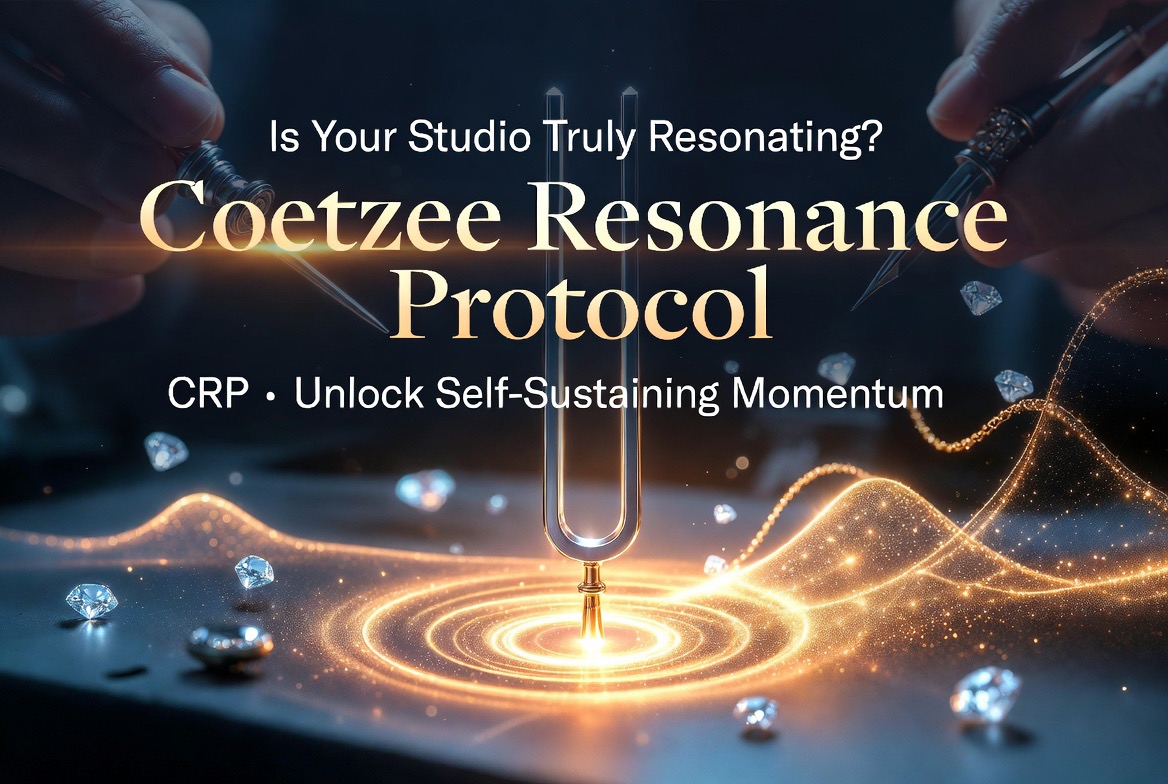
In physics, a resonating system produces its characteristic frequency with minimal energy input because its components are aligned with each other and with the driving force. The tuning fork struck once continues to vibrate at 440 Hz because its physical structure is aligned with that frequency. The crystal oscillator in a precision clock maintains its frequency without external correction because its molecular structure is the clock. The CCF studio in resonance does not require the founder to be the primary energy source for every quality decision, every provenance record, every craft conversation. It requires the founder to be the tuning agent — the person who detects when the system has drifted from its frequency and applies the minimum necessary intervention to restore alignment.
The Coetzee Resonance Protocol is that instrument. This article introduces it for the first time in the CCF corpus, grounds it in the organisational science literature that the resonance metaphor draws from, specifies its five observable signals, its weekly micro-diagnostic, its matched intervention menu, and its integration with the CCF’s existing measurement architecture.
The Theoretical Foundation: Resonance as an Organisational Concept
The resonance metaphor is not merely decorative. It has precise antecedents in the organisational science literature that must be engaged before the CRP’s diagnostic architecture can be grounded in something stronger than a useful image.
Richard Boyatzis and Annie McKee (2005) introduced resonant leadership as a construct grounded in Daniel Goleman’s (1995) emotional intelligence framework and the neuroscience of social contagion that Hatfield, Cacioppo, and Rapson (1993) documented in the Psychological Review. Their central claim was that leaders who create resonant emotional climates — who generate positive affect that spreads through the team through the neural mirroring mechanisms Hatfield et al. described — produce collective energy and sustained performance that dissonant leaders cannot. Resonance in Boyatzis and McKee’s framework is an emergent property of the leader-team interaction, not a characteristic of either the leader or the team alone. When the interaction is resonant, the system produces its characteristic pattern — psychological safety, discretionary effort, creative engagement — without the leader needing to actively maintain it. When the interaction is dissonant, the leader must work harder and harder to produce diminishing results.
Peter Senge’s (1990) learning organisation framework described organisational systems as having characteristic rhythms — feedback loops, delays, and reinforcing cycles — that, when aligned, produce self-reinforcing improvement. Senge’s systems thinking tradition established that the most important leverage points in an organisation are not the obvious high-effort interventions but the small, precisely placed adjustments that engage the system’s own dynamics. The CCF’s three-pillar complementarity is a Sengean system: the three mechanisms reinforce each other in ways that, when aligned, produce the supermodular gains that Milgrom and Roberts (1990, 1995) theorised. When misaligned — when one pillar is underperforming and suppressing the others’ marginal returns — the system requires disproportionate external energy to maintain.
Karl Weick’s (1979) social psychology of organising established that organisations maintain their coherence through ongoing interpretive processes — the continuous cycles of enactment, selection, and retention through which organisational members make sense of their environment and produce coordinated action. Weick’s (1995) sensemaking framework extended this to crisis contexts: when sensemaking breaks down, organisational performance degrades not because individuals become less capable but because the shared interpretive framework that coordinates their action has fractured. A CCF studio in resonance is one in which sensemaking is functioning — artisans interpret their work, their relationships, and their role through the shared framework the CCF’s three pillars create. A studio in drift is one in which that shared framework is beginning to fracture, producing the dissonance signals the CRP is designed to detect.
Edgar Schein’s (1992, 2010) model of organisational culture proposed that deep cultural assumptions — what the organisation’s members take for granted about how things work — produce surface-level artefacts and espoused values without requiring explicit management intervention. When culture is functioning, it is self-reinforcing: the artefacts and values that newcomers observe teach them the underlying assumptions, which they then reproduce through their own behaviour. When culture is dysfunctional, the artefacts and espoused values become decoupled from the underlying assumptions — the organisation says one thing and does another, and the gap produces the cynicism and compliance theatre that the CCF’s dissonance signals are designed to detect before they become cultural facts. Zucker’s (1986) crystallised institutionalisation is the organisational sociology complement to Schein: when practices have been institutionalised to the point of taken-for-grantedness, they reproduce themselves without active management. The CRP’s resonance signals are behavioural indicators of crystallised institutionalisation operating as designed.
Thomas and Velthouse (1990) and Spreitzer (1995) established the four dimensions of psychological empowerment — meaning, competence, self-determination, impact — as cognitive assessments that have real causal consequences for discretionary effort. Brown and Treviño (2006) demonstrated that authentic leadership — leadership characterised by transparency, balanced processing, internalised moral perspective, and relational transparency — produces the conditions for these assessments to remain positive over time. The CRP’s weekly micro-diagnostic is a leading indicator instrument for the empowerment dimensions that quarterly measurement would later confirm: the resonance signals are the behavioural expressions of high empowerment assessments, and the dissonance signals are the behavioural expressions of declining ones.
The Five Resonance Signals: What a CCF Studio Sounds Like When It Is Working
The five resonance signals are observable, specific, non-measurement-dependent indicators that the CCF is functioning at the level of genuine integration rather than performance. They are drawn from the organisational climate literature, the psychological safety research, and the tacit knowledge transfer literature. Each signal corresponds to one dimension of the CCF’s three-pillar architecture operating as designed. Together they constitute a picture of a studio in which the system is producing its characteristic frequency without the founder needing to generate it.
Resonance Signal 1 — Voluntary Voice. Artisans raise quality concerns before the founder notices the problem. This is Edmondson’s (1999) psychological safety criterion made observable — not a survey score but a specific daily behaviour. Nembhard and Edmondson (2006) established that leader inclusiveness is the primary activator of voice in lower-status team members: the leader’s specific, genuine invitations to contribute teach the team that voice is safe. When those invitations have been made consistently enough that the team no longer needs them — when an artisan volunteers a quality observation without being invited — the psychological safety climate has reached the level of genuine institutionalisation. The studio in resonance is one where the founder regularly hears about problems before they have been managed around, where a junior polisher mentions on Thursday that the surface finish on a piece from Tuesday is not quite right and she wants to redo it before it goes to setting. This is voice. It is the most important of the five resonance signals because it is the most difficult to produce and the most diagnostic when absent.
Resonance Signal 2 — Autonomous Craft Decision. Artisans make and complete craft decisions within their demonstrated competence range without escalating to the founder for approval. This is Spreitzer’s (1995) self-determination dimension made visible in daily bench behaviour. The distinction between delegation and autonomy is precise here: delegation is the founder giving permission; autonomy is the artisan not needing to ask. A studio in resonance has artisans who choose stone orientations, adjust setting depths, and resolve material specification questions within the scope of their documented competence without checking whether the choice is acceptable. The Proximal Interference dynamic — the CCF’s third novel construct — is absent when this signal is present. The founder’s physical presence in the studio does not trigger the escalation response that the Proximal Interference mechanism produces. Argote and Ingram (2000) established that tacit knowledge transfer reaches its most productive phase when the recipient begins making independent applications of the transferred knowledge — autonomous craft decisions are evidence that knowledge transfer has moved from observation to independent application.
Resonance Signal 3 — Routine Ownership. Artisans reference the habit routines as their own tools rather than as external compliance requirements. The linguistic marker is the pronoun: “I use the briefing template because it saves me time at handoff” is ownership; “I have to fill in the template before I pass the piece” is compliance. Adler and Borys (1996) established the enabling versus coercive formalisation distinction at the system design level; the CRP makes it observable at the individual interaction level. Wood and Neal (2007) established that habit automaticity converts deliberate action into context-triggered pattern — a routine that has crossed into automaticity is experienced by the artisan not as a rule they must follow but as their natural way of working. Lally, van Jaarsveld, Potts, and Wardle (2010) documented that this transition takes between 18 and 254 days — in a studio at Month 12 or later, routine ownership is the expected signal if the enabling design and the formation timeline have been respected. Its absence at Month 12 is a diagnostic for coercive framing that the founder introduced, intentionally or otherwise.
Resonance Signal 4 — Passport Pride. Artisans voluntarily reference their Digital Passport records in contexts where they are not required — in conversations with clients, in discussions with colleagues about craft decisions, in their own review of their professional development trajectory. Jiang and Cheng (2025) documented the mechanism: digital verification systems increase work engagement when they activate the meaning dimension of psychological empowerment — when the record is experienced as the artisan’s professional asset rather than the system’s compliance requirement. Passport Pride is that meaning activation made behavioural. It is Sipho narrating his bezel treatment in a 47-second Voice-to-Record annotation because he wants the reasoning on record, not because the system requires a annotation. It is Thabo opening his development record to show a colleague where he is in the Legitimate Peripheral Participation pathway, because he is proud of the progression. Lave and Wenger (1991) established that learning in communities of practice is visible in practitioners’ increasing identification with the community’s standards and artefacts — Passport Pride is that identification made concrete.
Resonance Signal 5 — Founder Peripheral. When operational questions arise — unusual client situations, material specification uncertainties, scheduling conflicts — the first resource consulted is a senior artisan, not the founder. The founder is available and trusted, but not necessary for routine operational problem-solving. This is the CCF’s Proximal Interference resolution at its most complete: the founder’s presence in the studio does not activate the escalation dynamic because the team has developed the competence, the authority, and the confidence to resolve operational questions within the team structure. Collins (2010) described collective tacit knowledge as knowledge distributed across a community of practice — accessible through participation in the community rather than through any single individual. A studio where Founder Peripheral is consistently observed is a studio where the collective tacit knowledge of the team has become genuinely distributed. Patel, Messersmith, and Lepak (2013) confirmed the three-way interaction: the supermodular performance gains of a fully implemented HPWS system emerge precisely when individual capability, team empowerment, and organisational systems are simultaneously operational. Founder Peripheral is the behavioural indicator that all three conditions are present.
The Five Dissonance Signals: What CCF Drift Looks Like Before It Becomes Structural Failure
The dissonance signals are the precise inverse of the resonance signals, and they are more important to recognise than the resonance signals because they are detectable earlier than the structural failure they precede. A studio that has been in resonance for eight months does not fall into dissonance overnight. The Repenning and Sterman (2002) capability trap operates progressively: each small accommodation to production pressure — each decision not to enforce a routine, each intervention in a piece that had been signed off, each measurement cycle skipped — slightly reduces the system’s self-reinforcing momentum, making the next accommodation easier and the next restoration harder. The dissonance signals are the early detection system for this progressive degradation.
Dissonance Signal 1 — Founder Magnetic. The founder finds themselves being pulled back into operational decisions they had previously delegated. The specific behavioural pattern is not dramatic — it is the founder who agreed not to intervene in signed-off work offering an unsolicited technical suggestion about the bezel depth on a piece that André has already signed. It is the founder who committed to asking rather than telling spending twenty minutes at the setting bench explaining an alternative approach to a stone orientation that Lindiwe had already resolved. Petriglieri (2011) described this as the identity relapse pattern: when production pressure is high, the founder’s defensive identity response — the Master Craftsman identity that the CCF’s Safety Pre-Flight was designed to work alongside rather than suppress — reasserts itself through behaviour rather than through deliberate choice. Ibarra (1999) established that identity transitions require ongoing provisional identity experiments to maintain — when those experiments are suspended under pressure, the old identity behaviours return by default. Founder Magnetic is the behavioural signal that provisional identity experiments have been suspended.
Dissonance Signal 2 — Silence After Questions. When the founder asks the end-of-day bench review question — “what did you notice today?” — the team responds with polite generalities rather than specific craft observations. The room produces the social sounds of engagement — nodding, brief responses, one or two comments about the day’s work — without the specific, personal quality observations that characterise a psychologically safe team. Edmondson (1999) described this as Wait-and-See behaviour: the team has learned that voice has a cost — perhaps a subtle signal that certain observations are not welcome, perhaps a pattern of responses to previous voice attempts that reduced the perceived benefit — and has reverted to the safer strategy of minimal disclosure. Weick (1995) established that sensemaking breakdowns produce organisational silence: when the shared interpretive framework is uncertain, the socially rational response is to withhold contribution until the framework is clearer. Silence after questions is the diagnostic for a safety climate that has cooled without the founder noticing the temperature drop.
Dissonance Signal 3 — Routine Workaround. Artisans are completing work that meets the quality standard, but the handoff documentation is consistently thinner than the routine specifies — the pieces are good, the records are summary. This is Feldman and Pentland’s (2003) ostensive-performative drift pattern: the routine’s performative execution has decoupled from its ostensive design without either party having made a decision to change it. The drift accumulates through small accommodations — a busy Tuesday where the full template felt like overhead, a week where three new commissions arrived simultaneously and the documentation slipped to minimum — until the thin version has become the new normal. Ichniowski, Shaw, and Prennushi (1997) established that partial adoption of bundled systems produces performance effects indistinguishable from zero: the routine’s value derives from its consistent execution, and consistent execution of a summary version is not the same as occasional execution of the full version. Routine Workaround is the early signal that the routine is losing the consistent execution that makes it valuable.
Dissonance Signal 4 — Passport Minimum. Digital Passport records are being completed at the minimum required level — accurate but thin, compliant but not personally engaged. Voice-to-Record annotations, where present, are one sentence rather than the richer narrations that characterise Passport Pride. The pieces are documented; Sipho’s reasoning is not. Frey and Jegen (2001) described the motivation crowding mechanism: extrinsic requirements crowd out intrinsic motivation when the requirement is experienced as controlling rather than enabling. Passport Minimum is the behavioural signal that the Digital Passport has crossed from enabling to controlling in the artisan’s experience — the record is now something to complete rather than something to own. Ryan and Deci (2000) established that this crossing is not irreversible: the meaning activation that Jiang and Cheng (2025) documented can be re-triggered by restoring the conditions of autonomy and purpose that Pillar 1’s empowerment architecture creates. But the re-triggering requires deliberate intervention. Passport Minimum left unaddressed becomes Passport Perfunctory, and Passport Perfunctory eventually produces records that are technically compliant and commercially worthless.
Dissonance Signal 5 — Measurement Anxiety. The quarterly measurement period produces visible anxiety in the team — artisans asking each other what scores they gave, founders checking whether the numbers will look good enough, a subtle shift in studio behaviour in the week before the measurement that does not reflect the studio’s typical operating pattern. Goodhart (1975), in a monetary policy paper that Strathern (1997) later formalised as Goodhart’s Law in the European Journal of Anthropology, established the principle: when a measure becomes a target, it ceases to be a good measure. A studio where the quarterly empowerment measurement produces anxiety rather than honest self-assessment has reached the Goodhart threshold — the measure is being managed rather than the phenomenon it measures. Kozlowski and Klein (2000) established that valid aggregation of individual scores to team-level constructs requires genuine within-group agreement, not socially coordinated responding. A measurement period characterised by anxiety and score comparison is producing coordinated responding, not genuine agreement — which means the quarterly data from that period tells the founder less than they think it does.
The Weekly Micro-Diagnostic: The CRP’s Core Instrument
The Weekly Micro-Diagnostic is the CRP’s primary instrument. It is a five-question self-assessment that the founder completes at the end of each working week — on Friday afternoon, or at the latest Sunday evening before the week ahead begins. Each question maps to one resonance signal, uses a 0–4 scale, and produces a weekly resonance score from 0 to 20. The diagnostic takes approximately three minutes to complete. It is not a substitute for the quarterly dual-level empowerment measurement, which produces statistically grounded data using Spreitzer’s (1995) validated instrument and Kirkman and Rosen’s (1999) team empowerment scale. It is the continuous monitoring instrument that sits between quarterly measurement events and allows the founder to detect drift weeks before the quarterly data would confirm it.
Schaufeli and Bakker (2004), in developing the Utrecht Work Engagement Scale, established the methodological principles for brief, repeated measurement instruments in organisational contexts: the instrument must be short enough to complete without resistance, anchored in specific observable events rather than general impressions, and produce scores whose week-to-week variation is meaningful rather than artefactual. Likert’s (1932) foundational work on scale construction established that equal-appearing intervals — the assumption that the difference between adjacent scale points is psychologically equivalent — is more defensible when the scale anchors are specific behavioural descriptions rather than evaluative adjectives. The CRP’s 0–4 scale uses behavioural frequency anchors throughout, not evaluative ratings.
The five questions of the Weekly Micro-Diagnostic are as follows. Q1 — Voice Index: This week, how many times did an artisan raise a quality concern before I noticed the problem myself? Score 0 if this did not happen. Score 1 if it happened once. Score 2 if it happened twice. Score 3 if it happened three times. Score 4 if it happened four or more times. Q2 — Autonomy Index: This week, what proportion of craft decisions within the team’s demonstrated competence were made and completed without escalation to me? Score 0 for less than 25%. Score 1 for 25–50%. Score 2 for 51–70%. Score 3 for 71–85%. Score 4 for more than 85%. Q3 — Routine Index: This week, did I observe artisans referencing the habit routines in ways that reflected ownership rather than compliance? Score 0 if not observed. Score 1 if observed once. Score 2 if observed twice. Score 3 if observed three or more times with at least one being spontaneous rather than prompted. Score 4 if routine ownership was observed routinely and spontaneously across multiple artisans. Q4 — Passport Index: This week, did any artisan reference their Digital Passport records voluntarily — not when required by the protocol? Score 0 if no. Score 1 if yes, once, prompted by a client conversation. Score 2 if yes, once, completely unprompted. Score 3 if yes, twice or more. Score 4 if yes, including an instance of an artisan using their records to explain a craft decision to a colleague or client. Q5 — Periphery Index: This week, how many operational questions that would previously have come to me were resolved by the team without my involvement? Score 0 if none. Score 1 if one. Score 2 if two. Score 3 if three. Score 4 if four or more.
The weekly total score from 0 to 20 produces four interpretive bands. A score of 16 to 20 indicates full resonance: the CCF is operating as a self-reinforcing system with minimal founder energy input. A score of 12 to 15 indicates functional resonance with monitoring: the system is working but one or two dimensions are below the resonance threshold, warranting attention before they drift further. A score of 8 to 11 indicates early drift: at least two dimensions are producing dissonance signals, and the matched interventions should be applied in the week following detection. A score of 4 to 7 indicates significant drift: the system is losing its self-reinforcing momentum and the founder should pause new initiatives and return to the prerequisite protocols for the dimensions showing the lowest scores. A score of 0 to 3 indicates resonance failure: the CCF has reverted to the pre-implementation state across multiple dimensions and requires a full restart from the Safety Pre-Flight protocol.
The diagnostic’s clinical analogy is precise. Weick (1979) established that organisational sensing — the detection of weak signals before they become strong problems — is the most important and most underused capability in management practice. The Weekly Micro-Diagnostic is an organisational sensing instrument: it detects weak signals in their specific, observable form before they become the structural failures that quarterly measurement confirms. Like vital signs monitoring in clinical medicine, its value is not in the diagnosis of acute conditions — the quarterly measurement instruments do that — but in the early detection of trends that, if unaddressed, will produce the acute conditions the acute instruments measure.
The Resonance Intervention Menu
For each dissonance signal, the CRP specifies a matched intervention — a specific, time-bounded action the founder takes within the week of detecting the signal. The intervention menu does not require additional instruments, additional staff time, or additional resources. Each intervention is an adjustment to how the founder conducts activities they are already conducting — the bench review, the team meeting, the craft conversation. This is the Sengean leverage principle: the smallest precisely placed adjustment that engages the system’s own dynamics.
The intervention for Dissonance Signal 1 (Founder Magnetic) is Active Error Modelling applied to the identity relapse itself. The founder identifies the specific moment of relapse — the exact bench decision where they intervened when they had committed not to — and names it at the next end-of-day review: “I noticed myself suggesting a different bezel approach on André’s piece this afternoon. That was mine to notice, not mine to fix. I’m naming it because it’s exactly the pattern we agreed to watch for.” This is the Edmondson (1999) psychological safety mechanism operating in the founder’s direction: the founder who acknowledges their own CCF non-compliance demonstrates that the system applies to them as well as to the team. Ibarra’s (1999) provisional selves framework predicts that naming the relapse — making it a deliberate object of reflection rather than a behaviour that simply occurred — reactivates the provisional identity experiment and reduces the probability of recurrence.
The intervention for Dissonance Signal 2 (Silence After Questions) is a return to the specific form of leader inclusiveness that Nembhard and Edmondson (2006) identified as the most effective activator of voice: not a general open-ended question but a targeted, specific invitation to a named artisan about a specific piece of work. “Lindiwe, I noticed you chose a different surface treatment on the Hendricks piece than the brief specified — I’d like to hear your reasoning when you have a moment.” The specificity of this invitation does two things simultaneously. It signals that the founder is genuinely observing the work, not performing an interest in it. And it lowers the social cost of responding, because the artisan is being invited to explain a decision they already made rather than to volunteer a general observation into a silent room. Spreitzer et al. (1997) established that the impact dimension of psychological empowerment — the belief that one’s contributions make a visible difference — is the dimension most sensitive to specific recognition of specific contributions. The targeted invitation is a direct impact activation intervention.
The intervention for Dissonance Signal 3 (Routine Workaround) is an unscheduled ten-minute routine co-design session with the team for the affected handoff. The framing is critical: “I notice the briefing documentation has been thinner this week. What’s creating friction? What would make this easier?” This is the Feldman and Pentland (2003) co-design process applied as a responsive intervention. The routine is adjusted based on the team’s input. Adjustment is not failure — it is the routine’s ostensive design being refined to improve the alignment between what the routine is designed to achieve and what the performative context allows. Argyris and Schön’s (1978) double-loop learning requires that the governing variables themselves be examined when a routine repeatedly underperforms — in this case, the governing variable is the routine’s specification, and the co-design session examines whether it is appropriately calibrated to the team’s current workflow reality.
The intervention for Dissonance Signal 4 (Passport Minimum) is meaning re-activation through exemplary narration. The founder selects a Voice-to-Record annotation from the archive that exemplifies rich provenance narration — Sipho’s 47-second bezel reasoning annotation is the archetype — and plays or reads it at the next team meeting, framed not as a standard to be met but as a reminder of what the Passport is for: “This is what provenance documentation looks like when it’s being used as a professional record rather than a compliance requirement. This is the kind of annotation that clients reference when they refer new clients to us.” The Jiang and Cheng (2025) meaning activation mechanism requires that the artisan experience the record as their own professional asset. The exemplary narration intervention re-anchors the Passport in its purpose rather than its process, restoring the intrinsic motivation that Ryan and Deci (2000) identified as the distinguishing feature of genuine rather than performed engagement.
The intervention for Dissonance Signal 5 (Measurement Anxiety) is founder self-disclosure of the measurement outcome before the team’s outcomes are shared. “My resonance score this week was 11. My lowest dimension was the Autonomy Index — I noticed I was consulted on three decisions this week that I should have let the team resolve without me. I’m not sure whether that’s because I inserted myself or because the team is less confident right now, and I want to understand which it is.” This disclosure converts the measurement from a performance review into a shared diagnostic. Kaplan and Norton’s (1992) balanced scorecard framework established that measurement systems produce their intended results only when the organisation understands and accepts the purpose of the measurement. A measurement system that produces anxiety rather than inquiry has failed at the communication of purpose — the founder’s self-disclosure intervention is a direct communication of purpose through demonstrated practice.
The CRP Dashboard: Tracking Resonance Over Time
The CRP Dashboard converts weekly micro-diagnostic scores into a longitudinal resonance trajectory. It has three components, each operating at a different level of analytical resolution.
The first component is the Weekly Score Plot. Each week’s total resonance score from 0 to 20 is plotted on a simple line graph. The trajectory over 13 consecutive weeks — one quarter — should show one of three patterns: stable resonance (scores consistently above 12, with week-to-week variation reflecting production cycle patterns rather than systematic drift), seasonal variation (predictable dips during peak production periods such as December and Valentine’s Day that recover without intervention), or structural drift (scores declining across multiple consecutive weeks without recovery). The slope of the trend line across four or more consecutive weeks is the primary diagnostic. A downward slope of more than one point per week across four weeks is the early-warning signal for structural drift that the quarterly measurement would later confirm. Senge (1990) established that the most dangerous signals in complex systems are the slow-moving trends that are individually unalarming but cumulatively decisive — the CRP’s weekly plotting converts those slow-moving trends into a visible trajectory.
The second component is the Signal Breakdown. Each week’s five individual signal scores are tracked separately, producing a spider diagram that shows which resonance dimensions are strongest and which are weakest in the current period. A studio with a consistently high Voice Index but a declining Passport Index has a specific diagnostic: the psychological safety climate is intact but the Digital Passport meaning activation is drifting. This directs the intervention to Dissonance Signal 4 rather than requiring a full CRP restart. A studio where the Periphery Index is declining while the other four signals remain strong has a different diagnostic: the team’s autonomous operational problem-solving is regressing, possibly because new artisans have joined who have not yet completed the Legitimate Peripheral Participation pathway, or possibly because a series of genuinely difficult client situations have reset the escalation habit. Chen, Kirkman, Kanfer, Allen, and Rosen’s (2007) multi-level measurement framework established that diagnostic precision requires dimension-specific measurement — aggregate scores that mask dimension-specific variation produce diagnostic errors. The Signal Breakdown prevents that masking.
The third component is the Intervention Log. Every time the founder detects a dissonance signal and applies an intervention, the log records three items: the signal detected (which of the five dissonance signals prompted the intervention), the intervention applied (which of the five matched interventions was used), and the score change in the week following the intervention (did the relevant signal score improve, hold, or decline further?). Over time, this log produces the studio’s specific evidence base for which interventions work in its specific context — a learning record that is both operationally useful and, for studios participating in the CCF’s empirical validation programme, a contribution to the field’s understanding of resonance dynamics in craft micro-enterprises. Argyris and Schön (1978) established double-loop learning as the organisational capacity to examine and adjust the governing variables of a system — the Intervention Log is the operational instrument for double-loop learning in the CRP context: it allows the founder to learn not just whether interventions worked but whether the CRP’s intervention menu is appropriately calibrated to their specific studio’s dynamics.
The CRP in the CCF’s Measurement Architecture
The CRP integrates with the CCF’s existing measurement architecture as the continuous monitoring layer between discrete measurement events. The architecture now has four temporal resolutions, each serving a distinct diagnostic function.
The daily layer comprises the Active Error Modelling log (the founder’s record of error acknowledgments made at the bench), the bench review notes (observations about who noticed what and whether voice was solicited or voluntary), and the delegation experiment outcomes (which decisions were made independently and which were escalated). These are qualitative observations that do not produce numerical scores — they are the raw material that informs the weekly micro-diagnostic’s five questions. The daily layer is the sensory surface of the CRP: the data that the weekly instrument processes into a score.
The weekly layer is the CRP Weekly Micro-Diagnostic: five questions, 0–20 score, three-minute completion time. This is the leading indicator layer — the instrument that detects drift at the signal level before it accumulates into the score-level change that quarterly measurement would confirm. The weekly layer is the CRP’s primary contribution to the CCF’s measurement architecture: it fills the seven-week gap between quarterly measurement events with a continuous monitoring signal that converts qualitative daily observations into a trackable weekly score.
The quarterly layer is the dual-level empowerment measurement instrument — the 12-item anonymous survey combining Spreitzer’s (1995) individual empowerment scale with Kirkman and Rosen’s (1999) team empowerment scale, administered anonymously to the full artisan workforce. This is the validated measurement layer: it produces statistically grounded data for comparison against the series’ established benchmarks and against any future national or sector-level normative data. The quarterly layer is the CRP’s anchor: the weekly scores should predict the quarterly measurement outcomes, and systematic discrepancies between weekly resonance scores and quarterly empowerment scores are diagnostic for either the CRP’s miscalibration (the founder is observing selectively) or the quarterly measurement’s contamination (the team is responding to survey anxiety rather than genuine empowerment assessments).
The annual layer is the CCF fidelity assessment — the three-pillar compliance check, routine audit, Digital Passport governance review, and succession readiness assessment that determines whether the CCF’s architecture remains intact at its most fundamental level. The annual layer is the strategic measurement: it addresses questions that the weekly and quarterly instruments cannot — whether the Phase 2 Architecture should be activated, whether the Apprenticeship Architecture’s Legitimate Peripheral Participation pathway is on track, whether the Hybrid Architecture’s POPIA compliance remains current. The annual layer requires the most time to complete and provides the most comprehensive picture of the CCF’s structural integrity.
The four-layer architecture is self-improving in the Argyris and Schön (1978) double-loop sense. A declining weekly CRP score that the founder addresses through an intervention, and that does not subsequently appear in the quarterly measurement data, is evidence that the intervention was timely and effective — the drift was reversed before it reached the magnitude that quarterly measurement would detect. A declining quarterly empowerment score that was not preceded by declining weekly CRP scores is evidence that the founder was not observing the leading indicators closely enough — which is itself a diagnostic for the CRP’s implementation fidelity rather than the CCF’s architectural integrity. An annual fidelity assessment that reveals routine drift that was not detected by either the weekly or quarterly instruments suggests the drift occurred in a dimension that neither instrument was designed to capture — which is grounds for adding a dimension to the weekly micro-diagnostic. The measurement architecture learns from its own gaps.
The Honest Scope of the CRP
The Coetzee Resonance Protocol is a diagnostic instrument, not a measurement instrument. The distinction matters and must be stated precisely. The quarterly empowerment measurement using Spreitzer’s (1995) validated scale produces construct-validated psychometric scores with known reliability coefficients and established normative comparisons. The CRP’s Weekly Micro-Diagnostic does not. Its five questions are grounded in the organisational literature but are not derived from a psychometric validation process — they have not been tested for internal consistency, test-retest reliability, or discriminant validity against related constructs. They are clinical diagnostic items in the tradition of rapid clinical assessment instruments — the Glasgow Coma Scale, the CAGE questionnaire, the AUDIT-C — whose value is screening sensitivity rather than diagnostic precision. They detect the presence of a problem early enough for intervention; they do not measure the severity of the problem with the precision that validated instruments provide.
This scope limitation has two practical implications. First, the CRP score should not be used as a substitute for the quarterly empowerment measurement. A founder who scores 18 out of 20 on the Weekly Micro-Diagnostic in the week before the quarterly measurement should still administer the quarterly measurement — because the CRP measures the founder’s observations of artisan behaviour, while the quarterly instrument measures the artisans’ own assessments of their empowerment experience. Both are necessary; neither is sufficient. Second, the CRP score should not be compared across studios without significant methodological caution. The five questions are anchored in absolute frequency counts (how many times this week) rather than relative assessments (how often does this happen compared to your expectations), which means scores from a 22-person studio with three departments will not be directly comparable to scores from a 10-person studio with a single production floor. The CRP is a within-studio longitudinal instrument — its value is in tracking the same studio’s trajectory over time, not in benchmarking studios against each other.
The research programme that would address these scope limitations is a natural extension of the CCF’s empirical validation agenda: a multi-site study that administers both the CRP Weekly Micro-Diagnostic and the Spreitzer (1995) quarterly instrument to the same studios over six months, testing whether the weekly score is a statistically significant predictor of the subsequent quarterly score. A confirmed predictive relationship would validate the CRP as a leading indicator instrument in the Kaplan and Norton (1992) sense. A null result would require revision of the diagnostic questions or the scoring anchors. Either outcome advances the CCF’s empirical programme — and the studio founders who complete the CRP weekly and the quarterly measurement quarterly are the researchers whose data would answer the question.
Frequently Asked Questions
1. What do I do if my weekly CRP score is consistently high — 16 or above — but the studio still does not feel right?
This is the most important question in this article, and the CRP’s honest answer is that a consistently high score in the presence of persistent unease is diagnostic for one of three things, each requiring a different response. First, the founder may be observing selectively — seeing the resonance signals and not the dissonance signals, because the resonance signals are more comfortable to register. The Schein (1992) cultural assumptions framework predicts that leaders are most blind to the signals that challenge their preferred interpretation of the situation. The intervention is to administer the quarterly empowerment measurement ahead of schedule and compare the anonymous artisan scores against the founder’s weekly observations. A significant discrepancy between the quarterly scores and the weekly CRP scores indicates selective observation. Second, the unease may be diagnostic for a dimension that the CRP’s five questions do not capture — an interpersonal conflict between two artisans, a client relationship that is producing invisible pressure on the team, a material cost increase that is creating financial anxiety that the founder is absorbing but not naming. The CRP is designed to detect CCF drift, not all sources of organisational unease. Persistent unease in the presence of high CRP scores should prompt a broader diagnostic conversation — Schein’s (2010) humble inquiry approach, in which the founder asks open, non-leading questions about what the team is experiencing, is the appropriate instrument for this broader assessment. Third, the CRP score may be accurate and the unease may be the founder’s own residual anxiety from the identity transition — the provisional selves discomfort that Ibarra (1999) described as the normal experience of identity expansion. A founder who has genuinely become Founder Peripheral may experience this as loss before they experience it as freedom. The weekly score and the quarterly measurement confirming resonance are the evidence that the unease is the founder’s, not the studio’s.
2. How do I administer the CRP during the implementation dip — is it useful when the scores are expected to be low?
The CRP is most useful during the implementation dip, not least useful. Repenning and Sterman (2002) established that the implementation dip’s primary danger is not the performance decline itself but the misinterpretation of the decline as evidence of system failure rather than transition. The Weekly Micro-Diagnostic during the dip period produces a pattern that is diagnostically valuable precisely because it is low: the question is not whether the score is low — it will be, during the dip — but whether the score’s component pattern is consistent with transition or consistent with failure. During a healthy implementation dip, the Autonomy Index typically drops first (artisans are adjusting to new decision frameworks and escalate more), the Voice Index drops second (the psychological safety climate is still warm but the team is uncertain about the new system), and the Periphery Index drops third. The Routine Index and Passport Index may actually improve during the early dip, because the new routines are being actively attended to rather than automatically executed. This pattern — declining autonomy and voice alongside improving routine engagement — is the signature of a healthy transition. The pattern of all five signals declining simultaneously is the signature of system failure rather than transition, and it requires the full Safety Pre-Flight restart rather than dip management. The CRP makes this diagnostic distinction visible week by week rather than requiring the founder to wait for the quarterly measurement to confirm whether they are in transition or failure.
3. Should I share my weekly CRP scores with the team, or is it a private founder instrument?
The answer depends on the studio’s current psychological safety level and the specific scores being shared. The general principle from Edmondson (1999) and Brown and Treviño (2006) is that transparency about assessment processes builds the trust that enables voice. A founder who shares their CRP scores — including the low scores — models the intellectual honesty that the CCF’s psychological safety architecture requires. The specific recommendation is to share the overall weekly score and the lowest individual signal score at the monthly team meeting, framed not as a report but as a joint diagnostic: “My Passport Index was 1 this week — I only observed one voluntary Passport reference. I want to understand whether that’s because the records are feeling like overhead again or because it was just a quieter client-conversation week.” This framing converts the score from a judgment about the team into an invitation for joint inquiry. What the founder should not share are scores that could be read as evaluation of specific artisans — a Voice Index of 0 shared without context could be read as “nobody spoke up this week,” which is a team evaluation rather than a shared diagnostic. The sharing protocol should always include the founder’s own reflexive question about what they might be doing to contribute to the signal level they are observing.
4. The CRP is named after its author rather than after the CCF. Is this a marketing decision or does it serve a theoretical purpose?
Both, and the honest answer names both. The naming convention follows the tradition of clinical diagnostic instruments — the Glasgow Coma Scale, the Apgar Score, the Hamilton Depression Rating Scale — in which the author’s name signals that this is a specific, designed instrument with a traceable intellectual lineage rather than a generic approach. In the Spence (1973) signalling framework that the CCF has applied throughout the series, naming the protocol is a costly signal: it creates a public accountability for the instrument’s claims that an anonymous framework component would not. If the CRP’s diagnostic validity is subsequently tested and found to be weak, the cost of that finding is borne by the named instrument and its named author rather than being absorbed into the broader framework. This is a commitment device in the economic sense — the naming raises the cost of future disconfirmation and therefore signals genuine confidence in the instrument’s diagnostic value. The theoretical purpose is the commitment. The marketing benefit — that a named instrument is more memorable and more citable than an unnamed one — is the secondary consequence rather than the primary motivation.
5. How does the CRP handle the situation where one artisan consistently scores 4 on every dimension — the Resonance Star — while others score 1 or 2? Does the CRP average wash out this variation?
This is the most technically precise question in the list, and it addresses the CRP’s most important design limitation. The Weekly Micro-Diagnostic’s five questions are framed at the studio level — “how many times did an artisan raise a quality concern” rather than “how many artisans raised quality concerns” — specifically to prevent the within-studio averaging that Chen et al.’s (2007) multi-level measurement research identified as the primary source of diagnostic error in empowerment measurement. A studio where one artisan raises quality concerns four times a week and four artisans raise none is not a studio in resonance — it is a studio with one high-performing outlier. The CRP’s Voice Index question, framed as a total frequency count rather than a team average, will still score 4 in this studio, masking the distributional problem. The Signal Breakdown’s spider diagram, which tracks each signal’s score over time, is the partial corrective: a studio where the Voice Index is consistently 4 but the Autonomy Index is consistently 1 is displaying a pattern — one artisan volunteering voice while the rest wait for permission — that the combination of signals reveals even when the individual signals do not. The fuller corrective is to supplement the weekly micro-diagnostic with a monthly distributional check: the founder asks themselves not just how many times a signal appeared this week but which artisans produced it. If the answer to “who raised a quality concern” is consistently the same person, the Voice Index score of 4 is misleading, and the real diagnostic is a team safety climate that has produced one vocal advocate rather than a collectively voiced team. This distributional check is not formalised in the CRP’s current instrument specification — it is a practitioner adjustment that founders with studio-level diagnostic sophistication should apply as a complement to the weekly score.
References
Adler, P. S., & Borys, B. (1996). Two types of bureaucracy: Enabling and coercive. Administrative Science Quarterly, 41(1), 61–89.
Argote, L., & Ingram, P. (2000). Knowledge transfer: A basis for competitive advantage in firms. Organizational Behavior and Human Decision Processes, 82(1), 150–169.
Argyris, C., & Schön, D. A. (1978). Organizational learning: A theory of action perspective. Addison-Wesley.
Boyatzis, R. E., & McKee, A. (2005). Resonant leadership: Renewing yourself and connecting with others through mindfulness, hope, and compassion. Harvard Business School Press.
Brown, M. E., & Treviño, L. K. (2006). Ethical leadership: A review and future directions. The Leadership Quarterly, 17(6), 595–616.
Chen, G., Kirkman, B. L., Kanfer, R., Allen, D., & Rosen, B. (2007). A multilevel study of leadership, empowerment, and performance in teams. Journal of Applied Psychology, 92(2), 331–346.
Collins, H. M. (2010). Tacit and explicit knowledge. University of Chicago Press.
Edmondson, A. C. (1999). Psychological safety and learning behavior in work teams. Administrative Science Quarterly, 44(2), 350–383.
Feldman, M. S., & Pentland, B. T. (2003). Reconceptualizing organizational routines as a source of flexibility and change. Administrative Science Quarterly, 48(1), 94–118.
Frey, B. S., & Jegen, R. (2001). Motivation crowding theory. Journal of Economic Surveys, 15(5), 589–611.
Goleman, D. (1995). Emotional intelligence: Why it can matter more than IQ. Bantam Books.
Goodhart, C. A. E. (1975). Problems of monetary management: The UK experience. In Papers in monetary economics (Vol. 1). Reserve Bank of Australia.
Hatfield, E., Cacioppo, J. T., & Rapson, R. L. (1993). Emotional contagion. Current Directions in Psychological Science, 2(3), 96–100.
Ibarra, H. (1999). Provisional selves: Experimenting with image and identity in professional adaptation. Administrative Science Quarterly, 44(4), 764–791.
Ichniowski, C., Shaw, K., & Prennushi, G. (1997). The effects of human resource management practices on productivity: A study of steel finishing lines. American Economic Review, 87(3), 291–313.
Jiang, H., & Cheng, X. (2025). Perceived algorithmic control and gig workers’ work engagement: Assessing the mediating role of psychological empowerment. Frontiers in Psychology. PMC.
Kaplan, R. S., & Norton, D. P. (1992). The balanced scorecard — measures that drive performance. Harvard Business Review, 70(1), 71–79.
Kirkman, B. L., & Rosen, B. (1999). Beyond self-management: Antecedents and consequences of team empowerment. Academy of Management Journal, 42(1), 58–74.
Kozlowski, S. W. J., & Klein, K. J. (2000). A multilevel approach to theory and research in organizations. In K. J. Klein & S. W. J. Kozlowski (Eds.), Multilevel theory, research, and methods in organizations (pp. 3–90). Jossey-Bass.
Lally, P., van Jaarsveld, C. H. M., Potts, H. W. W., & Wardle, J. (2010). How are habits formed: Modelling habit formation in the real world. European Journal of Social Psychology, 40(6), 998–1009.
Lave, J., & Wenger, E. (1991). Situated learning: Legitimate peripheral participation. Cambridge University Press.
Likert, R. (1932). A technique for the measurement of attitudes. Archives of Psychology, 22(140), 1–55.
Milgrom, P., & Roberts, J. (1990). The economics of modern manufacturing: Technology, strategy, and organization. American Economic Review, 80(3), 511–528.
Milgrom, P., & Roberts, J. (1995). Complementarities and fit: Strategy, structure, and organizational change in manufacturing. Journal of Accounting and Economics, 19(2–3), 179–208.
Nembhard, I. M., & Edmondson, A. C. (2006). Making it safe: The effects of leader inclusiveness and professional status on psychological safety and improvement efforts in health care teams. Journal of Organizational Behavior, 27(7), 941–966.
Patel, P. C., Messersmith, J. G., & Lepak, D. P. (2013). Walking the tightrope: An assessment of the relationship between high-performance work systems and organizational ambidexterity. Academy of Management Journal, 56(5), 1420–1442.
Petriglieri, G. (2011). Under threat: Responses to and the consequences of threats to individuals’ identities. Academy of Management Review, 36(4), 641–662.
Repenning, N. P., & Sterman, J. D. (2002). Capability traps and self-confirming attribution errors in the dynamics of process improvement. Administrative Science Quarterly, 47(2), 265–295.
Ryan, R. M., & Deci, E. L. (2000). Self-determination theory and the facilitation of intrinsic motivation, social development, and well-being. American Psychologist, 55(1), 68–78.
Schaufeli, W. B., & Bakker, A. B. (2004). Job demands, job resources, and their relationship with burnout and engagement: A multi-sample study. Journal of Organizational Behavior, 25(3), 293–315.
Schein, E. H. (1992). Organizational culture and leadership (2nd ed.). Jossey-Bass.
Schein, E. H. (2010). Organizational culture and leadership (4th ed.). Jossey-Bass.
Seibert, S. E., Wang, G., & Courtright, S. H. (2011). Antecedents and consequences of psychological and team empowerment in organizations: A meta-analytic review. Journal of Applied Psychology, 96(5), 981–1003.
Senge, P. M. (1990). The fifth discipline: The art and practice of the learning organization. Doubleday.
Spence, M. (1973). Job market signaling. Quarterly Journal of Economics, 87(3), 355–374.
Spreitzer, G. M. (1995). Psychological empowerment in the workplace: Dimensions, measurement, and validation. Academy of Management Journal, 38(5), 1442–1465.
Spreitzer, G. M., Kizilos, M. A., & Nason, S. W. (1997). A dimensional analysis of the relationship between psychological empowerment and effectiveness, satisfaction, and strain. Journal of Management, 23(5), 679–704.
Strathern, M. (1997). ‘Improving ratings’: Audit in the British University system. European Journal of Anthropology, 5(Spring), 1–21.
Thomas, K. W., & Velthouse, B. A. (1990). Cognitive elements of empowerment: An “interpretive” model of intrinsic task motivation. Academy of Management Review, 15(4), 666–681.
Weick, K. E. (1979). The social psychology of organizing (2nd ed.). Addison-Wesley.
Weick, K. E. (1995). Sensemaking in organizations. Sage.
Wood, W., & Neal, D. T. (2007). A new look at habits and the habit-goal interface. Psychological Review, 114(4), 843–863.
Zucker, L. G. (1986). Production of trust: Institutional sources of economic structure, 1840–1920. Research in Organizational Behavior, 8, 53–111.