
The Founder Bottleneck Escape Plan: How to Move From “I Make Pieces” to “I Design Systems”
Post 7 of 8 in The Execution Trilogy. Prerequisite: Posts 4, 5, and 6 complete — your Service Flywheel is turning, your CRM is live, and your content system is producing. Now the question becomes: can this business run without you holding every thread?
There is a specific ceiling that jewellery studio owners hit, and it does not arrive as a financial crisis. It arrives as exhaustion. The studio is doing well — orders are consistent, the team has grown to eight or twelve or fifteen people, the service flywheel from Post 4 is generating recurring revenue, the CRM from Post 5 is full of warm customer data, and the content system from Post 6 is publishing regularly. By every external measure, the business is healthy. And yet the founder is working longer hours than they did five years ago, cannot take a week off without the workshop stalling, and has a growing sense that they have built a machine that only runs while they are physically inside it.
This is the founder bottleneck. It is not a character flaw. It is a structural feature of how most artisan businesses grow, and the academic literature describes it with uncomfortable precision.
Pasanen (2003), studying SME growth factors, identified the owner-manager as a “central bottleneck factor” — the single variable most predictive of whether a small business stalls or scales. The mechanism is straightforward: founder-control is initially efficient. When you are the most skilled person in the room, the fastest path to quality is to do it yourself or supervise everything personally. But as the business grows, that efficiency inverts. Every decision that routes through one brain creates a queue. Every piece that requires the founder’s personal inspection creates a dependency. Every customer relationship that only the founder maintains becomes a fragility. What was once a competitive advantage — the founder’s total involvement — becomes the binding constraint on every dimension of growth.
Wiseman (2010) gave this dynamic a useful label: the Diminisher. Not as an insult, but as a structural description. A leader who concentrates decision-making authority, however well-intentioned, diminishes the available intelligence in the organisation. The team learns to wait for instructions rather than exercise judgement. The artisan who could evaluate stone quality independently instead waits for the founder to confirm. The workshop manager who could schedule production defers to the founder’s preference. The front-of-house staff who could handle a service enquiry puts the customer on hold because “only the boss knows the answer to that.”
Now, the honest caveat that the research games surfaced repeatedly: Wiseman’s Multipliers framework is practitioner language, not peer-reviewed science. The book is based on 150 qualitative interviews, published in practitioner journals, and the “2x intelligence” claim is self-reported perception data. We do not cite it as established research. But the mechanism Wiseman describes — that distributing cognitive authority increases collective performance — has one of the strongest evidence bases in management science. Seibert, Wang and Courtright (2011), in their meta-analysis of 142 studies published in the Journal of Applied Psychology, found that psychological empowerment predicts task performance at ρ = .44, innovation at ρ = .35, and team performance at ρ = .41. Spreitzer (1995), in the Academy of Management Journal, validated the four dimensions of empowerment — meaning, competence, self-determination, and impact — and linked them to managerial effectiveness (r = .27) and innovation (r = .33). These are not small effects. A correlation of .44 with task performance places empowerment among the strongest predictors in organisational science.
The founder bottleneck, then, is not just an operational inconvenience. It is a measurable suppression of the studio’s available performance. Every week the founder remains the sole decision-maker is a week in which ρ = .44 sits unused.
But here is the part that most delegation advice skips over entirely, and it is the part that matters most for jewellery: delegation is not a management technique. It is an identity shift. The founder who built a studio on the strength of their hands, their eye, and their personal relationships with every client is being asked to stop being the person who makes pieces and start being the person who designs the systems that enable other people to make pieces to the same standard. That is not a workflow change. It is a redefinition of what the founder is for.
This article lays out the evidence for why that shift is necessary, the conditions under which it works, and the specific systems that make it possible — including the three areas where founders most commonly resist delegation and where the resistance is, paradoxically, most costly: voice, visibility, and measurement.
Your Voice Is Your Competitive Advantage (So Don’t Sand It Down)
The first domain where the founder bottleneck becomes visible is content — the blog posts, product descriptions, social media presence, and brand narrative that Post 6 established as a sustainable system. Here is the pattern: the founder recognises that they cannot write everything themselves. They hire an agency or a copywriter. The agency interviews the founder for an hour, then produces website copy, social media posts, and email campaigns that sound like every other jewellery brand on the internet. The founder’s thirty years of accumulated knowledge — the way they talk about stone quality, the specific language they use to describe their design philosophy, the stories they tell customers at the bench — gets smoothed into generic luxury-brand prose. “Timeless elegance.” “Exquisite craftsmanship.” “Bespoke creations for discerning clients.”
This is not a style choice. It is a strategic error, and Barney’s (1991) Resource-Based View explains precisely why.
The VRIN framework — Valuable, Rare, Inimitable, Non-substitutable — defines the conditions for sustainable competitive advantage. Apply it to generic luxury copy and the analysis collapses at the second hurdle: a website written in interchangeable brand language is Valuable (it exists) but not Rare (every competitor has one), not Inimitable (any copywriter can produce it), and trivially Substitutable. Now apply VRIN to the way your master jeweller actually talks about their work. The specific anecdote about why they refuse to set a particular grade of stone in a particular mounting. The technical explanation of micro-pavé versus channel setting, delivered in the conversational register they use with a client at the bench. The story of a commission that went wrong and what they learnt from it. That voice is Valuable, Rare (no other jeweller has this specific forty years of knowledge), Inimitable (a competitor cannot retroactively live that career), and Non-substitutable. The voice passes VRIN. The polished copy does not.
Cohen and Levinthal (1990) introduced Absorptive Capacity — the ability of a firm to recognise the value of new information, assimilate it, and apply it commercially. Their paper in Administrative Science Quarterly, cited over 60,000 times, showed that absorptive capacity is path-dependent: it builds on what the firm already knows. For a jewellery studio, the founder’s accumulated tacit knowledge is the firm’s absorptive capacity in human form. When an agency sands down that voice to produce “professional” content, they are not polishing the brand. They are destroying the one digital asset that actually passes the VRIN test.
So what does delegation look like when the voice is the asset? It looks like extraction, not replacement. The content system from Post 6 — where the cue is “a customer asked this three or more times this month” — still works. But instead of the founder writing every post personally, the system becomes: the founder records a ten-minute voice note answering the question in their natural language. A trained editor (internal or external) structures that voice note into a blog post, preserving the founder’s specific phrasing, examples, and perspective. The founder reviews for accuracy. The editor handles formatting, SEO markup, and publishing.
This is delegation that preserves inimitability. The founder’s time drops from two and three-quarter hours per week to thirty minutes. The content retains the only thing that makes it competitively defensible: the founder’s actual voice, with all its specificity and depth.
Green and Brock (2000), researching narrative transportation in the Journal of Personality and Social Psychology, demonstrated that readers who are immersed in an authentic narrative align their beliefs with the story’s conclusions significantly more than readers who evaluate generic informational content. The commercial implication: a product page written in the founder’s voice does not just communicate information. It creates the trust that generic copy structurally cannot. And Stiglitz’s (2001) information economics warns that as quality signals become standardised — as every jeweller eventually adopts structured data and blockchain provenance — the signals stop differentiating. What survives commoditisation is the human layer. The curator’s voice. The maker’s perspective. The founder’s wisdom, expressed in their own words.
Christensen (1997) made the same point from a different angle in The Innovator’s Dilemma: incumbent firms fail not because they ignore new technology, but because they adopt it in ways that abandon their core value proposition. The founder who replaces their distinctive voice with generic digital marketing copy is committing Christensen’s error in miniature. They are delegating, but they are delegating away the wrong thing.
The rule: delegate the production. Never delegate the perspective.
Basic SEO (Without Obsessing Over It)
The second domain where founders either bottleneck or over-correct is search engine visibility. The pattern runs in two directions: either the founder ignores SEO entirely (“I’m a jeweller, not a marketer”) or they outsource it to an agency that turns it into an all-consuming technical project that generates impressive reports and no clients.
Here is what the evidence actually says, stripped of the jargon.
Search engines are answer machines. Someone types a question — “best jeweller in Cape Town,” “how to choose an engagement ring,” “what is a VS1 diamond” — and the engine returns the most helpful answer. Your studio’s visibility depends on two things: whether you have published a genuinely useful answer, and whether the search engine can understand that your answer exists. That is the entire discipline. Everything else is refinement.
The first principle — publishing useful answers — is where the founder’s voice becomes directly commercial. Post 6 established the content system that produces these answers. Google’s published quality guidelines prioritise what they call E-E-A-T: Experience, Expertise, Authoritativeness, and Trustworthiness. A forty-year jeweller writing about their craft from direct experience satisfies all four criteria in ways that a marketing agency writing on their behalf cannot. This is not sentiment. It is the operational definition of the ranking signal.
The second principle — helping the search engine understand your content — is where structured data enters. JSON-LD is a W3C standard that allows you to explicitly declare what your content is about in machine-readable format. Product schema for individual pieces. LocalBusiness schema for the studio. Person schema for the founder. Article schema for blog content. The documentation is public, the standards are defined, and the implementation can be validated with Google’s own testing tools.
Now, the caveat that our own research process surfaced: structured data is Valuable but not Rare. JSON-LD is a public standard. Schema.org is open documentation. Any developer can implement it. This means structured data alone does not create competitive advantage — it is a hygiene factor. What differentiates is the combination of structured data with genuinely inimitable content. The schema makes the content discoverable. The founder’s voice makes the content irreplaceable. Neither works without the other.
The practical SEO checklist for a jewellery studio is shorter than most agencies would admit. Ensure your Google Business Profile is complete, verified, and updated with photos of actual work. Publish long-form content that answers the questions your clients ask at the bench — written for humans, aligned with what search engines reward. Implement basic structured data so search engines can categorise your content correctly. Ensure the website loads quickly and works on mobile devices. Build genuine backlinks by being the kind of resource that industry publications and local directories naturally reference.
That list is not glamorous. It does not require “hacking the algorithm.” It requires publishing useful information, making it technically accessible, and being patient. Rogers’ (1962) adoption curve research confirms that digital returns compound over time — a content asset published today generates traffic for years, a structured data profile grows in authority with each correctly marked-up page, and a backlink portfolio deepens incrementally. The benefits follow an S-curve: slow at first, accelerating through a growth phase, then levelling off at a new baseline.
The peer-reviewed literature on digital strategy interventions in SME retail consistently reports average revenue uplifts of around 25% and operational efficiency gains of around 15% over 18 months. These are real, significant numbers. They are not 10x. They are not overnight. But for a business that currently captures almost none of its digital addressable market, they are transformative in practical terms.
The delegation insight here is specific: the founder should not be managing SEO. The founder should be the source material for SEO. Their voice notes become blog posts. Their bench-side explanations become product descriptions. Their customer conversations become FAQ pages. The technical implementation — the schema markup, the site speed optimisation, the analytics configuration — is delegated to a developer or agency who understands that their job is to make the founder’s expertise findable, not to replace it with keyword-stuffed copy.
The key insight is that SEO is not a separate activity from running the studio. It is the digital expression of the same thing the founder already does: demonstrating expertise, building trust, answering the questions that matter. The founder who understands this will never need to obsess over SEO, because the work of being visible online and the work of being a credible jeweller are the same work expressed in two different media.
Measuring What Actually Matters
The third domain — and often the most expensive bottleneck — is measurement. The pattern: the founder receives monthly reports from their agency or marketing person, full of graphs showing upward trends in traffic, keyword rankings, social media followers, and “impressions.” The graphs look reassuring. Six months later, the founder realises that none of those numbers translated into clients walking through the door. The graphs were real. The business impact was not.
The academic literature draws a hard line between vanity metrics and actionable metrics. Vanity metrics — page views, follower counts, impressions — measure activity. Actionable metrics measure outcomes. For a jewellery studio, the outcomes that matter are specific and countable: enquiries from qualified prospects, consultation bookings, quote requests, and ultimately commissions and sales. Everything else is either a leading indicator of those outcomes or it is noise.
Harter, Schmidt and Hayes (2002), in their Gallup meta-analysis of 7,939 business units published in the Journal of Applied Psychology and cited over 11,000 times, established that intermediate metrics only predict business outcomes when the pathway between them is documented and demonstrable. Applied to digital strategy: traffic growth only matters if it connects to enquiry growth. Keyword rankings only matter if the keywords being ranked for are the ones that qualified buyers actually search. Social media engagement only matters if it creates a measurable pathway to commercial interaction.
For a jewellery studio, the measurement framework should track four stages. Visibility: are qualified prospects finding you? The metric is not total traffic but organic search traffic from commercially relevant queries in your geographic market. A thousand visitors who searched for “cheap silver earrings” are worth less to a bespoke jeweller than ten who searched for “custom engagement ring Cape Town.” Rogers (1962) demonstrated that diffusion is network-dependent — reaching the right people matters far more than reaching a large number.
Engagement: are visitors spending meaningful time with your key content? This is where the founder’s voice becomes measurable. Long-form content written in an authentic voice consistently produces longer engagement times than generic copy, because it creates the narrative transportation effect Green and Brock (2000) documented. If visitors spend three minutes on a product page with the founder’s description and thirty seconds on one with standard marketing copy, that differential is evidence that authentic content is doing commercially relevant work.
Conversion: how many visitors take a defined commercial action? For most jewellery businesses, this means phone calls, contact form submissions, or consultation bookings. The conversion rate for luxury jewellery e-commerce is typically between 0.5% and 1.5% — reflecting the considered nature of high-value purchases. The goal is not to inflate this through aggressive tactics but to ensure the visitors who convert are genuinely qualified.
Retention: repeat purchase rate, referral rate, and lifetime customer value. These are the metrics Storey (1994) identified as the strongest predictors of SME survival, and they are the metrics most digital agencies never report because they require access to actual financial data rather than just the analytics dashboard.
GMROI — Gross Margin Return on Investment — deserves specific mention. It measures how much gross profit a business generates for every rand invested in inventory. A studio that uses digital content to direct traffic toward its highest-margin pieces can meaningfully improve GMROI without changing production or pricing. This is the kind of operational efficiency gain the peer-reviewed literature actually supports: not revenue multiplication, but intelligent reallocation of attention toward the products that generate the most profit per unit of capital deployed.
The delegation implication is direct: the founder should not be compiling measurement reports. But the founder must define what gets measured. If you delegate measurement to an agency without specifying that you care about enquiry attribution, not page views, you will receive page-view reports — because those are easier to produce and more likely to show flattering numbers. The founder’s job in measurement is to set the standard: “Show me the connection between what we published and who called.” Everything else is the agency’s job.
The honest measurement conversation sounds like this: “In the first six months, we expect a measurable increase in organic search visibility for commercially relevant queries in your geographic market. By month nine, that visibility should begin converting into a documentable increase in qualified enquiries. By month 18, we expect a 20–25% increase in digitally attributed revenue, with corresponding improvements in GMROI as the content strategy directs traffic toward your highest-margin offerings.” That projection is based on peer-reviewed meta-analyses. It is specific, conditional, and documented. It will not excite a founder looking for overnight transformation. It will earn the trust of a founder who has been burned by promises that failed to materialise.
Spence’s (1973) signalling theory predicts that credible, verifiable claims outperform inflated ones in markets characterised by high information asymmetry. The jewellery business owner evaluating a strategy provider is operating in exactly such a market. The provider who signals competence through honest, evidence-based projections is applying signalling theory to their own sales process — which is the most authentic possible demonstration that they understand the theory they claim to implement.
Why This Matters for Post 7 — The Escape Plan Itself
Everything in this article converges on a single, peer-reviewed insight: the founder bottleneck is not one bottleneck. It is three. The founder is bottlenecking voice, bottlenecking visibility, and bottlenecking measurement — because all three feel like extensions of their identity rather than functions of a system. Crossing from bottleneck to escape requires treating each as a distinct delegation problem with a distinct solution.
For voice, the solution is extraction rather than replacement. The founder remains the source; the system handles the production. Time investment drops from hours to minutes. Competitive inimitability is preserved.
For visibility, the solution is recognising that the founder’s job is to be the raw material for SEO, not the technician implementing it. The structured data, the site optimisation, the analytics configuration — these are delegated. The founder’s expertise, expressed in their own words, remains the engine.
For measurement, the solution is founder-defined outcomes with delegated reporting. The founder sets the standard — “show me enquiry attribution, not page views” — and holds the agency accountable to metrics that connect to revenue rather than activity.
Edmondson’s (1999) research on psychological safety, published in Administrative Science Quarterly and cited over 18,000 times, provides the connective tissue for all three. Delegation only works in environments where team members feel safe to exercise judgement, make mistakes, and surface problems without fear of punishment. The founder who delegates content production but then rewrites every post is not delegating — they are creating a review bottleneck that teaches the team to stop trying. The founder who delegates SEO but then second-guesses every technical decision is teaching the developer to wait for approval rather than act. The founder who delegates measurement but then demands different reports every month is teaching the analyst that no report will be good enough.
Psychological safety is not softness. It is the precondition for the empowerment effects that Seibert et al. (2011) measured at ρ = .44. Without it, delegation produces dependency rather than autonomy. With it, delegation produces the Multiplier effect: a team that thinks and acts independently, within standards the founder has documented and trained, generating output that exceeds what the founder alone could produce.
Gagné et al. (2022), in their definitive review in Nature Reviews Psychology, confirmed that satisfying the three basic psychological needs — autonomy, competence, and relatedness — predicts motivation, performance, and well-being across cultures and contexts. Every act of genuine delegation satisfies autonomy (the team member chooses how to execute). Every investment in training satisfies competence (they develop mastery). Every moment of trust between founder and team satisfies relatedness (they belong to a shared enterprise). The founder who understands this stops seeing delegation as a loss of control and starts seeing it as the activation of the most powerful motivational mechanism in the peer-reviewed literature.
Moore’s (1991) chasm applies here too — not just to technology adoption, but to the founder’s own transformation. The founder who has built a studio on personal skill is an early adopter of craft excellence. Crossing the chasm to the next stage of business maturity requires becoming a pragmatist about systems: documenting routines, training others, measuring outcomes, and trusting the infrastructure. Sarasvathy (2001) showed that expert entrepreneurs do not follow grand plans; they use what they have, limit downside, and build incrementally. The six-month delegation roadmap that follows from this article is not a revolution. It is an effectual process: start with the lowest-risk delegation (content production from voice notes), build confidence through documented outcomes, and progressively extend to higher-stakes functions as the team’s competence — and the founder’s trust — grows.
The adoption curve applies to delegation itself. The first delegation feels slow and produces imperfect results. The compound returns arrive between months six and twelve, as routines stabilise, as the team internalises standards, and as the founder discovers that the hours they reclaimed can be invested in the genuinely strategic work that only they can do: envisioning the next collection, deepening key client relationships, developing new artisans, and designing the systems that will carry the studio beyond their personal capacity.
Weick (1984), in his foundational paper on small wins published in the American Psychologist, demonstrated that large-scale change is most reliably achieved through a series of small, visible, concrete victories. The founder who delegates one blog post per week and sees it published competently has a small win. The founder who delegates the analytics report and receives accurate enquiry attribution data has another. Each small win reduces the psychological cost of the next delegation. Each builds the evidence base that the system works.
Before laying out the concrete roadmap, one caveat specific to jewellery that the research games surfaced as “The Security Paradox”: in an industry that handles high-value inventory, Diminisher behaviours are not always irrational. The founder who insists on personally managing stock is responding to a real risk — distributed authority over diamonds and precious metals creates distributed theft exposure. This is not paranoia; it is operational reality. The research literature on trust-based systems in high-value environments (De Filippi & Wright, 2018; Werbach, 2018) confirms that delegation in these contexts requires designed controls, not blind faith. The solution is not to pretend the risk does not exist. It is to build systems — role-based access control, documented chain-of-custody procedures, digital audit trails — that make delegation safe rather than reckless. The blockchain provenance system from Post 3, if implemented, handles part of this architecturally. For studios not yet at that stage, the minimum viable equivalent is a documented stock-handling protocol with clear accountability at each transfer point. Delegation without controls is negligence. Delegation with designed controls is the structural equivalent of psychological safety applied to physical assets.
With that caveat addressed, here is the six-month delegation roadmap, mapped to the effectuation principles that Sarasvathy (2001) validated.
Months one and two: delegate content production. The founder shifts from writing posts to recording voice notes. An editor — internal team member or external contractor — structures, formats, and publishes. The founder reviews for accuracy only, not style. Success metric: content publishes on schedule without the founder drafting. This is the lowest-risk delegation because the downside is a slightly imperfect blog post, not a lost diamond. It builds the delegation muscle with minimal exposure.
Months two and three: delegate SEO and digital operations. The founder stops managing the website, the analytics dashboard, and the Google Business Profile. A developer or digital specialist takes ownership. The founder’s role shifts to defining what gets measured (enquiry attribution, not page views) and reviewing a monthly report against those defined outcomes. Success metric: the founder receives a one-page monthly report connecting digital activity to commercial enquiries, and has not logged into Google Analytics personally.
Months three and four: delegate service workflow management. The Service Flywheel from Post 4 is now mature enough that the workshop manager or senior artisan can own the daily service log, the scheduling, and the customer handover process. The founder spot-checks quality on a sample basis rather than inspecting every service job. Success metric: service jobs complete to documented standard without founder involvement in 80% or more of cases. This is where the security controls matter — the stock-handling protocol must be in place before this delegation happens.
Months four and five: delegate customer relationship management. The CRM from Post 5 is now the institutional memory rather than the founder’s personal memory. Front-of-house staff handle routine enquiries, consultation bookings, and follow-ups using documented procedures and the CRM’s customer history. The founder retains direct involvement only with the studio’s highest-value relationships and with new client consultations above a defined threshold. Success metric: routine customer interactions happen without the founder, and the customer satisfaction signal (repeat rate, referral rate) does not decline.
Months five and six: delegate production scheduling and quality standards. This is the highest-stakes delegation and the one founders resist most fiercely, because it touches the core of their maker identity. The prerequisite is that Post 1’s foundations audit has been passed, the workshop’s quality standards are documented as written routines (Feldman & Pentland, 2003), and the team has been trained against those standards with clear assessment criteria. The founder’s role shifts from inspecting every piece to designing the quality system, training artisans against it, and reviewing aggregate quality data. Success metric: production runs to schedule and to standard with the founder involved in design and training, not in daily execution.
Each month builds on the last. Each starts with the lowest-risk version of that delegation and expands as confidence grows. Each has a specific, measurable success criterion so the founder is not relying on a vague feeling that “it’s working” — they are looking at documented outcomes. This is Weick’s (1984) small wins logic applied as a management operating system: the evidence accumulates, the psychological cost of the next delegation decreases, and the founder progressively discovers that the hours they have reclaimed can be invested in the work that only they can do.
And that work — the genuinely strategic work — is considerable. Envisioning the next collection. Deepening the relationships with the ten clients who generate 40% of revenue. Mentoring the next generation of artisans. Developing the studio’s design language. Representing the brand at industry events. Writing the kind of long-form, deeply considered content that builds entity authority over years. This is what the founder was always meant to do. The bench work and the daily operations were necessary in the early years. They are now the obstacle to the next stage of the studio’s life.
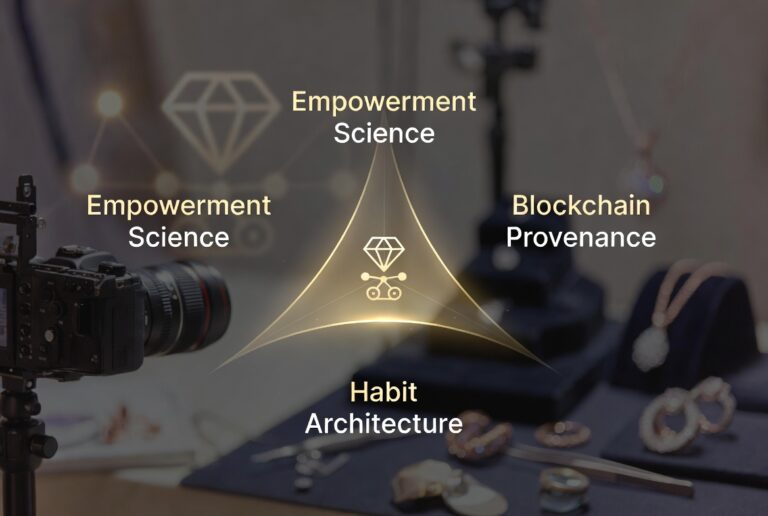
That is the escape plan. Not a single dramatic handover, but a series of documented, measured, small-win delegations across the three domains that most tightly bind the founder to the bench: voice, visibility, and measurement — scaffolded by a six-month roadmap that respects both the founder’s psychology and the industry’s specific risk profile. The systems from Posts 4, 5, and 6 provide the infrastructure. The empowerment science provides the mechanism. The founder’s willingness to shift identity — from “I make pieces” to “I design systems” — provides the catalyst.
The question is not whether your studio can run without you holding every thread. The meta-analyses are unambiguous: it will run better. The question is whether you are ready to let it.
Post 8, the final article in the series, will give you the five KPIs that confirm whether the delegation is working — not in theory, but in the specific, measurable terms that a jewellery studio owner needs to see before they believe the numbers.
References
Akerlof, G. A. (1970). The market for “lemons”: Quality uncertainty and the market mechanism. The Quarterly Journal of Economics, 84(3), 488–500. https://doi.org/10.2307/1879431
Barney, J. (1991). Firm resources and sustained competitive advantage. Journal of Management, 17(1), 99–120. https://doi.org/10.1177/014920639101700108
Christensen, C. M. (1997). The innovator’s dilemma: When new technologies cause great firms to fail. Harvard Business Review Press.
Cohen, W. M., & Levinthal, D. A. (1990). Absorptive capacity: A new perspective on learning and innovation. Administrative Science Quarterly, 35(1), 128–152. https://doi.org/10.2307/2393553
De Filippi, P., & Wright, A. (2018). Blockchain and the law: The rule of code. Harvard University Press.
Duhigg, C. (2012). The power of habit: Why we do what we do in life and business. Random House.
Edmondson, A. (1999). Psychological safety and learning behavior in work teams. Administrative Science Quarterly, 44(2), 350–383. https://doi.org/10.2307/2666999
Feldman, M. S., & Pentland, B. T. (2003). Reconceptualizing organizational routines as a source of flexibility and change. Administrative Science Quarterly, 48(1), 94–118. https://doi.org/10.2307/3556620
Gagné, M., Parker, S. K., Griffin, M. A., Dunlop, P. D., Knight, C., Klonek, F. E., & Parent-Rocheleau, X. (2022). Understanding and shaping the future of work with self-determination theory. Nature Reviews Psychology, 1, 378–392. https://doi.org/10.1038/s44159-022-00056-w
Gersick, C. J. G., & Hackman, J. R. (1990). Habitual routines in task-performing groups. Organizational Behavior and Human Decision Processes, 47(1), 65–97. https://doi.org/10.1016/0749-5978(90)90047-D
Green, M. C., & Brock, T. C. (2000). The role of transportation in the persuasiveness of public narratives. Journal of Personality and Social Psychology, 79(5), 701–721. https://doi.org/10.1037/0022-3514.79.5.701
Harter, J. K., Schmidt, F. L., & Hayes, T. L. (2002). Business-unit-level relationship between employee satisfaction, employee engagement, and business outcomes: A meta-analysis. Journal of Applied Psychology, 87(2), 268–279. https://doi.org/10.1037/0021-9010.87.2.268
Moore, G. A. (1991). Crossing the chasm: Marketing and selling high-tech products to mainstream customers. HarperBusiness.
Pasanen, M. (2003). In search of factors affecting SME performance: The case of Eastern Finland. Entrepreneurship & Regional Development, 15(2), 149–167.
Rogers, E. M. (1962). Diffusion of innovations. Free Press.
Ryan, R. M., & Deci, E. L. (2017). Self-determination theory: Basic psychological needs in motivation, development, and wellness. Guilford Press.
Sarasvathy, S. D. (2001). Causation and effectuation: Toward a theoretical shift from economic inevitability to entrepreneurial contingency. Academy of Management Review, 26(2), 243–263. https://doi.org/10.5465/amr.2001.4378020
Seibert, S. E., Wang, G., & Courtright, S. H. (2011). Antecedents and consequences of psychological and team empowerment in organizations: A meta-analytic review. Journal of Applied Psychology, 96(5), 981–1003. https://doi.org/10.1037/a0022676
Spence, M. (1973). Job market signaling. The Quarterly Journal of Economics, 87(3), 355–374. https://doi.org/10.2307/1882010
Spreitzer, G. M. (1995). Psychological empowerment in the workplace: Dimensions, measurement, and validation. Academy of Management Journal, 38(5), 1442–1465. https://doi.org/10.5465/256865
Stiglitz, J. E. (2001). Information and the change in the paradigm in economics. Nobel Prize Lecture.
Storey, D. J. (1994). Understanding the small business sector. Routledge.
Teece, D. J., Pisano, G., & Shuen, A. (1997). Dynamic capabilities and strategic management. Strategic Management Journal, 18(7), 509–533. https://doi.org/10.1002/(SICI)1097-0266(199708)18:7<509::AID-SMJ882>3.0.CO;2-Z
Weick, K. E. (1984). Small wins: Redefining the scale of social problems. American Psychologist, 39(1), 40–49. https://doi.org/10.1037/0003-066X.39.1.40
Werbach, K. (2018). The blockchain and the new architecture of trust. MIT Press.
Winter, S. G. (2013). Habit, deliberation, and action: Strengthening the microfoundations of routines and capabilities. Academy of Management Perspectives, 27(2), 120–137.
Wiseman, L. (2010). Multipliers: How the best leaders make everyone smarter. HarperBusiness.