
The Modern Jewellery Tech Stack: What Every Jewellery Retailer Needs to Compete in 2026
Most jewellery retailers don’t have a technology problem on the surface. They have a conversion infrastructure problem underneath everything else.
Their website looks fine. Their Instagram is active. Their WhatsApp is constantly buzzing. There may even be a Shopify or WooCommerce store running in the background.
Yet the actual business reality is often inconsistent:
- High-value leads disappear after initial enquiry
- Customers “think about it” and never return
- Staff rely on WhatsApp threads instead of structured pipelines
- Inventory decisions are reactive instead of data-driven
- Marketing generates interest, but not predictable revenue
In a category where a single transaction can be worth tens or hundreds of thousands, this gap is not small—it is structural.
The jewellery industry is still operating with a fragmented tech stack designed for low-consideration retail, not emotional, high-trust, high-ticket purchases.
2026 is effectively the tipping point where that model stops working.
Why Jewellery Retail Systems Are Breaking Down
Jewellery is one of the most complex retail categories to operate digitally because it sits at the intersection of:
- Emotional decision-making (engagements, milestones, gifts)
- High financial commitment
- Product variability (stones, settings, metals, certifications)
- Trust dependency (authenticity, provenance, valuation)
Yet most retailers still run systems designed for basic eCommerce.
The typical stack looks like this:
- Shopify or WooCommerce store (static catalogue)
- WhatsApp for enquiries and negotiation
- Manual quotation via PDF or email
- Spreadsheet-based inventory tracking
- Social media used as primary marketing channel
Individually, none of these tools are “wrong”. The problem is that they are not integrated into a single conversion system.
The result is predictable:
- Leads enter through one channel and die in another
- No visibility across the customer journey
- No structured follow-up logic
- No behavioural understanding of intent
In practice, most jewellery businesses are not losing customers at the point of sale—they are losing them in the gaps between systems.
The Core Issue: Jewellery Is Treated Like General eCommerce
Most retail platforms assume a simple model:
User visits → adds to cart → pays → receives product
But jewellery does not behave like that.
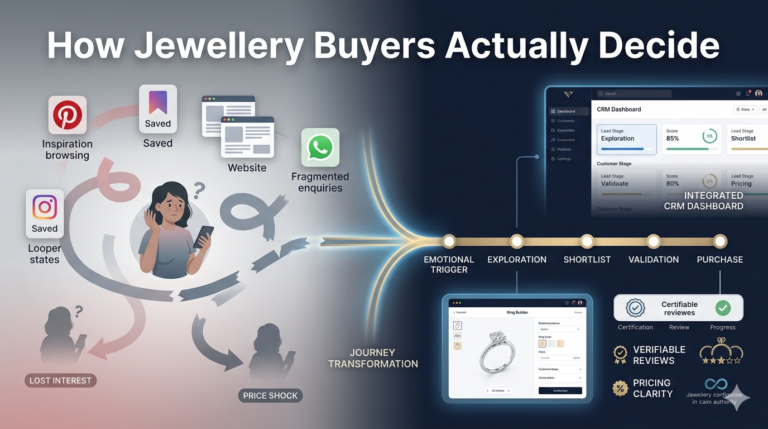
A typical jewellery buyer journey looks more like:
- Discovery (Instagram / Google / referral)
- Emotional resonance (saving designs, browsing styles)
- Private consideration (budget alignment, partner discussion)
- Direct enquiry (WhatsApp or email)
- Iterative refinement (stone size, setting, price)
- Appointment or consultation
- Final decision (often delayed multiple times)
This is not a checkout funnel. It is a guided decision system.
Most jewellery tech stacks fail because they only optimise step 1–2, and completely ignore 3–7.
The Modern Jewellery Tech Stack (2026 Framework)
A high-performing jewellery business in 2026 operates on a layered architecture, not a single platform.
Think of it as five interconnected systems:
1. Frontend Sales Layer (Experience Layer)
This is what the customer sees—but more importantly, how they interact.
A modern jewellery frontend is no longer a catalogue. It is a decision environment.
Key components:
- High-performance eCommerce platform (Shopify Plus / headless WooCommerce / custom builds)
- Mobile-first luxury UX (most jewellery browsing is mobile)
- Dynamic product pages with contextual storytelling
- Visual-first design (macro imagery, 360° views, lifestyle integration)
Critical upgrade: Product configurators
Instead of static product pages, retailers need:
- Ring builders (stone + setting + metal)
- Real-time pricing calculators
- Visual variation previews
This shifts the user from browsing to co-creation, which significantly increases conversion probability.
2. Conversion Layer (Where Revenue Is Actually Won or Lost)
This is the most neglected layer in the entire industry.
It includes everything that happens between “interest” and “purchase intent”.
Core systems:
- Quote automation engines (instead of manual PDFs)
- Appointment booking tied to product interest
- High-value abandoned enquiry recovery flows
- Conditional lead routing (budget-based segmentation)
Most jewellery businesses rely on WhatsApp as a pseudo-CRM.
This creates three problems:
- No tracking of intent over time
- No structured follow-up system
- No visibility into pipeline health
A proper conversion layer turns every enquiry into a tracked, time-sensitive opportunity, not a chat thread.
3. CRM + Sales Intelligence Layer
This is where most jewellery businesses are effectively blind.
A CRM in this context is not just a contact database. It is a behavioural intelligence system.
A modern setup includes:
- Full CRM integration (HubSpot, Zoho, or custom systems)
- Lead scoring based on behaviour:
- Number of visits
- Budget range interest
- Product categories viewed
- Engagement signals (saved items, return visits)
- WhatsApp integration with tagging and pipeline stages
The key shift here is from:
“Who is the customer?”
to
“What is this customer likely to do next?”
Without this layer, follow-ups are guesswork.
4. Inventory + Product Intelligence Layer
Jewellery inventory is not simple stock management—it is a dynamic valuation system.
Modern requirements include:
- Real-time inventory sync across platforms
- Diamond feed integration (carat, clarity, cut, certification)
- Dynamic pricing engines based on stone availability
- Certification verification systems (GIA / IGI integration)
This layer ensures that what the customer sees is not static—it is accurate, current, and financially coherent.
Without it, retailers risk:
- Overselling inventory
- Pricing inconsistencies
- Manual reconciliation overhead
5. Post-Sale Lifecycle Layer (The Hidden Revenue Engine)
Most jewellery businesses treat a sale as the end of the journey.
High-performing businesses treat it as the beginning of a lifecycle.
This layer includes:
- Anniversary and milestone automation (engagement dates, weddings)
- Upgrade pathways (stone upgrades, redesigns)
- Insurance and valuation reminders
- Customer lifetime value tracking (CLV segmentation)
This is where long-term profitability is built.
In jewellery, repeat purchase cycles are long—but extremely high value when activated correctly.
The Critical Gap: Why Most Jewellery Tech Stacks Fail
Across most retailers, the same structural problems appear:
1. Fragmentation
Every system operates independently. Nothing communicates.
2. Manual dependency
Staff act as the “integration layer” between tools.
3. No behavioural tracking
There is no understanding of intent progression.
4. No lifecycle design
Customers are not managed beyond the first sale.
5. WhatsApp overload
Communication is fast—but unstructured and unmeasurable.
The result is not inefficiency—it is invisible revenue leakage.
Business Impact of a Proper Jewellery Tech Stack
When implemented correctly, the transformation is not incremental—it is structural.
Typical outcomes:
- Higher conversion rates on high-value products (due to guided decision flows)
- Reduced lead loss (structured CRM + automation)
- Increased average order value (bundling + configurators)
- Better staff efficiency (less manual quoting)
- Predictable pipeline forecasting
Most importantly, the business shifts from reactive selling to system-driven revenue generation.
Strategic Reality: Jewellery Is Becoming a Systems Business
The industry is quietly moving from:
“who has the best designs”
to
“who has the best conversion infrastructure”
Design still matters. Brand still matters. Trust still matters.
But none of those matter if:
- leads are not tracked
- intent is not understood
- follow-up is inconsistent
- pricing logic is fragmented
In 2026, the competitive advantage is no longer just aesthetic—it is architectural.
Conclusion
Most jewellery retailers do not need more marketing.
They do not need more social media content or more traffic campaigns.
They need a connected system that converts existing intent into structured revenue.
The modern jewellery tech stack is not a luxury upgrade. It is becoming the baseline requirement for survival in high-ticket retail.
The businesses that win over the next cycle will not be the ones with the most beautiful stores.
They will be the ones with:
- the most intelligent systems
- the most integrated customer journeys
- and the most predictable conversion infrastructure
Everything else is secondary.