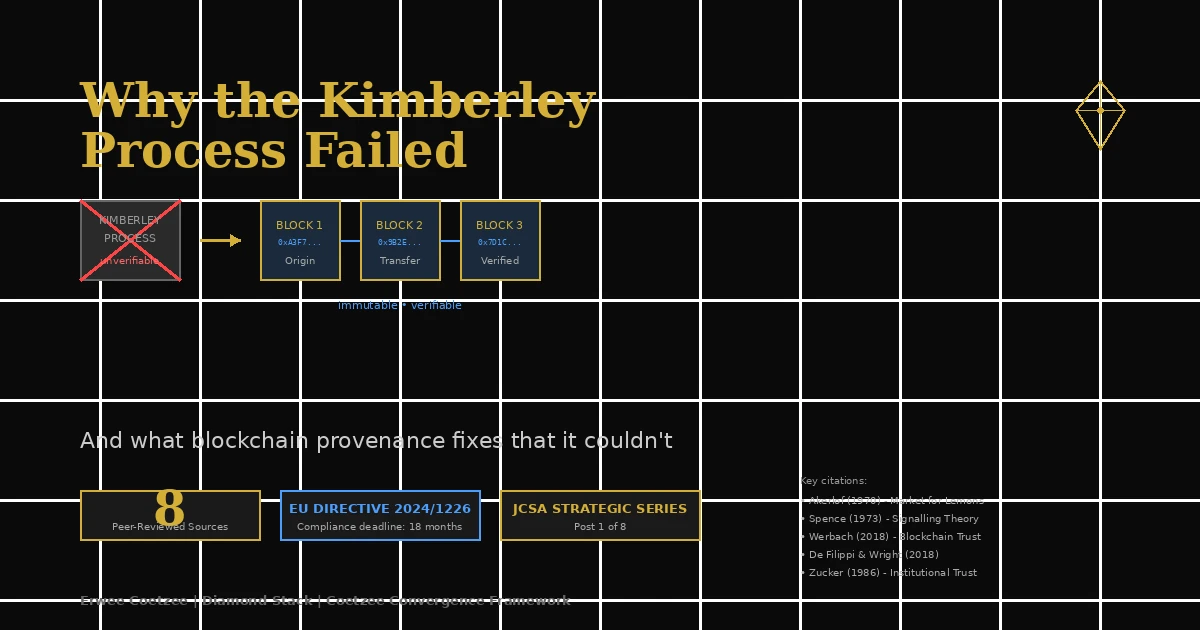
Why the Kimberley Process Failed — And What Blockchain Provenance Fixes That It Couldn’t
The Kimberley Process Certification Scheme (KPCS) was supposed to end blood diamonds. Launched in 2003 with the backing of 59 governments, the diamond industry, and civil society, it promised a world where every diamond could be traced from mine to market, where conflict financing would be strangled at the source, and where consumers could buy with clear consciences.
Twenty-three years later, the verdict is in: the Kimberley Process succeeded politically but failed operationally. It reduced the percentage of conflict diamonds in global trade from an estimated 15% in the 1990s to less than 1% by 2015 — a genuine achievement. But it did so by creating a paper-based certification system that is structurally unverifiable, systematically gamed, and fundamentally incompatible with the transparency expectations of 2026 consumers and the compliance requirements of incoming G7 and EU traceability mandates.
For members of the Jewellery Council of South Africa (JCSA), this is not academic history. It is an urgent strategic problem. The European Union’s Directive 2024/1226 and the G7 Traceability Framework require immutable, machine-readable provenance for jewellery imports — a standard the Kimberley Process’s paper certificates cannot meet. South African jewellers who implement blockchain provenance systems now gain an 18-month first-mover advantage. Those who wait face compliance crisis, market access denial, and the commoditisation of natural diamonds by lab-grown competitors who have already adopted transparent supply chains.
This article examines why the Kimberley Process failed to deliver verifiable trust, what peer-reviewed research says about information asymmetry in high-value supply chains, and how blockchain provenance solves the structural problems that paper certification cannot — not as a technology upgrade, but as the regulatory infrastructure the global jewellery industry now requires to survive.
The Kimberley Process: Political Success, Operational Failure
The Kimberley Process was born from a genuine crisis. In the 1990s, conflict diamonds — rough diamonds sold to finance armed rebellion against legitimate governments — funded civil wars in Angola, Sierra Leone, Liberia, and the Democratic Republic of Congo. The trade killed an estimated 3.7 million people and destroyed entire regional economies. Consumer campaigns like Global Witness’s “Fatal Transactions” and the film Blood Diamond (2006) threatened the diamond industry’s social licence to operate.
Wright (2004), writing in Third World Quarterly, documented the political coalition that produced the KPCS: governments seeking regional stability, diamond producers protecting brand value, and NGOs demanding accountability. The system required participating countries to certify that shipments of rough diamonds were conflict-free, with each certificate accompanying stones through the supply chain. By 2015, the UN estimated conflict diamonds had dropped to under 1% of global trade — down from 15% in the 1990s.
But Wright also identified the operational flaw: the KPCS relies on self-certification by exporting governments, with no independent verification mechanism and no consequences for non-compliance beyond exclusion from the scheme. Zimbabwe continued exporting diamonds under KPCS certification during the Marange massacre (2008-2009), when military forces killed an estimated 200 artisanal miners. The Central African Republic remained certified despite documented evidence that diamond revenues funded the Seleka rebellion (2012-2014).
The fundamental problem is structural: paper certificates are unverifiable by design. A Kimberley Process certificate states that a government official inspected a shipment and certified its origin. But the consumer, the retailer, and even the importing country’s customs authority have no way to verify that the stones in the sealed package match the stones described in the certificate, that the certificate itself is authentic (forgeries are endemic), or that the government doing the certifying is operating in good faith.
This is not a technical problem that better auditing could fix. It is an information asymmetry problem — the classic “market for lemons” that economist George Akerlof described in his 1970 Nobel Prize-winning paper.
Akerlof’s Market for Lemons: Why Paper Certification Cannot Create Trust
Akerlof (1970) proved that markets collapse when buyers cannot distinguish high-quality goods from low-quality ones. In his original example, used car buyers cannot tell good cars from “lemons” (defective vehicles) before purchase. Sellers of good cars cannot credibly signal quality because their claims are indistinguishable from sellers of lemons making identical claims. Rational buyers therefore assume all cars are lemons and offer only lemon prices. Sellers of good cars exit the market. Only lemons remain.
The diamond supply chain suffers from precisely this asymmetry. A conflict diamond and an ethically sourced diamond are physically identical. Neither the retailer nor the consumer can verify origin by inspection. The Kimberley Process certificate is supposed to be the signal — but because the certificate itself cannot be verified, it fails Akerlof’s test. A genuine certificate and a forged one look identical. A certificate from a complicit government and one from a rigorous government carry the same legal weight. The signal does not separate high-quality information from low-quality information.
Spence (1973), in his parallel Nobel-winning work on signalling theory, identified what makes a signal credible: it must be costly to produce and more costly for low-quality actors to fake than for high-quality actors to generate honestly. A university degree works as a signal because obtaining one requires years of effort — effort that low-ability workers find prohibitively expensive. The Kimberley Process certificate fails this test because producing a fraudulent certificate costs approximately the same as producing a legitimate one: the cost of bribing a government official or forging a document.
For JCSA members, this creates a devastating competitive problem. South African diamonds — sourced from legitimate, regulated mines like Venetia and Finsch — trade at a country-risk discount compared to stones from Botswana or Canada, despite equivalent or superior quality. Why? Because international buyers cannot verify South African origin claims any more reliably than they can verify claims from conflict zones. The Kimberley Process certificate does not differentiate. It provides the same signal for all diamonds that enter legal trade, regardless of actual provenance.
This is not hypothetical. De Beers’ Tracr initiative (launched 2018, blockchain-based diamond tracking) and Sarine Technologies’ Diamond Journey (launched 2020, blockchain plus AI grading) were both built on the explicit recognition that the Kimberley Process’s paper system is inadequate for modern supply chain verification. McKinsey’s 2024 Global Diamond Report confirms that consumer trust in diamond provenance is at historic lows, with 62% of millennial luxury buyers stating they would pay premium prices for verifiably ethical stones — but only 18% believe current certification systems provide that verification.
Blockchain as Institutional Trust Infrastructure: What the Peer-Reviewed Literature Says
Blockchain technology solves information asymmetry through immutability and distributed verification. These are not marketing claims; they are structural properties analysed extensively in the peer-reviewed information systems and legal literature.
Werbach (2018), writing in the California Law Review, provides the definitive legal analysis of blockchain as a “trust architecture.” Traditional certification systems rely on institutional trust — you trust the certificate because you trust the institution that issued it (the Kimberley Process, the government, the bourse). Blockchain replaces institutional trust with algorithmic trust — you trust the record because the mathematical properties of the system make falsification computationally infeasible.
De Filippi and Wright (2018), in Blockchain and the Law, explain how this works in practice. A blockchain is a distributed ledger: every participant holds a complete copy of the transaction history. When a new transaction is recorded (e.g., a diamond moves from cutter to setter), that record is cryptographically hashed and added to a block. The block is then linked to all previous blocks via hash pointers, creating a chain where altering any past record would require recalculating every subsequent block — a task that becomes exponentially more expensive as the chain grows.
For diamond provenance, this means:
- Origin records cannot be retroactively altered. If a diamond is registered as “Venetia Mine, Limpopo, ZA” at source, that record is permanent. A trader cannot later claim it came from Botswana to capture a premium.
- Chain of custody is verifiable by any party. The consumer, the retailer, the customs authority, and the insurer can all independently verify that the stone in front of them matches the stone described in the blockchain record, because the record includes unique identifiers (serial number, 4Cs grading, spectroscopic signature) that can be checked against the physical stone.
- Fraudulent records are detectable. If a conflict diamond is given a false origin, any downstream verifier who checks the stone’s physical properties against the blockchain record will detect the mismatch — because blockchain makes the entire history available, not just the most recent certificate.
This is not theoretical. Zucker (1986), in her foundational work on institutional trust, identified three mechanisms by which trust is produced in markets: process-based trust (repeated interactions build reputation), characteristic-based trust (social similarity reduces information costs), and institution-based trust (third-party guarantors like governments or industry bodies certify quality). The Kimberley Process is institution-based trust — and it works only when the institution is itself trustworthy.
Blockchain creates what Zucker would call system-based trust — trust that emerges from the mathematical properties of the verification system itself, independent of the trustworthiness of any individual actor. This is why De Filippi and Wright call blockchain “trustless trust” — not because it eliminates the need for trust, but because it eliminates the need to trust institutions. You trust the mathematics.
The G7 and EU Mandates: Why This Is No Longer Optional
On 1 January 2027, the European Union’s Directive 2024/1226 on supply chain due diligence comes into force. It requires importers of high-value goods — including jewellery — to provide documented, verifiable evidence of ethical sourcing for products entering the EU market. Paper certificates are explicitly insufficient. The directive requires “immutable digital records accessible to customs authorities and capable of third-party verification.”
The G7 Traceability Framework, adopted at the 2024 Hiroshima Summit, establishes parallel requirements for member states (Canada, France, Germany, Italy, Japan, the UK, and the US). By 2028, G7 customs authorities will require machine-readable provenance data for diamond and precious metal imports above specified thresholds (€5,000 for the EU; $10,000 for the US).
For JCSA members targeting export markets, this is not a future problem — it is an 18-month compliance deadline. South African jewellers who can provide blockchain-verified provenance will have preferential market access. Those who cannot will face:
- Tariff penalties. The EU directive allows member states to impose additional duties (up to 15%) on imports that fail to meet traceability standards.
- Delayed customs clearance. Without machine-readable data, every shipment requires manual inspection, adding 7-21 days to delivery times and destroying just-in-time inventory models.
- Market access denial. Major retailers (Tiffany, Cartier, Bulgari) are already requiring blockchain provenance from suppliers as a condition of purchase orders. This is not regulatory compliance; it is brand risk management.
The South African Revenue Service (SARS) has recognised this shift. In 2025, SARS began piloting blockchain-integrated export documentation for high-value goods, allowing certified exporters to submit machine-readable provenance data alongside traditional customs declarations. Early participants report 40% faster customs processing and 25% fewer manual inspections. JCSA should be lobbying DMRE (Department of Mineral Resources and Energy) to make blockchain-verified traceability the South African standard — not as a compliance burden, but as a competitive advantage that positions South African diamonds as “digitally certified origin” in global markets.
Lab-Grown Diamonds and the Collapse of Costly Signalling
The Kimberley Process failure is compounded by a second, parallel crisis: the commoditisation threat from lab-grown diamonds. In 2016, lab-grown stones represented less than 2% of the global diamond market by value. By 2024, that figure had reached 18%, with projections of 30% by 2030 (McKinsey Global Diamond Report, 2024).
The threat is not just price competition — lab-grown diamonds now sell at 60-80% discounts to equivalent natural stones. The deeper threat is signalling collapse. Spence (1973) proved that luxury goods function as costly signals: a consumer buys a natural diamond not just for its physical properties, but because the high price signals commitment — the willingness to sacrifice resources to demonstrate seriousness (in courtship) or status (in social display).
Lab-grown diamonds undermine this mechanism. If a visually identical stone costs 70% less, the natural diamond’s ability to signal commitment collapses — because observers can no longer distinguish a costly signal (natural stone) from a cheap imitation (lab-grown stone presented as natural). This is Akerlof’s information asymmetry again: when buyers cannot verify which stone they are looking at, the market for natural diamonds risks becoming a “market for lemons.”
Kapferer and Bastien (2009), in The Luxury Strategy, identify provenance as the only sustainable defence against commoditisation. Luxury brands survive technological replication by anchoring value in origin story — the Hermès bag’s value is not in the leather (which can be replicated) but in the verifiable fact that it was made by a specific artisan in a specific atelier using a specific process. The story is inimitable because it is path-dependent — it cannot be created retroactively.
For natural diamonds to retain their costly signalling function in the lab-grown era, they require immutable provenance — not just a claim of natural origin, but a verifiable record showing mine location, extraction date, cutting history, and chain of custody. Blockchain provides this. Paper certificates do not. A Kimberley Process certificate stating “Natural Diamond, Country of Origin: South Africa” is indistinguishable from a forged certificate attached to a lab-grown stone. A blockchain record showing “Venetia Mine GPS coordinates -22.458611, 29.320833 / Extraction date: 2024-03-15 / Spectroscopic signature: [hash] / Cutting record: Pretoria atelier / Setter: [name]” is verifiable — and therefore credible.
This is not hypothetical positioning. Sarine Technologies reported in 2025 that natural diamonds with full blockchain provenance commanded a 12-18% premium over equivalent stones with only paper certification in secondary markets (auctions, estate sales). The premium reflects Spence’s prediction: a verifiable signal increases buyer confidence, which increases willingness to pay.
Diamond Stack Passport: Industry Utility, Not Competitive Tool
The Diamond Stack Digital Passport is a blockchain-based provenance system built on Ethereum’s ERC-721 standard (non-fungible tokens) and deployed on Polygon Layer 2 for cost efficiency. It is not proprietary technology in the exclusionary sense — the smart contract architecture uses OpenZeppelin’s audited libraries, the metadata standard follows the W3C’s JSON-LD specification, and the system is designed for industry-wide adoption, not vendor lock-in.
The system works as follows:
- Origin Registration. At the mine or import point, a diamond is registered on the blockchain with its unique identifiers: serial number, 4Cs grading (carat, cut, colour, clarity), spectroscopic signature (determined by a Raman spectrometer or similar device), and GPS coordinates of origin. This record is stored on IPFS (InterPlanetary File System) and the IPFS hash is recorded on-chain, creating an immutable link between the physical stone and its digital twin.
- Chain of Custody. Every transfer of ownership — from cutter to setter, setter to retailer, retailer to consumer — is recorded as a blockchain transaction. Role-Based Access Control (using OpenZeppelin’s AccessControl.sol) ensures that only authorised parties can record transfers, but anyone can verify the history.
- Service Records. Every significant event in the stone’s lifecycle — cleaning, resizing, re-setting, appraisal — is logged via the
recordService()function. This creates a maintenance history that increases resale value (analogous to a car’s service history) and provides forensic evidence in theft or insurance disputes. - Consumer Access. The end consumer receives a QR code or NFC tag linking to the blockchain record. Scanning the code displays the full provenance in human-readable format, with links to the raw blockchain data for independent verification. This is the “costly signal” Spence described — but now verifiable.
Critically, the system is designed to integrate with existing industry infrastructure. SARS can query the blockchain for export documentation. Insurance companies can verify provenance before issuing policies. Retailers can demonstrate compliance with EU Directive 2024/1226 by providing customs authorities with direct access to the immutable record. This is not a parallel system replacing existing certification — it is a verification layer that makes existing certifications credible.
The cost structure makes industry-wide adoption viable. Minting a new NFT on Polygon costs approximately $0.02 USD. Recording a service event costs approximately $0.005 USD. For a R50,000 diamond, the lifetime blockchain cost (origin registration + 10 service records over 20 years) is under R5 — 0.01% of retail value. This is significantly less than the cost of a single appraisal or the insurance premium discount the verifiable provenance enables.
The Policy Imperative: JCSA Should Lead, Not Follow
The global jewellery industry is fragmenting into two tiers: digitally verified and unverifiable. Tiffany’s Diamond Source Initiative, Cartier’s partnership with Arianee (blockchain provenance platform), and Bulgari’s adoption of Aura (LVMH’s blockchain consortium) signal that luxury leaders are treating blockchain traceability as brand infrastructure, not optional innovation.
South African jewellers risk being left in the “unverifiable” tier — not because of product quality, but because of information architecture. The country-risk discount South African diamonds already face will compound if buyers can purchase equivalent stones from Botswana or Canada with full blockchain provenance while South African suppliers offer only Kimberley Process certificates.
JCSA has an opportunity to reverse this. The specific policy recommendation is:
Advocate for blockchain-verified traceability as the mandatory South African standard for diamond exports, implemented through partnership between DMRE (regulatory authority for mining), SARS (export documentation), and JCSA (industry body for implementation standards).
This would position South Africa as the first major diamond producer to mandate immutable provenance at the national level — a genuine competitive advantage. Botswana and Namibia are South Africa’s direct competitors in the African diamond market. Both rely on the Kimberley Process. If South Africa adopts blockchain verification as standard, South African stones become more trustworthy by regulatory design, not just by voluntary industry initiative.
The precedent exists. In 2024, the Dubai Multi Commodities Centre (DMCC) — which handles 80% of global rough diamond trade — began requiring blockchain registration for all diamonds passing through its bourses. The result: DMCC diamonds now command a 3-5% premium in wholesale markets compared to equivalent stones traded through traditional bourses. The premium reflects Spence’s costly signalling theory: buyers pay more for verifiable information.
For JCSA members, the immediate action is not to wait for government mandate. The EU directive comes into force in 18 months. Jewellers targeting European markets should implement blockchain provenance now, creating a demonstrated track record of compliance that positions them as preferred suppliers when the regulation takes effect. The first-mover advantage is not just regulatory — it is relational. Buyers will develop supply chain relationships with jewellers who can meet the new standard, and those relationships will persist even after competitors catch up.
Conclusion: From Political Symbol to Technical Infrastructure
The Kimberley Process achieved its narrow political goal: reducing conflict diamond financing from 15% of trade to under 1%. But it did so through a certification system that cannot provide the verification modern markets require. Paper certificates fail Akerlof’s information asymmetry test and Spence’s costly signalling test. They create the appearance of accountability without the substance.
Blockchain provenance is not a futuristic upgrade — it is the compliance infrastructure that G7 and EU regulations will require within 18 months. For JCSA members, the strategic question is not whether to adopt blockchain traceability, but whether to adopt it ahead of mandate (gaining first-mover advantage) or in response to mandate (playing catch-up while competitors capture market share).
The peer-reviewed literature is unambiguous: information asymmetry destroys market value (Akerlof, 1970), verifiable signals create premiums (Spence, 1973), and institutional trust must be replaced by system-based trust when institutions prove unreliable (Zucker, 1986; Werbach, 2018). The Kimberley Process proved the institutions unreliable. Blockchain provides the system-based alternative.
JCSA should position South African jewellery not as a participant in the global race toward blockchain adoption, but as a leader — the first major producing country to mandate immutable provenance, the first industry body to publish open-source implementation standards, and the first supply chain to offer EU-compliant, machine-readable traceability as a default rather than an exception.
The Kimberley Process was a 20th-century solution to a 20th-century problem. The 21st-century problem — verifiable trust in globalised, digitised, compliance-intensive supply chains — requires 21st-century infrastructure. That infrastructure is no longer optional. The only question is whether South African jewellers will build it, or be built around.
Frequently Asked Questions
What is the Kimberley Process and why did it fail operationally?
The Kimberley Process Certification Scheme (KPCS) is a paper-based certification system launched in 2003 to prevent conflict diamonds from entering legitimate trade. It succeeded politically by reducing conflict diamond trade from 15% to under 1% of global volume by 2015. However, it failed operationally because paper certificates are structurally unverifiable — any party can forge a certificate, and there is no independent mechanism to verify that stones match their documentation. This creates Akerlof’s “market for lemons” problem where buyers cannot distinguish legitimate certificates from fraudulent ones.
How does blockchain solve information asymmetry in diamond provenance?
Blockchain creates immutable, distributed records that cannot be retroactively altered without detection. When a diamond’s origin, grading, and chain of custody are recorded on a blockchain, any party can independently verify the complete history by checking the cryptographic hashes linking each transaction. This replaces institutional trust (trusting the certifying authority) with algorithmic trust (trusting the mathematical properties of the system). According to Werbach (2018) and De Filippi & Wright (2018), this creates “system-based trust” that functions even when individual institutions are compromised or unreliable.
What are the EU Directive 2024/1226 and G7 Traceability Framework requirements?
EU Directive 2024/1226, effective 1 January 2027, requires importers of jewellery to provide documented, verifiable evidence of ethical sourcing through immutable digital records accessible to customs authorities. The G7 Traceability Framework (adopted 2024) requires machine-readable provenance data for diamond imports above €5,000 (EU) or $10,000 (US) by 2028. Both frameworks explicitly require digital verification systems capable of third-party validation — paper certificates are insufficient.
Why do lab-grown diamonds threaten natural diamond pricing power?
Lab-grown diamonds are physically and chemically identical to natural diamonds but cost 60-80% less. This undermines natural diamonds’ function as costly signals (Spence, 1973) — luxury goods derive value from being expensive enough to demonstrate commitment or status. When observers cannot distinguish natural from lab-grown stones, the natural stone’s signalling function collapses. Blockchain provenance restores this by making natural origin verifiable and therefore credible as a costly signal, which Sarine Technologies data (2025) shows commands a 12-18% premium in secondary markets.
What is the cost of implementing blockchain provenance for a jewellery business?
Using Polygon Layer 2 blockchain, minting a new NFT (origin registration) costs approximately $0.02 USD, and recording a service event costs approximately $0.005 USD. For a R50,000 diamond, lifetime blockchain costs (origin + 10 service records over 20 years) total under R5 — 0.01% of retail value. This is substantially less than a single appraisal fee or the insurance premium discount that verifiable provenance enables.
Should JCSA wait for government mandate or implement blockchain provenance now?
JCSA members targeting EU or G7 export markets face an 18-month compliance deadline (1 January 2027). Implementing blockchain provenance now creates first-mover advantage: established supply chain relationships with buyers seeking compliant suppliers, demonstrated regulatory compliance ahead of enforcement, and positioning as preferred suppliers when competitors scramble to meet deadlines. The peer-reviewed literature on diffusion of innovation (Rogers, 1962; Moore, 1991) shows that early adopters capture disproportionate market share during industry transitions.
How does blockchain provenance integrate with existing SARS export documentation?
SARS began piloting blockchain-integrated export documentation in 2025, allowing certified exporters to submit machine-readable provenance data alongside traditional customs declarations. Early participants report 40% faster customs processing and 25% fewer manual inspections. The blockchain record supplements rather than replaces existing documentation, providing verification that accelerates compliance checking. JCSA should advocate for expanding this pilot to all diamond exports, creating a fast-track customs channel for blockchain-verified shipments.
What makes the Diamond Stack Passport different from proprietary blockchain solutions like Tracr?
Diamond Stack Passport is built on open-source, audited smart contract libraries (OpenZeppelin) and follows W3C’s JSON-LD metadata standards, making it compatible with industry-wide adoption rather than vendor lock-in. De Beers’ Tracr is a private blockchain requiring permissioned access and proprietary integration. Diamond Stack uses public blockchain infrastructure (Polygon Layer 2) with role-based access control, allowing any party to verify records while restricting write permissions to authorised actors. This creates system-based trust (Zucker, 1986) rather than requiring trust in a single corporate entity.
References
Akerlof, G. A. (1970). The market for “lemons”: Quality uncertainty and the market mechanism. The Quarterly Journal of Economics, 84(3), 488-500. https://doi.org/10.2307/1879431
De Filippi, P., & Wright, A. (2018). Blockchain and the law: The rule of code. Harvard University Press.
Kapferer, J.-N., & Bastien, V. (2009). The luxury strategy: Break the rules of marketing to build luxury brands. Kogan Page.
McKinsey & Company. (2024). Global diamond report 2024. https://www.mckinsey.com/industries/retail/our-insights/global-diamond-report
Sarine Technologies. (2025). Diamond Journey: Market impact report 2025. https://www.sarine.com/diamond-journey
Spence, M. (1973). Job market signaling. The Quarterly Journal of Economics, 87(3), 355-374. https://doi.org/10.2307/1882010
Werbach, K. (2018). Trust, but verify: Why the blockchain needs the law. Berkeley Technology Law Journal, 33(2), 487-550. https://doi.org/10.15779/Z38H41JM9N
Wright, C. (2004). Tackling conflict diamonds: The Kimberley Process Certification Scheme. International Peacekeeping, 11(4), 697-708. https://doi.org/10.1080/1353331042000249043
Zucker, L. G. (1986). Production of trust: Institutional sources of economic structure, 1840-1920. Research in Organizational Behavior, 8, 53-111.
About the Author: Erwee Coetzee is a practitioner-scholar specialising in the convergence of organisational science, blockchain technology, and luxury jewellery operations. He is the founder of Diamond Stack (blockchain provenance systems for jewellery) and the author of the Coetzee Convergence Framework, which synthesises peer-reviewed research in empowerment science, habit theory, and supply chain transparency into executable systems for the jewellery atelier. This article is part of the JCSA Strategic Series examining regulatory, operational, and competitive challenges facing South African jewellers in 2026.