The Wrong Map Will Get You Lost: A Practitioner’s Framework for Choosing the Right Digital Architecture for Your Jewellery Business
Author: Erwee Coetzee | Diamond Stack / SEO Gurus Series: Jewellery Digital Strategy Reading Time: ~22 minutes Published: March 2026
I want to tell you about two jewellery stores. Both in South Africa. Both are doing reasonable business. Both approached me in the same six-month window with what appeared, on the surface, to be the same problem.
The first was a bespoke jewellery studio in Cape Town — husband and wife, twenty-three years in the trade, a bench goldsmith whose hands had touched more engagement ring moments than any other craftsperson in their suburb. Their problem, as they described it: “We’re not showing up on Google.” They had hired an SEO agency eight months prior. The agency had built them a blog. It had written articles about “how to choose an engagement ring” and “top jewellery trends in South Africa.” It had built some backlinks. None of it had moved anything meaningful.
The second was a diamond retailer in Johannesburg — a WooCommerce store with a live Nivoda feed running approximately 40,000 loose stones. Their problem, as they described it: the same. “We’re not showing up on Google.” They, too, had hired an agency. The agency had recommended they blog more, improve their About page, and work on their Google Business Profile. The blog was producing content. The GBP had been updated. Nothing had moved.
Same symptom. Entirely different diseases. And both agencies had applied the same treatment to both patients without first establishing which disease they were dealing with.
This is the single most expensive mistake I see made in jewellery digital marketing. Not technical errors. Not bad content. Not even bad backlinks. It is the application of a generic digital architecture to a market that requires a specific one — and the failure to first ask the question that makes the right architecture obvious.
That question is not “what keywords should we target?” It is not “how much content should we produce?” It is this: what is your buyer doing when they search for you?
I have been working in technical SEO since 2012. Fourteen years. Long enough to have watched the industry change completely three or four times over and to have developed a persistent scepticism of anyone who tells you there is a universal framework that works for every business in every market.
There is not. There never was. And the jewellery industry is the vertical where this truth is most consequential — because the stakes of getting it wrong are not a few months of mediocre traffic. There are hundreds of thousands of rands in lost commissions, years of misdirected investment, and a competitive position that erodes while you do all the right things in the wrong order.
What I have developed over those fourteen years — and what I want to share with you here — is a set of frameworks that emerged from the specific, recurring failure modes I kept encountering. Not from academic theory, though the academic theory eventually helped me articulate what I was observing. From watching businesses spend money on digital architecture that was never going to work for them, because the architecture was designed for a different kind of buyer than the one they actually needed to attract.
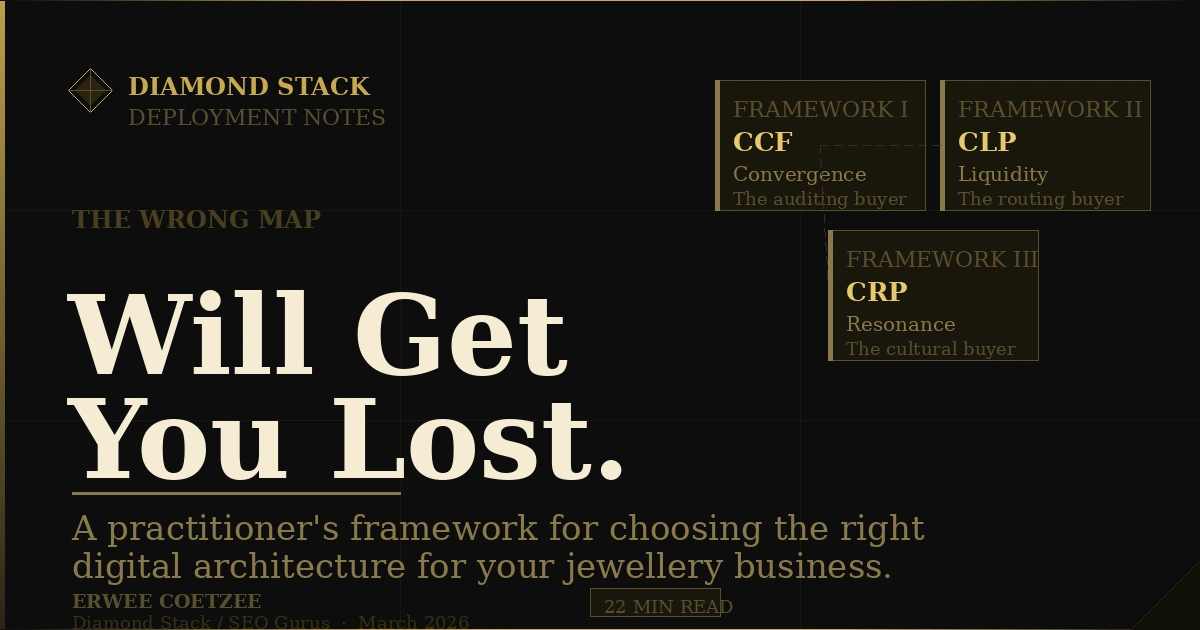
The frameworks have formal names now — the Coetzee Convergence Framework, the Coetzee Liquidity Protocol, and the Coetzee Resonance Protocol, published under Creative Commons on SEO Gurus for anyone who wants the full methodology documentation. But in this article, I am less interested in the formal mechanics and more interested in the underlying logic. Because once you understand the logic, the right framework for your business becomes obvious. And once you apply the right framework, the kind of progress that has been eluding you tends to start happening with surprising speed.
Let me return to those two jewellery stores, because they are the cleanest illustration I have for what I want to explain.
When I sat with the bespoke studio couple, the first thing I asked them was: “Tell me about the last five clients who commissioned a piece from you. How did each of them find you?”
They thought about it. One came from a referral. One had found them on Instagram and then spent three months quietly following their work before making contact. One had Googled “bespoke engagement ring Cape Town” and visited them in person twice before sending an enquiry email. One had found an old press feature in a local magazine, Googled the studio name to verify they were still operating, checked their reviews, looked at their About page, and then called. One had been a past client returning for an anniversary piece.
Not one of these buyers had read a trend article. Not one had clicked through from a “how to choose an engagement ring” blog post. Every single one had conducted what I can only describe as an investigation. They were not browsing. They were auditing. They were trying to answer a single, high-stakes question: Can I trust these people with one of the most important purchases I will make in my life?
And the agency had been writing trend content. For auditors.
The second store — the diamond retailer — was a different matter entirely. Their buyer was not conducting an investigation. Their buyer was executing a specification query. By the time someone lands on a product page for a 1.21ct G VS1 excellent cut round diamond with IGI certification, they already know what they want. They have completed their education. They have decided on the 4Cs, the certification body, and the budget. They are routing — matching their specification to available inventory — and the store that returns the most complete, accurate, and machine-readable match to their specification wins the transaction.
Their agency had told them to write more blog content and update their About page. For routers.
The diagnostic failure in both cases was the same: the agency never asked what the buyer was doing. They applied a generic content strategy to a market-specific conversion problem and wondered why it was not working.
Here is the distinction I want you to carry through the rest of this article, because everything else flows from it.
Some buyers audit. Some buyers route. And some — in a category that does not fit cleanly into either — evaluate culture over a long relationship arc.
Auditing behaviour is what the bespoke studio’s buyers were doing. High-stakes purchase, information asymmetry between buyer and seller, a decision cycle measured in weeks rather than minutes. These buyers are not persuaded by a well-optimised product page. They are satisfied — or not — by the completeness and consistency of the evidence they find when they investigate you. Does your structured data tell Google who you are with sufficient confidence? Do your credentials appear in machine-readable form, or are they locked in a framed certificate on your studio wall? Does your About page describe a business that has been around long enough to be trusted? Do your reviews say what matters — not just “excellent service” but the specific things that answer the specific anxieties of a buyer spending R75,000 on a ring they cannot touch until after they have paid?
Routing behaviour is what the diamond retailer’s buyers were doing. They are not auditing the entity behind the product. They already know what they want. They are executing a structured query against available inventory, and increasingly in 2026, they are delegating that query execution to an AI layer that resolves it before the human even sees a results page. The questions this buyer needs answered are: Does this stone exist in the exact specification I need? Is the attribute data complete enough for me to be certain? Is it in stock? Can it be delivered in time?
Cultural auditing is a third mode that I encounter with a specific type of jewellery business — usually artisan studios or bespoke jewellers who are trying to move into B2B territory: corporate gifting contracts, commission work from interior design studios, jewellery for architectural or installation projects. The buyer here is a procurement officer or a creative director who has passed the basic entity audit (yes, you are credible, yes, you exist) and has moved into a deeper evaluation. They are asking: are the values of this studio compatible with our organisation? Will the craftsperson we are going to be in a three-month co-creation relationship with understand our brand, share our aesthetic principles, and operate with the professionalism we require?
This mode of evaluation cannot be addressed with credentials alone, and it cannot be addressed with attribute completeness. It requires a digital identity that is culturally coherent — where every public signal, from the website’s vocabulary to the craftsperson’s LinkedIn to the press coverage they have attracted, expresses a consistent and genuine identity that a sophisticated B2B buyer can audit for alignment.
Three buyer behaviours. Three architectures. And the crucial point: applying the architecture designed for one behaviour type to a buyer operating in a different mode produces not neutral results but actively negative ones. The bespoke studio’s trend blog was not just unhelpful — it was damaging their positioning by associating them, in Google’s entity understanding, with content categories that signal “general informational jewellery site” rather than “specialist trusted commission studio.” The diamond retailer’s improved About page was a wasted resource because the routing buyer is not evaluating the About page — they are evaluating the product data completeness.
I want to be specific about what the correct architecture looks like for each buyer type, because specificity is what separates a useful framework from a consultant’s jargon.
For the auditing buyer — the bespoke studio, the luxury jeweller, the estate jeweller with 40 years of reputation and a thin digital presence — the architecture that works is what I have formalised as the Coetzee Convergence Framework.
The CCF is grounded in Signalling Theory — the economic principle, developed by Michael Spence in the 1970s, that in markets with high information asymmetry, buyers rely on signals that are structurally costly or difficult to fake. A GIA Graduate Gemologist qualification is a costly signal — it requires significant time and investment to obtain, it is independently verified, and it cannot be invented. A trade association membership is a costly signal. Forty years of business history is a costly signal. These are precisely the signals that auditing buyers are looking for, and they are precisely the signals that most jewellery websites fail to make machine-readable.
The framework has four operational pillars, but the one I want to emphasise here — because it is the most distinctive and the most counterintuitive — is what I call Ruggedised SEO. Most SEO practitioners think about building signals. Ruggedised SEO is the discipline of eliminating contradictions in the signals you already have.
The Prins & Prins case illustrates this better than any explanation I can offer. Prins & Prins is a Cape Town luxury jeweller with approximately 40 years of trading history. Before we intervened, they had decent domain age, positive review sentiment, and a physical premises with a genuinely established reputation. What they also had — and what was suppressing their visibility despite all the positive signals — were two conflicting JSON-LD declarations on their site, an inconsistent business name format across several citation sources, and an aggregateRating being pulled from two different sources simultaneously. Google’s entity resolution system could not confidently assign a single Knowledge Graph identity to the entity because the signals were contradicting each other. The positive signals existed, but the noise-to-signal ratio was too high for the algorithm to resolve with confidence.
We fixed the contradictions. We consolidated the entity signals. We added structured credential markup for their gemological qualifications and trade association memberships. We implemented the FAQPage schema, addressing the three anxiety vectors that high-value jewellery buyers actually carry into the purchase decision: certificate authenticity, the bespoke commission process, and after-sales service. We did not write a single new blog article.
The Semrush Visibility Index for their primary 14-query engagement ring cluster in South Africa moved from 12.4% to 41.8% over ten months. A 340% relative increase. Without new content. By fixing the architecture.
I share that not to claim the framework works in all circumstances — a single case observation cannot prove that — but because it illustrates the mechanism I am describing. The problem was not the absence of signals. It was the presence of contradictions that suppressed the signals that existed. Ruggedised SEO is the practice of building entity signals with sufficient internal consistency that search systems can resolve the entity with confidence. Clarity before amplification. Every time.
The routing buyer needs a completely different architecture, and understanding why requires understanding something about how AI systems parse product data that most jewellery retailers — and most of their developers — have never been told.
When an AI agent or a large language model encounters a diamond product page, it does not read it the way you are reading this essay. It converts the entire page — the on-page content, the structured data, the image alt text, everything — into a mathematical representation called a vector embedding. Think of this as placing the page in a vast multidimensional space where proximity to another point means semantic similarity. A diamond product page with complete, accurate attribute data is placed, in that vector space, very close to the queries that describe that diamond. A page with incomplete or ambiguous attribute data is placed at a greater distance from those queries.
Here is the part that matters operationally: an absent attribute does not produce a neutral distance. It produces a greater distance than an explicitly stated value — even a negative one. A diamond whose fluorescence attribute is blank is not understood as “probably no fluorescence.” It is understood as genuinely uncertain — and AI routing systems are programmed to avoid routing to uncertain matches because the cost of a wrong routing decision (a buyer who orders and returns, or a buyer who abandons mid-checkout after discovering the stone has fluorescence when they wanted none) is built into the agent’s confidence model. Uncertainty is penalised. Explicit confirmation — even explicit confirmation of “None” — is rewarded.
This means that for every diamond in your feed integration where a single attribute is missing, you are creating an active penalty against every query that specifies that attribute. A store with 40,000 stones and 80% attribute completeness does not have near-perfect coverage. It has 8,000 stones that are creating active penalties against the queries they should be winning.
The architecture that solves this — what I have formalised as the Coetzee Liquidity Protocol — centres on what I call Attribute Certainty. The CLP’s primary moat variable for diamond retail is the ability to return a confirmed value, or an explicit “None,” for every attribute that a specific buyer might use to constrain their search. Not some of the attributes. All of them. The difference between a store that wins agentic routing decisions and one that does not is often not their price, their brand, or even their certificate quality. It is whether their fluorescence attribute returns “None” or blank.
There is a second dimension to the CLP that I consider equally important, and that the February 2026 Merchant Centre disruption made vivid for every diamond retailer who experienced it. The CLP requires a Resilience Floor — a minimum revenue capacity that can be sustained without Merchant Centre feed inclusion. The disruption lasted, for some merchants, approximately eleven days. Diamond retailers whose entire inventory discoverability depended on the feed found their visibility reduced to near zero for that period. Retailers who had maintained what I call a Crawlable Shadow — fully attributed Product schema on every product page, rendered in the initial HTML response so that Googlebot could index it independently of the feed — found their long-tail organic traffic increase substantially as users and agents, finding Shopping surfaces empty, reverted to standard organic search.
The Crawlable Shadow sounds like a technical detail. It is actually a business continuity decision. And it is only possible if the underlying data architecture is correct, because a Crawlable Shadow that mirrors poorly normalised, vocabulary-inconsistent feed data does not protect you. It propagates the same data quality problems into your organic search presence that are already suppressing your Shopping visibility.
The third architecture — the one that applies to the boutique studio making a cultural pivot — is the one I find most interesting to talk about, because it requires thinking about digital presence in a way that most SEO practitioners have never been trained to consider.
The Coetzee Resonance Protocol is built on a specific and testable claim: in markets where the delivery cycle is long, information asymmetry is high, and the buyer’s primary uncertainty is cultural rather than technical, the determinant of selection is not what you can do. It is whether the buyer trusts the humans who will be doing it.
The formalised version of this is an Authority–Resonance Score: Authority equals the product of Employee Nodes and Signal Coherence, divided by Ambiguity. In plain language: your digital authority in a cultural auditing market is a function of how many credentialled, publicly visible individuals constitute your organisation, how consistently those individuals express a coherent identity, and inversely, how much contradiction exists between what you claim to be and what your observable signals suggest you are.
For a single-craftsperson jewellery studio, this translates into something very specific. The craftsperson is both the business and the employee graph. Their Person entity — the structured data representation of their identity across their website, their Google Business Profile, their LinkedIn, and any press coverage they have attracted — must be internally coherent in a way that a one-page website and an inconsistent Instagram account simply are not.
The mechanism I call Semantic Triangulation describes what this coherence requires in practice. The craftsperson must author technically substantive content on their own domain — not trend articles, but craft-philosophy-grade content that demonstrates the depth of their knowledge in their specific discipline. This is Node A: the self-declared expertise. That content must then be cited by an external source that is independently maintained — a design council feature, a trade body spotlight, a press mention. This is Node B: the corroborative external confirmation that transforms self-declared expertise into a verified claim. And the vocabulary and identity markers used in both nodes must be mirrored in their public platform presence — their GBP description, their LinkedIn headline, the way they describe their work in every public context. This is Node C: the consistency confirmation.
The algorithm requires all three nodes because it is doing the same thing a sophisticated B2B procurement officer is doing: it is checking whether the entity is the same canonical source of authority across multiple independently maintained surfaces. One beautifully written website with no external confirmation is a single signal. Three aligned signals from independently maintained sources are a triangulated identity, and triangulation is what produces the entity confidence that organic visibility in a cultural auditing market requires.
There is a third pillar in the CRP that I call the Boutique Filter, and it is the one that generates the most resistance when I explain it to boutique jewellery studios. The Boutique Filter is the deliberate removal of content and signals that attract the wrong buyer tier — mass-market vocabulary, accessibility-signalling language, content that positions the studio as an option rather than a destination.
The resistance comes from the word “removal.” Nobody wants to hear that traffic will decrease. But the Ambiguity Penalty in the CRP formula is not a soft signal. When a studio’s website simultaneously says “luxury bespoke commissions” and ranks for “affordable custom rings Cape Town,” it is creating a positioning contradiction that is legible both to sophisticated B2B buyers conducting a cultural audit and to Google’s entity classification system. Both audiences draw the same conclusion: this entity does not know what it is. And entities that do not know what they are do not get the benefit of the doubt at high stakes.
Traffic decreases. Lead quality increases. The economics of the outcome depend entirely on what your average commission value is — but for any studio operating above approximately R50,000 per commission, the calculation favours specificity over volume at every turn.
I want to address the question that I imagine is forming for any jewellery business owner reading this, particularly one operating at a level of complexity where these distinctions are not clean.
What if my business does all three things?
A significant jewellery e-commerce operation — one that handles bespoke commissions, runs a live diamond feed, and is pursuing B2B gifting clients — does not fit cleanly into a single framework. And the answer is not to pick one and apply it universally. The answer is to recognise that the three buyer behaviours operate at different stages of the purchase journey, and to apply the correct framework at each stage.
At the discovery stage — when a potential client encounters your brand through a search result, a referral, or a social mention and makes their initial credibility assessment — the CCF governs. Your entity signals need to pass the verification audit. The JewelryStore schema, the credential markup, the Ruggedised SEO hygiene, the consistent NAP across citation surfaces — these are the architecture that survives the first contact investigation.
At the inventory selection stage — when a buyer has decided you are credible and is evaluating whether your product matches their specification — the CLP governs. Your diamond data needs to return Boolean True values on every specified attribute. Your product pages need to load in under two seconds on mobile. Your Crawlable Shadow needs to be complete and server-rendered. Your feed normalisation needs to be consistent enough that the schema on your PDPs does not contradict itself.
At the commission and relationship stage — when a buyer is evaluating whether to trust you with a six-figure project over a six-month relationship — the CRP governs. Your cultural signals need to be coherent, triangulated, and free of positioning contradictions that would make a risk-averse procurement officer hesitate.
These three stages operate in sequence. A failure at Stage 1 prevents the buyer from reaching Stage 2. A failure at Stage 2 loses the transaction to a competitor with better data quality, regardless of how strong your entity architecture is. A failure at Stage 3 closes the door on the highest-value client relationships your business is capable of attracting.
The diagnostic question is not which framework to apply. It is which stage in your buyer journey is currently failing — and therefore which framework to address first.
I want to return to those two jewellery stores I started with, because both of them are instructive in how this played out.
The bespoke studio needed the CCF. We rebuilt their entity architecture from the foundation: a canonical JewelryStore JSON-LD block with correct sameAs links to their CIPC registration, their GBP, and their LinkedIn. We marked up the bench goldsmith’s GIA Graduate Gemologist qualification in structured credential data. We implemented the FAQPage schema, addressing the three anxiety vectors. We removed four pieces of generic trend content that were actively muddying their topical entity signals. We eliminated two conflicting JSON-LD declarations that had been generating entity fragmentation for months. We added a structured author schema to their portfolio pieces, linking the craftsperson’s Person entity to each piece.
No new blog content. No link-building campaign. No keyword targeting exercise.
Within four months their visibility for high-intent bespoke jewellery queries in their market area had moved materially. Within six months, they had received two enquiries from buyers who had found them through Google — both commission-level clients who specifically mentioned finding their gemologist credentials in the search result as a factor in their decision to reach out.
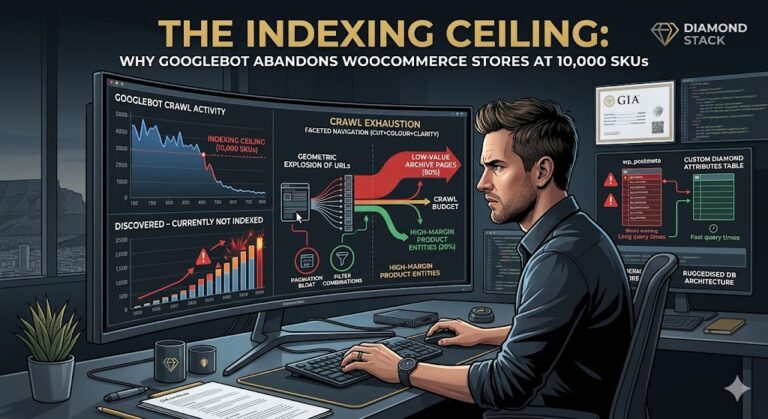
The diamond retailer needed the CLP. We audited their feed integration and found exactly what I expected: 22% of their 40,000 stones had at least one blank attribute in the data that was populating their product schema. Fluorescence was blank on approximately 8,000 stones. Origin was blank on almost all of them. The cut grade vocabulary was inconsistent — some stones from one feed source used “Excellent,” some from another used “EX,” and these were rendering as different values in the schema. Their TTFB on diamond PDPs was averaging 3.8 seconds under normal load because their feed was pushing into native wp_postmeta, and the database query performance had degraded under the 800,000+ rows that 40,000 stones with 20 attributes each had generated.
We rebuilt the data layer with custom database tables, indexed on the most-filtered attributes. We implemented a normalisation mapping that enforced canonical vocabulary across all feed sources. We built the Crawlable Shadow properly — server-side JSON-LD with all 22 attributes on every PDP — and confirmed it was rendering in the initial HTML response rather than being JavaScript-injected. We set explicit “None” values for all blank fluorescence fields on GIA and IGI graded natural diamonds. We confirmed the origin of every stone where the feed data included it.
TTFB dropped to under 180ms across the diamond catalogue. Feed approval rate in Merchant Centre moved from 76% to 94%. Long-tail specification query traffic increased measurably within two months. And when the February feed disruption came, their Crawlable Shadow held — organic specification query traffic increased rather than disappearing.
Two different diagnoses. Two different architectures. Two sets of results that neither would have achieved if their agencies had continued applying the same generic treatment to both.
I have written this essay for one reason: because the most expensive mistake a jewellery business can make with its digital investment is to apply the wrong architecture to the right problem.
The content agency that writes trend articles for a bespoke studio is not dishonest. They are applying the framework they know — content volume, keyword targeting, backlink acquisition — to a market that requires something else entirely. The entity architecture that converts an auditing buyer is not built from blog posts. It is built from structured credential signals, coherent identity across citation surfaces, and the systematic elimination of contradictions that suppress the entity confidence that high-stakes buyers require before they will enquire.
The developer who optimises an About page for a diamond retailer is not incompetent. They are fixing the wrong thing. The routing buyer is not on the About page. They are on the product page, evaluating attribute completeness and data quality, and increasingly they are not even the ones making the decision — an AI layer is making it for them based on the structured data quality of 22 product attributes.
The brand agency that writes beautiful copy for a boutique studio without touching the underlying entity architecture is not failing at creativity. They are failing at signal coherence. Beautiful copy on a site whose structured data, GBP description, LinkedIn profile, and press vocabulary all express a different identity than the copy creates is beautiful copy that is working against itself.
The frameworks I have described in this article are not proprietary secrets. They are published under Creative Commons on SEO Gurus, with full documentation, scoring models, and falsifiability conditions. I am not interested in protecting them. I am interested in the industry using them correctly.
Use the CCF when your buyer is auditing. Use the CLP when your buyer is routing. Use the CRP when your buyer is evaluating the humans behind the work over a long relationship arc. And before you start any digital architecture work, ask the question that makes the right choice obvious.
What is your buyer doing when they search for you?
Everything else follows from that.
Erwee Coetzee is the founder of SEO Gurus, a Cape Town-based technical SEO consultancy, and Diamond Stack, a specialist WooCommerce development practice for jewellery e-commerce. He has been active in technical SEO since 2012. The Coetzee Convergence Framework (CCF), Coetzee Liquidity Protocol (CLP), and Coetzee Resonance Protocol (CRP) are published under Creative Commons Attribution 4.0 at seo-gurus.co.za. The full methodology papers, including ECS scoring models, SC formula documentation, ARS framework, and case evidence, are available for download and citation.