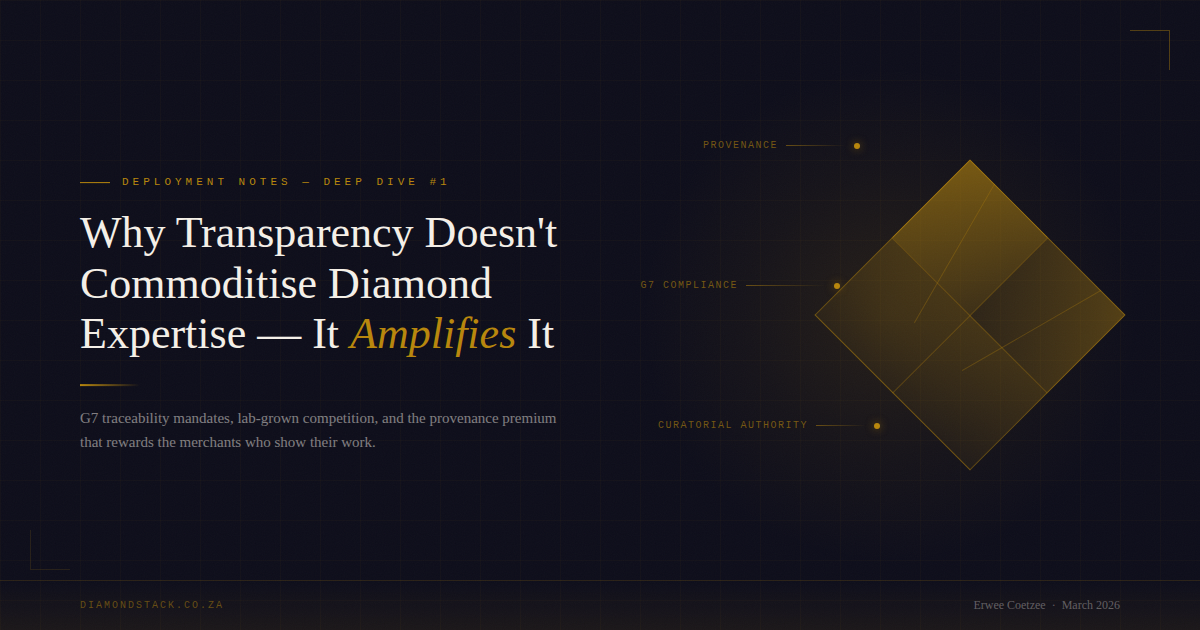
Why Transparency Doesn’t Commoditise Diamond Expertise – It Amplifies It
For more than a century, the global diamond industry has operated on a principle that most participants understand intuitively but rarely articulate: the less the buyer knows, the more the seller controls. Information asymmetry has been the invisible architecture of margin protection. The wholesaler in Antwerp who knows exactly where a parcel originated, who cut it, and what comparable stones traded for last week holds an advantage over the retailer in Johannesburg or New York who does not. That asymmetry has historically been the source of profit, the basis of negotiation, and the reason why “trust” in the diamond trade has always been personal rather than systemic.
So when technology platforms promise “transparency” and “traceability,” the instinctive reaction from experienced merchants is not excitement. It is fear. The fear is specific and rational: if every buyer can see what I see, my expertise becomes worthless. If provenance data is available to everyone, I lose the informational edge that justifies my margin. If the supply chain becomes a glass pipeline, I become a commodity middleman who can be replaced by an algorithm.
This fear is the single greatest barrier to digital adoption in the jewellery trade. It is also fundamentally wrong.
The premise that transparency destroys expertise rests on a confusion between two very different kinds of value: the value of hoarding information, and the value of interpreting it. In a pre-digital market, these were often the same thing. The merchant who had exclusive access to a parcel of rough from Botswana also had exclusive knowledge of its potential yield, its likely colour grade after cutting, and its probable market value once polished. Access and interpretation were bundled together, and the bundle was the margin.
Digital platforms unbundle them. And in that unbundling, the merchant’s interpretive skill — the curatorial eye, the grading expertise, the supplier relationship — does not disappear. It becomes more visible, more demonstrable, and ultimately more valuable.
Part I: The Provenance Premium — What the Data Actually Shows
The argument for transparency is not theoretical. It is empirical, and the data from 2024 and 2025 is unambiguous.
McKinsey’s research on the diamond industry indicates that roughly one-third of fine jewellery purchases could be influenced by environmental, social, and governance (ESG) factors by 2025. That is not a niche segment. That is a structural shift in how consumers evaluate a purchase that often represents one of the largest discretionary expenditures of their lives. The consumer walking into a jewellery store in 2026 is not the same consumer who walked in a decade ago. They have been conditioned by every other industry — food, fashion, electronics — to expect visibility into where products come from and how they were made.
The 2024 Dubai Diamond Conference made this pressure explicit. Speakers across multiple panels identified traceability as one of the most pressing issues facing the industry. A new consensus has emerged that diamonds leaving mines need to be traceable, placing extraordinary pressure on miners and manufacturers to definitively solve the traceability question. This is not a hypothetical future requirement. It is a present-tense operational reality.
Sarine Technologies, one of the industry’s leading technology providers, has framed this even more directly. In the diamond market of 2026, transparency is not a trend — it is a necessity. Every player in the pipeline, from mining companies to retailers, is searching for traceability solutions. Rapaport magazine has termed it “the race to trace.”
But here is the data point that matters most for the independent merchant: traceable diamonds can command price premiums. McKinsey’s analysis suggests that markets may bifurcate based on diamonds that do or do not meet legal or social-responsibility constraints. In plain language, the stone with a verified provenance story sells for more than the stone without one. The stone without one may, in certain markets, become unsellable entirely.
This is the provenance premium. It is not a marketing gimmick. It is a market mechanism that rewards the merchant who can surface verified information about a stone’s journey — and penalises the merchant who cannot.
Part II: The Lab-Grown Pressure Cooker
The provenance premium does not exist in a vacuum. It exists in a market that is being reshaped by the most significant competitive disruption the diamond industry has faced since the De Beers cartel era: lab-grown diamonds.
The numbers are stark. According to BriteCo’s 2025 analysis, approximately 42% of all diamond jewellery sold in the United States now incorporates lab-grown diamonds. In the engagement ring category specifically, that figure rises to nearly 48%. The relative market share of lab-grown jewellery has grown by over 700% in the past five years. A one-carat lab-grown diamond now averages around $1,000 at retail, compared to approximately $4,200 for a comparable natural stone.
For the natural diamond merchant, these numbers are not a death sentence — but they are a forcing function. Lab-grown diamonds compete primarily on price. They are chemically and optically identical to natural diamonds. The consumer who is shopping purely on specifications and cost has a rational reason to choose lab-grown. The only sustainable counter-argument for natural diamonds is the one thing a laboratory cannot replicate: origin.
A natural diamond from Botswana that was cut in Antwerp and graded by GIA carries a story that no CVD reactor can manufacture. But that story only has value if it can be told — and verified — at the point of sale. The merchant who can surface a complete provenance narrative is not competing with lab-grown diamonds on price. They are competing on an entirely different axis: authenticity, rarity, and meaning. The merchant who cannot surface that narrative is competing on price by default, and on price, lab-grown will win every time.
This is where transparency amplifies expertise rather than destroying it. The experienced diamond merchant knows things about a stone that no database can capture: the subtle warmth of a particular rough parcel from Jwaneng, the way certain cutting houses in Surat handle fancy shapes, the indicators that distinguish a truly exceptional stone from one that merely meets specification. But in a market where lab-grown alternatives are 60–80% cheaper, that knowledge is worthless unless it can be translated into a visible, verifiable, customer-facing narrative.
Transparency does not replace the merchant’s eye. It gives the merchant’s eye a microphone.
Part III: The G7 Regulatory Wall — Compliance as Market Access
If the consumer demand for provenance were the only driver, a merchant could theoretically ignore it and accept a gradually shrinking market. But the regulatory landscape of 2025–2026 has removed that option.
On 6 December 2023, the G7 members announced a coordinated effort to restrict diamond imports from Russia. The measures have been implemented in phases. Since 1 September 2024, the prohibition applies to Russian natural and synthetic diamonds processed in third countries, covering stones of 0.5 carats and above. From 1 March 2025, KP certificates for rough diamond imports into the EU must specify all countries of origin — mixed-origin declarations are no longer accepted.
The EU’s full traceability-based evidence requirement for all diamond imports within scope has been deferred to 1 January 2026, but the direction is unmistakable. Diamond companies will need to work with a fully-fledged traceability system. The Antwerp World Diamond Centre (AWDC) has acknowledged that the deadline extension gives companies much-needed time to prepare, but the requirement itself is not in question.
The penalties for non-compliance are not symbolic. Under EU Directive 2024/1226, fines can reach up to five percent of a company’s global turnover or €40 million, whichever is greater. In the United States, OFAC penalties under IEEPA carry civil monetary penalties of up to $368,136 per violation or twice the transaction amount.
For the independent merchant, the implication is existential. A diamond that cannot demonstrate non-Russian origin through verifiable documentation is not merely less valuable — it is potentially unliquidable in G7 markets, which account for approximately 70% of global polished diamond consumption. The merchant who cannot prove provenance does not lose margin. They lose market access.
This regulatory reality transforms the transparency conversation from a philosophical debate about “openness” into a practical question of business survival. The merchant’s expertise in sourcing, evaluating, and curating diamonds has not become less valuable. It has become essential — but only if it can be documented, verified, and surfaced through digital infrastructure that meets regulatory standards.
Part IV: The Information Asymmetry Fallacy
The traditional diamond trade’s reliance on information asymmetry was always a fragile foundation. It depended on the buyer’s inability to access information independently. That condition has been eroding for two decades, and it is now effectively gone.
Consider the consumer journey in 2026. Before entering a jewellery store, a motivated buyer can access GIA’s online database to verify a grading report. They can check RapNet for wholesale price indications. They can compare carat-for-carat pricing across multiple online retailers. They can read about the Four Cs in more detail than most retail sales staff can recite from memory. They can, if they are particularly diligent, look up Kimberley Process certification requirements and understand the basics of rough diamond provenance.
The buyer who walks through the door already knows more than the industry assumed any buyer would ever know. The merchant who relies on the buyer’s ignorance to maintain margin is not protecting expertise. They are betting against the internet, and the internet does not lose that bet.
But here is what the internet cannot provide: the ability to evaluate whether a particular stone, in hand, under a loupe, represents genuine value. The internet can tell you that a 1.5-carat G VS2 round brilliant should trade within a certain price range. It cannot tell you whether the light performance of the specific stone in front of you is exceptional, average, or disappointing. It cannot tell you whether the fluorescence listed on the report affects the stone’s face-up appearance in natural light. It cannot tell you whether the inclusion mapped on the plot is eye-clean at arm’s length or visible at six inches.
This is the merchant’s actual expertise, and it is undiminished by transparency. In fact, it is enhanced by it. When the buyer arrives already educated on grading terminology and pricing benchmarks, the merchant who can go deeper — explaining why this particular stone, at this particular price, represents a better proposition than the alternatives the buyer has already researched — demonstrates authority that commands premium pricing.
The merchant’s value was never in hoarding information. It was in interpreting it. Transparency strips away the first and amplifies the second.
Part V: Curation as Competitive Moat
If information asymmetry is dead, what replaces it? The answer is curatorial authority.
In every industry that has undergone the transparency transition — wine, fine art, specialty coffee, craft spirits — the same pattern emerges. When consumers gain access to baseline information, the merchants who thrive are the ones who curate, contextualise, and narrate. The sommelier’s value did not decrease when wine rating apps became ubiquitous. It increased, because the consumer who knows enough to read a score also knows enough to appreciate a recommendation that goes beyond the score.
The same dynamic is now playing out in the diamond trade, and the merchants who recognise it are already winning.
Consider what curatorial authority looks like in practice for a diamond retailer. It is the ability to select from a universe of available stones and present an edited collection that reflects a specific aesthetic, value proposition, and sourcing philosophy. It is the ability to say: “I chose this stone from this particular source for these specific reasons, and here is the documentation that proves everything I am telling you.”
That sentence is only possible when transparency infrastructure exists. Without verifiable provenance data, the merchant’s claim is just a story. With it, the claim is an authenticated narrative — one that the consumer can verify independently, which paradoxically makes them more likely to trust it. This is the mechanism by which transparency amplifies expertise. The merchant who can prove their sourcing decisions creates a trust signal that the merchant who merely asserts their expertise cannot match.
In e-commerce, this dynamic is even more pronounced. The online diamond retailer cannot rely on the physical experience of holding a stone. Their entire value proposition must be communicated through product data, imagery, and narrative. The retailer whose product pages surface a complete provenance story — mine of origin, cutting house, certification body, and chain of custody — creates a fundamentally different buying experience from the retailer who offers a grading report number and a stock photo.
The first retailer is selling a verified artefact with a documented history. The second is selling a commodity. The price premium attaches to the first, not the second. And the expertise required to curate, verify, and present that information is the diamond merchant’s traditional skill set, expressed through digital infrastructure.
Part VI: The Technology Layer — Where Architecture Meets Expertise
Transparency does not happen by itself. It requires infrastructure — specifically, digital architecture that can ingest provenance data from upstream sources, associate it with individual stones, and surface it at the point of sale in a format that both consumers and regulators recognise.
This is where the technology conversation intersects with the expertise conversation. The diamond industry’s adoption of platforms like Tracr (De Beers), Sarine’s Diamond Journey, and independent integration layers reflects a recognition that provenance data must be systematised, not anecdotal. De Beers’ Tracr platform has registered over three million diamonds at source, with each stone assigned a unique digital identity capturing critical attributes. As of 2025, all diamonds over one carat registered on Tracr can be traced to a single country of origin.
However, the industry’s traceability landscape is fragmented. The DMCC’s 2024 report on provenance, traceability, and technology made six key recommendations, including the promotion of a technology-agnostic approach to safeguard the dynamic nature of traceability technologies and the creation of a compatibility layer that allows for secure data transfer across the value chain. This language is significant: it acknowledges that no single platform will own the end-to-end provenance journey, and that interoperability between systems is essential.
For the independent merchant, this fragmentation creates both a challenge and an opportunity. The challenge is navigating multiple data sources — Nivoda, RapNet, IDEX, GIA, Tracr, Sarine — each with their own API structures and data formats. The opportunity is that the merchant who can aggregate these sources into a coherent, consumer-facing provenance narrative has a competitive advantage that no single upstream platform can replicate.
This is the architectural thesis behind platforms like Diamond Stack: not to compete with Tracr or Sarine at the verification layer, but to provide the independent merchant with a sovereign system that ingests verified data from multiple upstream sources and presents it within the merchant’s own commercial environment. The merchant controls what is surfaced, how it is presented, and what narrative wraps the data. The upstream platforms provide the raw verification. The merchant’s system provides the interpretation and curation.
Architecture, in this context, is not a technical detail. It is the digital manifestation of the merchant’s curatorial authority.
Part VII: The Antwerp Paradox — Why the World’s Most Traditional Hub Is Going Digital
If transparency truly destroyed merchant value, Antwerp would be the last place to adopt it. The Antwerp diamond district handles approximately 84% of the world’s rough diamonds and 50% of polished diamonds by value. It is the most concentrated expression of the “handshake culture” that the diamond trade romanticises. Deals are sealed with a mazal, a handshake and a Hebrew blessing, in bourses where families have traded for generations. If any market had the institutional inertia to resist digitisation, it would be this one.
And yet Antwerp is leading the compliance transition, not resisting it. The AWDC has been actively preparing its member companies for the traceability mandate. The Diamond Office in Antwerp serves as the EU’s designated authority for verifying diamond imports under the G7 sanctions framework. Antwerp is not adopting transparency because it wants to. It is adopting transparency because the regulatory framework has made it a condition of continued market access.
But something interesting is happening beneath the compliance surface. The Antwerp dealers who have embraced digital provenance documentation are discovering that it does not erode their competitive position. It strengthens it. When a dealer can present a client with a blockchain-verified chain of custody from a Botswana mine through an Antwerp cutting house to a polished certificate, they are not merely satisfying a regulatory requirement. They are demonstrating a level of supply-chain mastery that their less-digitised competitors cannot match.
The handshake has not been replaced. It has been augmented. The mazal still seals the deal, but now it seals a deal backed by verifiable data rather than verbal assurance. The trust is deeper because it is supported by evidence. The relationship is stronger because neither party is dependent on the other’s honesty alone. Both can verify independently, and that mutual capacity for verification paradoxically increases mutual confidence.
This is the pattern that will repeat across every diamond hub: Mumbai, Tel Aviv, New York, Hong Kong, Johannesburg. The merchants who digitise first do not lose their relational advantage. They convert it from a perishable, personal asset into a durable, systematic one.
Part VIII: The Price-Scraper Objection — Why Visible Data Does Not Equal Vulnerable Margins
One of the most persistent objections to digital transparency from experienced merchants is the price-scraper problem. If my inventory data is online, the argument goes, then price-comparison engines will index it, and I will be forced into a race to the bottom on pricing. My margins will be compressed by algorithms that surface the cheapest comparable stone from anywhere in the world.
This objection contains a kernel of truth and a fundamental misunderstanding. The truth is that price-scrapers do exist, and they do index publicly available diamond listings. RapNet, IDEX, and various aggregator sites already provide price benchmarks that any buyer can access. The market is already more price-transparent than most merchants acknowledge.
The misunderstanding is the assumption that all data must be public or private, with no middle ground. A well-architected e-commerce platform gives the merchant granular control over what is surfaced to whom. The provenance story — mine of origin, cutting house, ethical sourcing credentials, GIA certification — is customer-facing. It belongs on the product page because it drives trust and premium pricing. The cost basis, supplier terms, and margin structure are not customer-facing. They belong behind the merchant’s login, in their administrative dashboard, where no scraper can reach them.
The distinction is between transparent provenance and transparent pricing. These are not the same thing. A merchant can tell the complete story of a stone’s journey from mine to market without disclosing what they paid for it. In fact, the more detailed the provenance story, the more difficult it becomes for a price-scraper to reduce the stone to a commodity comparison. A one-carat G VS2 round brilliant is a commodity. A one-carat G VS2 round brilliant from the Jwaneng mine, cut by a master craftsman in Antwerp, with a blockchain-verified chain of custody and a GIA report confirming exceptional light performance, is not a commodity. It is a curated product, and curated products resist algorithmic price compression.
The merchant who fears price-scrapers is actually fearing commoditisation. And the cure for commoditisation is not less information but more — specifically, more of the kind of information that distinguishes one stone from every other stone with the same specifications. That information is precisely what a provenance-enabled digital platform surfaces. The price-scraper threat is real for merchants who offer undifferentiated inventory with no story. It is irrelevant for merchants who sell documented, verified, curated diamonds.
Part IX: Beneficiation Meets Digital Infrastructure — The South African Context
For South African jewellers, the transparency imperative carries an additional dimension that is often overlooked in global industry analysis: beneficiation.
South Africa is one of the world’s significant diamond-producing nations, with a long and complex history of extraction, cutting, and trade. The beneficiation debate — the question of how much value-addition should occur in the country of origin before diamonds are exported — has been a feature of South African economic policy for decades. What digital transparency offers is a mechanism to make beneficiation claims verifiable.
A South African jeweller who sources stones cut and polished domestically, from rough mined in South African operations, has a provenance story that resonates with both local consumers and international buyers interested in ethical sourcing. But that story needs infrastructure. It needs a digital product page that can surface the mine of origin, the local cutting house, and the domestic certification. It needs schema markup that search engines can read, so that the provenance narrative appears in search results alongside the product listing. It needs compliance documentation that satisfies G7 import requirements for any international sales.
Without digital infrastructure, the beneficiation story is a verbal claim made across a counter. With it, it is a verified, searchable, indexable asset that commands both consumer trust and search engine visibility. The South African jeweller who can digitise their beneficiation narrative is not just telling a better story. They are building a moat that no international competitor without the same supply chain proximity can replicate.
This is transparency amplifying expertise in its most literal form. The expertise is the local knowledge — the relationships with domestic cutters, the understanding of South African rough characteristics, the ability to source ethically within a complex regulatory environment. The transparency infrastructure is what makes that expertise visible, verifiable, and commercially valuable at scale.
Part X: The Consumer Psychology of Verified Stories
There is a psychological dimension to the transparency-expertise relationship that the industry frequently underestimates. When a consumer can verify a claim independently, they trust it more than if they must take it on faith. This is counterintuitive to merchants who believe that mystery and exclusivity drive desire, but it is consistent with decades of consumer behaviour research.
Millennials and Gen Z consumers — who now represent the largest cohort of diamond buyers by volume — have grown up in an information-rich environment. They are sophisticated evaluators of claims. They know that marketing language is designed to persuade, and they discount it accordingly. What they do not discount is verifiable data. A GIA report number that can be checked online. A provenance certificate that traces a stone to a specific mine. A product page that includes the cutter’s name and location.
These are not nice-to-have features. They are trust signals that function at a neurological level. When a consumer can confirm a claim through an independent source, the dopamine response associated with “discovery” and “validation” reinforces their purchase confidence. The merchant who provides these verification touchpoints is not giving away control. They are building a trust architecture that makes the consumer more likely to buy, more likely to pay a premium, and more likely to return.
This is particularly acute in the engagement ring market, where emotional stakes are at their highest. The buyer is not just evaluating a product. They are evaluating whether the merchant is trustworthy enough to guide one of the most significant purchases of their life. Every verifiable data point on the product page — the GIA report, the provenance certificate, the compliance documentation — reduces the buyer’s anxiety and increases their confidence. The transparent merchant does not lose the sale to a competitor who offers less information. They win it because the buyer feels safer, more informed, and more certain that the stone they are choosing is worthy of the moment it will represent.
The old model of diamond selling was built on mystique and information scarcity. The new model is built on verified narrative and curatorial authority. Both models reward expertise. But the new model rewards it more reliably, because the trust is not dependent on personal chemistry between buyer and seller. It is embedded in the infrastructure.
Part XI: The Digital Product Page as Competitive Weapon
Everything discussed in this article converges on a single artefact: the product page. In e-commerce, the product page is where the merchant’s expertise either materialises or evaporates. It is the moment of truth where curatorial authority, provenance data, compliance documentation, and brand narrative either cohere into a compelling buying experience or collapse into a generic listing.
Consider two product pages for the same category of stone. The first displays a stock photograph, a GIA report number, the Four Cs, and a price. The second displays a high-resolution image shot from multiple angles, a GIA report number that links to the full report, the Four Cs with contextual explanation, a provenance section detailing the mine of origin and the cutting house, a compliance badge confirming G7 traceability status, a narrative paragraph written by the merchant explaining why this particular stone was selected for their collection, and a price that is fifteen to twenty percent higher than the first.
Which page converts better? The evidence from every high-trust e-commerce category — fine wine, luxury watches, artisan furniture — is unambiguous: the page with more verified information converts at higher rates and at higher average order values. The consumer does not experience the additional information as clutter. They experience it as confidence. And confidence is the precondition for a purchase that represents a significant percentage of the buyer’s disposable income.
Building product pages at this level requires more than good copywriting. It requires a data architecture that can pull verified attributes from upstream sources, associate them with individual product listings, and render them in a format that is both human-readable and machine-readable. The machine-readability matters because search engines parse structured data to determine whether a product listing merits visibility in search results. A product page with proper JSON-LD schema markup — including provenance attributes, certification references, and compliance signals — sends a trust signal to Google’s algorithms that a page without that markup cannot match.
This is where the expertise-transparency loop closes. The merchant’s curatorial knowledge informs the stone selection. The transparency infrastructure surfaces the verification. The structured data communicates both to search engines. The search visibility drives qualified traffic. The qualified traffic encounters a product page that demonstrates the merchant’s authority. And the authority justifies the premium price.
Every step in that loop depends on the merchant’s expertise. None of them work without transparency infrastructure. The two are not in tension. They are the same system, and the merchants who build it first will own the market.
Part XII: The Amplification Thesis — What This Means for the Independent Merchant
The practical implications of the transparency shift can be distilled into five principles:
- Your curatorial eye is your most valuable asset — but only if it can be demonstrated digitally. The ability to select exceptional stones from a universe of available inventory has always been the merchant’s core skill. In a transparent market, that skill becomes more visible and more valued, provided you have the digital infrastructure to surface your selections alongside verified provenance data.
- Compliance is not a cost centre. It is a revenue enabler. The merchant who treats G7 traceability requirements as a bureaucratic burden will invest the minimum necessary and gain nothing beyond regulatory clearance. The merchant who treats compliance documentation as customer-facing content converts a regulatory requirement into a competitive advantage.
- Lab-grown competition makes provenance infrastructure urgent, not optional. Every month that passes without a verifiable provenance story on your product pages is a month where price-sensitive consumers default to lab-grown alternatives. The provenance narrative is the only sustainable differentiation strategy for natural diamonds.
- Platform independence matters. The technology you use to surface provenance data should not be owned by your supplier, your competitor, or a platform that can change access terms unilaterally. The merchant’s sovereignty over their commercial data, customer relationships, and margin logic is non-negotiable.
- The transition is already underway. The question is not whether the diamond trade will become transparent. The G7 has answered that question. The only question is whether you will lead the transition or be dragged through it.
Conclusion
The diamond industry’s fear of transparency is rooted in a model of value creation that is already extinct. The merchant who relied on information hoarding to maintain margins has been losing ground to price-comparison engines, online databases, and lab-grown alternatives for years. Clinging to opacity is not a strategy for margin protection. It is a strategy for accelerated irrelevance.
The merchant who embraces transparency — who builds digital infrastructure capable of surfacing verified provenance data, who treats compliance documentation as customer-facing content, who uses their curatorial expertise to create authenticated narratives around individual stones — is not giving up an advantage. They are converting a depreciating asset (information hoarding) into an appreciating one (demonstrable authority).
The data supports this. McKinsey projects market bifurcation based on traceability. The G7 is mandating compliance at scale. Lab-grown competition is forcing natural diamond merchants to compete on story rather than specification. Consumer behaviour research confirms that verifiable claims command higher trust and higher willingness to pay.
Transparency does not commoditise expertise. It reveals it, authenticates it, and makes it the basis of premium pricing in a market that no longer tolerates opacity.
The merchants who understand this will thrive. The merchants who do not will discover that the handshake culture they loved was never protecting their expertise. It was hiding the fact that they did not have enough of it.
For the independent jeweller reading this from Cape Town, Johannesburg, Hatton Garden, or the 47th Street Diamond District, the practical takeaway is specific. Your knowledge of stones, your supplier relationships, your ability to spot value that others miss — these are not threatened by transparency. They are your primary competitive weapon in a market that is rapidly losing patience with merchants who cannot back up their claims with evidence. The lab-grown alternative is cheaper, identical under a microscope, and available on Amazon. The only counter-move that works is a verified story that no laboratory can fabricate and no algorithm can replicate.
Build the infrastructure to tell that story. Document the provenance. Surface the compliance. Let the data speak for your expertise, and your expertise will command the premium it has always deserved — but can no longer extract through information hoarding alone.
The diamond trade is not being disrupted by transparency. It is being liberated by it. The merchants who see that first will define the next era of the industry. The merchants who do not will be remembered as the ones who owned the hay but lost the race.
Sources
- McKinsey & Company. “The Diamond Industry Is at an Inflection Point: Lab-Grown Diamonds — Next Steps for the Diamond Industry,” November 2024. mckinsey.com
- Sarine Technologies. “How a Unified Diamond Industry Can Build True Traceability and Customer Confidence,” 2024. blog.sarine.com
- Sarine Technologies. “The Trends Set to Define the 2025 Diamond Industry,” 2025. blog.sarine.com
- De Beers Group. “Tracr Case Study,” 2024. debeersgroup.com
- BriteCo. “The Lab-Grown Vs. Natural Diamond Report,” 2025. brite.co
- Rapaport. “Diamond Traceability: Retailers Respond to Consumer Demand,” December 2023. rapaport.com
- Rapaport. “EU Delays Sanctions Traceability Rules, Requires Specific Diamond Mining Origin on Certs,” February 2025. rapaport.com
- Antwerp World Diamond Centre (AWDC). “Update on G7: The Sixteenth Sanction Package Against Russia,” 2025. awdc.be
- European Commission. “FAQs: Sanctions Russia — Diamonds,” 2024. finance.ec.europa.eu
- FiveBy. “From Mine to Market: G7’s Diamond Trade Rules Demand Full Traceability,” August 2024. fiveby.com
- Accenture. “Tracr Pioneers Trust in Diamond Traceability,” February 2026. accenture.com
- DMCC / Dubai Media Office. “Diamond Industry Must Embrace Digital Innovation to Advance Traceability,” September 2024. mediaoffice.ae
- National Jeweler. “EU Once Again Pushes Back Deadline on Diamond Traceability,” 2025. nationaljeweler.com
- CNRG Zimbabwe. “G7 Sanction Shifts Global Diamond Landscape,” 2024. cnrgzim.org
- Exotic Diamonds SA. “Top Diamond Industry Trends 2025,” 2025. exoticdiamondsa.com