Why Jewellery Stores Lose 60–80% of High-Intent Buyers (And How Technology Fixes It)
Most jewellery businesses assume the problem is simple: they need more traffic, better ads, or stronger salespeople.
That assumption is usually wrong.
In reality, many jewellery retailers already generate enough interest to sustain significantly higher revenue. The issue is not demand—it is system failure across the customer journey.
High-intent buyers are not being “lost” at the point of sale. They are being lost quietly, continuously, and invisibly between systems that were never designed to work together.
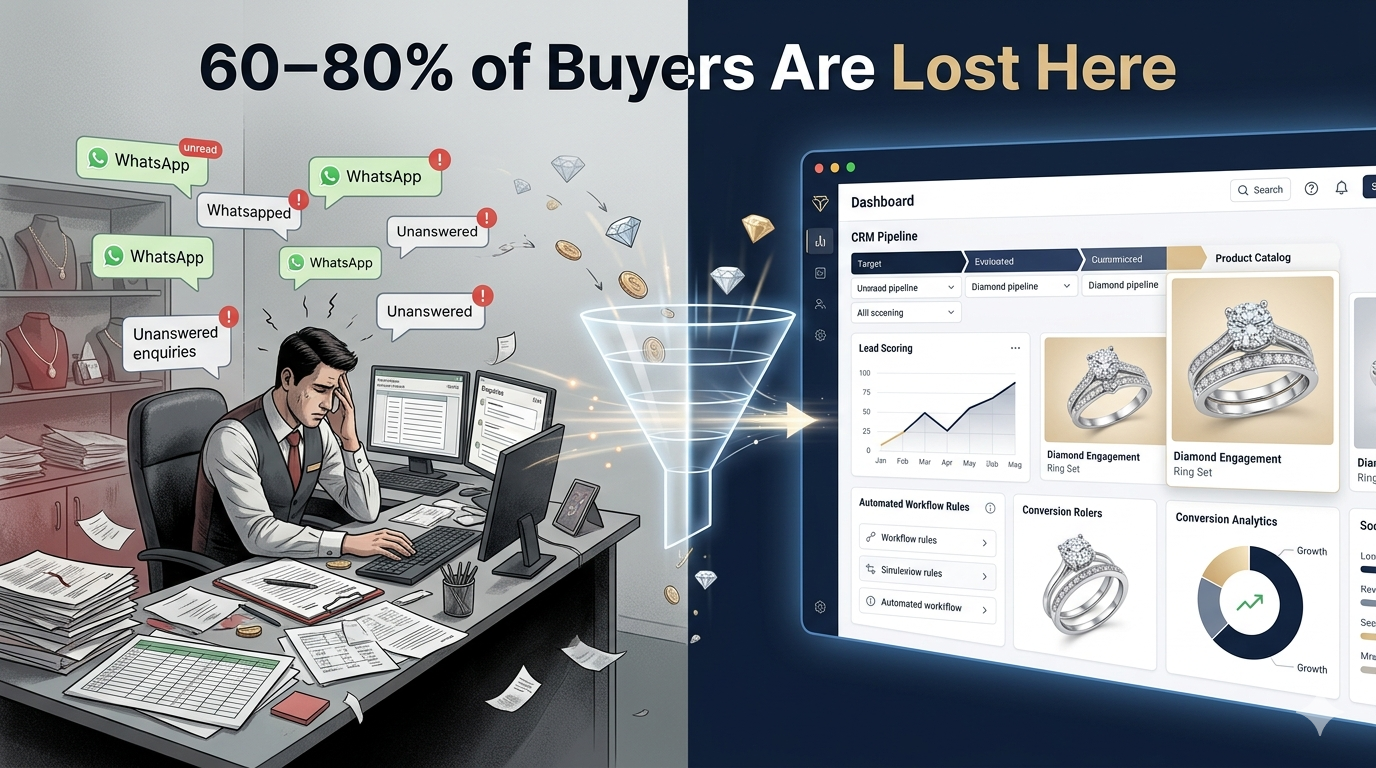
In many jewellery businesses, 60–80% of serious buyer intent never becomes a structured opportunity.
Not because people aren’t interested—but because the infrastructure cannot hold, track, or convert that intent.
The Real Problem: Jewellery Is a High-Intent, Low-System Industry
Jewellery sits in a unique retail category:
- High emotional value (engagements, milestones, gifting)
- High financial value (significant purchase decisions)
- High consideration time (days to months of deliberation)
- High trust requirement (authenticity, certification, risk sensitivity)
Yet most jewellery businesses operate on systems designed for:
low-cost, fast-decision eCommerce
That mismatch creates structural leakage.
A customer does not behave like a “cart and checkout” user. They behave like a multi-stage decision-maker moving through emotional and financial validation loops.
And most systems fail to track that journey.
Where Jewellery Businesses Actually Lose Customers
The loss is not random. It happens in predictable failure zones.
1. Discovery to Enquiry Drop-Off
A large percentage of users:
- Browse rings
- View product pages
- Compare styles
- Save or mentally note options
…and never convert into a structured enquiry.
Why?
Because most jewellery sites are catalogues, not guided systems.
There is:
- No contextual prompting
- No behavioural capture
- No conversion trigger at the right emotional moment
So interest remains passive instead of becoming actionable.
2. WhatsApp Becomes a Broken CRM
This is one of the biggest structural issues in jewellery retail.
WhatsApp is used for:
- Enquiries
- Pricing discussions
- Negotiation
- Follow-ups
- Appointment scheduling
But it is not:
- A CRM
- A pipeline system
- A tracking environment
- A behavioural intelligence tool
The result:
- Conversations are fragmented
- Staff memory replaces data
- No visibility into deal stages
- High-value leads disappear into chat history
In practice, WhatsApp becomes a black box sales system with no analytics layer.
3. Manual Quoting Delays Kill Momentum
Jewellery purchases are emotionally time-sensitive.
When a buyer requests:
- pricing
- variations
- diamond options
- comparisons
they are usually in a high emotional engagement window.
But many businesses respond with:
- manual quotes
- delayed responses
- inconsistent formatting
- human-dependent turnaround times
This creates friction.
And friction kills momentum.
Even a few hours of delay can shift a buyer from:
“ready to decide”
to
“still thinking about it”
4. No Behavioural Tracking of Intent
Most jewellery businesses cannot answer basic questions like:
- What products did this buyer view before enquiring?
- Did they return multiple times before messaging?
- What price range did they consistently engage with?
- What styles indicate their preference profile?
Without this, every lead is treated as identical.
But they are not identical.
There are:
- high-intent buyers (ready to purchase)
- research-phase buyers (comparison stage)
- emotional browsers (early exploration)
- price-sensitive evaluators
Without behavioural data, all follow-ups are generic guesses.
5. Weak or Non-Existent Follow-Up Systems
This is where the majority of revenue leakage becomes permanent.
Most jewellery leads:
- are not systematically followed up
- are not segmented
- are not nurtured over time
- are not reactivated with triggers
Instead, follow-up depends on:
- memory
- available time
- staff discipline
This creates inconsistency—and inconsistency destroys conversion rates in high-ticket sales.
A jewellery sale is rarely lost because of one interaction.
It is lost because:
there is no structured second, third, or fourth interaction system
Why Traditional Jewellery Systems Fail
The root issue is not individual tools—it is architecture.
Most jewellery businesses combine:
- Shopify or WooCommerce (static catalogue)
- WhatsApp (communication layer)
- spreadsheets (inventory or tracking)
- manual quoting (sales process)
Individually, these tools are functional.
But together they form a non-integrated ecosystem.
And in that environment:
- data does not flow
- intent is not captured
- sales stages are not defined
- decisions are not tracked
The system depends on humans to act as integration points.
That is not scalable.
The Hidden Cost of No Conversion Infrastructure
The financial impact is rarely visible on the surface.
But it compounds in four major ways:
1. Lost Revenue (Invisible Leakage)
High-intent buyers simply disappear without structured conversion attempts.
2. Higher Acquisition Costs
Businesses spend more on ads to replace lost leads instead of converting existing ones.
3. Operational Inefficiency
Staff spend time re-explaining, re-quoting, and re-engaging the same leads.
4. Unpredictable Sales Pipeline
Revenue becomes reactive instead of forecastable.
In most cases, the issue is not traffic volume—it is conversion inefficiency inside the system.
How Modern Technology Fixes the Problem
The solution is not “more tools”.
It is a connected conversion architecture.
1. CRM + Lead Scoring Systems
A proper CRM layer transforms raw enquiries into structured data.
It enables:
- tracking every lead interaction
- scoring buyer intent based on behaviour
- segmenting customers by readiness to buy
- prioritising high-value opportunities
Instead of treating every enquiry equally, the system begins to answer:
“Who is most likely to convert right now?”
2. Automated Follow-Up Systems
Automation replaces inconsistent human follow-up with structured engagement flows:
- email sequences
- WhatsApp automation (where appropriate)
- timed reminders
- behavioural triggers (e.g. revisit product page → follow-up prompt)
This ensures no lead is forgotten, delayed, or deprioritised.
It also introduces consistency into a process that was previously dependent on memory.
3. Behaviour Tracking Systems
Modern jewellery systems track:
- product views
- return visits
- engagement time on product pages
- category interest (rings, bands, diamonds)
- implied budget ranges
This creates a buyer intent profile, not just a contact record.
That profile becomes the foundation for:
- personalised follow-ups
- relevant product recommendations
- accurate sales conversations
4. Quote Automation Systems
Instead of manually generating quotes:
- pricing rules are systemised
- variations are dynamically generated
- response times are reduced from hours/days to minutes
This preserves buyer momentum at critical decision moments.
In high-ticket sales, speed is often a conversion factor.
5. Conversion-Driven eCommerce Flows
A modern jewellery website is not a catalogue.
It is a guided decision system:
- product configurators
- appointment booking tied to interest level
- intelligent prompts based on behaviour
- structured pathways from browsing → enquiry → purchase
This reduces friction and increases clarity for the buyer.
Before vs After: The Structural Shift
Before (Traditional Jewellery Stack)
- Reactive selling
- WhatsApp-driven communication
- Manual quoting
- No visibility into buyer intent
- Inconsistent follow-up
- Unpredictable revenue
After (Modern Jewellery Tech Stack)
- Structured sales pipeline
- CRM-driven intelligence
- Automated follow-up systems
- Behaviour-based targeting
- Real-time engagement tracking
- Predictable conversion flow
The difference is not cosmetic.
It is operational.
Strategic Reality: Jewellery Retail Is Becoming a Systems Industry
The jewellery market is shifting.
Competitive advantage is no longer only:
- design quality
- brand reputation
- or marketing spend
It is increasingly:
- system design
- conversion infrastructure
- data visibility
- automation maturity
In other words:
Jewellery businesses are becoming technology-enabled sales systems, not product catalogues.
Those that adapt will scale efficiently.
Those that don’t will continue to lose invisible revenue every month.
Conclusion
Jewellery businesses are not failing because of lack of demand.
They are failing because demand is not being structurally captured, tracked, or converted.
Most high-intent buyers are not lost due to rejection.
They are lost due to absence of systems that convert intent into action.
The businesses that solve this will not need to increase traffic significantly to grow revenue.
They will simply convert more of what they already have.
And in high-ticket retail, that is the real leverage point.