
RAG-Ready E-commerce: Structuring Your Diamond Catalogue for Retrieval-Augmented Generation
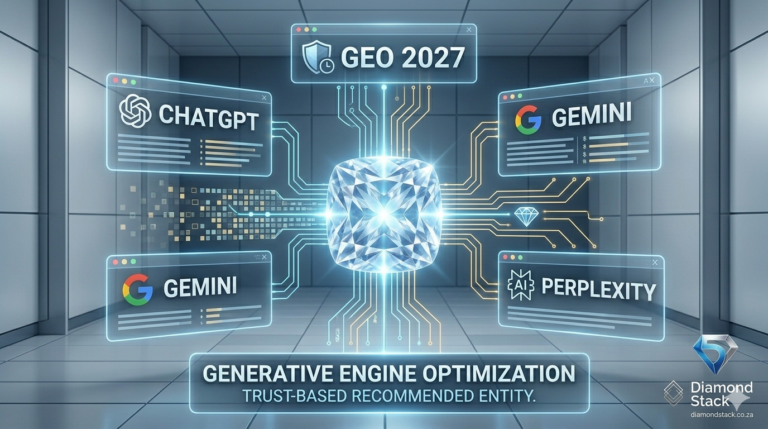
The traditional Search Engine Results Page (SERP) is no longer the sole gatekeeper of high-intent e-commerce traffic. We are entering the era of the AI shopping agent. High-net-worth buyers are bypassing the traditional Google search bar, instead prompting Large Language Models (LLMs) like ChatGPT or Claude with complex, multi-variable queries: “Find a 1.5-carat, VVS2, oval diamond engagement ring in an 18k yellow gold setting, available in South Africa under R120,000.”
When an AI agent receives this prompt, it does not browse your WooCommerce store the way a human does. It executes a Retrieval-Augmented Generation (RAG) process. It scours the web for structured, factual data, retrieves the exact parameters, and generates a synthesised recommendation.
If your digital catalogue is built solely for human aesthetic appeal—relying on visual page builders and flowery product descriptions—your inventory is effectively invisible to these agents. To survive the shift toward agentic search, you must implement the Coetzee Liquidity Protocol (CLP).
In this context, the CLP acts as the architectural standard for making complex inventory data instantly retrievable and machine-readable. Here is why your current WooCommerce build is choking LLMs, and how to structure your diamond feed for RAG readiness.
The DOM Bloat Chokehold
An AI agent crawling a webpage operates within a strict context window—a hard limit on the number of tokens (words and code snippets) it can process in a single pass.
Most premium jewellery websites are built on heavy visual frameworks like Elementor, WPBakery, or bloated commercial themes. When an LLM requests your product page, it is immediately hit with a tsunami of HTML DOM (Document Object Model) bloat. Before the crawler even reaches the critical data—the carat weight, the GIA certification number, or the price—it has to parse 4,000 lines of nested <div> tags, SVG icons, slider scripts, and empty CSS classes.
This is the DOM Bloat Chokehold. The LLM exhausts its token allocation parsing your layout rather than your inventory. It abandons the crawl and moves to a competitor whose code is leaner.
The CLP Solution: Data must be ruthlessly decoupled from the presentation layer. Your WooCommerce architecture requires semantic HTML5 where the product data sits as high up in the document tree as possible. If you cannot rebuild the frontend from scratch, you must rely entirely on the JSON-LD payload to bypass the DOM entirely.
Paragraphs vs. Key-Value Pairs: The Extraction Failure
Historically, SEOs have buried critical product attributes inside marketing copy to increase keyword density. A product description might read: “This breathtaking D colour, excellent cut engagement ring features a flawless VVS1 clarity diamond set in a durable platinum band.”
For a human, this paints a picture. For a RAG system, it introduces a severe extraction failure.
To answer a user’s prompt, the LLM must expend computational effort to parse that paragraph, identify the adjectives, extract the factual variables (D, VVS1, Platinum), and map them to its internal understanding of a diamond. This introduces a high probability of hallucination or miscategorisation. When an AI agent encounters ambiguity, it drops the entity.
The CLP Solution: LLMs crave key-value pairs. Your WooCommerce database must be re-engineered so that every single diamond attribute is isolated in a custom meta field or a strict taxonomy.
attribute_colour: Dattribute_clarity: VVS1attribute_metal: Platinum 950
When data is structured as definitive key-value pairs, the RAG system can instantly retrieve the variables with 100% mathematical certainty. Attribute certainty guarantees agentic recommendation.
The JSON-LD Bridge: Your Passive API
The greatest misconception in modern technical SEO is that Schema markup (application/ld+json) is merely a tool for triggering Google Rich Snippets (like review stars or price tags in the SERPs).
Under the Coetzee Liquidity Protocol, JSON-LD is treated as a passive API payload. It is the purest, most concentrated data layer on your entire website.
When an advanced LLM crawler hits your URL, it actively hunts for the <script type="application/ld+json"> block. If constructed correctly, this block contains the entire matrix of the product—the brand, the exact SKU, the global identifier, the aggregated ratings, and the specific material properties—formatted perfectly for machine consumption. It allows the AI agent to completely bypass the DOM bloat and the marketing paragraphs.
If your WooCommerce store is relying on a default SEO plugin to auto-generate your Schema, you are broadcasting a generic, diluted entity. You must inject highly customised Product and Offer schema that details the exact cut, colour, clarity, and certification authority directly into the JSON-LD bridge.
The Pricing Hallucination Risk
Diamond e-commerce is inherently volatile. Prices fluctuate based on the global Rapaport diamond trading network, currency exchange rates (especially the ZAR/USD spread), and live supplier API feeds.
If an LLM crawls your product page today and caches a static HTML price of R55,000, and a user queries that agent three weeks from now, the LLM will confidently quote R55,000. If the live API price has since jumped to R62,000, you have a catastrophic user experience failure. The buyer clicks through to your site, sees the discrepancy, assumes bait-and-switch tactics, and bounces. This is a pricing hallucination.
The CLP Solution: You must signal volatility to the machine. Within your JSON-LD offers schema, it is critical to enforce the priceValidUntil property, aggressively limiting the lifespan of the cached price. Furthermore, your architecture should leverage real-time edge caching strategies that update the machine-readable data layer the moment the API feed synchronises, ensuring that any crawler hitting the URL receives the absolute latest pricing context.
Liquid Data Wins
We are moving rapidly away from a web of pages toward a web of data. The jewellery retailers who dominate the next decade will not be the ones with the most aggressive link-building campaigns or the prettiest frontend designs.
The winners will be the technical operators who build the most liquid databases. By structuring your WooCommerce catalogue for Retrieval-Augmented Generation, you ensure that when the AI shopping agent asks a question, your inventory provides the only mathematical, indisputable answer.