
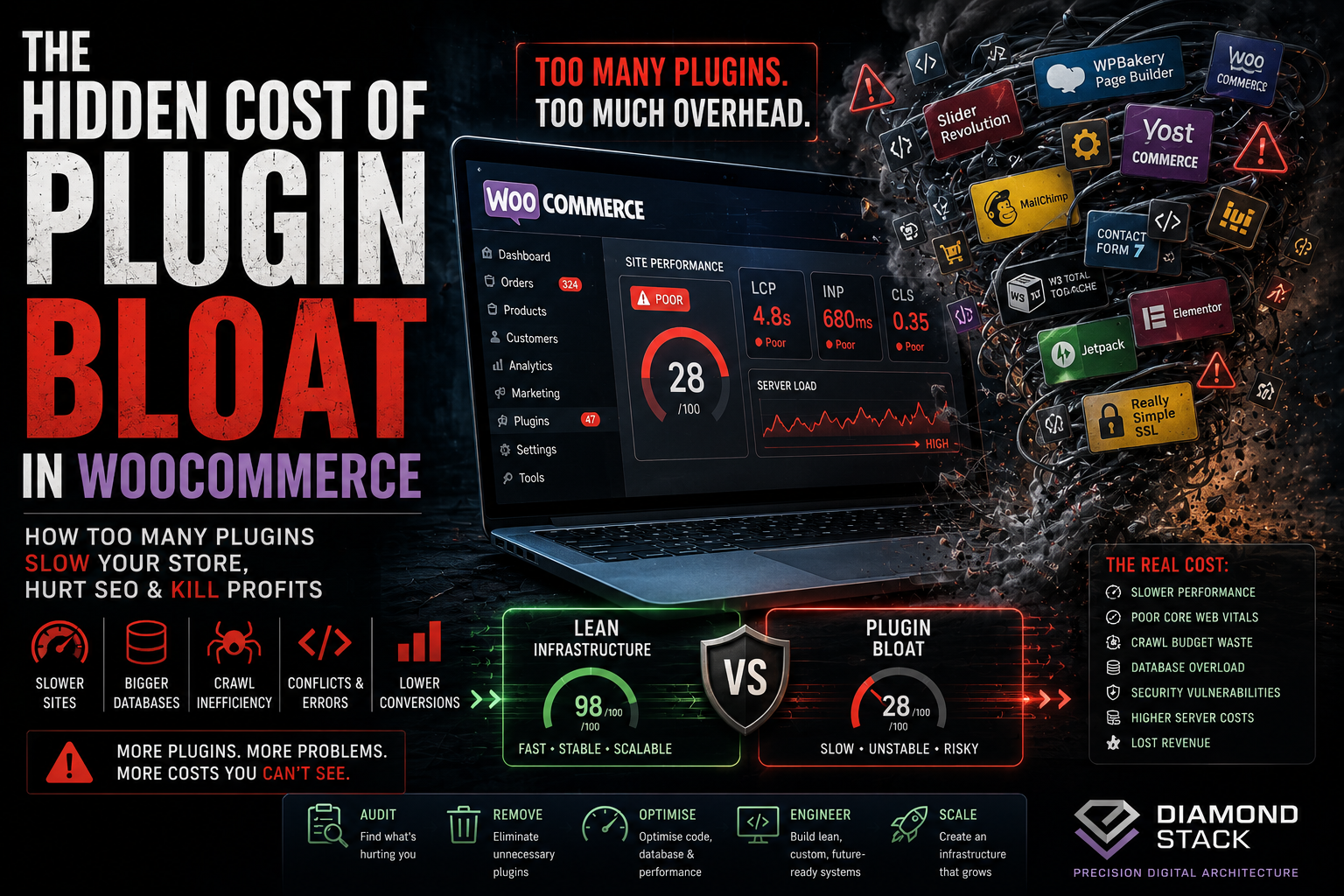
The Hidden Cost of Plugin Bloat in WooCommerce
At first, the WooCommerce store appears successful.
The homepage loads.
Orders flow through.
Marketing campaigns run.
Products sync correctly.
The business grows.
Then the symptoms begin.
The admin dashboard becomes sluggish.
Product updates take longer to save.
Checkout delays emerge on mobile.
Core Web Vitals begin deteriorating.
Search visibility fluctuates unpredictably.
Server usage spikes without explanation.
Database tables swell silently beneath the surface.
The business responds the same way many ecommerce operators do:
another optimisation plugin,
another caching layer,
another marketing integration,
another frontend enhancement.
The infrastructure becomes progressively heavier while the underlying problems worsen.
This is the hidden reality of plugin bloat in WooCommerce.
Most ecommerce businesses do not experience catastrophic technical collapse overnight. Instead, they suffer gradual operational degradation through accumulated software complexity.
A WooCommerce store rarely fails because of one plugin.
It fails because of fifty interacting systems layered without architectural discipline.
Every plugin added to WooCommerce introduces:
- additional code execution,
- database queries,
- dependency chains,
- memory allocation,
- rendering overhead,
- security exposure,
- crawl complexity,
- and semantic instability.
Over time, the ecommerce platform evolves into a fragmented software ecosystem rather than a coherent operational system.
This is not merely a WordPress inconvenience.
It is infrastructure decay.
As ecommerce search becomes increasingly AI-mediated and performance-sensitive, plugin-heavy WooCommerce environments create growing problems for:
- search visibility,
- crawl efficiency,
- semantic clarity,
- operational scalability,
- and conversion performance.
Modern ecommerce infrastructure rewards precision.
Plugin bloat creates entropy.
How WooCommerce Plugin Bloat Happens
Plugin bloat rarely begins intentionally.
Most WooCommerce stores accumulate complexity gradually through operational convenience.
The “Just Add Another Plugin” Culture
WooCommerce’s flexibility is one of its greatest advantages.
Almost any feature can be added through plugins:
- advanced filtering,
- wishlist systems,
- review platforms,
- product configurators,
- SEO tools,
- analytics dashboards,
- dynamic pricing,
- loyalty programmes,
- AI chat systems,
- and marketing automation.
This accessibility creates a dangerous pattern.
Instead of engineering cohesive systems, many businesses continuously stack plugins to solve isolated operational needs.
Each plugin appears harmless individually.
Collectively, they create computational fragmentation.
Agency Handovers and Infrastructure Drift
Many ecommerce stores evolve through multiple:
- developers,
- agencies,
- freelancers,
- marketing teams,
- and operational managers.
Each layer introduces:
- new tools,
- overlapping functionality,
- abandoned plugins,
- duplicated systems,
- and inconsistent implementation standards.
Over time, the WooCommerce environment loses architectural coherence.
The store becomes an archaeological record of past technical decisions.
Feature Accumulation
As businesses grow, operational requirements expand.
Stores begin adding:
- multilingual systems,
- CRM integrations,
- ERP connectors,
- dynamic shipping logic,
- advanced search layers,
- abandoned cart systems,
- social commerce integrations,
- analytics suites,
- and customer personalisation engines.
Without governance, feature accumulation becomes infrastructure sprawl.
Plugin Residue
One of the least discussed issues in WooCommerce is plugin residue.
Even after plugins are removed, many leave behind:
- database tables,
- autoloaded options,
- orphaned metadata,
- cron jobs,
- transients,
- scheduled tasks,
- and residual configuration layers.
The system becomes progressively polluted over time.
This silent accumulation contributes heavily to operational degradation.
The Infrastructure Cost of Excessive Plugins
Every WooCommerce plugin carries an infrastructure cost.
The problem is that most businesses only evaluate frontend functionality while ignoring computational impact.
Excessive Database Queries
Plugins frequently introduce:
- custom database lookups,
- repeated queries,
- inefficient joins,
- real-time processing,
- and uncached data requests.
As plugins accumulate, database activity multiplies rapidly.
This affects:
- product loading,
- admin responsiveness,
- checkout performance,
- search functionality,
- and backend stability.
WooCommerce stores burdened with plugin-heavy query structures often experience severe latency under traffic spikes.
CSS and JavaScript Inflation
Many plugins load:
- frontend CSS,
- JavaScript frameworks,
- third-party libraries,
- tracking scripts,
- animation assets,
- and API dependencies.
Often these assets load sitewide regardless of necessity.
The result is frontend obesity.
Pages become heavier.
Rendering becomes slower.
Interaction becomes delayed.
Search systems must process this complexity too.
Memory Consumption
Plugins consume server memory through:
- background processes,
- runtime execution,
- API communication,
- session management,
- and dynamic functionality.
As memory usage increases, server responsiveness declines.
This impacts:
- user experience,
- crawl efficiency,
- and operational scalability.
Cron Job Overload
WooCommerce stores frequently rely on WP-Cron for:
- scheduled emails,
- synchronisation tasks,
- inventory updates,
- abandoned cart logic,
- analytics processing,
- and automation workflows.
Plugin-heavy environments often generate excessive scheduled tasks competing for server resources.
This creates:
- background congestion,
- execution delays,
- and processing instability.
Autoloaded Option Bloat
Many plugins store configuration data using autoloaded options.
These load automatically on every request.
Over time, autoloaded data can become enormous, significantly increasing:
- page generation time,
- database load,
- and memory usage.
Most store owners never realise this problem exists.
Plugin Bloat and WooCommerce Performance Collapse
Performance degradation rarely appears immediately.
It compounds gradually until operational instability becomes unavoidable.
Slow Checkout Performance
Checkout performance is one of the most commercially sensitive areas of WooCommerce.
Plugin-heavy stores often introduce:
- delayed payment gateway execution,
- excessive validation logic,
- dynamic shipping calculations,
- and third-party API bottlenecks.
Milliseconds matter during checkout.
Every delay increases abandonment risk.
Backend Latency
Many WooCommerce stores become operationally difficult to manage due to admin dashboard slowdown.
Symptoms include:
- delayed product saves,
- slow inventory updates,
- sluggish order processing,
- unresponsive reporting systems,
- and unstable plugin interactions.
Operational friction accumulates across the entire business.
Mobile Rendering Problems
Mobile environments expose plugin inefficiency brutally.
Heavy frontend systems overwhelm:
- weaker processors,
- limited bandwidth,
- and constrained rendering environments.
Common symptoms include:
- delayed interaction,
- layout instability,
- rendering lag,
- oversized payload delivery,
- and filter performance failures.
The customer experiences friction.
Search engines experience crawl cost.
Core Web Vitals Degradation
Plugin-heavy WooCommerce environments frequently fail:
- Largest Contentful Paint (LCP),
- Interaction to Next Paint (INP),
- and Cumulative Layout Shift (CLS).
Excessive scripts and frontend dependencies create:
- render-blocking assets,
- delayed interaction readiness,
- and unstable visual rendering.
Performance engineering directly affects:
- search visibility,
- crawl allocation,
- and conversion performance.
The SEO and Crawl Efficiency Impact
Plugin bloat creates serious SEO infrastructure problems beyond page speed alone.
Crawl Waste
Many plugins generate:
- duplicate URLs,
- parameterised pages,
- unnecessary archives,
- filtered navigation states,
- and low-value endpoints.
Search systems waste resources crawling semantically weak pages.
This reduces crawl efficiency.
JavaScript Rendering Overhead
Modern search engines increasingly render JavaScript-heavy pages.
However, rendering incurs computational cost.
Plugin-heavy frontend systems require:
- more execution,
- more rendering time,
- and more processing allocation.
High rendering cost reduces crawl prioritisation efficiency.
Broken Canonicalisation
SEO plugins, filtering systems, and ecommerce enhancements frequently conflict with:
- canonical tags,
- indexation rules,
- and taxonomy structures.
This creates semantic confusion within search systems.
Taxonomy Fragmentation
Many plugins introduce:
- custom taxonomies,
- duplicate category systems,
- and overlapping archive structures.
This weakens semantic clarity.
Search systems struggle to determine:
- authoritative pages,
- entity relationships,
- and category hierarchy.
Search Infrastructure Engineering
SEO is no longer isolated from infrastructure.
Modern technical SEO increasingly overlaps with:
- rendering optimisation,
- semantic architecture,
- crawl governance,
- and computational efficiency.
Plugin bloat directly undermines these systems.
AI Search Visibility and Semantic Instability
Search is evolving toward machine-mediated retrieval.
This creates new risks for plugin-heavy WooCommerce environments.
Structured Data Corruption
Plugins frequently interfere with:
- schema markup,
- structured data relationships,
- product entities,
- and metadata consistency.
Conflicting schema implementations create semantic instability.
AI systems lose confidence in retrieval quality.
Entity Confusion
Modern retrieval systems increasingly rely on:
- entity relationships,
- semantic hierarchy,
- and contextual consistency.
Plugin-heavy environments often create:
- duplicate entities,
- inconsistent metadata,
- fragmented relationships,
- and semantic contradictions.
This weakens machine understanding.
AI Systems Prefer Efficiency
AI retrieval systems increasingly reward:
- lean architecture,
- semantic clarity,
- computational efficiency,
- and structured consistency.
Heavy WooCommerce environments create retrieval friction.
A visually functional website may still perform poorly within AI discovery ecosystems.
Machine-Readable Commerce Requires Stability
Future ecommerce visibility depends on:
- structured relationships,
- stable rendering,
- and semantic coherence.
Plugin instability undermines all three.
The Hidden Commercial Cost of Technical Debt
Most businesses underestimate the financial consequences of plugin bloat.
Technical debt creates operational drag across the entire organisation.
Higher Hosting Costs
As WooCommerce environments become heavier, businesses often compensate through:
- larger servers,
- more aggressive caching,
- additional infrastructure layers,
- and expensive hosting upgrades.
The infrastructure becomes more expensive simply to maintain baseline functionality.
Developer Dependency
Plugin-heavy environments become increasingly fragile.
Businesses rely more heavily on:
- emergency developer intervention,
- plugin troubleshooting,
- compatibility management,
- and ongoing technical maintenance.
Operational autonomy declines.
Scaling Limitations
Many WooCommerce stores struggle during:
- traffic spikes,
- seasonal demand,
- large catalogue expansion,
- or operational growth.
Infrastructure complexity limits scalability.
Migration Difficulty
Plugin-heavy ecosystems become difficult to migrate because:
- dependencies overlap,
- data structures fragment,
- and compatibility layers intertwine.
Businesses become trapped inside unstable technical environments.
Security Exposure
Every plugin increases potential attack surface.
Outdated or poorly maintained plugins introduce:
- vulnerabilities,
- exploit risk,
- authentication issues,
- and API exposure.
Security risk compounds with plugin volume.
Compounding Digital Entropy
One of the most dangerous patterns in WooCommerce is recursive complexity.
Businesses often install new plugins to solve problems created by previous plugins.
The infrastructure becomes self-reinforcing chaos.
This is digital entropy.
Building a Lean WooCommerce Infrastructure
The future of WooCommerce belongs to lean operational architecture.
Plugin Governance Frameworks
Every plugin should justify:
- its operational value,
- performance impact,
- semantic influence,
- and infrastructure cost.
Plugin governance should become a formal operational discipline.
Functionality Consolidation
Many WooCommerce stores use multiple plugins performing overlapping functions.
Consolidating functionality reduces:
- dependency chains,
- rendering overhead,
- and maintenance complexity.
Custom Development vs Plugin Dependency
In many cases, lightweight custom functionality creates greater stability than:
- stacking generic plugins,
- introducing large frameworks,
- or adding unnecessary integrations.
Precision engineering outperforms plugin accumulation.
Lightweight Frontend Architecture
Lean ecommerce systems prioritise:
- minimal JavaScript,
- efficient CSS delivery,
- semantic HTML,
- reduced DOM complexity,
- and fast rendering pipelines.
Performance should feel invisible.
Database Optimisation
WooCommerce databases require ongoing hygiene including:
- transient cleanup,
- orphaned metadata removal,
- query optimisation,
- and autoload management.
Database stability improves:
- backend responsiveness,
- crawl efficiency,
- and operational scalability.
Object Caching and Infrastructure Optimisation
Well-engineered caching systems dramatically reduce:
- query load,
- rendering overhead,
- and server strain.
Infrastructure efficiency matters more than cosmetic optimisation.
Semantic Code Discipline
AI-ready ecommerce systems require:
- semantic consistency,
- structured data integrity,
- stable rendering,
- and machine-readable architecture.
Lean systems create stronger semantic confidence.
The Future of WooCommerce Infrastructure
Ecommerce infrastructure is entering a new era.
The next generation of search, retrieval, and AI commerce will increasingly reward:
- computational efficiency,
- semantic precision,
- and operational discipline.
Retrieval-First Commerce
Search systems increasingly prioritise:
- structured entities,
- clean rendering,
- and semantically stable environments.
Future ecommerce visibility will depend on machine readability.
Composable Infrastructure
WooCommerce ecosystems are evolving toward:
- modular architecture,
- lean integrations,
- API-driven systems,
- and composable commerce principles.
Operational flexibility must coexist with infrastructure precision.
Edge Rendering and Distributed Performance
Future ecommerce systems will increasingly rely on:
- edge caching,
- distributed rendering,
- and geographically optimised infrastructure.
Heavy plugin ecosystems conflict with this direction.
Machine-Mediated Ecommerce
AI systems increasingly mediate:
- product discovery,
- recommendation,
- comparison,
- and retrieval.
Machine-readable commerce requires computational discipline.
Plugin-heavy chaos becomes increasingly incompatible with future ecommerce ecosystems.
Conclusion
Plugin bloat is not simply a WordPress inconvenience.
It is infrastructure instability disguised as convenience.
Every unnecessary plugin increases:
- computational overhead,
- semantic complexity,
- operational fragility,
- crawl inefficiency,
- and technical debt.
WooCommerce remains one of the most powerful ecommerce platforms available.
But without architectural discipline, flexibility becomes fragmentation.
Modern ecommerce success increasingly depends on:
- lean infrastructure,
- semantic clarity,
- computational efficiency,
- crawl optimisation,
- and AI-ready operational systems.
The businesses that dominate the next generation of ecommerce will not necessarily have the most plugins, features, or frontend spectacle.
They will have the most coherent systems.
At Diamond Stack, WooCommerce infrastructure is engineered through the lens of:
- lean operational architecture,
- AI-ready ecommerce systems,
- semantic commerce engineering,
- technical SEO optimisation,
- and high-performance digital infrastructure.
For growing ecommerce businesses, plugin accumulation is no longer a harmless operational shortcut.
It is a scaling liability.
Request a WooCommerce Technical Audit, Plugin Infrastructure Review, AI Visibility Assessment, or Ecommerce Performance Audit to identify where plugin bloat, semantic instability, and hidden technical debt may already be restricting scalability, visibility, and operational efficiency.