Entity SEO for Ecommerce: Structuring Your Store for the AI Retrieval Era
A customer searches for “oval diamond engagement ring.”
Ten years ago, search engines primarily matched those words against indexed pages.
Today, the retrieval process is radically different.
Modern AI-driven search systems increasingly interpret:
- the meaning of the query,
- the contextual relationships between products,
- the intent behind the search,
- the semantic associations between entities,
- and the broader product ecosystem surrounding the request.
The system no longer simply sees:
“oval,”
“diamond,”
“engagement,”
and “ring.”
It understands:
- gemstone categories,
- luxury jewellery relationships,
- metal types,
- bridal intent,
- product entities,
- brand associations,
- semantic hierarchy,
- pricing signals,
- and contextual product relevance.
Search is evolving into machine understanding.
And ecommerce architecture is being forced to evolve with it.
This is the emerging reality of Entity SEO.
Traditional SEO focused heavily on:
- keywords,
- backlinks,
- metadata,
- and page-level optimisation.
Entity SEO focuses on:
- relationships,
- semantic structure,
- machine-readable meaning,
- and contextual understanding.
This distinction matters enormously because AI retrieval systems increasingly operate less like search indexes and more like knowledge systems.
Search engines are no longer simply ranking pages.
They are modelling reality.
In this new environment, ecommerce stores are no longer competing purely through:
- content volume,
- keyword targeting,
- or link acquisition.
They are competing through semantic clarity.
The businesses dominating the next generation of ecommerce visibility will not necessarily have the largest websites.
They will have the most understandable systems.
What Is Entity SEO?
Entity SEO is the process of structuring digital information so machines can understand:
- what something is,
- how it relates to other things,
- and why it matters contextually.
An entity is not merely a keyword.
It is a recognised object or concept with semantic relationships.
For ecommerce, entities include:
- products,
- brands,
- categories,
- gemstones,
- materials,
- industries,
- technical specifications,
- suppliers,
- and contextual attributes.
For example:
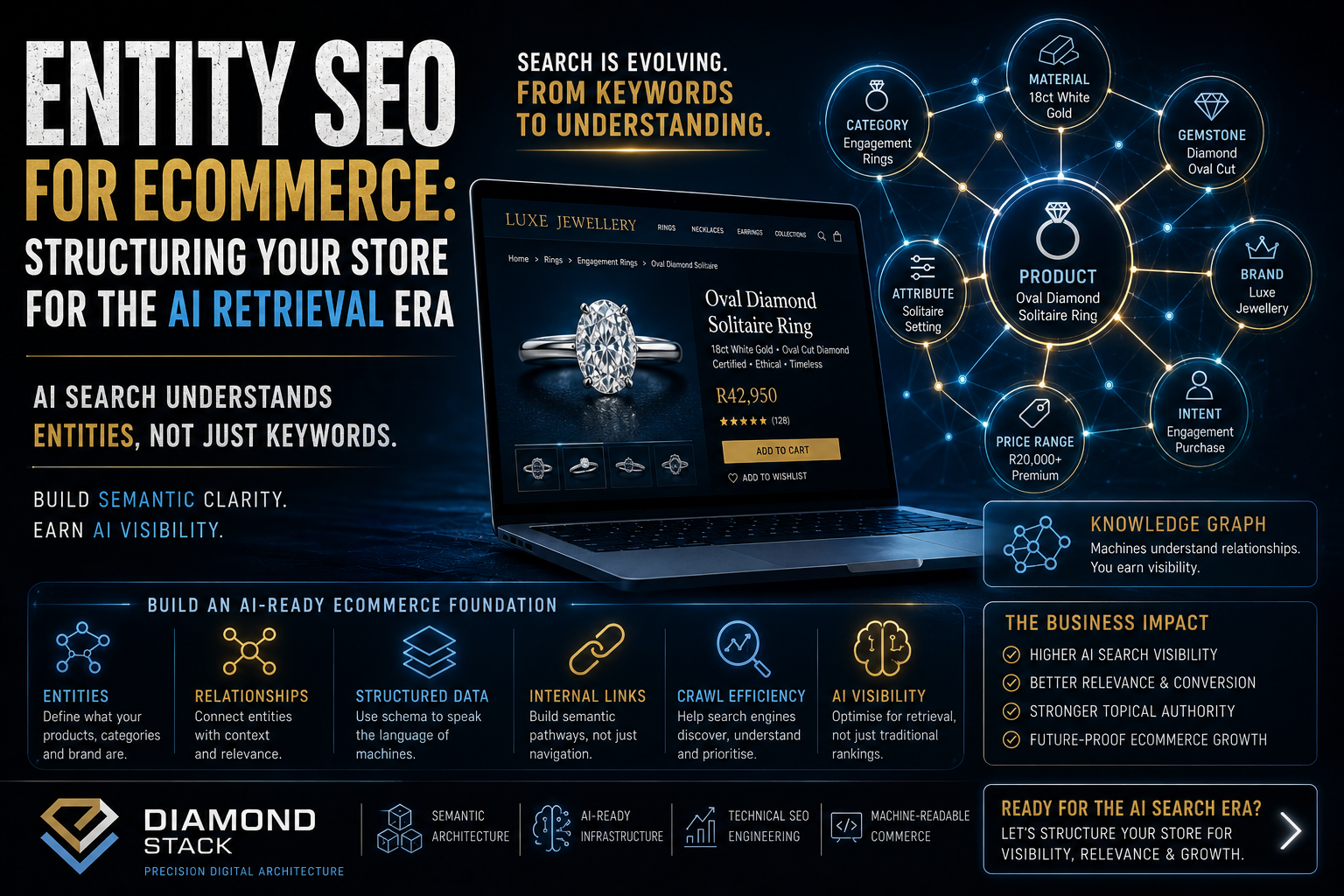
“Platinum solitaire engagement ring”
contains multiple entities:
- platinum,
- solitaire,
- engagement ring,
- jewellery,
- luxury product category,
- gemstone setting style,
- and bridal purchasing intent.
Modern search systems increasingly map these relationships rather than simply matching phrases.
Keywords Describe Pages. Entities Describe Reality.
Traditional SEO focused on optimising pages around isolated keyword targets.
Entity SEO focuses on constructing semantic understanding.
A page about:
“18ct white gold oval diamond engagement rings”
is no longer evaluated purely through keyword density.
Search systems increasingly evaluate:
- material relationships,
- gemstone relationships,
- luxury product context,
- brand associations,
- category hierarchy,
- and semantic consistency.
This changes ecommerce strategy fundamentally.
Search Engines Are Becoming Relationship Engines
Modern search systems increasingly operate through:
- knowledge graphs,
- semantic indexing,
- contextual retrieval,
- vector search,
- and entity modelling.
Instead of asking:
“Which page contains this keyword?”
AI systems increasingly ask:
“Which entities best satisfy the contextual meaning of this query?”
This shift is enormous for ecommerce.
Visibility now depends on semantic precision.
Why Traditional Ecommerce SEO Is Becoming Obsolete
Many ecommerce SEO strategies still operate according to outdated assumptions.
The traditional model focused heavily on:
- keyword repetition,
- thin category optimisation,
- metadata manipulation,
- and content volume.
These tactics increasingly struggle within AI-driven retrieval environments.
Keyword-Centric SEO Creates Semantic Weakness
Many ecommerce stores produce:
- repetitive category pages,
- duplicate metadata,
- low-context product descriptions,
- and isolated product listings.
These structures often contain keywords without semantic depth.
AI systems increasingly prioritise:
- contextual understanding,
- semantic consistency,
- and relationship modelling.
A page optimised purely around phrases without strong entity relationships appears semantically weak.
Thin Product Pages Are Retrieval Problems
Many ecommerce product pages still contain:
- minimal descriptions,
- generic specifications,
- disconnected attributes,
- and weak contextual information.
From a machine understanding perspective, these pages provide insufficient semantic confidence.
AI retrieval systems prefer environments with:
- clear entity relationships,
- structured contextual signals,
- and strong semantic coherence.
AI Overviews Are Changing Search Behaviour
The rise of:
- AI Overviews,
- conversational search,
- semantic retrieval systems,
- and machine-generated answers,
is fundamentally changing ecommerce discovery.
Search engines increasingly synthesise information rather than simply displaying ranked links.
This means ecommerce stores must become:
- retrievable,
- understandable,
- and semantically trustworthy.
Traditional keyword strategies alone are no longer sufficient.
Retrieval-First Search Changes Everything
Modern search increasingly behaves like retrieval infrastructure.
AI systems retrieve:
- entities,
- relationships,
- concepts,
- and contextual associations.
The ecommerce stores best structured for semantic retrieval gain disproportionate visibility advantages.
Ecommerce as a Semantic Product Graph
Modern ecommerce should function as a semantic product graph rather than a digital catalogue.
This is one of the most important conceptual shifts in AI-ready commerce.
Products Exist Within Relationship Systems
A product does not exist independently.
It exists within:
- categories,
- attributes,
- materials,
- compatibility relationships,
- industries,
- collections,
- and contextual use cases.
For example, a luxury watch may connect semantically to:
- Swiss manufacturing,
- chronograph movements,
- sapphire crystal,
- luxury accessories,
- stainless steel,
- men’s fashion,
- and premium gifting.
AI systems increasingly evaluate these relationships holistically.
Jewellery Ecommerce as a Semantic Ecosystem
A jewellery ecommerce store should not merely list products.
It should establish semantic relationships between:
- gemstones,
- precious metals,
- ring settings,
- bridal collections,
- certification standards,
- and luxury categories.
This creates a machine-readable product graph.
The same applies to:
- industrial suppliers,
- technical wholesalers,
- electronics retailers,
- security equipment providers,
- and manufacturing businesses.
Structured Hierarchy Creates Semantic Confidence
Semantic clarity depends heavily on hierarchy.
Well-engineered ecommerce environments reinforce:
- category structure,
- attribute consistency,
- contextual grouping,
- and entity relationships.
Search systems increasingly reward structural coherence.
Structured Data and Machine-Readable Commerce
Structured data is becoming foundational infrastructure for AI retrieval systems.
Many businesses still treat schema markup as a technical enhancement.
In reality, it is semantic communication infrastructure.
Product Schema as Entity Reinforcement
Product schema helps search systems understand:
- product identity,
- pricing,
- availability,
- reviews,
- brand relationships,
- and category context.
Without structured product relationships, semantic understanding weakens.
Organisation Schema and Brand Identity
Organisation schema reinforces:
- business identity,
- supplier authority,
- location relevance,
- and brand relationships.
AI systems increasingly evaluate organisational trust through structured data consistency.
FAQ Schema and Contextual Depth
FAQ schema provides additional semantic reinforcement by clarifying:
- product intent,
- customer concerns,
- compatibility questions,
- and contextual usage.
This improves retrieval confidence.
Breadcrumb Schema and Hierarchy Understanding
Breadcrumb schema reinforces:
- category relationships,
- navigational hierarchy,
- and contextual product positioning.
Hierarchy matters deeply within semantic systems.
Structured Data Is Infrastructure Engineering
Structured data should not be implemented randomly.
It should be engineered systematically as part of:
- semantic architecture,
- entity modelling,
- and machine-readable commerce design.
AI systems increasingly depend on structured clarity.
Entity SEO and AI Retrieval Optimisation
AI retrieval systems fundamentally change how ecommerce visibility operates.
Vector Search and Contextual Understanding
Traditional search relied heavily on keyword matching.
Modern vector search evaluates:
- contextual similarity,
- semantic relationships,
- entity proximity,
- and conceptual relevance.
This allows AI systems to retrieve products based on meaning rather than exact phrasing.
Retrieval Confidence Depends on Semantic Stability
AI systems prefer ecommerce environments with:
- consistent metadata,
- structured relationships,
- semantic clarity,
- and stable hierarchy.
Fragmented WooCommerce environments often create:
- duplicate entities,
- inconsistent attributes,
- overlapping taxonomies,
- and semantic ambiguity.
This weakens retrieval confidence.
Entity Ambiguity Reduces Visibility
If search systems cannot confidently determine:
- what a product is,
- how it relates to categories,
- or why it matters contextually,
visibility declines.
Semantic uncertainty reduces retrieval prioritisation.
Machine-Readable Commerce Requires Precision
Future ecommerce visibility depends on:
- machine-readable inventory,
- semantic consistency,
- crawl efficiency,
- and structured relationships.
Entity SEO is fundamentally about reducing semantic friction.
Internal Linking as Relationship Engineering
Internal linking is no longer merely navigational.
It is semantic relationship engineering.
Internal Links Reinforce Entity Relationships
Every internal link communicates contextual association.
For example:
- linking gemstones to ring collections,
- linking categories to educational content,
- linking specifications to compatible products,
helps search systems understand semantic relationships.
Semantic Hierarchy Improves Crawl Efficiency
Well-engineered internal linking improves:
- crawl prioritisation,
- contextual understanding,
- entity clustering,
- and semantic authority flow.
Poor internal linking creates ambiguity.
Contextual Authority Pathways
Internal links help establish:
- topical authority,
- contextual depth,
- and semantic reinforcement.
AI retrieval systems increasingly evaluate these relationships.
Relationship Architecture Matters
Modern ecommerce systems should guide:
- users,
- crawlers,
- and AI retrieval systems,
through coherent semantic pathways.
This is relationship architecture.
Building an AI-Ready Ecommerce Architecture
Future ecommerce infrastructure requires deliberate semantic engineering.
Semantic Category Structures
Categories should reflect:
- logical hierarchy,
- contextual grouping,
- semantic precision,
- and product relationships.
Overlapping or fragmented taxonomies weaken entity clarity.
Structured Product Attributes
Product attributes should be:
- standardised,
- crawlable,
- semantically consistent,
- and machine-readable.
This improves:
- retrieval understanding,
- filtering precision,
- and contextual modelling.
Taxonomy Governance
Taxonomies should be actively governed to prevent:
- duplication,
- fragmentation,
- overlapping relationships,
- and semantic drift.
Hierarchy discipline matters.
Crawl Path Optimisation
Search systems require efficient crawl environments.
Businesses must minimise:
- crawl waste,
- duplicate URLs,
- parameter inflation,
- and semantically weak pages.
Entity SEO overlaps heavily with crawl engineering.
Lightweight Frontend Architecture
Heavy frontend environments often interfere with:
- semantic extraction,
- structured data visibility,
- and rendering efficiency.
Lean infrastructure improves machine understanding.
Semantic Content Clustering
Educational content should reinforce:
- product entities,
- category relationships,
- and contextual expertise.
This creates semantic reinforcement across the ecommerce ecosystem.
The Future of Semantic Commerce
Ecommerce is entering the retrieval era.
Search systems increasingly function as:
- semantic interpreters,
- contextual recommendation engines,
- and machine-mediated discovery systems.
AI Commerce Assistants
Consumers will increasingly interact with:
- AI shopping assistants,
- conversational commerce systems,
- and semantic product recommendation engines.
These systems depend heavily on entity clarity.
Retrieval-First Ecommerce
Future ecommerce visibility will increasingly depend on:
- retrieval compatibility,
- semantic precision,
- and machine-readable architecture.
Traditional ranking models are evolving toward retrieval ecosystems.
Autonomous Discovery Systems
AI systems increasingly evaluate:
- product relationships,
- contextual fit,
- semantic confidence,
- and supplier authority,
without requiring traditional search behaviour.
This changes how ecommerce visibility works fundamentally.
Computational Trust
Future search visibility increasingly depends on computational trust:
- structured consistency,
- semantic clarity,
- crawl efficiency,
- and machine readability.
Businesses that communicate clearly to machines gain disproportionate visibility advantages.
Conclusion
Entity SEO is not simply another SEO trend.
It is the emerging architecture of machine-readable commerce.
Search engines are evolving from:
- indexing systems,
into: - semantic relationship engines.
AI retrieval systems increasingly prioritise:
- contextual understanding,
- entity relationships,
- semantic clarity,
- and computational trust.
Traditional keyword-focused ecommerce SEO is becoming insufficient within this environment.
Future ecommerce visibility will depend on how effectively businesses structure:
- products,
- categories,
- relationships,
- attributes,
- and contextual meaning,
into coherent semantic ecosystems.
The businesses dominating the AI retrieval era will not merely publish more content.
They will build more understandable systems.
At Diamond Stack, ecommerce architecture is engineered through the lens of:
- semantic commerce systems,
- Entity SEO,
- AI-ready WooCommerce infrastructure,
- structured data engineering,
- retrieval-first architecture,
- and machine-readable operational design.
For ecommerce brands, luxury retailers, technical suppliers, and WooCommerce operators, semantic clarity is no longer optional.
It is discoverability infrastructure.
Request an Entity SEO Audit, Semantic Ecommerce Assessment, AI Retrieval Visibility Review, or Technical SEO Architecture Audit to identify where semantic fragmentation, crawl inefficiency, and weak entity relationships may already be limiting your ecommerce visibility in the AI retrieval era.