
The Diminisher’s Tax: How Micro-management Erodes Luxury Margins
In the high-end jewellery trade, we are obsessed with the “leaks.” We track stone paracels to the milligram and audit security protocols with religious fervour. Yet, the most expensive leak in your business isn’t happening in the workshop or the vault. It’s happening in the boardroom.
It is called the Diminisher’s Tax.
Based on recent research—including a meta-analysis of over 30,000 citations on leadership multipliers—the data is unequivocal: certain leadership behaviours don’t just stifle morale; they act as a direct compounding tax on your gross margins.
The Anatomy of the Tax
A “Diminisher” is a leader who believes they are the smartest person in the room. In a luxury retail context, this is the CEO who insists on approving every Instagram caption, every technical SEO tweak, and every line of a supplier contract.
While this feels like “quality control,” the data tells a different story. By being the bottleneck, you aren’t ensuring quality; you are capping intelligence. When an elite team is managed by a Diminisher, they provide only 50% of their actual capability. You are paying 100% of a specialist’s salary but receiving half the cognitive output.
That 50% gap is the first instalment of the Diminisher’s Tax.
Rotting Capital vs. Rotating Capital
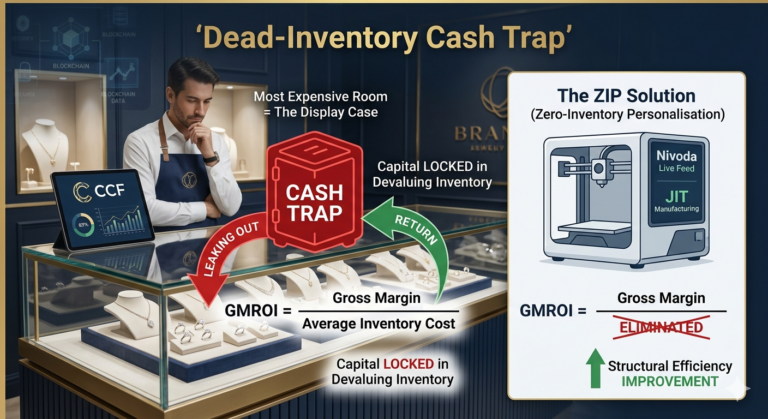
In our technical work at Diamond Stack, we look at the business through the lens of GMROI (Gross Margin Return on Investment).
A Multiplier leader understands that to keep capital rotating, they must empower their team to make data-driven decisions at the edge. A Diminisher, however, slows the “velocity of decision.” When a store manager or head of digital has to wait three days for a CEO’s “nod” to mark down stagnant stock or pivot a search strategy, that capital sits. It rots.
A slow decision-making cycle is the primary driver of a declining Altman Z-Score. If your business is drifting toward the “Grey Zone,” it is rarely because the market is down—it’s because your leadership “drag” is higher than your market “thrust.”
Technical Sovereignty: The Multiplier’s Tool
You cannot be a Multiplier if you are a tenant.
If your brand is built on a restrictive SaaS platform like Shopify, you have effectively outsourced your leadership to a “Digital Landlord.” Your team cannot innovate because the platform won’t let them. They cannot optimise because the “Landlord” owns the code.
Technical Sovereignty—owning your stack, your data, and your environment—is a prerequisite for Multiplier leadership. It provides your experts with a high-performance laboratory where they can actually work. When you move to a self-hosted, sovereign stack, you aren’t just changing software; you are removing the technical “ceiling” that turns your best people into order-takers.
The Day Zero Reality Check
The Diminisher’s Tax is invisible until you measure it.
At Diamond Stack, our Day Zero Audit doesn’t just look at your site speed; it looks at your business health. We measure the delta between your current GMROI and your potential if technical and leadership bottlenecks were removed.
If you are tired of paying a “tax” on your own expertise, it’s time to stop renting your infrastructure and start multiplying your results.