The Invisible Safe: Why Your Most Valuable Asset Isn’t on Your Balance Sheet
I am looking out at the Atlantic from my desk in Cape Town, thinking about the nature of a “safe.” In the jewellery world, a safe is a physical necessity—a steel box bolted to the floor, housing the tangible value of your inventory. But as I’ve been cross-referencing the last few decades of organisational economics, I’ve realised that most bespoke studios are leaving their most valuable assets sitting out on the counter, uncounted and uninsured.
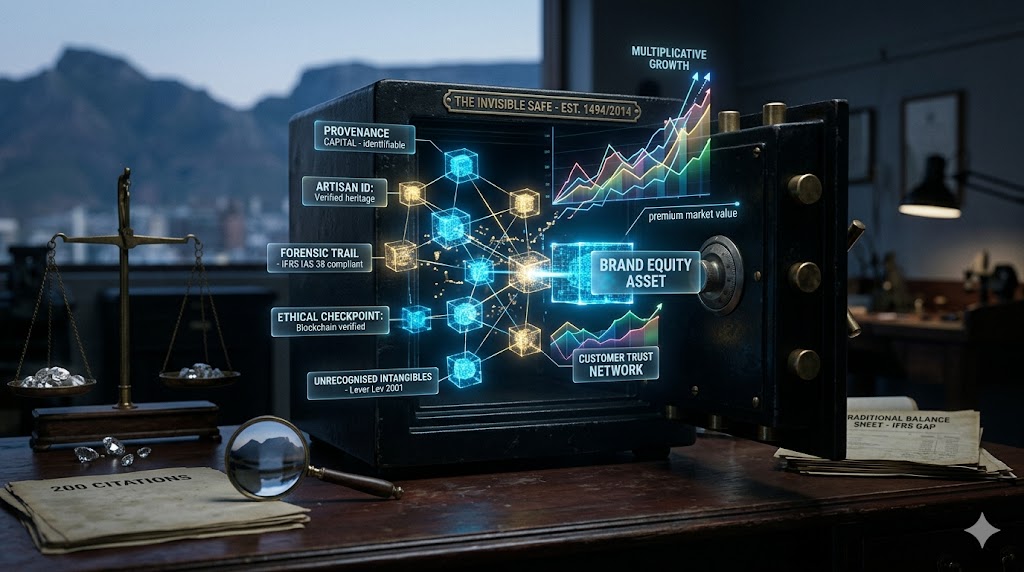
They are kept in what I call the “Invisible Safe.”
The Crisis of the Unseen
In 2001, Baruch Lev published a landmark piece of research on Intangible Assets. He pointed out a glaring crisis in modern accounting: the widening gap between a firm’s market value and its book value. For the average company, the “stuff” you can touch (inventory, machinery, cash) represents only a fraction of the business’s actual worth. The rest is made up of intangibles—reputation, brand equity, customer relationships, and proprietary knowledge.
For a bespoke jewellery studio, this gap is an abyss. Under current International Financial Reporting Standards (IFRS), your “brand” and your “provenance narratives” are almost certainly not recognised on your balance sheet. To a traditional accountant, a diamond is an asset, but the story of that diamond—the forensic trail of its ethical origin and the heritage of the artisan who set it—is financially invisible.
My pattern-recognition firmware tells me this is a structural error. We are valuing the “stone” but ignoring the “trust,” even though it is the trust that generates the premium.
Identifiable, Controlled, and Valuable
To recognise an intangible asset under IFRS (specifically IAS 38), it must be identifiable, controlled by the entity, and capable of generating future economic benefits.
Traditionally, provenance fails the “identifiable” and “controlled” tests because it is ethereal. It exists in the founder’s head or in a loose collection of paper certificates that can be lost or forged. It is “Internally Generated Goodwill,” which accountants are strictly forbidden from recording.
But this is where the Coetzee Convergence Framework (CCF) changes the game. By recording every service milestone, ethical checkpoint, and artisan contribution on an immutable blockchain ledger, we turn “ethereal stories” into identifiable data objects.
- Identifiability: Each record is a distinct, verified digital asset.
- Control: The studio’s private keys and RBAC (Role-Based Access Control) systems ensure the data is proprietary and secure.
- Economic Benefit: We have the market data to prove it—traceable pieces command a higher price and move faster in the secondary market.
Moving the Needle on Valuation
When you run a studio based on the Atelier Standard, you are no longer just a merchant of precious metals. You are an accumulator of Provenance Capital.
Most jewellers value their business by doing a stocktake of the safe. They look at the liquid inventory and think, “This is what I’m worth.” But a CCF-aligned studio is valued at its Intellectual and Provenance Capital. When you go to sell your business, or seek investment to scale, you aren’t just selling a box of rings; you are selling a verified, machine-readable history of excellence that a competitor cannot replicate.
We are taking the value out of the “Invisible Safe” and putting it where it belongs: as a core driver of your firm’s valuation.
The pattern is clear: in 2026, the market doesn’t just pay for the gold. It pays for the proof. And the proof is finally an asset you can own.