The Unified System — How Externalisation, Frameworks, and Cognitive Complementarity Become the Operating System of Your Atelier
Erwee Coetzee
Diamond Stack
Cape Town, South Africa
You’ve made it to Post 8.
Over the past seven posts, you’ve learned the theory, the cautionary tales, the methodology, and the practice. You’ve started keeping a Daily Provenance Log. You’ve begun thinking about frameworks. You’ve reflected on the cognitive diversity of your team.
Now comes the question: How does all of this work together?
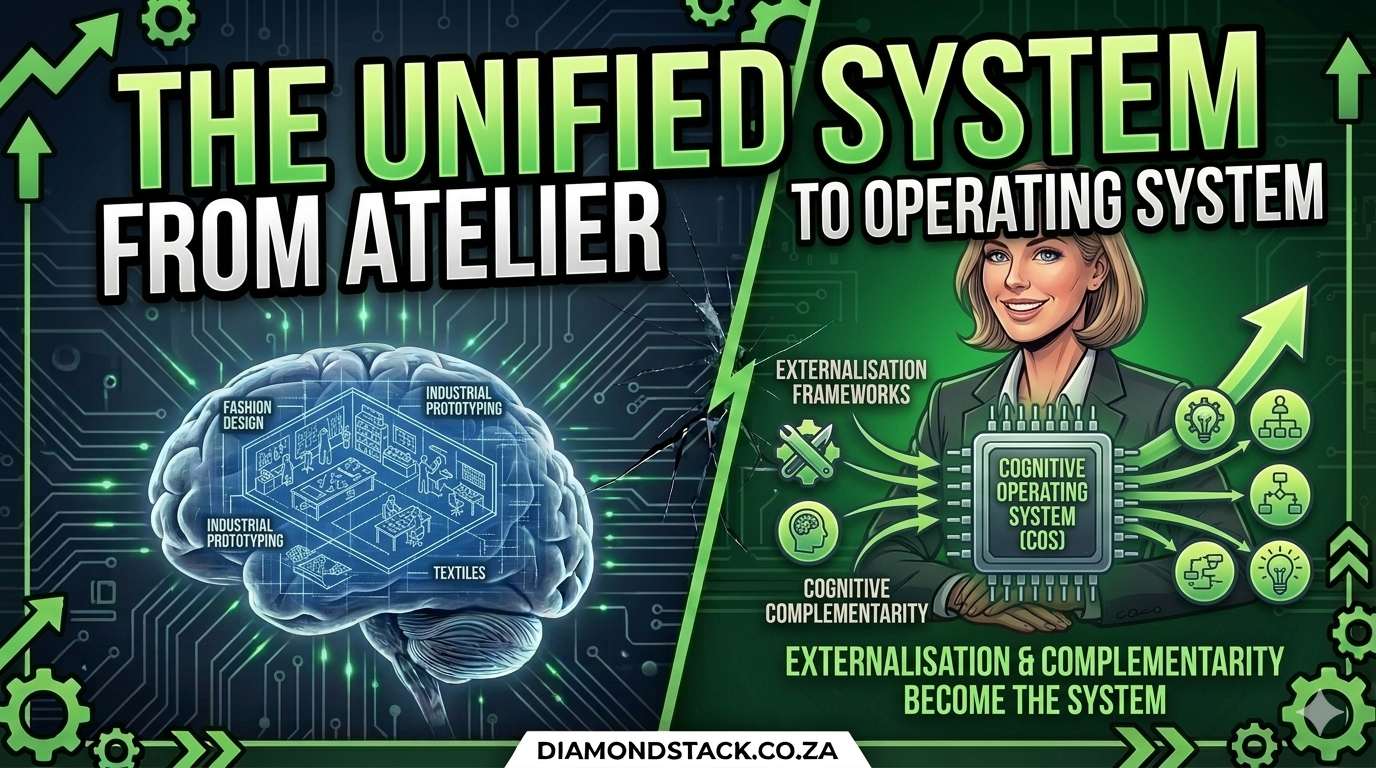
Post 8 is not another new concept. It’s the unification. The moment where externalisation, shared frameworks, and cognitive complementarity converge into a single operating system—what I call the Coetzee Convergence Framework.
The Three Pillars Converged
Pillar 1: Psychological Empowerment
Your team feels trusted to make decisions. Not because you’ve delegated and left them alone. But because you’ve built frameworks that make good decisions possible.
When Mthembu understands the Stone Selection Framework—when he knows that you’re not asking him to guess what you want, but to apply a shared logic—he feels empowered. He’s not executing your vision. He’s executing a framework you built together.
Spreitzer (1995) showed that empowerment isn’t about freedom from structure. It’s about structure that lets people exercise judgment. That’s what Pillar 1 is: competence + confidence + clarity = empowerment.
Pillar 2: Habit-Based Externalisation
Your tacit knowledge becomes explicit through daily practice. The Daily Provenance Log isn’t punishment or extra work. It’s the keystone habit that makes everything else possible.
Because you log daily, your team sees your thinking. Because they see it, they can articulate frameworks with you. Because frameworks are articulated, they can practice. Because they practice with feedback, they develop judgment.
The habit activates the system. Duhigg’s keystone habit concept wasn’t just theory—it was the operational linchpin that made externalisation non-negotiable.
Pillar 3: Cognitive Complementarity
Your team doesn’t need to clone you. They need to complement you.
You bring C/D thinking (relationships, vision). Your A-quadrant person brings data and rigor. Your B-quadrant person brings process and reliability. Your second C-quadrant brings interpersonal depth.
Together, the group makes better decisions than any individual. Not because they’re all smarter. But because different perspectives surface different risks and opportunities.
How They Work Together: The Operating System
Here’s the system in motion:
Day 1–10: The Log
You log a stone selection decision. You note: “Selected warmer tone for Q1 collector season. Rejected technically perfect stone because it lacked presence. Market showed immediate interest in selection.”
Your A-quadrant team member reads: “Interesting. Let me check the actual sales data on those decisions.” They validate your pattern with evidence.
Your B-quadrant team member reads: “So the criteria are: collector psychology, presence, seasonal fit, market position. Let me create a checklist we can use.” They operationalise.
Your C-quadrant team member reads: “This is vulnerable—you’re showing your thinking. That builds trust.” They notice the relational impact.
This is Pillar 2 (habit) + Pillar 3 (complementarity) in motion. Your log activates your team’s different perspectives simultaneously.
Month 1–3: The Frameworks Emerge
After 60 logged decisions, you sit down with your team to articulate frameworks (Post 6 methodology).
Your A-quadrant person says: “I see three clear patterns in the data.” Your B-quadrant person says: “Here’s how we’d systematise that.” Your C-quadrant person says: “How do we make sure the team understands the why, not just the framework?”
The framework that emerges is richer than anything you would have written alone. It’s informed by logic (A), structure (B), and relational understanding (C).
This is Pillar 2 (externalisation) + Pillar 3 (complementarity) creating something none of you could create individually.
Month 4–6: Practice and Calibration
Mthembu starts making stone selections using the framework. He’s not perfect. Some selections are brilliant. Some miss the mark.
When a selection is excellent, your C-quadrant person celebrates publicly: “Mthembu nailed the collector psychology on that one.” This builds psychological safety (Pillar 1).
When a selection misses, your B-quadrant person offers structured feedback: “You nailed the seasonal fit and presence. Next time, focus more on the market position quadrant.” This is empowerment with clarity (Pillar 1).
Your A-quadrant person tracks which types of selections convert fastest: “Your A-and-B criteria are spot-on. Your D criterion (discovery vs. expected) correlates with repeat purchases.” This is insight that calibrates the framework itself.
This is all three pillars in motion: Psychological empowerment (safe practice), Habit-based externalisation (framework in use), Cognitive complementarity (different perspectives calibrating together).
Month 9+: The Operating System
By month nine, stone selection is no longer something Mthembu needs approval for. He’s making 80% of decisions independently. Your role has shifted from approver to orchestrator.
When an unusual stone comes through—something that doesn’t fit the framework—Mthembu brings it to the team meeting. Your A person analyzes the market opportunity. Your B person suggests a process adaptation if it’s selected. Your C person checks the team’s capacity. Your D person imagines where this could lead. You synthesize: “Here’s how we integrate this outlier into our system.”
The decision is made by the group. The framework is applied by the group. The system evolves through the group.
You’re no longer the bottleneck. You’re the integrator.
Why This System Scales
It doesn’t depend on founder presence. Once frameworks are articulated and cognitive styles are understood, decisions can happen without you in the room. The system is self-sustaining.
It doesn’t depend on founder knowledge. You’re not trying to transfer everything you know. You’re building a system where different knowledge complements each other. An A-quadrant person contributes data analysis. A B-quadrant person contributes operational thinking. Neither replaces your knowledge—they enhance it.
It gets better over time. Every decision logged, every framework applied, every calibration made—the system learns. It adapts. It improves. Not because you’re adding new layers. But because the three pillars interact, creating feedback loops that make the system itself smarter.
From Theory to Execution
Here’s how to move from reading Post 8 to implementing the CCF:
Week 1–4: Start the Daily Provenance Log
If you haven’t already. Ten minutes a day. Decision + Result + Pattern. This is non-negotiable. It’s the foundation of everything.
Week 5–8: Identify your team’s cognitive styles
Which people are A, B, C, D? Where are you strong? Where are you missing? Don’t do formal assessments—just observe for a month.
Week 9–12: Start framework articulation
Pick one decision category (stone selection, design, pricing). Pull 20–30 logged examples. Sit down with your team and extract the frameworks using the Post 6 methodology.
Week 13–20: First practice round
Your team member practices decisions within the framework. You review. You calibrate. You build trust through feedback.
Week 21+: Expand and iterate
Add another decision category. Build another framework. Add another team member. Let the system grow organically.
What You’re Actually Building
This isn’t a management system. It’s not a philosophy. It’s an operating system for your atelier.
Just like a computer’s operating system coordinates different applications so they work together seamlessly, the CCF coordinates different people with different thinking styles so your atelier works together seamlessly.
The Daily Provenance Log is the kernel. The frameworks are the applications. The cognitive styles are the processors. Together, they run your business.
And unlike a human founder, an operating system can be documented, taught, and replicated. You can hand it to someone and they can run it. Not perfectly like you would. But well enough. And they’ll make it their own.
Where to Go From Here
Post 8 is the end of the series. But it’s also the beginning of implementation.
You now have a complete framework. You know why credibility matters (Post 1). You know your bottleneck is structural (Post 2). You know how to fix it (Posts 3–7). And you know how to integrate it all into a system (Post 8).
The question is no longer “Is this possible?” It’s “Will I commit to the 90-day implementation?”
Because that’s what it takes. Not perfect execution. But consistent, daily execution of the keystone habit. Honest dialogue with your team. Willingness to be wrong. Commitment to building something bigger than your own knowledge.
If you’ve read this far, I believe you’re ready.
Start the Daily Provenance Log this week. Not tomorrow. This week. Pick your tool. Pick your time. Do it today if you can.
That’s what the CCF builds. That’s where we’re heading.
The Three Pillars: Academic Foundation
Pillar 1: Psychological Empowerment
Spreitzer, G. M. (1995). Psychological empowerment in the workplace: Dimensions, measurement, and validation. Academy of Management Journal, 38(5), 1442–1465.
The foundational work showing that empowerment emerges from competence (understanding the framework), meaning (believing in the work), and impact (seeing decisions matter). The CCF activates all three.
Pillar 2: Habit-Based Externalisation
Duhigg, C. (2012). The power of habit: Why we do what we do in life and business. Random House.
Gersick, C. J. G., & Hackman, J. R. (1990). Habitual routines in task-performing groups. Academy of Management Review, 15(4), 710–720.
Nonaka, I., & Takeuchi, H. (1995). The knowledge-creating company. Oxford University Press.
How daily habits activate knowledge transfer. How tacit knowledge becomes explicit through routines. How group habits create organisational capability.
Pillar 3: Cognitive Complementarity
Herrmann, N. (1996). The whole brain business book. McGraw-Hill.
Belbin, R. M. (1981). Management teams: Why they succeed or fail. Butterworth-Heinemann.
Why diverse thinking styles outperform homogeneous teams. How to identify and leverage cognitive differences. Why founders can’t be the only brain in the room.