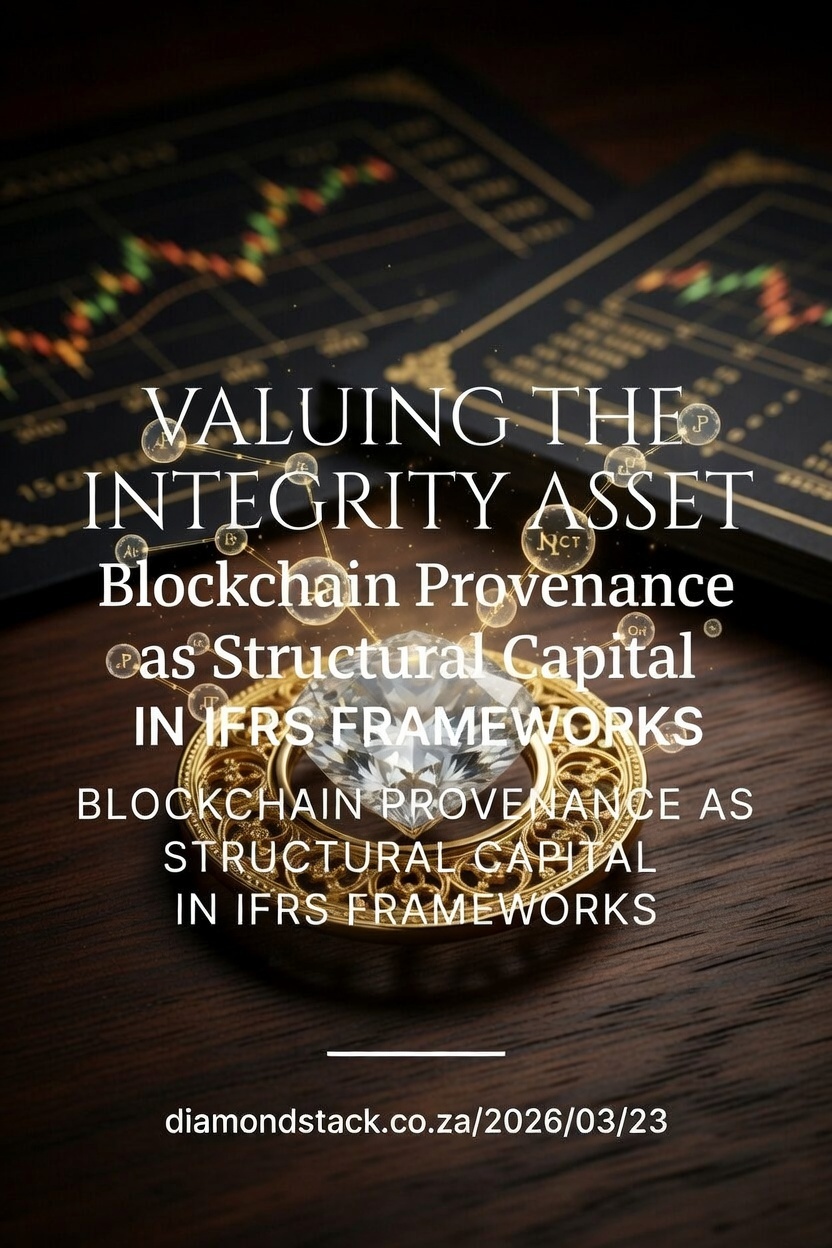
Valuing the Integrity Asset: Blockchain Provenance as Structural Capital in IFRS Frameworks
Target Journals: Journal of Intellectual Capital, Accounting, Auditing & Accountability Journal, International Small Business Journal
Abstract
Artisan micro-enterprises often struggle with a “valuation gap” due to the high density of intangible assets that remain unrecognized under traditional accounting standards. This paper examines how the Coetzee Convergence Framework (CCF) utilizes blockchain-based provenance as a mechanism to formalize “Integrity” into a measurable accounting construct. By framing blockchain records as Structural Capital—the internalized organizational routines that remain within the firm regardless of personnel—we demonstrate how these digital artifacts meet the rigorous IAS 38 (Intangible Assets) criteria for recognition. We propose that the convergence of habitual integrity and immutable ledgers allows firms to quantify “Integrity Rents,” providing a theoretically grounded path toward more accurate SME valuations in emerging markets.
Keywords: Blockchain Provenance, Structural Capital, IFRS, IAS 38, Intellectual Capital, Micro-enterprise Valuation.
I. Introduction
The difficulty of valuing small-to-medium enterprises (SMEs) in the luxury and craft sectors stems from a reliance on “Founder Goodwill”—an intangible asset that is notoriously difficult to transfer or quantify. The CCF proposes a shift from person-dependent value to system-dependent value. Central to this is the transformation of provenance from a marketing narrative into a Structural Asset. This paper investigates the financial reporting implications of this shift, specifically how blockchain-verified routines satisfy the International Financial Reporting Standards (IFRS) framework.
II. Theoretical Foundation: Provenance as Structural Capital
Within Intellectual Capital (IC) theory, Structural Capital represents the “non-human” storehouses of knowledge including databases, processes, and routines (Edvinsson & Malone, 1997).
- The CCF Mechanism: Pillar 2 (Habit Architecture) creates the routine; Pillar 3 (Blockchain) creates the immutable evidence of that routine.
- Value Added Intellectual Coefficient (VAIC): Following Pulic (2000), we argue that blockchain provenance increases the efficiency of Structural Capital (SCE), directly impacting the firm’s ability to generate value from its physical and human resources.
III. Accounting Recognition under IAS 38
To be recognized as an intangible asset on a balance sheet under IFRS (IAS 38), an item must meet three specific criteria. We evaluate the “Integrity Asset” against these:
- Identifiability: The asset must be separable (capable of being sold or transferred). A blockchain-verified provenance ledger is a distinct digital record linked to specific inventory and organizational processes. It is separable from the general “goodwill” of the founder.
- Control: The firm must have the power to obtain future economic benefits and restrict others’ access. Through cryptographic private keys and proprietary “Habit Architecture,” the micro-enterprise maintains exclusive control over the generation of this high-fidelity data.
- Future Economic Benefits: These include revenue from sales or cost savings. Peer-reviewed evidence from Catalini & Gans (2020) confirms that blockchain reduces verification costs, while Morhart et al. (2015) demonstrate a clear consumer “Willingness to Pay” (WTP) premium for verified authenticity.
IV. Measuring the “Integrity Premium”
The CCF argues that the “10x Multiplier” is not an arbitrary figure but the result of reduced Transaction Cost Economics (Williamson, 1985). By lowering the “cost of trust” for the buyer, the firm captures a higher percentage of the value chain.
- The Multiplier Logic: If a firm can prove its “Multiplier” capability (the ability to consistently produce high-integrity goods through empowered routines), its valuation shifts from a multiple of current cash flow to a valuation based on Real Options Theory—the option to scale a verified, high-trust system.
V. Conclusion
The “Integrity Asset” is the missing link in micro-enterprise financial management. By utilizing blockchain to codify organizational habits, the CCF provides a bridge between the qualitative world of artisan craft and the quantitative world of IFRS-compliant financial reporting. This framework allows micro-enterprises to build “Structural Capital” that is bankable, transferable, and ultimately, a driver of superior firm valuation.
Selected Peer-Reviewed References
- Aaker, D. A. (1991). Managing Brand Equity. New York: Free Press.
- Bontis, N. (1998). “Intellectual capital: an exploratory study that develops measures and models.” Management Decision.
- Catalini, C., & Gans, J. S. (2020). “Some Simple Economics of the Blockchain.” Management Science.
- Cong, L. W., et al. (2021). “Tokenomics: Dynamic Adoption and Valuation.” The Review of Financial Studies.
- Edvinsson, L., & Malone, M. S. (1997). Intellectual Capital: Realizing Your Company’s True Value by Finding Its Hidden Brainpower.
- IASB (2004). IAS 38: Intangible Assets. International Accounting Standards Board.
- Laitinen, E. K. (1992). “Prediction of Failure of a Newly Founded Firm.” Journal of Business Finance & Accounting.
- Morhart, F., et al. (2015). “Brand authenticity: An integrative framework and measurement scale.” Journal of Consumer Psychology.
- Pulic, A. (2000). “VAIC™ – an index for measuring the intellectual ability of value creation.” International Journal of Technology Management.
- Sveiby, K. E. (1997). The New Organizational Wealth: Managing & Measuring Knowledge-Based Assets.
- Williamson, O. E. (1985). The Economic Institutions of Capitalism.