
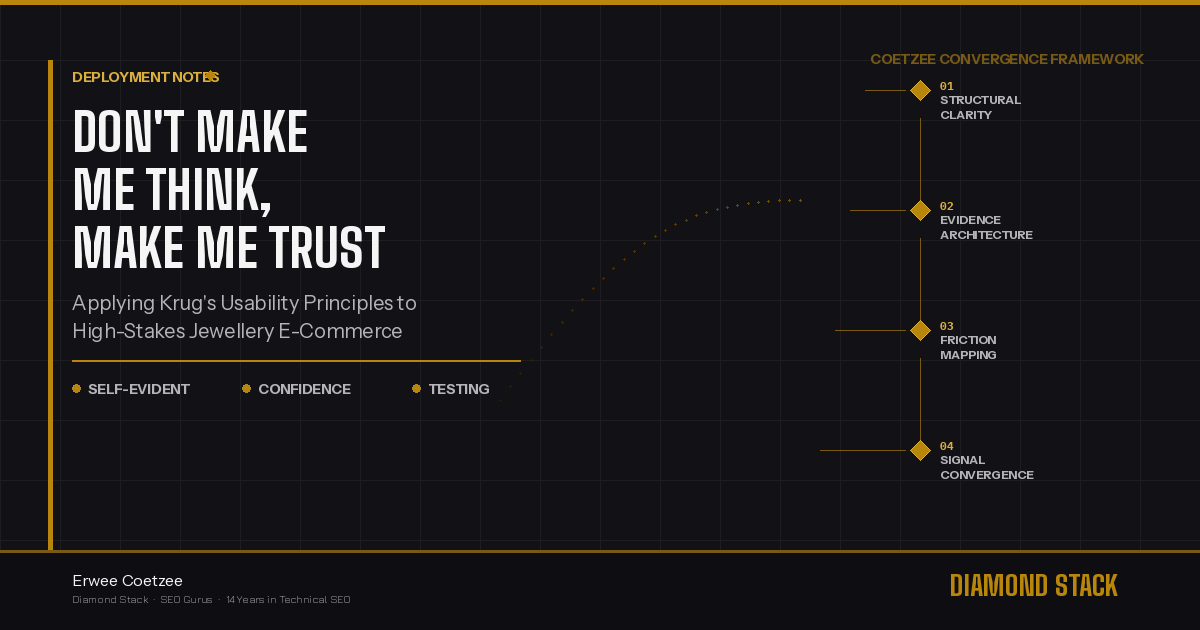
Don’t Make Me Think, Make Me Trust
I first read Steve Krug’s Don’t Make Me Think in the early years of my career, long before I specialised in jewellery e-commerce or developed the frameworks I use today. At the time, it struck me as obvious. Of course websites should be self-evident. Of course users should not have to decode navigation structures or puzzle over what happens when they click a button. Krug’s central thesis — that every question mark a website forces into a user’s mind is a cognitive tax that degrades the experience — seemed so self-evidently correct that I assumed the entire industry would absorb it within a few years and move on.
That was fourteen years ago. I am still waiting.
In the intervening decade and a half, I have audited hundreds of websites across dozens of verticals. I have built e-commerce platforms for diamond retailers, developed search visibility strategies for businesses operating in some of the most competitive markets in South Africa, and authored two books on advanced SEO and AI search. And in that time, I have come to understand that Krug’s insight was not merely a design principle. It was, in disguise, a trust principle. And nowhere is that more consequential than in the jewellery industry.
Consider the stakes. A person visiting a jewellery e-commerce website is not browsing for a pair of socks. They may be selecting an engagement ring — an object that represents one of the most significant emotional and financial commitments of their life. They may be spending twenty thousand, fifty thousand, a hundred thousand rands on a single transaction with a business they have never physically visited. The cognitive load that Krug identified as the enemy of good web design becomes, in this context, something far more dangerous: the enemy of trust. And in high-friction trust markets, the absence of trust is not merely an inconvenience. It is a transaction killer.
This is the terrain where the Coetzee Convergence Framework operates. The CCF is the strategic methodology I developed specifically for high-friction trust markets — industries where the purchase decision carries significant emotional weight, financial risk, or both, and where the buyer’s default posture is scepticism rather than curiosity. Jewellery, financial services, healthcare, legal services, high-value property — these are markets where every digital interaction is simultaneously an opportunity to build trust and a risk of destroying it.
What I want to explore in this article is the deep, structural connection between Krug’s usability philosophy and the trust architecture that the CCF demands. Because I have come to believe that they are not merely compatible. They are, when properly understood, two expressions of the same underlying truth: that in digital commerce, friction is the enemy of conversion, and in high-trust commerce specifically, friction is the enemy of belief.
Part I: Krug’s Three Laws, Restated for High-Trust Commerce
Krug’s book contains many insights, but at its core are three principles that I have found translate directly into the high-trust commerce environment. Let me restate them in the language of jewellery e-commerce, because the specificity is where the value lives.
First Law: Don’t Make Me Think — Every Moment of Confusion Is a Moment of Doubt
Krug’s original formulation is about cognitive load. A web page should be self-evident — the user should be able to “get it” without expending any conscious effort to understand what they are looking at or what they should do next. In a jewellery context, I restate this as: every moment of confusion is a moment of doubt. When a potential buyer lands on a diamond product page and encounters an unfamiliar certification abbreviation without explanation, or finds that the filter system resets after applying the third parameter, or cannot determine whether the displayed price includes VAT and the setting — each of these micro-confusions is not just a usability failure. It is a trust fracture. The buyer’s internal monologue shifts from “This stone looks beautiful” to “Do these people know what they’re doing?”
In my experience, the shift happens unconsciously and is almost impossible to recover from within the same session. The buyer may not be able to articulate why they navigated away. They will simply report, if asked, that the experience “felt off.” What they are describing, though they lack the vocabulary for it, is accumulated cognitive friction that eroded their willingness to trust.
Second Law: Minimise Clicks, Maximise Confidence
Krug does not literally say “minimise clicks” — he argues, correctly, that the number of clicks matters less than the difficulty of each click. A user who makes five effortless, obvious clicks is happier than a user who makes two clicks that required deliberation. I translate this for jewellery e-commerce as: every interaction should increase the buyer’s confidence rather than test their patience.
Think about the typical journey of someone shopping for a diamond engagement ring online. They arrive with a rough budget and perhaps a vague sense of what they want — round brilliant, maybe a carat, something in the G-H colour range. The website’s job is to guide that intention toward a specific stone and setting with increasing specificity and increasing confidence at every step. Each filter applied should feel like a refinement, not a restriction. Each product page visited should feel like a discovery, not a dead end. The buyer should feel progressively smarter about their choice, not progressively more confused.
When I audit jewellery websites, the most common failure I find is what I call the “confidence cliff.” The browsing experience is adequate — perhaps even pleasant — until the buyer reaches the point of committing to a specific stone. At that moment, they encounter a product page that fails to answer the questions that commitment raises: Can I see this stone in more detail? What does this GIA report mean in plain language? What does the setting look like from the side? Is this stone actually in stock, or am I about to be disappointed? How long until delivery? What is the return policy on a bespoke piece? Each unanswered question is a step backward on the confidence curve. Enough unanswered questions and the buyer simply leaves — not because they decided against buying, but because the website failed to carry them past the threshold of commitment.
Third Law: When in Doubt, Test
Krug’s insistence on usability testing is, I believe, the most underappreciated section of his book. Not because the principle is complex — it is disarmingly simple — but because it is almost universally ignored outside of Silicon Valley product teams. In fourteen years of working with South African businesses, I can count on one hand the number of clients who had conducted even basic usability testing on their e-commerce platform before engaging me.
The CCF treats testing as a structural discipline, not a periodic event. When I build jewellery e-commerce platforms through Diamond Stack, we conduct observational testing with real users at three points: post-launch, post-first-content-sprint, and at quarterly intervals thereafter. The protocol is deliberately simple — five users, three tasks, observational notes on where hesitation occurs. Krug himself recommends a similar lightweight approach, and he is right: the insight-per-hour ratio of even crude usability testing vastly exceeds that of almost any other research method. What you learn in thirty minutes of watching someone try to find a one-carat round brilliant on your website is worth more than a year of analytics dashboards.
Part II: Where Krug Meets the Coetzee Convergence Framework
The Coetzee Convergence Framework was built for a specific type of market: one where the distance between browsing and buying is long, the emotional stakes are high, and the buyer’s default state is guarded. In these markets, every touchpoint must converge toward a single objective: the progressive elimination of doubt. Not the creation of desire — the buyer already has desire, or they would not be on your website. The job of the digital experience is to remove every obstacle between existing desire and completed action.
This is where Krug’s usability philosophy and the CCF converge so precisely that they become, in practice, inseparable. Let me trace the convergence across the four pillars of the CCF as I apply them to jewellery e-commerce.
Pillar One: Structural Clarity
The first pillar of the CCF demands that the website’s architecture make the buyer’s journey structurally obvious. Not visually obvious — structurally. The distinction matters. Visual clarity is about how things look. Structural clarity is about how things are organised so that the user never has to wonder where they are, how they got there, or what they should do next.
Krug calls this the “trunk test”: if you were dropped onto any page of a website with no prior context (as if you had been blindfolded, driven around, and then dropped there from the trunk of a car), could you immediately identify where you are, what the major sections are, how to search, and how to get back to the homepage? It is a brutally effective test, and the vast majority of jewellery websites fail it.
In the CCF, I extend this principle into information architecture. For a jewellery e-commerce site, structural clarity means: a primary navigation that mirrors the buyer’s mental model (not the seller’s inventory taxonomy), breadcrumbs that provide persistent orientation, category pages that load with sensible defaults rather than blank filter states, and product pages that follow a consistent template so that the buyer’s eye knows exactly where to find each piece of information without having to re-learn the layout for every stone.
I have seen jewellery websites where the navigation is organised by supplier rather than by product type, where rings, necklaces, and loose stones are all accessed through different navigation paradigms, and where the search function returns results in an order that bears no relationship to any logic a buyer would recognise. Each of these is a structural clarity failure, and each generates the kind of “thinking” that Krug warns against — which, in the high-trust context of jewellery, translates directly into doubt.
Pillar Two: Evidence Architecture
The second pillar of the CCF is what I call evidence architecture: the systematic, structured presentation of proof at every point where the buyer’s scepticism might activate. In a high-friction trust market, the buyer is not simply looking for information. They are looking for reasons to believe.
Krug’s work touches on this indirectly when he discusses the importance of clear, honest content and the elimination of “happy talk” — the vague, self-congratulatory copy that fills space without communicating anything of value. In the CCF, I make this principle explicit and structural: every product page, every category page, and every step of the checkout process must include evidence elements that address the buyer’s unspoken objections.
For a diamond product page, evidence architecture means: the GIA or AGS certificate number, linked to the certifying body’s verification page. High-resolution imagery from multiple angles, preferably including video. A plain-language explanation of the stone’s specifications — not just the technical data, but what that data means for how the stone will actually look on a finger, in natural light, from across a dinner table. Customer reviews or testimonials that reference specific aspects of the buying experience. Clear, unambiguous return and warranty policies, visible without scrolling or clicking through to a separate page. Delivery timeline, presented as a specific range, not a vague “3–5 business days.”
Each of these evidence elements serves the same function that Krug’s self-evident design serves: it removes a question from the buyer’s mind before the buyer has to consciously formulate it. The difference in the CCF context is that the questions being answered are not navigational (“Where do I click?”) but fiduciary (“Can I trust this?”). The principle is identical. The stakes are higher.
Pillar Three: Friction Mapping
The third pillar of the CCF is the systematic identification and elimination of friction across the entire buyer journey. This is where Krug’s usability testing philosophy and the CCF become most directly operational.
Friction mapping is not the same as usability testing, though it incorporates usability testing as a primary data source. It is a comprehensive audit of every point in the buyer’s journey where momentum could be lost. In jewellery e-commerce, the friction points are predictable and, in my experience, remarkably consistent across businesses of different sizes and market positions.
The first friction cluster occurs at discovery: the buyer searches for a term like “one carat diamond ring Cape Town,” lands on your site, and must immediately determine whether this website is relevant, trustworthy, and worth their time. If the landing page does not confirm all three within approximately three seconds — through visual quality, content relevance, and structural clarity — the buyer bounces. This is Krug’s “don’t make me think” applied at the speed of first impression.
The second friction cluster occurs at exploration: the buyer begins filtering and browsing your catalogue. Here, every slow page load, every confusing filter interaction, every unexpected layout change between product pages adds friction. I audit this phase by recording screen sessions and logging what I call “hesitation events” — moments where the user’s cursor stops moving, where they scroll up and down searching for something, where they click the back button. Each hesitation event is a data point marking friction.
The third friction cluster occurs at commitment: the buyer has found a stone they like and is considering purchase. This is where the confidence cliff lives, and it is where the majority of jewellery e-commerce revenue is lost. The buyer’s hesitation at this stage is not navigational confusion. It is trust uncertainty. And the solution is not better design in the visual sense — it is better evidence architecture, combined with a checkout process so straightforward that it feels inevitable rather than effortful.
The fourth friction cluster occurs post-purchase: confirmation emails, delivery tracking, and follow-up communication. Most jewellery retailers treat this phase as operational rather than experiential. That is a mistake. The post-purchase phase is where buyer’s remorse either takes hold or is extinguished, and it is where the foundation for lifetime customer value is laid. A clear, well-timed confirmation email with an expected delivery date, a tracking link that actually works, and a follow-up message three days after delivery asking about the experience — these are not operational niceties. They are trust compounding mechanisms.
Pillar Four: Signal Convergence
The fourth pillar of the CCF brings us back to the broader digital ecosystem and connects directly to the entity SEO and authority-building work that underpins everything I do through SEO Gurus. Signal convergence is the principle that every digital touchpoint of your brand — your website, your Google Business Profile, your social media, your supplier directory listings, your structured data, your content, your reviews — must tell a single, coherent, self-reinforcing story.
Krug does not address this dimension directly, because his work predates the era of multi-platform discovery. But the underlying principle is the same: consistency eliminates cognitive load. When a buyer encounters your brand on Google, clicks through to your website, visits your Instagram, and reads your Google reviews, they should feel at every stage that they are interacting with the same entity. The voice, the visual language, the factual details, the level of professionalism — all should converge. Any divergence creates the digital equivalent of what Krug would call “making them think.” And in a high-trust market, making them think means making them doubt.
Signal convergence is also where structured data and schema markup become trust instruments rather than merely technical SEO tactics. When your product pages carry comprehensive Product schema, your business carries Organisation and LocalBusiness schema, and your content carries Article and Person schema for the author — you are not just optimising for search engines. You are creating a machine-readable trust architecture that allows Google, AI assistants, and other discovery systems to present your business with the kind of authoritative context that human buyers interpret, correctly, as evidence of legitimacy.
Part III: What I Build Differently Because of This Convergence
Understanding the theoretical connection between Krug and the CCF is useful. But I am, by temperament and by profession, a builder. So let me describe, concretely, what this convergence looks like in the platforms I develop through Diamond Stack.
Product Pages That Answer Before the Question Forms
Every diamond product page I build follows a template that I call the “pre-emptive answer” structure. The page is organised not by what the seller wants to communicate, but by the sequence of questions that the buyer’s mind generates when evaluating a high-value stone. The sequence, refined over dozens of implementations and usability tests, runs: What does it look like? (hero image, video, 360-degree view). What are its specifications? (four Cs, presented in plain language with technical data accessible but not foregrounded). Why should I trust these specifications? (certification details, linked to verification). What will it cost me, fully loaded? (total price including setting, VAT, delivery). What happens if I’m not satisfied? (returns and warranty, visible without scrolling). How do I proceed? (clear, singular call to action).
Each section exists because, in observational testing, that question arose at that point in the buyer’s evaluation. Nothing on the page exists because “it’s good practice” or because “other sites do it.” Everything exists because a real human, looking at a real diamond, needed that information at that moment. This is Krug’s usability philosophy made architectural. And it is the CCF’s evidence architecture made visible.
Search and Filtering That Guides Rather Than Gates
The diamond search and filtering experience is where the majority of jewellery e-commerce websites fail the Krug test most egregiously. The typical implementation presents the buyer with a wall of filter options — cut, clarity, carat, colour, shape, certification, price, setting type — and expects them to know what they want before they begin. This is the equivalent of walking into a physical jewellery store and being asked to fill out a specification sheet before anyone will show you a single ring.
The systems I build through Diamond Stack approach filtering as a guided conversation. Sensible defaults are loaded based on the entry path: a buyer arriving from a search for “engagement rings under R50,000” sees a pre-filtered view that reflects that intent. Filters are applied progressively and non-destructively — each applied filter refines the results while clearly showing what has been applied, with one-click removal. The results count updates in real time, providing constant feedback that the system is responsive and the buyer is in control. And crucially, the filtering state persists: a buyer who navigates to a product page and then returns to the catalogue finds their filters intact, not reset. That single detail — filter persistence — is responsible for more rescued conversion journeys than any other technical feature I have implemented.
Checkout as Trust Ceremony
I think about checkout differently from most developers. The conventional view treats checkout as a conversion funnel — a series of steps to be compressed, optimised, and stripped of friction. That view is correct for commodity e-commerce. For high-value jewellery, it is incomplete.
In the CCF, checkout is what I call a “trust ceremony.” The buyer has committed to a significant purchase, and the checkout process must honour that commitment by being simultaneously efficient and reassuring. This means: clear, step-indicated progress (you are on step 2 of 4). A persistent order summary that updates in real time as options are selected. Security indicators that are visible but not hysterical (trust badges, SSL indicators, payment partner logos — present but not oversized, because oversizing security indicators paradoxically suggests that security is in question). A guest checkout option that does not require account creation before purchase. And at the final step, a clear summary of everything the buyer is about to commit to: the stone, the setting, the total cost, the delivery estimate, and the return policy — all visible on a single screen, without scrolling, on both desktop and mobile.
Krug would recognise this immediately: it is a checkout that does not make the buyer think. But in the CCF context, it does something more: it makes the buyer feel that they are in competent, trustworthy hands. The efficiency itself is evidence of professionalism. The clarity itself is evidence of honesty. The ceremony is the trust.
Part IV: The Compound Cost of Cognitive Friction in Trust Markets
I want to be explicit about why this matters commercially, because the cost of ignoring these principles is not merely aesthetic. It is financial, and it compounds.
When a jewellery website forces a buyer to think — in Krug’s sense — at any point in the journey, three things happen simultaneously. First, the buyer’s confidence decreases. Second, their cognitive load increases, making every subsequent interaction marginally harder. Third, and most insidiously, their perception of the business’s competence decreases. These three effects are multiplicative, not additive. A buyer who encounters three small friction points does not experience three times the doubt of a single friction point. They experience doubt that has compounded through three cycles, each amplifying the last.
I have seen this pattern in analytics data across dozens of jewellery e-commerce sites. The metric I watch most closely is what I call the “exploration-to-product ratio”: the number of catalogue page views relative to the number of product page views. In a well-architected experience, this ratio is low — buyers quickly find relevant stones and dive into product pages. In a friction-heavy experience, the ratio is high — buyers browse the catalogue extensively but rarely commit to viewing a specific stone in detail. They are window shopping because the experience has failed to build sufficient confidence for them to narrow their focus. The desire is present. The trust is not.
In a high-average-order-value vertical like jewellery, even modest improvements to this ratio represent significant revenue. I have seen cases where addressing a single friction point — fixing a filter that reset after three applications, adding plain-language certification explanations to product pages, implementing filter persistence — resulted in a fifteen to twenty per cent increase in product page engagement and a corresponding increase in enquiry and conversion rates. When your average transaction is measured in five or six figures, a twenty per cent improvement in conversion is not an optimisation. It is a step change.
Part V: Frequently Asked Questions
What is the Coetzee Convergence Framework?
The CCF is a strategic methodology I developed for businesses operating in high-friction trust markets — industries where the purchase decision carries significant emotional or financial weight and where the buyer’s default state is scepticism. It consists of four pillars: structural clarity, evidence architecture, friction mapping, and signal convergence, all working in concert to progressively eliminate buyer doubt across the digital experience.
How does “Don’t Make Me Think” apply differently to jewellery versus general e-commerce?
In general e-commerce, cognitive friction costs convenience. In jewellery e-commerce, cognitive friction costs trust. The same usability failure that causes mild annoyance on a clothing website causes genuine doubt on a jewellery website, because the financial and emotional stakes are exponentially higher. A confusing filter on a fast-fashion site might cost a thirty-rand sale. A confusing filter on a diamond site might cost a fifty-thousand-rand engagement ring.
Do I need to read Krug’s book to implement these principles?
I would encourage it — it is short, practical, and remarkably free of jargon. But the principles themselves are actionable without the book: make every page self-evident, ensure every interaction increases buyer confidence rather than testing patience, and test with real users early and often. If you are operating in the jewellery industry, the CCF provides the trust-specific architecture that translates Krug’s general principles into high-stakes application.
Can these principles be applied to an existing website, or does it require a rebuild?
Both are possible. If the existing platform is architecturally sound — built on WooCommerce or another flexible system — many of these principles can be implemented incrementally: product page restructuring, filter improvements, evidence element additions, and checkout refinements. If the platform itself is the constraint (limited templating, poor API support, inflexible checkout flow), then a strategic rebuild is likely more cost-effective than attempting to patch a fundamentally limiting architecture.
Conclusion: Every Pixel Is a Promise
Steve Krug’s genius was in articulating something that was hiding in plain sight: that the best websites are the ones that do not require their users to think about the website. The website disappears. What remains is the task, the content, the journey.
In high-trust commerce, I believe the same principle operates at a deeper level. The best jewellery e-commerce experience is one where the website disappears and what remains is the stone, the setting, the moment. The buyer does not think about the navigation, the filters, the checkout steps, the return policy. They think about the person they are buying for. They think about the expression on that person’s face. They think about the weight of the ring in their pocket.
Every element of the digital experience either supports that state or disrupts it. Every pixel is either building trust or eroding it. Every interaction is either moving the buyer toward commitment or giving them a reason to hesitate.
That is the convergence that the CCF seeks to create. Not the convergence of SEO and UX as academic disciplines, but the convergence of every digital signal into a single, unified experience of competence and care. When your website’s structure, evidence, friction management, and cross-platform signals all converge — when they all tell the same story, with the same clarity, at the same standard of excellence — something remarkable happens. The buyer stops thinking. And starts trusting.
That is when they buy.
For the independent jeweller reading this from Cape Town, Johannesburg, Hatton Garden, or the 47th Street Diamond District — your knowledge of stones, your supplier relationships, your ability to curate an exceptional collection — these are not threatened by better UX. They are amplified by it. The question is whether your digital infrastructure honours that expertise or obscures it behind friction, confusion, and doubt.
Build the architecture that lets your expertise speak. Eliminate the friction that makes your buyers think. Create the experience that makes them trust. The tools exist. The frameworks are proven. The only variable is whether you will act.
Erwee Coetzee is the founder of Diamond Stack, a specialist WordPress development studio for jewellery e-commerce, and SEO Gurus, a technical SEO consultancy focused on entity-based optimisation and durable search visibility. The Coetzee Convergence Framework (CCF) is one of three proprietary methodologies developed by Erwee for high-trust, high-friction digital markets. With fourteen years of experience in search and digital architecture, Erwee works with independent jewellers and businesses in trust-sensitive verticals to build digital experiences that convert scepticism into confidence.