The Bench and the Stack: 300% Year-on-Year Growth, a Nostalgic Metaphor
There is a workbench in a shop on Long Street in Cape Town that has been in continuous use for over forty years. The wood is stained with decades of polishing compound and jeweller’s rouge. The lamp clamped to its edge has been replaced three times, but the clamp marks from the original are still visible in the grain. The loupe in the top drawer has appraised more stones than any database has catalogued. The man who sits at that bench — let us call him Johan, because I have met a dozen Johans at a dozen benches across South Africa — can tell you things about a diamond that no grading report will ever capture. The way a stone’s fire shifts under the warm fluorescent tubes he has used for thirty years. The almost imperceptible asymmetry in a pavilion angle that a GIA certificate rounds away but his eye catches in a quarter-second. The supplier in Antwerp whose parcels consistently over-deliver on colour, and the one in Mumbai whose VS2 inclusions are always exactly where you do not want them.
Johan’s knowledge is extraordinary. It is also, in commercial terms, almost entirely invisible.
His shop has a website. It was built eight years ago by a nephew who was studying graphic design at the time. It has a gallery of product photographs taken on a velvet cloth with a smartphone. The contact page lists a landline number and an email address. It does not appear on the first three pages of Google for any search term a potential buyer might use. It has no structured data, no product schema, no integration with any diamond feed. The sum total of Johan’s four decades of accumulated expertise, as far as the digital world is concerned, is a static brochure that receives fewer visitors per month than a moderately popular Instagram post about a cat.
Three blocks away, there is another jewellery business. It was started two years ago by a twenty-eight-year-old named Lerato who has never hand-set a stone in her life. She could not distinguish a Tolkowsky ideal cut from a modified brilliant by eye. Her supplier relationships consist of a Nivoda API key and a RapNet login. But her WooCommerce store is immaculately architected. Her product pages carry full JSON-LD schema. Her diamond filtering allows customers to search by cut, clarity, carat, colour, shape, certification, and price with sub-second response times across a catalogue of twelve thousand stones. Her Google Business Profile is optimised and actively managed. Her content strategy generates three long-form articles per month, each with proper author entity markup. She ranks on the first page of Google for eleven jewellery-related search terms in the Cape Town market.
Lerato’s digital infrastructure is extraordinary. Her curatorial depth, compared to Johan’s, is almost entirely absent.
Here is my thesis, and it is the thesis of this entire article: the jewellery industry’s next era of growth — and I believe that growth can exceed 300% for individual businesses within three to five years — will be built neither by the Johans nor the Leratos alone. It will be built by the businesses that combine both. The bench and the stack. The generational eye and the digital architecture. The wood-grain wisdom and the structured data. Together.
Part I: The Bench — What Forty Years Teaches That No Algorithm Can Learn
I want to begin by giving the bench its full due, because the digital transformation conversation in the jewellery industry too often treats the older generation’s knowledge as an obstacle to be overcome rather than an asset to be leveraged. This is not just disrespectful. It is strategically illiterate.
What does a career at the bench actually produce? Let me try to catalogue what I have observed across fourteen years of working with independent jewellers in South Africa and beyond.
First, there is grading instinct. A GIA grading report is a standardised document that reduces a diamond’s characteristics to a set of categories. It is extraordinarily useful as a baseline. But anyone who has spent time in the trade knows that two stones with identical grading reports can present very differently in practice. The position of an inclusion matters as much as its classification. The way a stone handles light under different conditions — daylight, candlelight, the LED lighting that dominates modern retail — varies in ways that the report does not capture. The experienced jeweller does not read a grading report and know the stone. They read it and know what questions to ask when they see the stone. That interpretive layer is the product of thousands of hours of looking, comparing, and developing a calibrated eye that no machine learning model has yet replicated.
Second, there is supplier intelligence. The diamond supply chain is not a commodity market, despite what the pricing databases might suggest. Specific cutting houses produce consistently better results for specific stone types. Specific rough sources yield predictable characteristics that experienced buyers learn to anticipate. The jeweller who has maintained relationships with three or four trusted suppliers over twenty years possesses a sourcing advantage that a newcomer with a Nivoda login cannot replicate in two years, or five, or possibly ever. Those relationships are built on shared history, mutual reliability, and the kind of trust that only time produces.
Third, there is customer intuition. The jeweller who has helped a thousand couples choose an engagement ring has developed a sensitivity to unspoken preferences, budget anxieties, and emotional dynamics that no customer journey analytics platform can match. They know when a buyer says “I want the biggest stone we can afford” but means “I want something beautiful that will make her feel loved.” They know when a customer is genuinely undecided and when they are testing whether the jeweller will upsell. This emotional intelligence, honed through decades of face-to-face interaction, is the difference between a transaction and a relationship.
Fourth, and perhaps most importantly, there is reputation. A jeweller who has operated honestly in a community for thirty or forty years carries a trust asset that no amount of Google reviews can construct from scratch. Their name means something. Their word means something. In a market where the product is expensive, emotionally significant, and technically opaque to the average buyer, that reputation is not a legacy advantage. It is a present-tense competitive weapon — provided it can be made visible to the people who are searching for exactly what that jeweller offers.
This is the bench. This is what forty years teaches. And it is being wasted, in business after business, because the digital infrastructure to amplify it does not exist.
Part II: The Stack — What Architecture Makes Possible
Now let me give the stack its due, because the generational knowledge conversation too often dismisses digital infrastructure as superficial — as though a website were merely a shop window rather than a commerce engine.
The stack, in the context I use the term through Diamond Stack, refers to the complete digital architecture underneath a jewellery e-commerce operation. It is not a website. It is a system. And that system, when properly engineered, does things that no physical shopfront — however beautiful, however well-staffed, however perfectly located — can do.
The stack makes expertise discoverable. Over seventy per cent of jewellery purchases now begin with an online search. The buyer in Constantia who types “bespoke engagement ring Cape Town” into Google at eleven o’clock on a Tuesday night is expressing purchase intent that is immediate, specific, and valuable. If Johan’s shop does not appear in those results — and without proper technical SEO, structured data, and content strategy, it will not — then Johan’s forty years of expertise are invisible to the buyer who needs them most. The buyer finds Lerato instead, or Blue Nile, or a Johannesburg retailer with better digital infrastructure. Johan’s knowledge exists. The buyer’s need exists. The stack is the bridge between them.
The stack makes expertise scalable. Johan can serve one customer at a time in his physical shop. He can have perhaps six meaningful consultations in a working day. His addressable market is limited to the people who physically enter his premises, plus whatever word-of-mouth referrals his reputation generates. A properly architected e-commerce platform extends his reach to every buyer with an internet connection who is searching for what he offers. Not through impersonal automation, but through the structured presentation of his curatorial philosophy, his sourcing criteria, and his editorial perspective on every stone in his collection. The product page becomes the digital expression of the conversation he would have across the counter — except it is available twenty-four hours a day, seven days a week, to an audience of thousands rather than a handful.
The stack makes expertise verifiable. When Johan tells a customer across the counter that a particular stone has exceptional light performance, the customer has to trust his word. When that same claim is presented on a product page alongside a GIA report link, a provenance certificate, high-resolution imagery, video, and a plain-language explanation of what the grading data means in practice — the claim is not weaker for being accompanied by evidence. It is stronger. This is the principle I have written about extensively in the context of the Coetzee Convergence Framework: in high-trust markets, evidence does not replace the expert’s authority. It amplifies it.
The stack makes expertise compounding. Every product page published, every article written, every structured data element implemented, every Google Business Profile post, every customer review — these are not one-time marketing expenses. They are assets that accumulate. A product page with proper schema and unique editorial content continues to attract search traffic for years. A body of content that demonstrates deep expertise in diamond selection builds entity authority that makes every subsequent piece of content more visible. The stack does not just amplify expertise at a point in time. It creates a flywheel where expertise generates visibility, visibility generates traffic, traffic generates sales, and sales generate reviews that further compound the authority.
This is the stack. This is what architecture makes possible. And it is being wasted, in business after business, because the bench’s knowledge has not been fed into it.
Part III: The 300% Arithmetic — Why This Is Not Hyperbole
I need to address the number directly, because 300% growth sounds like the kind of figure that belongs in a pitch deck rather than a serious industry analysis. It is not. Let me show the arithmetic.
The typical independent jeweller in South Africa — and I have audited enough of them to speak with confidence — captures between two and five per cent of their addressable digital market. By “addressable digital market” I mean the total search volume for jewellery-related queries within their geographic and product scope, multiplied by the average conversion rate for the category. The reason they capture so little is not that the demand does not exist. It is that their digital infrastructure is so rudimentary that they are invisible to the majority of potential buyers.
Consider a jeweller whose primary market is engagement rings and fine diamond jewellery in the Cape Town metro area. The monthly search volume for relevant queries in this market — “engagement rings Cape Town,” “diamond rings South Africa,” “bespoke engagement ring,” and their long-tail variants — runs into the tens of thousands. The jeweller with no meaningful SEO presence captures almost none of this traffic. The jeweller with a properly architected platform, structured data, content strategy, and entity SEO can realistically capture five to fifteen per cent of relevant search traffic within twelve to eighteen months of disciplined execution.
The conversion mathematics follow. If the current digital revenue is R500,000 per year (which is typical for an independent with a basic website and some word-of-mouth online traffic), increasing qualified search traffic by a factor of five to eight — which is what proper digital infrastructure delivers — does not produce a linear increase in revenue. It produces an exponential increase, because the traffic is more qualified (people actively searching for what you sell), the product pages are better architected for conversion (evidence architecture, trust signals, clear calls to action), and the average order value in jewellery is high enough that even modest conversion improvements produce large revenue changes.
R500,000 becoming R1.5 million is 200% growth. R500,000 becoming R2 million is 300%. R500,000 becoming R2.5 million is 400%. These are not fantasy figures. They are the direct mathematical consequence of making a business that was effectively invisible to online buyers become visible, trustworthy, and transactable. I have seen it happen. I have built the platforms on which it happened. And the businesses where it happened most dramatically were the ones that combined deep generational expertise with properly engineered digital architecture.
The bench provided the product knowledge, the curatorial edge, and the supplier relationships that made the offering genuinely superior. The stack made that superiority visible, discoverable, and convertible at scale. Neither alone produced the result. Both together produced growth that transformed the business.
Part IV: The Handover That Is Not a Handover
There is a conversation happening in jewellery businesses across the world that follows a depressingly predictable script. The older generation, approaching retirement, wants to “hand over” the business to the younger generation. The younger generation wants to “modernise” it. Both sides treat this as a transfer of ownership and a change of direction. The older generation fears that their life’s work will be dismantled. The younger generation fears that they will be trapped running a business model that is visibly declining.
Both fears are legitimate. Both are also unnecessary, provided the transition is framed correctly.
The bench-and-stack model reframes the generational transition not as a handover but as a merger. The older generation is not stepping aside. They are providing the irreplaceable inputs — the knowledge, the relationships, the reputation, the curatorial eye — that give the digital platform its competitive edge. The younger generation is not replacing what came before. They are building the infrastructure that makes what came before visible to a market that has moved online.
In practical terms, this means the generational transition begins not with a discussion about who runs the business, but with a knowledge audit. What does the older generation know that has never been documented? Which suppliers are trusted, and why? What are the grading nuances that differentiate a genuinely exceptional stone from one that merely meets specification? What is the sourcing philosophy — the principles that guide which stones are selected and which are passed over? What are the stories that customers have responded to most powerfully over the years?
This knowledge, once documented, becomes the foundation of the digital platform’s content strategy, product differentiation, and brand narrative. Johan’s forty years of bench wisdom becomes the editorial voice of the product pages. His supplier intelligence becomes the sourcing story that distinguishes the business from every other retailer listing the same Nivoda inventory. His customer intuition informs the UX decisions that shape the buyer’s journey. His reputation becomes the entity authority that structured data communicates to search engines and AI discovery systems.
The younger generation, meanwhile, provides the technical competence to build and maintain the architecture: the WooCommerce platform, the API integrations, the structured data, the content production workflow, the analytics instrumentation, the ongoing SEO discipline. They do not need to know how to grade a diamond. They need to know how to build a system that translates diamond grading expertise into digital authority.
This is not a handover. It is a collaboration in which each generation contributes what the other cannot. And the output of that collaboration — a jewellery e-commerce platform that combines irreplaceable expertise with state-of-the-art digital architecture — is something that neither a pure-bench business nor a pure-stack business can produce.
Part V: The Knowledge Extraction Protocol — Making the Invisible Visible
The practical challenge of the bench-and-stack model is that the bench’s knowledge is largely tacit. It lives in the jeweller’s head, in their hands, in their instincts. It has never needed to be articulated because, in a physical retail environment, it was demonstrated rather than explained. The customer saw the jeweller examine a stone, heard the verbal explanation, felt the confidence that came from watching someone who clearly knew what they were doing.
Digital platforms cannot demonstrate tacit knowledge directly. They require that knowledge to be made explicit — translated into words, images, data structures, and narrative that can be published, indexed, and consumed by people who have never met the jeweller in person.
This translation process is what I call the knowledge extraction protocol, and it is the most important — and most overlooked — step in the generational digital transition. When I work with jewellery businesses through Diamond Stack, this is where we begin. Not with wireframes or platform selection, but with structured interviews that extract the bench’s knowledge into a format that can feed the stack.
The protocol covers four domains. Sourcing philosophy: why does this jeweller choose the stones they choose? What makes their selection criteria different from the default? What are they looking for that a consumer browsing a Nivoda feed would not know to look for? Grading interpretation: what does this jeweller know about how grading data translates to real-world appearance? Where do the reports fall short, and what does their experience fill in? Customer wisdom: what have forty years of face-to-face interactions taught about what buyers actually want, fear, and need? Trade relationships: which suppliers, cutting houses, and certification bodies does this jeweller trust, and what is the basis of that trust?
Each of these domains produces content assets that feed directly into the digital platform. Sourcing philosophy becomes the “About Our Collection” narrative and the editorial voice of product descriptions. Grading interpretation becomes the educational content strategy — articles, guides, and product page annotations that demonstrate expertise to both human readers and search engine crawlers. Customer wisdom informs the UX architecture — the friction mapping, the evidence placement, the checkout design. Trade relationships become the provenance story that distinguishes the business in a market where lab-grown alternatives are available at a fraction of the price.
The knowledge extraction protocol typically takes two to three weeks of structured sessions, producing a document that serves as the blueprint for the entire digital strategy. I have never encountered a jeweller with more than fifteen years of experience who did not possess enough tacit knowledge to fuel twelve months of content production and a completely differentiated digital presence. The knowledge is always there. The extraction is what is missing.
Part VI: The Industry Tailwinds — Why the Next Five Years Are Different
The bench-and-stack model does not exist in a vacuum. It exists in a market that is being reshaped by forces that, for perhaps the first time in the modern history of the jewellery industry, favour the independent operator over the conglomerate.
The lab-grown disruption has permanently altered the competitive landscape. Lab-grown diamonds now account for nearly half of all diamond engagement rings sold in the United States. For the independent natural diamond merchant, this creates an urgent need to compete on story rather than specification — and the bench’s knowledge of provenance, sourcing, and stone character is exactly the story that lab-grown alternatives cannot replicate. But that story must be digitised to reach the buyer who is currently defaulting to lab-grown because no natural diamond merchant has presented a compelling alternative at the moment of their online search.
The G7 traceability mandates are transforming compliance from a bureaucratic burden into a competitive advantage. The independent jeweller who can demonstrate verified provenance on their product pages is not just satisfying a regulatory requirement. They are creating a trust signal that distinguishes them from competitors who cannot or will not provide the same transparency. The bench’s supplier relationships — the knowledge of exactly where stones originate and through whose hands they pass — become commercially valuable when they can be documented and surfaced through digital infrastructure.
The AI discovery revolution is reshaping how consumers find products and services. Google’s AI Overviews, ChatGPT’s product recommendations, and other AI-driven discovery systems increasingly surface answers rather than links. The businesses that are surfaced in these answers are the ones with strong entity signals, comprehensive structured data, and content that demonstrates genuine expertise. The bench’s knowledge, properly structured and published, is exactly what AI systems are designed to identify and elevate. The stack’s architecture is what makes that knowledge legible to the systems that will increasingly determine which businesses buyers discover.
The direct-to-consumer shift has removed the wholesale gatekeepers that once stood between independent jewellers and their end customers. Platforms like Nivoda and RapNet give even the smallest jeweller access to global diamond inventory. The question is no longer whether an independent can access competitive product. The question is whether they can present that product with the curatorial authority and digital sophistication that commands premium pricing. The bench provides the authority. The stack provides the sophistication.
Each of these tailwinds independently favours the bench-and-stack model. Together, they create a window of opportunity that I believe is unprecedented in the modern jewellery industry. The independent jeweller who combines generational expertise with professional digital architecture is positioned to capture market share from larger competitors who are slower to adapt, less authentic in their storytelling, and less agile in their digital execution.
Part VII: The Architecture of the Combined Model
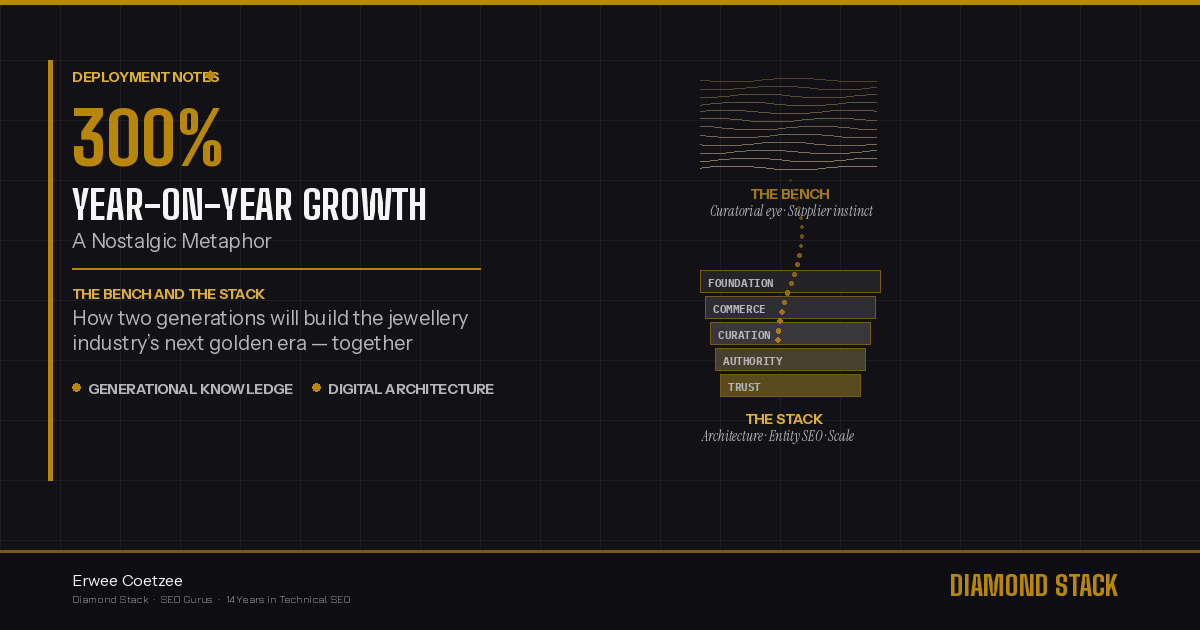
Let me describe, concretely, what the bench-and-stack model looks like when fully implemented. This is not theoretical. It is the architecture I build through Diamond Stack, informed by the strategic frameworks I have developed through SEO Gurus.
The foundation layer is a high-performance WooCommerce platform with proper server infrastructure, mobile-first design, and Core Web Vitals optimisation. This is the non-negotiable baseline. A slow, poorly built website cannot be saved by good content or great expertise. The foundation must be solid before anything else is built on top of it.
The commerce layer integrates diamond feeds from suppliers like Nivoda, RapNet, IDEX, and VDB. Real-time or near-real-time inventory synchronisation, faceted search across all relevant attributes, and performant handling of large catalogues. This layer gives the business access to global inventory — but so does every other jeweller with the same API keys. The commerce layer is necessary but not differentiating.
The curatorial layer is where the bench’s knowledge enters the system. Product descriptions that go beyond specifications to include the jeweller’s editorial perspective. A “Why We Selected This Stone” narrative on curated pieces. Educational content that demonstrates grading expertise. Provenance documentation that surfaces the sourcing story. Author entities with structured bios that establish the jeweller as a recognised authority. This layer is what no competitor with the same Nivoda feed can replicate, because it is built on knowledge that only the bench possesses.
The authority layer is the structured data and entity SEO architecture that makes the curatorial layer legible to search engines and AI discovery systems. Product schema with full attribute coverage. Organisation and LocalBusiness schema. Person schema for the author entities. Article schema for published content. BreadcrumbList for site structure. FAQ schema for embedded questions. This layer communicates the business’s expertise in the language that machines understand, ensuring that the bench’s knowledge is surfaced in search results, AI overviews, and knowledge panels.
The trust layer encompasses everything that builds buyer confidence: Google Business Profile optimisation, review generation systems, evidence architecture on product pages (certification links, provenance badges, return policies), and checkout design that honours the significance of the purchase. This layer converts the authority signals into commercial outcomes — turning visibility into traffic, traffic into engagement, and engagement into revenue.
Each layer depends on the one below it and amplifies the one above it. The foundation supports the commerce. The commerce enables the curation. The curation feeds the authority. The authority drives the trust. And the trust generates the revenue that funds continued investment in all five layers. This is the flywheel. This is how 300% happens.
Part VIII: Frequently Asked Questions
Is 300% growth in the jewellery industry realistic within three to five years?
For individual independent jewellers, yes — when growth is measured against their current digital revenue baseline. Most independent jewellers capture less than five per cent of their addressable market online. Properly architected e-commerce with diamond feed integration, entity SEO, and structured content can unlock the remaining ninety-five per cent of demand that currently flows to competitors with better digital infrastructure. A jeweller doing R500,000 annually online reaching R2 million is a 300% increase — and it is well within reach with the right architecture and twelve to eighteen months of disciplined execution.
Does digital transformation mean the older generation’s skills become irrelevant?
The opposite. The older generation’s curatorial eye, supplier relationships, and grading expertise are the irreplaceable inputs that give a digital platform its competitive edge. Without that knowledge, a website is just another generic listing. The digital infrastructure amplifies generational expertise by making it visible, discoverable, and transactable at scale — reaching thousands of buyers instead of only those who walk through the physical door.
How do I start the generational transition in my jewellery business?
Start with a knowledge audit: document the older generation’s supplier relationships, sourcing criteria, grading philosophy, and curatorial principles. This knowledge becomes the content strategy and product differentiation for the digital platform. Then build the technical foundation — a WooCommerce architecture with proper diamond feed integration, structured data, and mobile-first design — so that the documented expertise has a vehicle to reach the market at scale.
What role does each generation play in the bench-and-stack model?
The bench generation provides curatorial authority, supplier networks, grading instinct, and the trust that comes from decades of reputation. The stack generation provides digital architecture, commerce engineering, entity SEO, and the systems that make expertise visible to search engines, AI discovery, and online buyers. Neither can deliver transformative growth alone. The bench without the stack is invisible. The stack without the bench is hollow.
Conclusion: The Grain and the Grid
There is a moment in every generational jewellery business where the older generation looks at the younger generation’s laptop screen and sees a world they do not recognise. And there is a corresponding moment where the younger generation looks at the older generation’s loupe and sees a skill they do not possess. Both moments contain the same mixture of admiration and anxiety. Both moments contain the same unspoken question: is there a place for me in what comes next?
The answer, for both, is yes. But only if they build together.
The bench — with its scarred wood, its decades of accumulated intuition, its relationships sealed with a handshake and honoured across generations — is not a relic. It is a foundation. The knowledge embedded in that wood, in those hands, in those instincts, is precisely the competitive advantage that the digital market is crying out for. In a world of algorithmic recommendations and lab-grown alternatives and twelve-thousand-stone Nivoda feeds that all look identical, the jeweller who can say “I chose this stone for these reasons, and here is the evidence” possesses something that no technology can manufacture.
The stack — with its APIs, its structured data, its entity graphs, its search visibility, its commerce architecture — is not a replacement. It is an amplifier. It takes the knowledge that was previously locked in one-to-one conversations across a counter and makes it available to every qualified buyer searching for exactly that expertise. It does not replace the human judgement. It broadcasts it.
The grain of the wood and the grid of the data. The warmth of the loupe lamp and the precision of the schema markup. The mazal that seals the deal and the checkout flow that processes it. These are not opposites. They are partners.
Three hundred per cent growth is not a dream. It is the natural consequence of making extraordinary expertise — expertise that already exists, that has already been earned, that has already been proven across decades — visible to a market that is desperately searching for it. The bench has the knowledge. The stack has the reach. The question is whether they will be joined.
The jewellery industry’s next golden era will not be built by technologists who know nothing about diamonds. It will not be built by master jewellers who know nothing about digital. It will be built by the families, the partnerships, the businesses that have the wisdom to honour both — and the courage to build together.
The bench is waiting. The stack is ready. It is time.
Erwee Coetzee is the founder of Diamond Stack, a specialist WordPress development studio for jewellery e-commerce, and SEO Gurus, a technical SEO consultancy focused on entity-based optimisation and durable search visibility. With fourteen years of experience in search and digital architecture, Erwee works with independent jewellers to build digital infrastructure that amplifies generational expertise into scalable commercial advantage.