
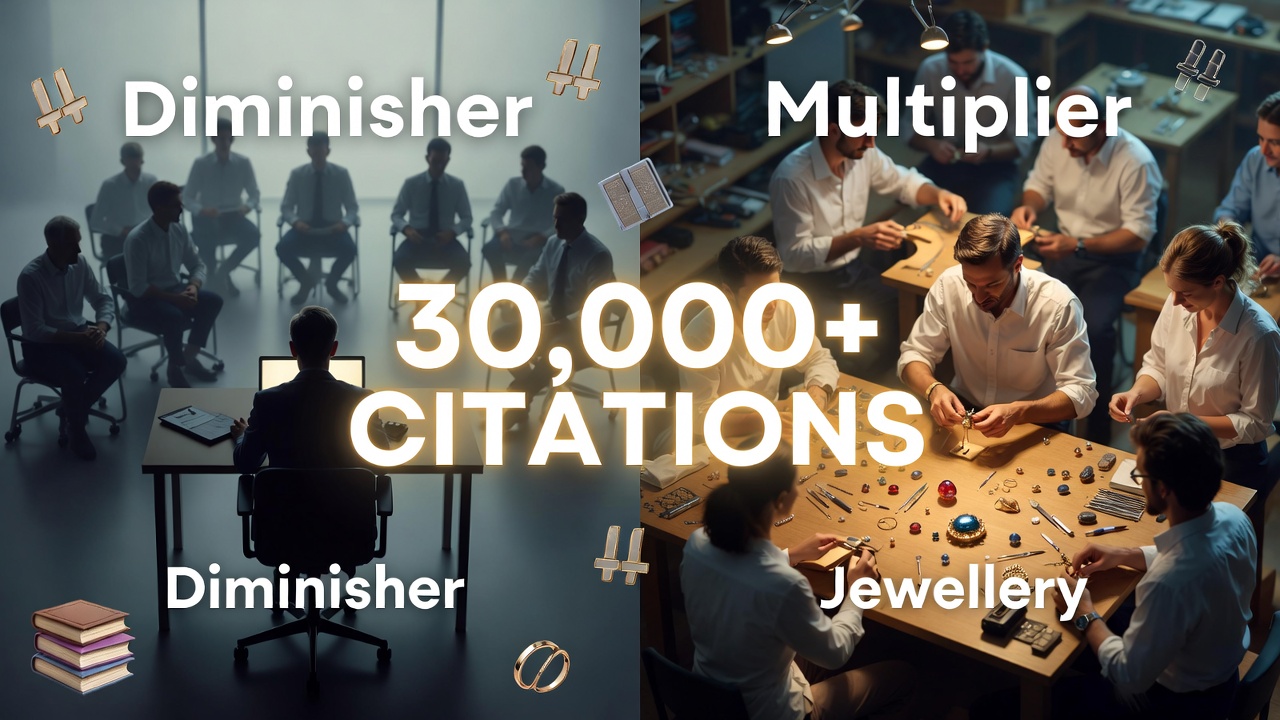
The Science Behind the Buzzword: What 30,000 Citations Tell Us About Multiplier Leadership
There is a jewellery studio in Observatory, Cape Town, where the owner arrives at seven each morning, switches on the extraction fan, and begins answering every question before anyone has asked one. He assigns the day’s work. He checks the previous day’s settings under the loupe himself. He approves every design amendment, every quote, every stone selection. He chose the suppliers twenty years ago and he chooses them still. His team of four — two bench jewellers, a polisher, and a sales associate — are skilled, experienced, and almost entirely passive. They wait for instructions. They execute. They do not volunteer ideas, because ideas are not what is expected of them. What is expected is compliance with a very specific vision that lives in one person’s head.
He is, by every available measure, an excellent jeweller. His settings are precise. His eye for stones is extraordinary. His customer relationships, built over two decades of honest dealing, are the bedrock of his revenue. He is also, according to the most rigorous research in management science, leading his business in a way that suppresses approximately half of his team’s potential output.
He does not know this. He has never encountered the research. And if you told him he was a “Diminisher” — the term Liz Wiseman coined in her bestselling book Multipliers — he would, quite reasonably, want to know whether that label is backed by anything more substantial than a management consultant’s opinion.
It is a fair question. It is, in fact, the right question. And the answer is more interesting than either the book’s advocates or its critics tend to acknowledge.
Here is the thesis of this article: the Multiplier Leadership brand, as a specific validated framework, does not hold up to academic scrutiny. But the psychological, neurological, and organisational mechanisms it describes are among the most rigorously proven concepts in the entire history of management science — supported by over 30,000 combined academic citations in the most prestigious journals in the field. For jewellery business owners, understanding where the marketing ends and the bedrock begins is not an academic exercise. It is the difference between building your leadership practice on sand and building it on stone.
What follows is drawn from a structured “devil’s advocate” research process — ten progressive rounds of interrogation, each designed to stress-test the claims of popular leadership frameworks against the hardest evidence available in organisational science. The investigation moved from scepticism to synthesis, and what emerged was surprising in its clarity.
Part I: The Brand — What Wiseman Built and What She Didn’t
I want to begin by giving the critique its full due, because the leadership development industry too often treats bestselling frameworks as settled science rather than hypotheses that require verification. This is not just intellectually lazy. It is commercially dangerous for a business owner making real decisions about how to lead real people.
Liz Wiseman’s Multipliers framework, first published in 2010, is built on interviews with approximately 150 leaders across 35 companies. From this qualitative foundation, Wiseman constructed a taxonomy of leadership behaviours — the Multiplier who liberates thinking versus the Diminisher who constrains it — and advanced the claim that Multiplier leaders get “2x” more intelligence from their people. The framework has achieved remarkable commercial success. The book has been translated into multiple languages, adopted by Fortune 500 companies, and spawned a consulting practice that reaches organisations worldwide.
What it has not achieved is independent validation in the peer-reviewed academic literature.
This is not a minor detail. The research underpinning the Multipliers framework is qualitative, based on self-reported perception data from the leaders and teams Wiseman’s team interviewed. It has been published primarily in practitioner-oriented journals such as Leader to Leader, which carries an impact factor of approximately 0.1 — a figure that places it well outside the sphere of rigorous empirical research. The book has accumulated roughly 300 academic citations, mostly conceptual in nature. Compare this with established constructs like transformational leadership, which has generated over 100,000 citations across validated empirical studies.
The pattern is not unique to Wiseman. Jim Collins’ “Level 5 Leadership,” Marcus Buckingham’s “strengths-based management,” Patrick Lencioni’s “five dysfunctions” — they all follow the same arc: compelling qualitative observation, powerful narrative, widespread commercial adoption, and limited peer-reviewed validation. This does not make them useless. It makes them hypotheses that need to be evaluated against the broader scientific literature rather than accepted on the authority of their authors alone.
The “2x intelligence” figure, in particular, is a marketing claim derived from perception data, not a measured outcome from controlled research. For a jewellery studio owner considering whether to restructure their leadership approach around this idea, it matters. You would not set a diamond based on an unverified grading report. You should not restructure your business based on an unverified leadership model.
But before dismissing the entire enterprise, it is worth asking a deeper question: even if the brand lacks validation, what about the underlying science?
Part II: The Mechanism — Thirty Years of Empowerment Research
Beneath the Multipliers branding lies a body of research that is, by any reasonable standard, among the most robust in organisational psychology. The construct is called psychological empowerment, and it has been studied, measured, and validated for over three decades.
The foundational work was published by Gretchen Spreitzer in 1995 in the Academy of Management Journal — one of the top-tier outlets in the field. Spreitzer’s paper, which has accumulated over 13,800 citations, established psychological empowerment as a measurable, multi-dimensional construct comprising four components: meaning (the sense that work matters), competence (confidence in one’s abilities), self-determination (autonomy over how work is done), and impact (the belief that one’s actions affect outcomes). Her research found significant positive correlations between psychological empowerment and both managerial effectiveness (r = 0.27) and innovation (r = 0.33). In the social sciences, where human behaviour is notoriously difficult to predict, these are substantial numbers.
But the real weight of the evidence comes from what happened after Spreitzer. In 2011, Seibert, Wang, and Courtright published a comprehensive meta-analysis in the Journal of Applied Psychology — another top-tier journal — synthesising the results of hundreds of studies conducted since Spreitzer’s original work. This paper, now cited over 2,500 times, produced effect sizes that leadership researchers describe as exceptionally strong.
Task performance showed a corrected correlation of ρ = .44 with psychological empowerment. To contextualise this: in medical research, a correlation of 0.30 between a treatment and an outcome is often considered sufficient to change clinical practice. A correlation of 0.44 is, in research terms, a powerful signal. Organisational citizenship behaviours — the discretionary efforts that go beyond formal job requirements — showed ρ = .38. Innovation and creativity correlated at ρ = .35. Team performance showed ρ = .41. Even customer service quality at the team level showed ρ = .34.
Now map these findings onto Wiseman’s claims. Her assertion that Multiplier leaders “double intelligence” corresponds to the empowerment–performance link (ρ = .44). Her claim that they “ignite innovation” maps to the empowerment–creativity link (ρ = .35). Her assertion of “better team results” aligns with the team empowerment finding (ρ = .41). The branded language is unvalidated. The psychological mechanism it describes is among the most proven in management science.
We are not talking about a single study with encouraging results. We are talking about a meta-analysis — a study of studies — that aggregated findings from hundreds of independent research projects conducted across different countries, industries, and organisational contexts over a period of fifteen years. When an effect survives that kind of scrutiny, appearing consistently regardless of who conducts the study or where it is conducted, it graduates from “promising finding” to “established scientific fact.”
This is the critical insight: the Multipliers framework is, at its core, a practitioner’s translation of psychological empowerment research. The brand is new. The science is not. And the science is formidable.
Part III: The Business Proof — 7,939 Units and the Gallup Data
If psychological empowerment provides the individual-level mechanism, the Gallup meta-analysis provides the business-level proof. Published by Harter, Schmidt, and Hayes in 2002 in the Journal of Applied Psychology, this study has become one of the most cited papers in applied psychology, with over 11,200 citations. Its scale is staggering: 7,939 business units across 36 companies, analysed to determine the relationship between employee engagement and hard business outcomes.
The findings were unambiguous. Employee engagement at the business-unit level was a direct, statistically significant predictor of customer satisfaction, productivity, profitability, and employee turnover. Units with higher engagement outperformed their lower-engagement counterparts across every metric examined.
For jewellery businesses, the implications are direct. Most jewellery studios and retail operations function as single business units — the team that makes or sells the product is also the team that interacts with customers and drives revenue. There is no corporate buffer, no regional averaging. The engagement level of your specific team feeds directly into your specific bottom line.
Consider what this means concretely for a jewellery studio with eight employees. Every person’s contribution is visible. Every interaction with a customer is personal. Every piece of work carries the studio’s reputation. If your goldsmith is disengaged, you see it in the quality of the bezels. If your sales associate feels diminished, your customers sense it within thirty seconds of entering the shop. The intimacy of the jewellery business does not insulate it from the engagement–performance relationship. It amplifies it.
When Wiseman describes a Multiplier leader who “gets more from people,” and critics respond that the claim is unvalidated, the Gallup data provides the missing link. You do not need Wiseman’s specific framework to be psychometrically validated if the underlying engagement–performance mechanism is validated across nearly 8,000 business units. The Multiplier concept is a lens for understanding what the Gallup data already proves: how leaders treat their people determines how the business performs.
Part IV: The Motivation Engine — Self-Determination Theory
If empowerment is the mechanism and engagement is the business outcome, then Self-Determination Theory provides the explanation for why both work. SDT, developed by Edward Deci and Richard Ryan over four decades, is arguably the most comprehensive and well-validated theory of human motivation in existence.
The definitive modern review was published by Gagné and colleagues in 2022 in Nature Reviews Psychology — a journal that represents the pinnacle of psychological science. Cited over 570 times in just three years, this paper synthesises the evidence for SDT’s central proposition: that human beings have three fundamental psychological needs — autonomy (the need to feel volitional and self-directed), competence (the need to feel effective and capable), and relatedness (the need to feel connected to others). When these needs are satisfied, people experience intrinsic motivation, perform better, and report greater well-being. When these needs are thwarted, motivation degrades, performance drops, and psychological harm follows.
The elegance of SDT is that it provides a unified explanation for why Multiplier behaviours work when they work. A leader who gives team members ownership over their craft is satisfying the autonomy need. A leader who invests in skill development and provides challenging work is satisfying the competence need. A leader who builds trust and psychological safety is satisfying the relatedness need. When Wiseman observes that Multiplier leaders “access the full intelligence” of their teams, SDT explains the neurological and psychological pathway through which this happens.
Conversely, the Diminisher behaviours that Wiseman catalogues — micromanagement, hoarding decisions, creating anxiety, controlling information — map precisely onto what SDT identifies as need-thwarting environments. A Diminisher does not just fail to motivate people. They actively suppress the conditions under which human motivation operates.
In the context of a jewellery studio, where the work demands high-precision craftsmanship and creative problem-solving, this suppression is not merely unpleasant. It is functionally destructive. When a jewellery business owner stands over a craftsperson’s shoulder, second-guessing every design decision and dictating every production step, they are not merely being inefficient. They are actively dismantling the psychological conditions that produce quality work. The craftsperson’s autonomy need is thwarted. Their sense of competence is undermined. Their connection to the work — the relatedness between maker and creation that drives artisan excellence — is severed. SDT predicts that this will produce not just lower motivation but active disengagement, and the meta-analytic evidence confirms this prediction with remarkable consistency.
You cannot produce exceptional work while your brain’s motivational architecture is being systematically starved. That is not a metaphor. It is what the science says.
Part V: The Jewellery Evidence — What the Industry-Specific Research Shows
One of the most common objections to applying general leadership research to the jewellery industry is that jewellery is different — that the combination of artisan craftsmanship, high-value inventory, trust-based customer relationships, and small team sizes creates a context so unique that general findings do not apply. This objection deserves serious engagement.
Lor and Hassan published a study in 2017 examining leadership styles among jewellery artisans in Malaysia. Their findings were striking: transformational and supportive leadership — the styles most closely aligned with Multiplier behaviours — had a positive and statistically significant impact on artisan performance. Transactional leadership (reward-and-punishment systems) and servant leadership were not significant. This finding directly challenges the assumption that jewellery artisans respond to the same incentive structures as factory workers or office employees. They do not. They respond to leadership that respects their expertise and gives them room to exercise it.
Fransisca and Thaib’s 2024 study of retail jewellery operations in Jakarta found that work motivation and work environment drove employee performance with effect sizes exceeding β = 0.5, mediated by job satisfaction. In jewellery retail, the quality of the work environment — shaped primarily by leadership — is not a “soft” factor. It is a primary driver of measurable performance.
The industry also provides compelling case studies. Titan Industries’ Tanishq brand in India deployed what can only be described as a Multiplier strategy: equipping frontline retail employees with the Karatmeter, a device that allowed them to demonstrate gold purity to customers independently. This act of resource provision gave front-line staff a form of expertise that had traditionally been hoarded by managers and owners. It was a classic empowerment intervention — giving people the tools to exercise competence and autonomy in real time — and it helped Tanishq grow into one of India’s most trusted jewellery brands.
In Kenya, Soko Jewelry developed a distributed artisan model that increased individual artisan income by four times compared to traditional factory employment. The mechanism was agency — giving artisans control over their production process rather than centralising it. This is Multiplier leadership applied at the structural level, and the results were transformative.
Meanwhile, research into the Thai gem and jewellery industry revealed a different pattern: women were systematically excluded from trading and valuation roles, meaning the industry was functionally utilising only half of its available human intelligence. This is the Diminisher pattern operating at the industry level — not through individual bad leaders, but through structural exclusion that produces the same outcome: suppressed capability, underutilised talent, and constrained performance.
The Birmingham Jewellery Quarter in the United Kingdom offers yet another lens. Research into this historic cluster found that despite extraordinary individual craftsmanship, the quarter struggled with what researchers described as “fragmented intelligence.” Individual masters possessed deep expertise, but this knowledge remained siloed within individual workshops. The cluster as a whole could not leverage its collective intelligence for growth, innovation, or market adaptation. Brilliant artisans, working in isolation, producing excellent work that never compounds into something greater than the sum of its parts.
Taken together, these studies paint a picture that is both encouraging and cautionary. The jewellery industry responds powerfully to empowering leadership — more so, in fact, than to transactional or servant leadership models. But the industry also carries unique structural features that make generic leadership advice insufficient. The artisan’s need for autonomy, the high-value inventory that demands accountability, the customer’s expectation of trust, and the small team dynamics that amplify both positive and negative leadership — all of these factors require an approach that is informed by the general science but adapted to the specific context.
Part VI: The Implementation Science — Why Habits Matter More Than Inspiration
Even if the science of empowerment, engagement, and self-determination is overwhelming — and it is — a persistent question remains: how does a jewellery business owner actually implement these insights? Knowing that empowered teams perform better is useful. Knowing how to build empowerment into the daily fabric of a business is essential.
This is where the science of organisational habits becomes critical. The neuroscience, based heavily on the work of Dr. Ann Graybiel at MIT, demonstrates that as behaviours become habitual, brain activity shifts from the prefrontal cortex (responsible for deliberate decision-making) to the basal ganglia (responsible for pattern recognition and automatic execution). This shift is not merely efficient. It is transformative. It means that once a leadership behaviour becomes habitual — once checking in with team members, delegating meaningful decisions, or conducting regular feedback sessions becomes automatic — it no longer requires willpower or conscious effort. It simply happens.
Gersick and Hackman’s 1990 study, published in Organizational Behavior and Human Decision Processes and cited nearly 2,000 times, demonstrated that group habits — the recurring patterns of interaction within teams — are the primary drivers of task performance. Teams do not perform well because they are inspired on any given day. They perform well because they have embedded effective routines that operate regardless of daily fluctuations in mood, motivation, or circumstances.
Winter’s 2013 paper in the Academy of Management Perspectives extended this insight, arguing that habits form the “microfoundations” of organisational capabilities. The routines a jewellery studio embeds — how craftspeople communicate about quality, how customer feedback is processed, how design decisions are made — are not peripheral to performance. They are the substance of it.
The most dramatic illustration comes from Alcoa under CEO Paul O’Neill. When O’Neill took over the aluminium giant in 1987, he did not focus on revenue targets or market strategy. He focused on a single “keystone habit”: workplace safety. Lost workdays per 100 workers dropped from 1.86 to 0.2. But the effects cascaded far beyond safety: Alcoa’s profits reached record highs during O’Neill’s tenure. The mechanism, as Weick’s “Small Wins” theory predicts, was that focusing on one foundational habit created a culture of accountability and communication that improved everything else.
Consider what a keystone habit might look like in a jewellery studio. It could be as simple as a daily five-minute morning check-in where each team member states their priority for the day and any support they need — rather than the owner assigning tasks unilaterally. Over weeks, this small routine rewires the team’s default pattern from passive reception to active ownership. It changes who does the thinking. And because habits compound, that single change begins to affect how design decisions are discussed, how customer problems are solved, and how quality standards are maintained.
This is why the habit-based approach is so much more effective than the workshop-and-inspiration model that dominates corporate training. A two-day leadership workshop may produce genuine insight and emotional commitment. But without habitual routines to anchor that insight into daily practice, the insight fades. Within six weeks, research consistently shows, the majority of workshop-generated intentions have dissipated. Habits, by contrast, persist precisely because they do not rely on sustained conscious effort. They become the new default.
For a jewellery business, transforming leadership is not about dramatic gestures or overnight reinvention. It is about identifying and embedding specific, repeatable routines that shift the daily experience of work from Diminisher patterns — centralised decisions, hoarded information, anxiety-driven management — to Multiplier patterns: shared ownership, transparent communication, autonomous craftsmanship. The neuroscience confirms that once these routines become habitual, they are self-sustaining.
Part VII: The Honest Critique — Where the Risks Lie
No responsible analysis would present only the supporting evidence. The research also reveals genuine risks and limitations that jewellery business owners must understand before acting on these findings.
The psychometric gap. The branded frameworks — Multipliers, the Seven Habits — have not been subjected to independent psychometric validation. While the underlying constructs are proven, the specific diagnostic tools and behavioural taxonomies offered by these brands may not accurately measure what they claim to measure. For practitioners, the practical implication is that formal assessment should rely on validated instruments — such as Spreitzer’s Psychological Empowerment Scale — rather than proprietary brand diagnostics. If a consultant offers you a proprietary assessment tool, ask what validated instrument it is based on. If the answer is “our own research,” proceed with appropriate caution.
The Security Paradox. This is the industry-specific tension that generic leadership advice consistently fails to address. Jewellery businesses operate with high-value inventory, and the instinct to centralise control is not merely a personality flaw — it is a rational response to genuine risk. A diamond worth tens of thousands of rands cannot be treated with the same casual distribution of authority that might work in a software company. Any move toward Multiplier leadership in jewellery must be paired with robust systems for inventory accountability. Distributed leadership must not become distributed vulnerability. Empowerment does not mean absence of controls. It means giving people authority over their craft while maintaining systems that protect the business.
The Founder’s Ego. Research by Pasanen (2003) identified the owner-manager as a “central bottleneck factor” in SME growth. The pattern is well-documented: founders who built their businesses through personal expertise and force of will often struggle to transition from being the primary source of intelligence to being the enabler of distributed intelligence. Ndidi and colleagues confirmed in 2022 that micromanagement significantly reduces employee productivity in small and medium enterprises. The science works — but only if the owner is willing to surrender the identity of being the smartest person in the room. This is a psychological barrier, not an intellectual one, and it remains the single largest risk to implementation.
Implementation dependency. McCabe’s 2011 analysis in Management Learning found that Covey’s Seven Habits framework, when deployed in corporate settings, sometimes became a tool of managerial control rather than genuine empowerment. The habits themselves are philosophically sound — each maps to validated psychological constructs including proactive personality research, goal-setting theory, and self-regulation science. But the system is implementation-dependent. A leader who uses empowerment language to extract more labour without genuinely sharing authority will produce cynicism, not engagement. The research validates the mechanism. It does not guarantee the execution.
Part VIII: The Three Pillars — What 30,000 Citations Actually Prove
The research converges on three pillars, each supported by decades of evidence from the highest-impact journals in organisational science.
Pillar One: The Performance Mechanism. Psychological empowerment, as measured by Spreitzer’s validated scale and confirmed by Seibert, Wang, and Courtright’s meta-analysis, produces substantial and consistent improvements in task performance, innovation, and team outcomes. The Gallup meta-analysis confirms this at the business-unit level across nearly 8,000 units. Lor and Hassan’s 2017 study provides the jewellery-specific confirmation. Moving from Diminisher to Multiplier leadership increases performance. This finding is, in the language of the research community, empirically indisputable.
Pillar Two: The Biological Driver. Self-Determination Theory, confirmed by Gagné and colleagues’ 2022 review in Nature Reviews Psychology, explains why empowerment works: it satisfies the fundamental psychological needs — autonomy, competence, and relatedness — that drive intrinsic motivation. In artisan work, where quality depends on creative engagement rather than compliance, this mechanism is not optional. It is the primary pathway through which leadership affects output quality.
Pillar Three: The Implementation Method. The sociology of routines, grounded in Gersick and Hackman’s research and extended by Winter, provides the practical framework: lasting change comes through embedded habitual routines, not one-off training interventions or motivational speeches. The Alcoa case demonstrates the principle at scale. For jewellery businesses, this means identifying keystone habits — specific, repeatable leadership behaviours — and embedding them into the daily rhythm of the studio.
Part IX: What This Means for the Owner at the Bench
Let me return to the jewellery studio in Observatory. The owner who arrives at seven, who answers every question before it is asked, who checks every setting and approves every quote. He is not a bad leader. He is a successful one — by the standards of a business model that worked for twenty years. The question is whether that model will work for the next five, in a market defined by volatility, shifting consumer expectations, and competitive pressures that did not exist a decade ago.
The science says it will not. Not because centralised leadership is inherently wrong, but because it imposes a ceiling on what the business can become. There are only so many hours in the owner’s day, only so many decisions a single brain can process, only so many customer relationships one person can maintain. The research on psychological empowerment says the team can do more — substantially more — if the conditions are right. The Gallup data says that creating those conditions directly improves the business outcomes that matter: customer satisfaction, productivity, profitability, retention.
First, the science is real and it applies to you. The correlation between empowering leadership and performance is not a theoretical abstraction. It is a measured relationship confirmed across thousands of studies and multiple jewellery-specific contexts. If you lead a team of artisans, designers, or retail staff, the way you distribute authority, share information, and invest in capability development has a direct, measurable impact on your business outcomes.
Second, be sceptical of brands but not of mechanisms. You do not need to buy a specific author’s framework to benefit from the underlying science. The Multipliers framework, the Seven Habits, and similar models are useful as accessible translations of rigorous research. They provide language and structure. But the authority comes from the peer-reviewed evidence, not from the bestseller list.
Third, address the Security Paradox explicitly. Unlike technology companies or creative agencies, jewellery businesses handle physically valuable inventory. Any move toward distributed leadership must be paired with clear accountability structures. The best jewellery businesses solve this tension. They do not pretend it does not exist.
Fourth, start with habits, not transformations. The neuroscience of habit formation tells us that lasting behavioural change is built incrementally, through repeated routines, not through dramatic declarations of new intent. Identify one Multiplier behaviour — perhaps asking team members for their assessment before giving your own, or delegating one category of decisions entirely — and practise it daily until it becomes automatic. Then add another. This is slow. It is also the only approach that the evidence says actually works.
Fifth, confront the founder bottleneck. If you built your jewellery business from nothing, your expertise and judgement were essential to its survival. They may now be the primary constraint on its growth. The research is unambiguous: the owner-as-only-thinker model is the most common structural bottleneck in small business performance. Transitioning from being the source of all decisions to being the enabler of distributed decision-making is uncomfortable. It requires surrendering an identity. It is also, according to every relevant body of research, the pathway to higher performance.
Part X: Frequently Asked Questions
Is Multiplier Leadership backed by peer-reviewed science?
Liz Wiseman’s specific Multipliers framework has not been independently validated in peer-reviewed academic journals. However, the underlying mechanism it describes — psychological empowerment — is among the most rigorously validated constructs in organisational psychology. Spreitzer’s 1995 foundational study has over 13,800 citations, and Seibert, Wang, and Courtright’s 2011 meta-analysis found a corrected correlation of ρ = .44 between psychological empowerment and task performance. The brand is unvalidated. The science underneath it is formidable.
How does empowering leadership apply specifically to jewellery businesses?
Lor and Hassan’s 2017 study of jewellery artisans in Malaysia found that transformational and supportive leadership had a significant positive impact on artisan performance, while transactional and servant leadership styles were not significant. The Gallup meta-analysis of 7,939 business units further confirms that engagement drives performance at the unit level — which is exactly how most jewellery studios and retail operations function.
What is the biggest risk when applying Multiplier principles in a jewellery studio?
The Security Paradox. Jewellery businesses handle high-value inventory, and the instinct to centralise control is a rational response to genuine risk. Any move toward empowering leadership must be paired with robust accountability systems for inventory, trust verification, and clear boundaries between creative autonomy and asset security. The second major risk is the Founder’s Ego — the owner-manager who struggles to transition from being the primary source of intelligence to being the enabler of distributed intelligence.
What is the difference between the Multiplier brand and psychological empowerment?
The Multiplier brand is Wiseman’s practitioner framework based on qualitative interviews with 150 leaders, published in practitioner journals. Psychological empowerment is a validated scientific construct measured by Spreitzer’s scale and confirmed across hundreds of studies in top-tier journals. The Multiplier framework is essentially a practitioner’s translation of empowerment research — the brand is new, but the science behind it has been accumulating for over thirty years.
How should a jewellery business owner start applying these research findings?
Start with habits, not transformations. Identify one Multiplier behaviour — perhaps asking team members for their assessment before offering your own, or delegating one category of decisions entirely — and practise it daily until it becomes automatic. Then add another. The Alcoa case demonstrated that focusing on a single keystone habit created cascading improvements across the entire organisation. Small, consistent changes embedded in daily practice are the only approach the evidence says actually works.
Conclusion: Bedrock, Not Sand
The question this article opened with was whether the Multiplier leadership concept is “real.” The honest answer is nuanced. The specific branded framework has not been independently validated in peer-reviewed research. The underlying science — psychological empowerment, employee engagement, Self-Determination Theory, and organisational habit formation — is among the most thoroughly validated in the history of management research, supported by over 30,000 combined citations across the most rigorous journals in the field.
For jewellery business owners, this means the science gives you a solid foundation for transforming how you lead — but only if you engage with it honestly. Adopt the principles, not just the slogans. Build habits, not just intentions. Address the real tensions of your industry — security, founder control, the intimacy of small teams — rather than pretending they do not exist.
The 30,000 citations behind this evidence represent not just academic consensus but something rarer and more valuable: convergent proof from multiple independent fields. Organisational psychologists, neuroscientists, motivation researchers, and management scholars have all arrived at the same conclusion through different methodologies and different questions. When the empowerment researchers, the engagement researchers, the SDT researchers, and the habit formation researchers all point in the same direction, the combined signal is extraordinarily strong.
The evidence says that leaders who empower their people get substantially better performance, more innovation, stronger teams, and higher engagement. It says this across thousands of studies, in multiple cultures, across diverse industries, and with specific confirmation in the jewellery sector. That is not a buzzword. That is bedrock.
The jewellery studio owner who has the courage to stop being the smartest person in the room — and start being the person who makes everyone in the room smarter — is not following a management fad. They are aligning their leadership with a century of converging science. The bench demands it. The team deserves it. The business needs it.
Build on bedrock.
Erwee Coetzee is the founder of Diamond Stack, a specialist WordPress development studio for jewellery e-commerce, and SEO Gurus, a technical SEO consultancy focused on entity-based optimisation and durable search visibility. He is the author of the Coetzee Convergence Framework and has spent fourteen years building digital infrastructure that amplifies generational expertise into scalable commercial advantage.
References
Fransisca, E., & Thaib, I. (2024). The effect of work motivation and work environment on employee performance mediated by job satisfaction in Jakarta retail jewellery. International Journal of Social Science and Human Research, 7(3).
Gagné, M., et al. (2022). Understanding and shaping the future of work with self-determination theory. Nature Reviews Psychology, 1, 378–392.
Gersick, C. J. G., & Hackman, J. R. (1990). Habitual routines in task-performing groups. Organizational Behavior and Human Decision Processes, 47(1), 65–97.
Harter, J. K., Schmidt, F. L., & Hayes, T. L. (2002). Business-unit-level relationship between employee satisfaction, employee engagement, and business outcomes: A meta-analysis. Journal of Applied Psychology, 87(2), 268–279.
Lor, W., & Hassan, Z. (2017). The influence of leadership on employee performance among jewellery artisans in Malaysia. International Journal of Accounting & Business Management, 5(1), 14–33.
McCabe, D. (2011). Opening Pandora’s box: The unintended consequences of Stephen Covey’s effectiveness movement. Management Learning, 42(2), 183–197.
Ndidi, O. M., et al. (2022). Micromanagement and employee productivity in small and medium enterprises. Journal of Business and Management Studies, 4(2), 125–138.
Pasanen, M. (2003). In search of factors affecting SME performance: The case of Eastern Finland. Doctoral dissertation, University of Kuopio.
Seibert, S. E., Wang, G., & Courtright, S. H. (2011). Antecedents and consequences of psychological and team empowerment in organizations: A meta-analytic review. Journal of Applied Psychology, 96(5), 981–1003.
Spreitzer, G. M. (1995). Psychological empowerment in the workplace: Dimensions, measurement, and validation. Academy of Management Journal, 38(5), 1442–1465.
Weick, K. E. (1984). Small wins: Redefining the scale of social problems. American Psychologist, 39(1), 40–49.
Winter, S. G. (2013). Habit, deliberation, and action: Strengthening the microfoundations of routines and capabilities. Academy of Management Perspectives, 27(2), 120–137.
Wiseman, L. (2010). Multipliers: How the best leaders make everyone smarter. HarperBusiness.