The Digital ROI Paradox: Why Traditional Metrics Fail High-Ticket Jewellery
In the luxury jewellery sector, the most dangerous number on your dashboard is often the one you are most focused on: Return on Ad Spend (ROAS).
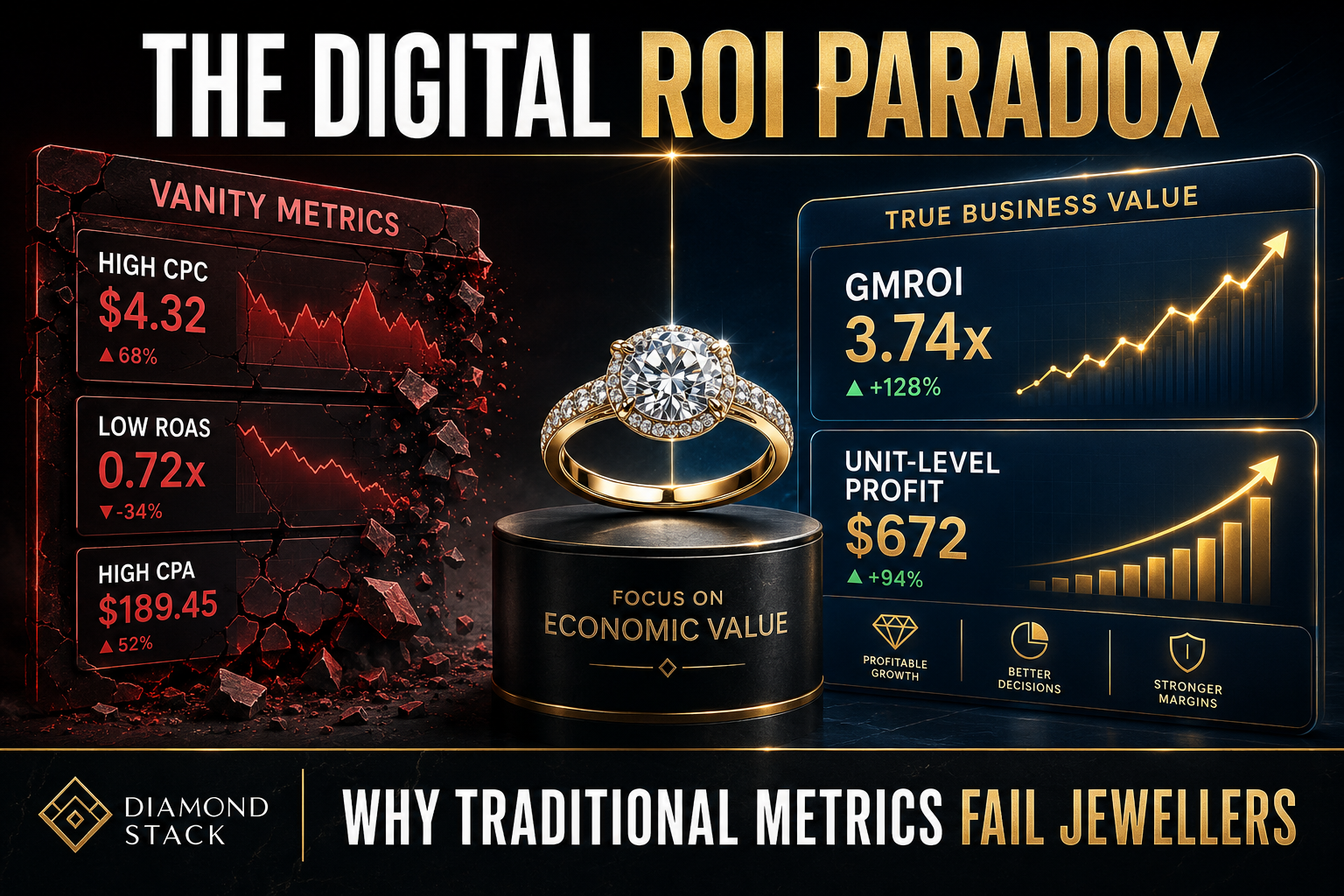
For most retailers, a high ROAS is a badge of honor. But in the world of high-ticket, high-trust commerce, ROAS is frequently a vanity metric—a distorted view of performance that masks whether your business is actually growing, or simply running on a treadmill of low-value transactions. If you are managing your digital strategy based on standard “eCommerce benchmarks,” you are likely underfunding your growth and misjudging the health of your bottom line.
The Vanity Metric Trap
Traditional marketing tools are designed for mass-market retail, where the goal is volume. In those models, a 5x ROAS is a success. But jewellery is not a commodity. When you chase “cheap” clicks or volume-based conversions, you dilute your brand equity and attract customers who are looking for discounts rather than craftsmanship.
When you optimize for ROAS, you incentivize your digital team to target “low-hanging fruit”—customers who are ready to buy immediately but often at lower price points. You miss the high-value client who is in the “research phase,” evaluating your brand’s authority, certification, and long-term trust indicators.
Introducing Unit-Level Digital Costing
To understand your true profitability, you must shift your perspective from aggregated marketing costs to Unit-Level Digital Costing.
This approach requires you to track the cost to acquire a single high-value engagement ring client, accounting for the entire journey. This includes:
- The Discovery Cost: The investment required to capture the client via AI search and educational content.
- The Trust Cost: The budget spent on high-end GIA certifications, expert consultations, and technical trust-signaling tools.
- The Conversion Cost: The human capital and time required for your in-store sales team to close the final sale.
When you view your digital spend as a unit-level investment rather than a generic expense, you realize that spending $500 to acquire a $10,000 sale is vastly more profitable than spending $50 to acquire a $200 sale—even if your “ROAS” looks technically lower on the surface.
The GMROI Framework
Instead of obsessing over ROAS, luxury retailers should prioritize Gross Margin Return on Investment (GMROI).
GMROI tells you how many dollars of gross margin you are generating for every dollar invested in your digital presence and inventory. In jewellery, where margins are tied to specific stone qualities and craftsmanship, GMROI provides a far more accurate picture of business health than revenue growth alone. It forces your team to stop asking, “How much traffic did we get?” and start asking, “How much margin did this specific campaign contribute to the bottom line?”
Beyond the Dashboard
Digital performance cannot exist in a vacuum; it must be integrated with your financial modeling. In high-trust industries, data precision is paramount. Whether you are using the Coetzee Convergence Framework to audit your digital activations or analyzing your unit-level costing, you need to ensure that your digital spend is directly supporting your highest-margin inventory.
The brands that will dominate in the coming years are those that stop treating “digital” as a separate department and start treating it as a core component of their financial strategy.
The Bottom Line
If your digital strategy is built on vanity metrics, you are likely leaving profit on the table. It is time to move beyond the surface-level data and embrace the underlying economics of your high-ticket business.
Is your digital spend actually driving profit?
At Diamond Stack, we specialize in high-level business modeling and digital strategy for luxury ateliers. Let’s conduct a Digital Economic Audit to align your ad spend with your true gross margin goals.