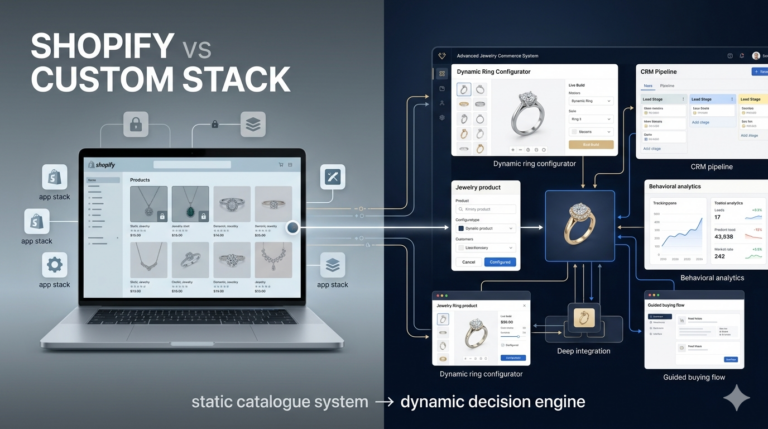

Shopify vs. WooCommerce for Live Diamond Feeds: Which Platform Wins in 2026?
Connecting a live diamond feed via API is not a standard e-commerce exercise; it is an enterprise-grade data synchronization challenge. Most bespoke jewellery brands attempt to force a massive Nivoda or RapNet feed into out-of-the-box web setups, treating a diamond like a standard t-shirt SKU.
This approach inevitably fails. When attempting to push 100,000+ dynamic SKUs—each requiring daily updates for pricing fluctuations, inventory status, and digital certificates—standard architectural limits break down. In 2026, the debate between Shopify and WooCommerce for high-volume jewellers comes down to data control, server performance, and forensic technical hygiene.
The Shopify Dilemma: API Rate Limits and “Rented” Architecture
Shopify is a highly refined SaaS platform, but it operates on a shared, multi-tenant infrastructure. To protect their servers from being overwhelmed, Shopify enforces rigid API rate limits.
For a bespoke jeweller syncing a massive global diamond feed, these limits throttle data synchronization. If a feed contains 150,000 stones with constantly shifting international prices, API throttling means your site’s inventory lags behind reality. This lag creates the most damaging customer experience possible in luxury e-commerce: a high-net-worth client purchasing a R250,000 diamond that was sold by a supplier hours ago.
Furthermore, relying on Shopify means operating on a “rented” architecture. To sync these feeds, brands are forced to rely on expensive, third-party middleware apps. These apps inflate monthly overhead, inject heavy JavaScript payloads that slow down the front end, and strip away the brand’s absolute control over how their core data is routed and stored.
The WooCommerce Trap: Post Meta Bloat and Crashing Servers
While Shopify restricts data flow, a standard WooCommerce setup simply collapses under its weight. Let’s be forensically brutal about WooCommerce’s default flaws: out of the box, WooCommerce stores product data in the wp_postmeta table.
Dumping 100,000 unique, highly detailed diamond records (each with dozens of attributes like cut, clarity, polish, symmetry, and GIA numbers) into a standard WordPress database creates catastrophic database bloat.
This massive injection of digital debt immediately destroys server response times. It breaks faceted filtering systems—making it impossible for a user to quickly search for an “Oval, 2 Carat, VVS1, D Color” stone without the page hanging. More importantly, it ruins your TTFB (Time to First Byte). A standard WooCommerce setup running a massive live feed will buckle during database queries, often causing the site to crash completely.
The Diamond Stack Solution: Forensic WooCommerce Architecture
The definitive answer for high-ticket jewellery e-commerce is not abandoning WooCommerce; it is fundamentally re-architecting it. When built correctly, WooCommerce provides the absolute control necessary for massive data ingestion.
By bypassing standard WordPress tables and creating custom database tables dedicated exclusively to diamond inventory, we eliminate post meta bloat entirely. The query speed goes from seconds to milliseconds.
Coupling this streamlined database structure with a hyper-optimized block environment—specifically utilizing lightweight solutions like Kadence Blocks instead of heavy, resource-draining page builders—results in a forensically clean codebase.
- Bypassing the Bloat: Custom tables ensure that your standard e-commerce elements (like custom rings or ready-to-wear collections) load instantly, while the massive diamond feed queries a highly indexed, separate table.
- The Sovereign Stack: This approach allows brands to own a true Sovereign Stack. You dictate the server resources, the caching layers, and the exact API routing without third-party interference.
- Performance: A forensic build allows you to maintain absolute control over your data while consistently achieving 99+ PageSpeed scores on mobile, even while actively syncing 100,000+ diamonds.
E-E-A-T and Search Visibility: How Architecture Impacts SEO
Search engine architecture in 2026 heavily relies on technical efficiency. Google allocates a strict crawling and rendering budget to your domain.
A bloated Shopify site reliant on third-party JavaScript apps, or a standard WooCommerce site choking on database queries, drains this budget instantly. If Googlebot gets stuck rendering a poorly built diamond feed, it will abandon crawling your high-margin, bespoke category pages.
A fast, forensically clean technical foundation is the non-negotiable prerequisite for E-E-A-T (Experience, Expertise, Authoritativeness, and Trustworthiness). You cannot build trust signals or authoritative content on an architecture that takes five seconds to load. Clean code and rapid server response times validate your site’s authority at a foundational level.
The Verdict
While Shopify offers an easier onboarding path for basic retail operations, an architecturally optimized WooCommerce build remains the definitive choice for serious bespoke jewellers managing high-volume live feeds. True scalability in the luxury sector requires complete ownership of your data environment, entirely free of digital debt.
Are your live diamond feeds destroying your site speed and search visibility? Contact Diamond Stack today for a forensic technical audit, and let us engineer your Sovereign Stack.