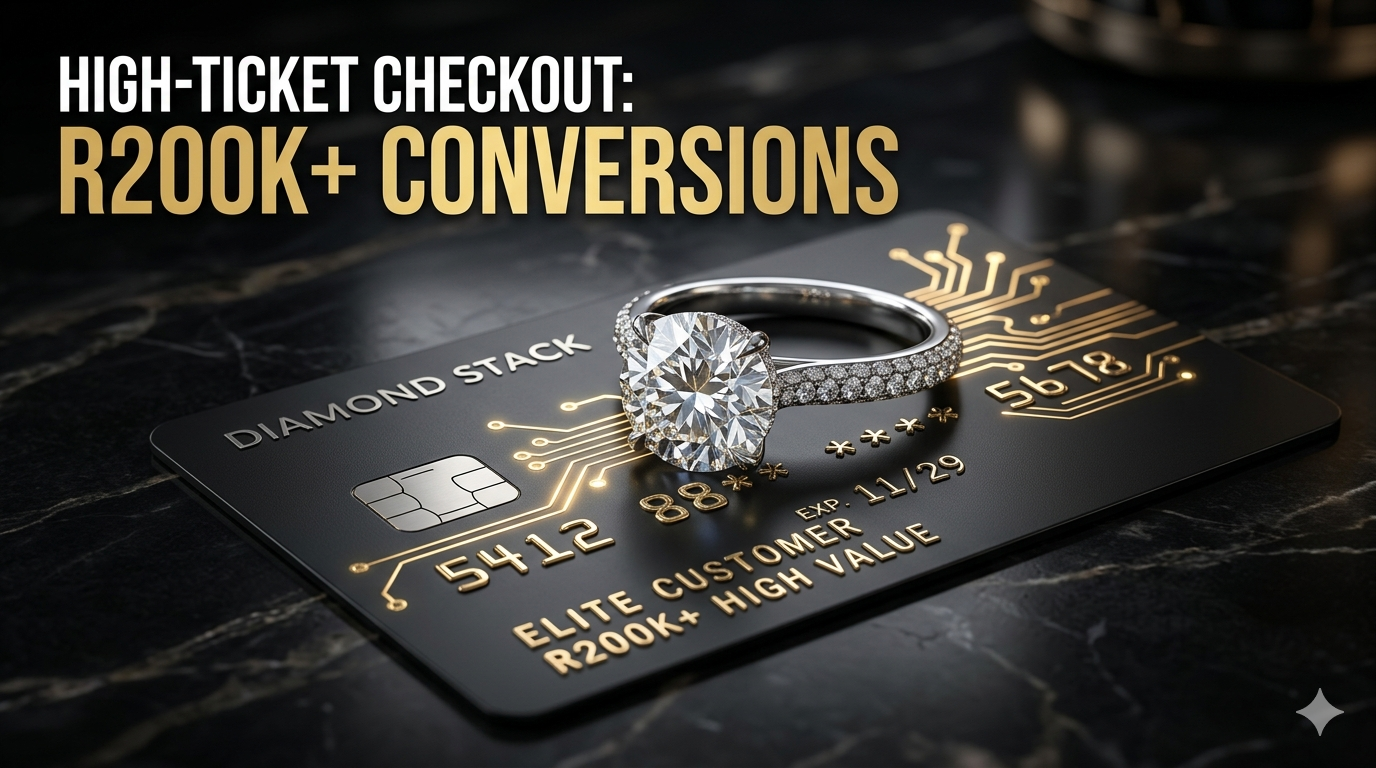
The Anatomy of a High-Ticket Checkout: Removing Friction for R200k+ Jewellery Purchases
Standard e-commerce platforms are inherently designed to sell low-risk commodities. A default Shopify or WooCommerce checkout flow is optimised for frictionless, impulse purchases—like a R500 t-shirt or a fast-fashion accessory.
However, trying to push a R250,000 bespoke engagement ring through that exact same transactional architecture is a guaranteed way to kill your conversion rate.
South African jewellery brands routinely spend thousands optimising product pages, implementing WebGL 3D renders, and integrating complex live diamond feeds via Nivoda or RapNet. Yet, when the high-net-worth user finally clicks “Add to Cart,” they are pushed into a rigid, generic checkout funnel that actively discourages the purchase. High-ticket conversions require a fundamentally different architectural approach tailored to the South African banking and logistics landscape.
The Payment Problem: Overcoming Local Banking Infrastructure
The primary bottleneck in luxury e-commerce isn’t user intent; it is banking infrastructure. When a customer attempts to purchase a R350,000 diamond ring, standard local payment gateways (like standard PayFast or Yoco setups) usually fail due to daily debit limits imposed by banks like FNB, Standard Bank, or Investec, or automated fraud triggers.
A user experiencing a declined card at the final step will rarely return to try again later. To salvage these conversions, your checkout architecture must accommodate high-value financial routing.
- Split-Payment Logic: You must allow users to bypass daily card limits (often capped at R50,000 or R100,000) by splitting the transaction across multiple credit or debit cards. Custom development is required to hold the inventory in escrow while the segmented payments clear.
- Instant and Manual EFT Integrations: High-net-worth South Africans often prefer bank transfers for large sums. The checkout must dynamically generate secure, trackable wire instructions. Integrating Instant EFT providers (like Ozow or Stitch) can speed up the process, but for massive amounts, the system must automatically hold the specific diamond via API until manual cross-bank clearing (e.g., Absa to Nedbank) is verified.
- Milestone Payments: For bespoke pieces, integrate a deposit architecture. Allow the user to pay a 50% upfront deposit to secure the stone and initiate the CAD design phase, with the remainder billed prior to local delivery.
Concierge Interception: Humanising the Final Step
A R200,000+ purchase rarely happens without a moment of final hesitation. The standard e-commerce approach is to rely on automated “abandoned cart” emails, but for high-ticket jewellery, the abandonment is often a signal that the user needs immediate human reassurance.
We call the solution Concierge Interception. Instead of forcing a binary “Buy Now or Leave” decision, advanced checkouts provide high-intent off-ramps.
- Diamond Hold & Consult: Introduce a feature that allows the user to temporarily reserve the specific diamond from the live feed and instantly book a video consultation or an in-person viewing at your Sandton or Cape Town showroom.
- VIP Live Intercept: Use CRM data to detect hesitation (e.g., dwelling on the final checkout step for more than three minutes). Trigger a high-priority, human-operated WhatsApp or live chat prompt offering immediate assistance with payment routing or secure shipping queries.
Trust Architecture at the Point of Sale
A standard SSL padlock icon next to the URL is a baseline requirement, not a conversion driver. When a stranger is preparing to EFT you R400,000, your checkout must deploy advanced trust architecture directly at the point of sale.
Visual proximity matters. Trust signals must be integrated right next to the “Complete Order” button to counteract last-minute anxiety.
- Dynamic Certification API Pulls: Don’t just say “Certified.” Use the GIA, IGI, or EGL South Africa API to pull the specific digital certificate into an iframe or lightbox directly within the checkout summary.
- Insured Logistics Badges: Luxury buyers worry about transit in South Africa. Explicitly outline your secure logistics chain using recognised badges (e.g., RAM Hand-to-Hand Couriers, Ferrari Logistics, or Brinks).
- Transparent Bespoke Policies (CPA Alignment): Clearly distinguish between the return policy for loose diamonds versus custom-set rings, ensuring compliance with the South African Consumer Protection Act (CPA). Ambiguity at this stage destroys trust.
Platform Capabilities: Customising the Flow
Achieving this level of checkout sophistication requires breaking out of standard templates. The technical execution depends entirely on your foundational tech stack and how it interacts with the South African digital ecosystem.
- Shopify Plus: For enterprise merchants, Shopify’s checkout extensibility allows developers to build custom UI components and integrate advanced CRM apps. However, integrating robust South African payment gateways (like Peach Payments or PayGate) to handle ZAR natively without exorbitant conversion fees requires precise architectural setup.
- WooCommerce: As an open-source platform, WooCommerce is highly favoured in South Africa because it offers absolute control and avoids USD subscription fees. Using custom hooks and filters, developers can override the default checkout behaviour entirely to build luxury flows. The risk here is database bloat; custom payment logic must be heavily optimised so it doesn’t inflate your Core Web Vitals.
Stop Losing High-Intent Buyers at the Finish Line
Fixing a high-ticket checkout flow offers the highest ROI of any technical e-commerce optimisation. If your live diamond integration brings the user to the cart, but your checkout architecture scares them away, you are bleeding critical revenue. Lowering your cart abandonment rate by just 2% on R200,000+ transactions fundamentally changes your annual profitability.
Is your checkout flow killing your high-ticket sales? Contact Diamond Stack today for a comprehensive e-commerce architecture audit. We build bespoke, high-performance web environments designed explicitly to convert luxury buyers in the South African market and abroad.