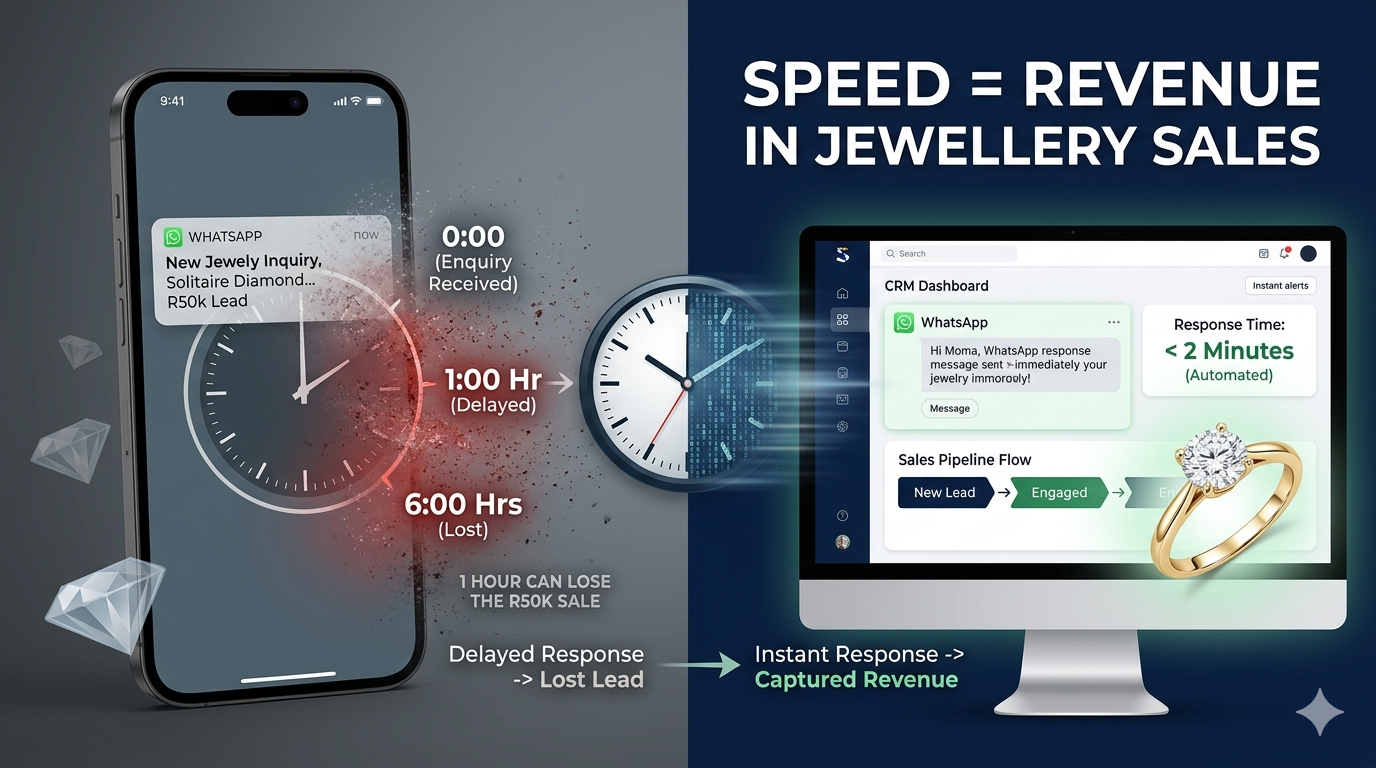
How Response Time Affects Jewellery Sales Conversion (And Why 1 Hour Can Lose a R50k Lead)
In jewellery retail, most revenue loss does not happen because of bad products or lack of interest.
It happens because of timing.
A potential buyer enquires, shows intent, shares details, and then waits. Sometimes minutes. Sometimes hours. Sometimes longer.
And in that gap between intent and response, something subtle happens:
the emotional urgency that drives the purchase begins to decay.
By the time the business responds, the buyer is often no longer in the same psychological state that triggered the enquiry.
In high-ticket jewellery sales, that shift is enough to change the outcome entirely.
This is not a customer service issue.
It is a conversion timing system problem.
Why Response Time Matters More in Jewellery Than Most Industries
Not all purchases behave the same way.
Buying a jewellery item—especially engagement rings or custom pieces—is a high-emotion, high-risk decision.
Customers are not just evaluating price or design. They are navigating:
- emotional significance (engagements, milestones, gifting)
- financial commitment
- fear of making the wrong choice
- comparison across multiple retailers
- uncertainty about specifications and value
This creates a unique behavioural pattern:
intent is strong, but unstable
Unlike low-cost purchases, jewellery decisions are highly sensitive to timing.
The moment a customer reaches out, they are typically in a peak emotional engagement state.
That state does not last long.
The Hidden Psychology of Lead Decay
To understand why response time matters, you need to understand how intent decays over time.
A jewellery lead does not remain static. It follows a predictable psychological curve.
1. Immediate Intent Phase (0–15 minutes)
This is the highest-value window.
The customer is:
- emotionally activated
- actively exploring options
- comparing ideas
- motivated to receive validation or guidance
At this stage:
- trust is being formed
- urgency is at its peak
- conversion probability is highest
A fast response here does more than provide information—it locks in momentum.
2. Active Comparison Phase (15 minutes – 6 hours)
If there is no immediate response, the buyer’s behaviour changes.
They begin to:
- contact other jewellers
- compare pricing
- evaluate responsiveness
- reassess initial excitement
The emotional driver is still present, but it is now mixed with rational comparison.
At this stage:
you are no longer the only voice in the decision process
You are one of several options.
3. Cooling Phase (6 – 24 hours)
This is where most conversions are lost.
The emotional intensity fades and is replaced by:
- hesitation
- rational reconsideration
- distraction from other priorities
- reduced urgency
The buyer may still be interested, but the momentum has been diluted.
Even if they eventually respond, the likelihood of conversion has dropped significantly.
4. Dormant Phase (24+ hours)
After 24 hours, the lead is no longer “warm” in behavioural terms.
Now the business must:
- re-engage interest
- rebuild emotional momentum
- overcome competing priorities
At this stage, the conversion is no longer a continuation—it becomes a restart.
And restarts are expensive.
Why Jewellery Businesses Respond Too Slowly
Most jewellery businesses do not intentionally delay responses.
The issue is structural, not behavioural.
Common causes include:
1. Manual WhatsApp handling
All communication depends on someone actively seeing and replying.
2. No structured lead routing
Enquiries are not automatically assigned or prioritised.
3. No CRM alert system
High-value leads do not trigger urgency mechanisms.
4. Inconsistent staff availability
Response speed varies depending on workload and time of day.
5. Lack of prioritisation logic
A R5,000 enquiry and a R50,000 enquiry are treated the same.
The system does not distinguish value or urgency.
The Real Cost of Slow Response Times
The impact of delayed response is not theoretical.
It is measurable in revenue loss.
In high-ticket jewellery sales:
- initial response speed directly influences trust
- trust directly influences conversion probability
- delay reduces emotional momentum
- reduced momentum lowers purchase confidence
The longer the delay:
- the more alternatives the buyer evaluates
- the lower your perceived responsiveness becomes
- the higher the chance of drop-off or competitor conversion
Even small delays compound.
A one-hour delay is not just one hour lost.
It is a shift in the buyer’s psychological state.
And in jewellery, that shift is often irreversible.
What High-Performing Jewellery Businesses Do Differently
The difference between average and high-performing jewellery operations is not staff effort.
It is system design around speed-to-lead.
1. Automated Speed-to-Lead Responses
Immediately after an enquiry:
- the customer receives an acknowledgment message
- expectations are set (e.g. response time, next steps)
- engagement is maintained while human follow-up occurs
This preserves momentum instead of letting it decay.
2. CRM-Driven Lead Alerts
Instead of relying on WhatsApp notifications alone:
- leads are captured in a central CRM
- high-value enquiries trigger instant alerts
- sales teams are prioritised based on intent and value
This ensures the right leads receive immediate attention.
3. WhatsApp Integration as a Controlled Channel
WhatsApp remains the communication tool, but it is no longer the system.
In a structured setup:
- conversations are logged automatically
- customer profiles are visible to all staff
- interaction history is preserved
- context is never lost
WhatsApp becomes a front-end interface, not the backend system.
4. Automated Follow-Up Sequences
If a lead does not respond:
- follow-ups are triggered automatically
- reminders are scheduled
- re-engagement flows activate over time
This prevents leads from silently disappearing.
The system maintains engagement even when humans are not actively managing it.
How Automation Eliminates Response-Time Revenue Loss
The purpose of automation is not to replace human interaction.
It is to ensure no lead is left waiting without engagement.
When properly implemented, automation provides:
- instant response capability
- consistent first-contact experience
- prioritisation of high-value opportunities
- structured follow-up discipline
- reduced dependency on manual availability
The result is a system that protects intent at every stage.
Example: Optimised Jewellery Response Workflow
A properly designed system works like this:
- Customer submits enquiry (website, WhatsApp, configurator)
- CRM instantly captures lead data
- Automated acknowledgment message is sent immediately
- Sales team receives priority alert based on value signals
- Human response is sent with full context
- Customer engagement is tracked in CRM
- If no reply, automated follow-ups begin
- Pipeline stage updates dynamically
- Lead progresses or is reactivated based on behaviour
At no point is the lead left untracked or unmanaged.
Common Mistakes Jewellery Businesses Make
Even businesses aware of response-time issues often implement partial solutions incorrectly.
Common mistakes include:
- relying solely on faster manual replies
- treating all leads equally
- using WhatsApp as the only response system
- lacking prioritisation logic
- no automation for after-hours leads
- no tracking of response-time performance
These approaches improve effort—but not structure.
And without structure, performance remains inconsistent.
Strategic Insight: Speed Is Not a Behaviour Problem—It Is a System Design Problem
Most businesses frame response time as:
- staff efficiency
- discipline
- workload management
But in reality:
response speed is a reflection of system architecture
If your system depends on humans noticing and reacting, speed will always be inconsistent.
If your system is designed to:
- capture leads instantly
- prioritise them automatically
- trigger immediate responses
- maintain structured follow-up
Then speed becomes a built-in property of the system—not a human dependency.
Conclusion
In jewellery sales, timing is not a secondary factor.
It is a core driver of conversion.
Leads do not disappear randomly. They decay predictably over time when engagement is delayed or inconsistent.
A one-hour delay is often enough to:
- reduce emotional urgency
- introduce competitors into the decision
- shift the buyer into rational comparison mode
- lower conversion probability significantly
The businesses that consistently win are not necessarily those with better products or better marketing.
They are the ones with systems designed to respond faster than intent decays.
Because in high-ticket jewellery:
speed is not a service metric—it is a revenue protection system.