Why Jewellery Businesses Get Leads But Still Don’t Make Sales (The Quality vs Quantity Problem)
Most jewellery businesses describe the same frustration in different words:
- “We’re getting enquiries, but not enough sales.”
- “Leads are coming in, but they’re not converting.”
- “Marketing is working, but revenue isn’t matching it.”
On the surface, this sounds like a marketing issue.
More traffic. Better ads. Stronger content.
But in practice, many jewellery businesses already have enough leads.
The real problem is not volume.
It is lead quality and lead handling structure.
And in high-ticket retail, that distinction is everything.
Why More Leads Does Not Automatically Mean More Revenue
In theory, more leads should create more sales.
But jewellery does not behave like a transactional product category.
It behaves like a high-consideration decision system, where each lead carries a different level of intent, urgency, and buying readiness.
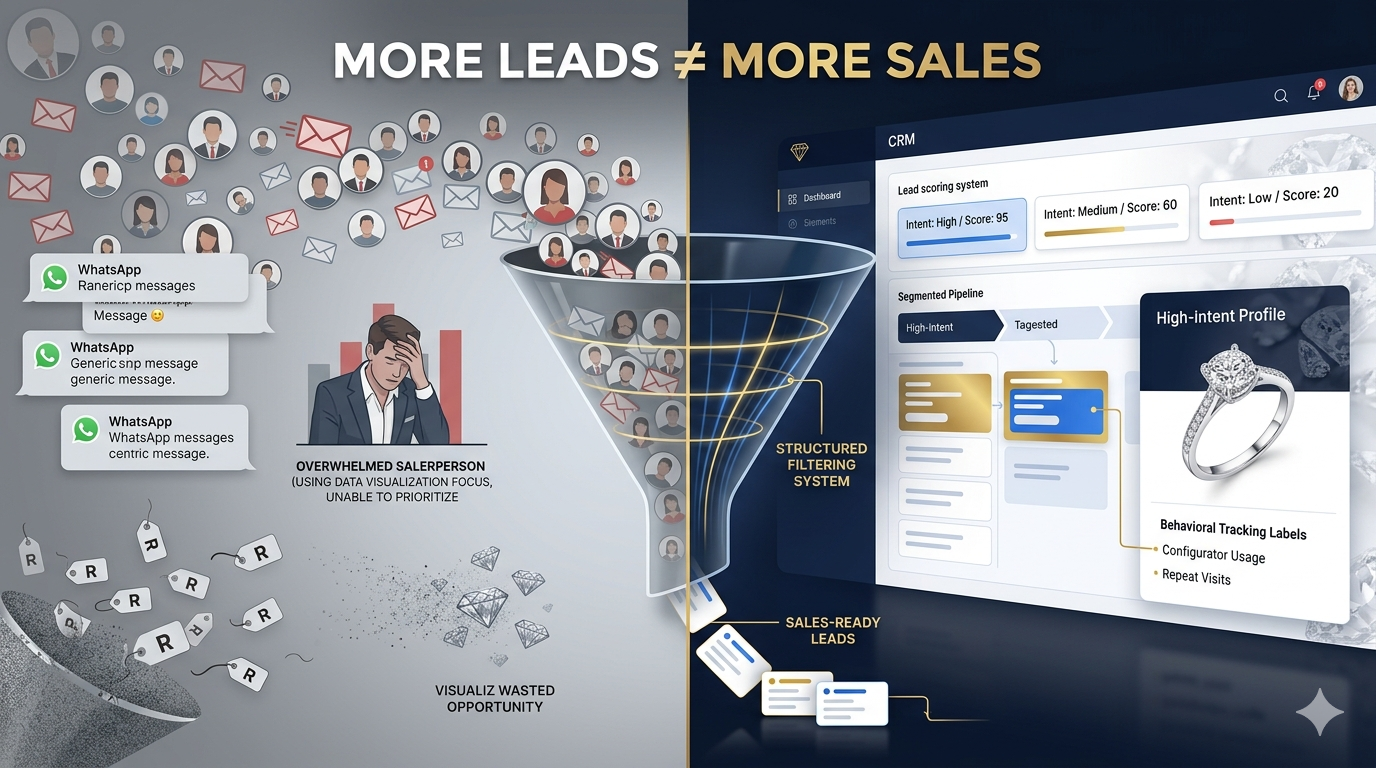
When lead volume increases without structure, three things happen:
- Sales teams become overloaded
- High-value leads get diluted
- Low-intent leads consume disproportionate attention
Instead of increasing revenue efficiency, the system becomes noisier.
And noise is expensive.
Because in jewellery sales:
attention is the most valuable resource—not traffic
The Hidden Problem: Mixed-Intent Lead Flow
Most jewellery businesses do not realise they are dealing with fundamentally different types of leads.
But from a system perspective, leads typically fall into three categories:
1. High-Intent Buyers
These are ready-to-act customers.
Characteristics:
- clear purchase motivation (engagement, milestone, gifting)
- defined budget range
- urgency or timeline
- willingness to engage in detail
These leads convert quickly—if handled correctly.
But they are also fragile.
Any delay, confusion, or misalignment reduces conversion probability significantly.
2. Research-Driven Browsers
These users are exploring options.
Characteristics:
- comparing designs or pricing
- still early in decision cycle
- emotionally interested but not committed
- longer consideration period
They can convert—but only through structured nurturing.
3. Casual Enquiry Leads
These are low-intent interactions.
Characteristics:
- price checking
- general curiosity
- no defined timeline
- often non-converting
They consume time but generate minimal revenue.
The critical issue is this:
most jewellery businesses treat all three categories the same
This creates systemic inefficiency.
Why Jewellery Leads Fail to Convert (Core Structural Breakdown)
The conversion problem is rarely about persuasion.
It is about lack of qualification and prioritisation systems.
1. No Lead Qualification System at Entry Point
Most leads enter through:
- website forms
- social media enquiries
But they all enter the same funnel stage.
There is no structured filtering based on:
- budget
- intent
- urgency
- product type
- engagement level
As a result:
every lead is treated as equally valuable until proven otherwise
This is fundamentally inefficient.
2. No Behavioural Tracking or Intent Visibility
Most jewellery businesses cannot answer basic questions like:
- Which products did this lead view multiple times?
- Did they use a configurator or customisation tool?
- How often did they return before enquiring?
- What price range are they interacting with?
Without behavioural data:
- intent is invisible
- prioritisation becomes guesswork
- follow-ups are generic
And generic follow-ups underperform in high-ticket environments.
3. No CRM Scoring or Segmentation
Even when a CRM exists, it is often used as a contact database—not a decision engine.
This leads to:
- no lead scoring
- no segmentation by intent or value
- no prioritisation logic
So a R5,000 enquiry is treated the same as a R50,000 engagement ring lead.
That is not a sales system.
That is a message inbox.
4. Sales Time Misallocation
Without qualification systems, sales teams default to:
- responding to whoever messages first
- spending time on low-intent enquiries
- reacting instead of prioritising
This creates a hidden cost:
high-value leads do not receive proportionally higher attention
And in jewellery sales, timing + attention directly influence conversion.
The Operational Cost of Poor Lead Quality
Lead quality issues are not just about lost sales.
They create systemic inefficiencies across the business:
1. Wasted sales effort
Time is spent on leads that were never likely to convert.
2. Lower conversion rates
High-intent buyers are not prioritised effectively.
3. Increased marketing waste
More spend is required to compensate for poor conversion efficiency.
4. Slower response to valuable leads
High-value opportunities are delayed or diluted.
5. Reduced revenue per lead
The system generates activity but not optimisation.
The core issue is simple:
the system is optimising for volume, not value
What High-Performing Jewellery Businesses Do Differently
High-performing systems do not rely on intuition.
They rely on structure.
1. Lead Scoring Systems
Leads are automatically scored based on:
- behaviour (product views, repeat visits)
- engagement depth
- budget indicators
- source quality
- configurator usage
This creates a prioritisation hierarchy.
High-score leads are treated differently from low-score leads immediately.
2. Structured CRM Pipelines
Instead of a single inbox, leads are organised into stages:
- new enquiry
- engaged
- qualified
- quoting
- negotiating
- closed
This creates visibility over where revenue is actually sitting.
3. Behaviour-Based Qualification
Intent is inferred from actions, not just messages:
- configurator interactions
- product comparisons
- return visits
- time spent on high-value pages
This is significantly more accurate than self-reported intent.
4. Automated Filtering Systems
Automation ensures:
- high-intent leads trigger immediate alerts
- low-intent leads enter nurturing flows
- unqualified leads are not prioritised manually
- follow-ups are consistent regardless of workload
This removes human bias from lead handling.
How CRM Transforms Lead Quality Management
A properly structured CRM system changes how leads are handled fundamentally.
It enables:
- visibility into lead value before engagement
- prioritisation based on probability of conversion
- structured segmentation across all enquiries
- automated nurturing for non-ready buyers
- improved forecasting accuracy
Instead of reacting to leads, businesses begin managing intent pipelines.
Example: Optimised Lead Qualification System
A modern system works like this:
- Lead enters via website, configurator, or WhatsApp
- System captures behavioural and contextual data
- CRM assigns a lead score automatically
- High-score leads trigger immediate sales alerts
- Medium-score leads enter structured follow-up flows
- Low-score leads are nurtured automatically over time
- Pipeline stage updates dynamically based on engagement
At no point are leads left unclassified or unmanaged.
Common Mistakes Jewellery Businesses Make
Most businesses trying to improve performance focus on the wrong layer.
Common mistakes include:
- prioritising more lead generation instead of better qualification
- treating CRM as a contact list instead of an intelligence system
- relying on manual judgement for lead prioritisation
- ignoring behavioural signals entirely
- failing to segment lead types properly
These mistakes result in:
increased activity without increased efficiency
Strategic Insight: Lead Quality Is a System Output, Not a Marketing Input
This is the key shift in thinking.
Marketing generates leads.
But systems determine:
- which leads are valuable
- which leads are ready
- which leads will convert
- and how efficiently they are handled
In other words:
lead quality is not created by marketing—it is created by system design
Without structured filtering, even high-quality traffic produces low-quality outcomes.
Conclusion
Jewellery businesses are not struggling because they lack leads.
They are struggling because they lack lead intelligence systems.
When every enquiry is treated equally:
- high-value buyers are diluted
- sales teams are overloaded
- conversion efficiency drops
- revenue becomes unpredictable
But when leads are structured, scored, and prioritised:
- fewer leads are needed to generate more revenue
- sales effort becomes focused
- conversion rates increase
- predictability improves
In jewellery retail, success is not determined by how many leads you generate.
It is determined by:
how intelligently you filter, prioritise, and convert them into revenue.