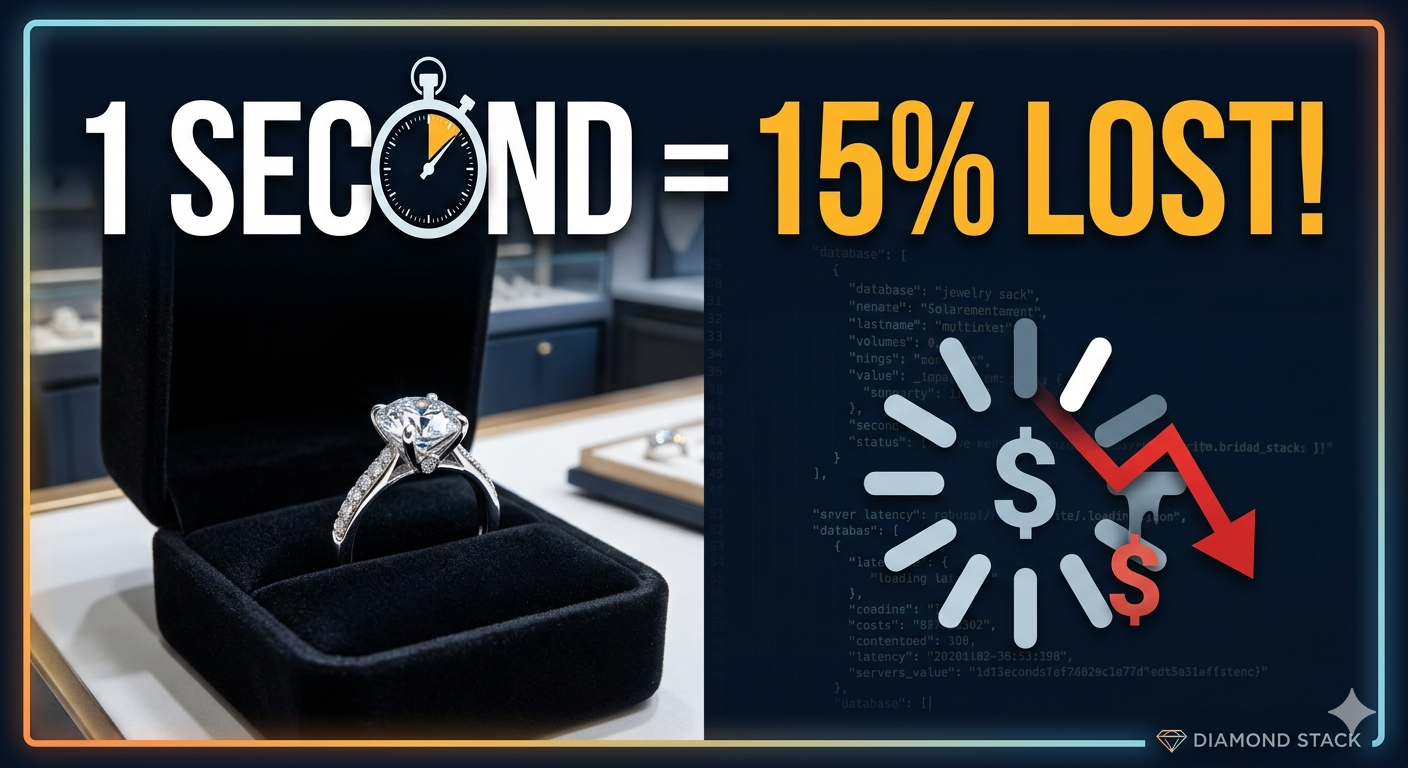
The Invisible Tax on Your Jewelry Sales: How 1-Second of Latency Costs You 15% of Your Bridal Conversions
In the high-stakes world of fine jewelry, the digital storefront is your most important salesperson. When a customer lands on your site to browse engagement rings, they aren’t just looking at pixels—they are embarking on an emotional journey. They are stressed, excited, and looking for a sign of trust.
If that journey is interrupted by a spinning loading icon, you haven’t just suffered a technical glitch. You have suffered a catastrophic loss of trust.
In e-commerce, every millisecond counts. In the luxury diamond market, where the average order value is high and the emotional investment is higher, a one-second delay in page load time is a hidden tax on your revenue that is likely costing you 15% or more of your potential bridal conversions.
The “Bridal Anxiety” Factor
When a customer is shopping for an engagement ring, they are in a state of “high-intent anxiety.” They are comparing your pieces against competitors, reading reviews, and trying to validate a massive financial decision.
They expect a luxury experience. If your site takes three or four seconds to render a high-resolution diamond image or to filter search results from a live inventory feed, the spell is broken. The user doesn’t think, “Oh, their server is slow.” They think, “This company feels outdated,” or worse, “Is this site safe?”
When the experience lags, they don’t wait. They bounce. And that bounce is a sale that went directly to a competitor whose site was built for speed.
The Three Technical Culprits
Why are so many jewelry websites—especially those built on WooCommerce—dragging their feet? It usually comes down to the architecture of how they handle inventory.
- The API Bottleneck: Integrating live feeds from RapNet or Nivoda is a necessity, but doing it incorrectly is a disaster. If your site is pulling data in real-time on every page refresh without a robust caching strategy, you are forcing the user’s browser to wait for a third-party server to respond before they see anything on their screen.
- Database Bloat: Many jewelry stores have thousands of SKUs. If your database queries are unoptimized, your site has to “search the library” every time a customer clicks a filter. Without proper indexing and query management, your site gets slower as you add more inventory—exactly the opposite of what you want.
- Hefty Asset Management: High-definition diamond videos and 360-degree spinners are essential for luxury sales, but they are heavy. If these aren’t served via a Content Delivery Network (CDN) or compressed using modern formats like WebP or AVIF, they will choke your page load speed.
Why You’re Paying an “Invisible Tax”
Think of your slow site as an “Invisible Tax.” You are paying it every single day, in every single session, in the form of abandoned carts and lost leads.
Most business owners look at their marketing spend and ask, “Why aren’t my ads converting?” But if you are sending paid traffic to a site that takes three seconds to load, you are essentially pouring water into a bucket with a hole in the bottom. You are paying for the click, but you are failing to close the lead because the infrastructure couldn’t keep pace with the customer’s desire to buy.
The Path to High-Performance Jewelry E-commerce
Fixing this isn’t just about “speeding up the site”—it’s about building a digital infrastructure that reflects the quality of the diamonds you sell.
A high-performance site is an asset that works for you 24/7. It improves your search engine rankings, keeps your visitors engaged, and—most importantly—converts high-intent browsers into lifetime customers.
Is your current digital infrastructure leaking revenue?
At Diamond Stack, we specialize in building, auditing, and optimizing high-performance WooCommerce environments specifically for the jewelry industry. We know the unique demands of live diamond inventory feeds, and we know how to make them fly.
Don’t let technical latency eat your margins.
Click here to request your complimentary Performance Audit. Let’s identify exactly where your site is losing speed—and where you are losing sales.