Why Most Jewellery Websites Don’t Convert Visitors Into Buyers (Even With High Traffic)
Most jewellery businesses misdiagnose their own performance.
When a website underperforms, the immediate conclusion is usually:
- “We need more traffic”
- “We need better ads”
- “We need stronger social media”
- “We need more visibility”
But in practice, many jewellery websites already receive sufficient traffic.
The real problem is not acquisition.
It is conversion.
More specifically:
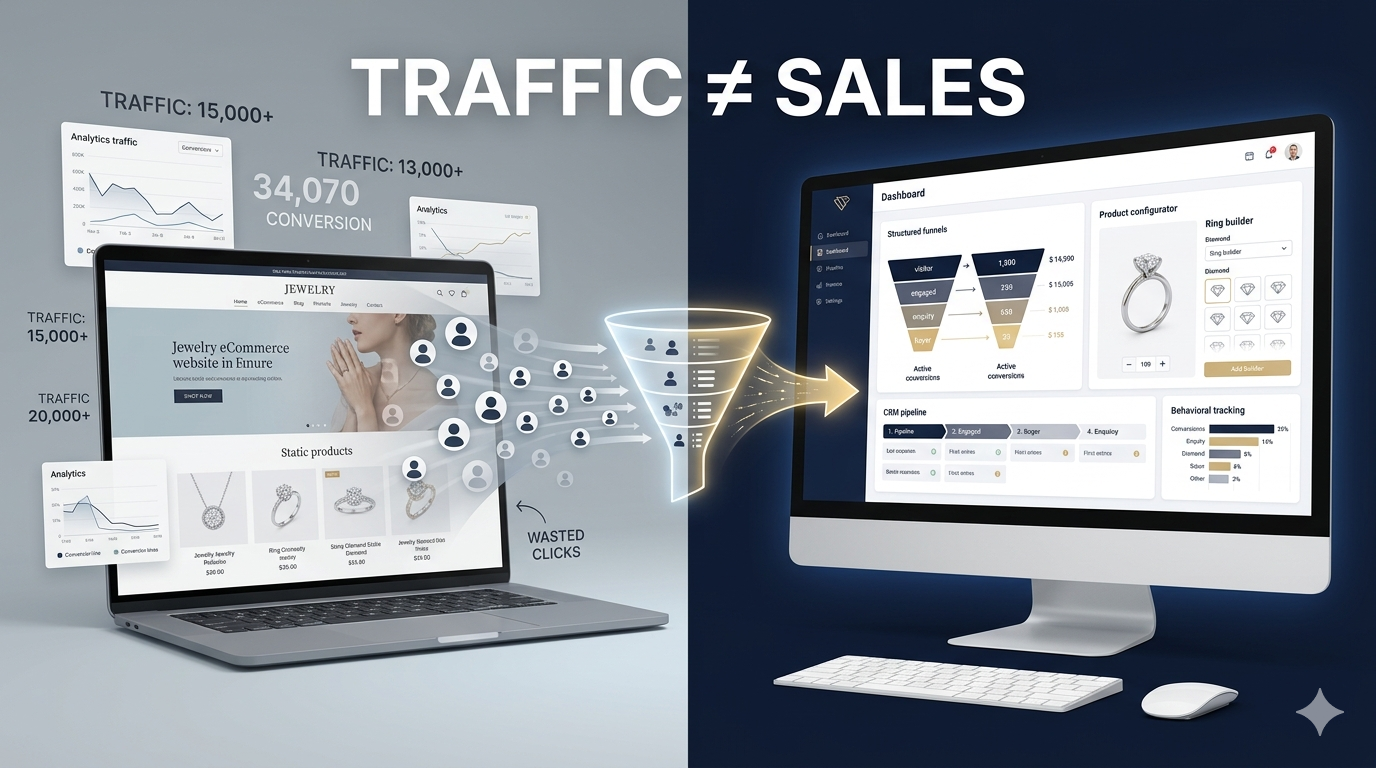
most jewellery websites are not conversion systems—they are digital catalogues.
And in high-ticket retail, that distinction determines whether traffic becomes revenue or disappears without trace.
The Illusion of “Good Traffic” in Jewellery eCommerce
Traffic is often treated as a success metric. But in jewellery retail, traffic is a misleading indicator.
Not all traffic represents buying intent.
In fact, jewellery traffic typically includes:
- early-stage browsers exploring styles
- emotionally driven users saving ideas for later
- gift inspiration searches with no immediate purchase intent
- comparison shoppers across multiple sites
- casual engagement without financial readiness
This creates a false sense of performance:
- high sessions
- high page views
- high engagement time
But low conversion.
The critical misunderstanding is this:
Jewellery traffic is emotionally high, but commercially unqualified.
Without a conversion system in place, traffic becomes noise—not revenue.
Why Jewellery Websites Fail to Convert (Core Breakdown)
The issue is not isolated. It appears consistently across most jewellery eCommerce setups.
It typically stems from five structural weaknesses.
1. Static Product Catalogues
Most jewellery websites are structured as digital catalogues:
- product images
- descriptions
- price tags (sometimes “from” pricing)
- enquiry or add-to-cart buttons
The problem is that jewellery is not a fixed product category.
It is a configuration-based product category.
A single ring can change significantly based on:
- diamond carat
- cut, clarity, colour
- setting type
- metal choice
- band design
Yet users are expected to mentally construct the final product.
This creates a fundamental conversion problem:
customers are asked to imagine value instead of experiencing it
Imagination introduces uncertainty. Uncertainty reduces conversion.
2. Lack of Buyer Guidance
Most jewellery websites assume users know what they want.
They don’t.
High-value jewellery purchases are complex decisions involving:
- emotional factors (engagement, symbolism, gifting)
- financial considerations
- aesthetic preference uncertainty
- fear of making the wrong choice
Without structured guidance, users are left to navigate alone.
There is typically:
- no decision flow
- no progressive narrowing of options
- no step-by-step buying journey
- no contextual explanation of choices
As a result:
browsing does not evolve into decision-making
It remains passive exploration.
3. Weak Trust Infrastructure
Jewellery is a high-trust purchase category.
Customers are not just evaluating design. They are evaluating:
- authenticity
- value for money
- certification legitimacy
- long-term durability
- resale perception
Yet most websites underdeliver on trust-building systems.
Common gaps include:
- unclear pricing logic
- limited certification visibility
- weak explanation of sourcing or quality standards
- minimal reassurance mechanisms
In high-ticket eCommerce, trust is not a brand attribute.
It is a system requirement.
Without it, hesitation increases—and hesitation kills conversion.
4. No Behavioural Tracking or Intent Capture
Most jewellery websites do not understand user behaviour beyond basic analytics.
They can see:
- page views
- session duration
- bounce rates
But they cannot see intent.
They cannot answer:
- What did this user repeatedly view?
- Which styles did they compare?
- What price range did they engage with?
- Did they return multiple times before leaving?
Without behavioural insight:
every visitor is treated as identical
This leads to generic messaging, generic UX flows, and generic conversion paths—all of which perform poorly in high-consideration retail.
5. Friction at Decision Points
Even when users are interested, websites often fail at the final step.
Common friction points include:
- unclear next steps (buy vs enquire vs book appointment)
- lack of confidence in product selection
- overwhelming choice structures
- absence of guided recommendations
- slow or disconnected enquiry processes
At this stage, the customer is not lacking interest.
They are lacking clarity.
And in conversion systems:
confusion is equivalent to abandonment
The Psychology Behind Jewellery Conversion Failure
Jewellery purchases sit in a unique psychological category.
They combine:
- high emotional significance
- high financial commitment
- high perceived risk
This creates a dual decision structure:
Emotional layer:
- symbolism
- relationships
- milestones
- personal meaning
Rational layer:
- price
- quality
- durability
- perceived value
When either layer is unresolved, hesitation increases.
But the key conversion insight is this:
jewellery buyers do not convert when they are informed—they convert when they are confident.
Confidence does not come from information alone.
It comes from structure, clarity, and control over the decision process.
The Missing Layer: Conversion Architecture
Most jewellery websites lack a dedicated conversion system.
They rely on static content instead of structured decision environments.
A proper conversion architecture includes four key components.
1. Guided Buying Systems
Instead of browsing random products, users are guided through structured journeys:
- engagement ring selection flows
- budget-based narrowing systems
- lifestyle-based recommendations
- step-by-step decision paths
This transforms browsing into decision progression.
2. Product Configurators
Configurators allow users to build their product:
- choose diamond characteristics
- select setting styles
- adjust metals and design elements
- see variations in real time
This eliminates imagination-based uncertainty.
It replaces it with:
interactive certainty
3. Trust Systems
High-conversion jewellery websites make trust explicit:
- certification visibility (GIA, IGI, etc.)
- transparent pricing logic
- clear sourcing and quality explanations
- social proof tied to actual purchases
Trust is no longer implied.
It is structured into the experience.
4. Behavioural Tracking Systems
Instead of guessing intent, systems track it:
- repeated product views
- configuration behaviour
- return visits
- engagement depth
- price sensitivity signals
This enables:
- segmentation
- personalised follow-ups
- prioritised sales engagement
Conversion becomes data-driven, not assumption-driven.
Why More Traffic Will Not Fix Conversion Problems
A common assumption is that increasing traffic will solve revenue issues.
In reality:
traffic amplifies whatever system already exists
If the system is weak:
- more traffic = more wasted opportunity
- more ad spend = more inefficiency
- more visitors = more leakage
Without conversion architecture, traffic is not an asset—it is a multiplier of inefficiency.
What High-Converting Jewellery Websites Do Differently
High-performing jewellery eCommerce systems share consistent characteristics:
- structured buying journeys instead of open browsing
- configurators that replace imagination with interaction
- CRM integration behind every enquiry
- behavioural tracking tied to sales follow-up
- clear next-step logic at every stage
They do not rely on visitors “figuring it out”.
They guide the decision process from start to finish.
Strategic Insight: Conversion Is the Real Competitive Advantage
The jewellery industry is undergoing a structural shift.
Websites are no longer digital brochures.
They are becoming:
decision systems that convert intent into structured revenue
In this environment:
- design matters
- branding matters
- traffic matters
But none of these compensate for a broken conversion system.
The real differentiator is no longer visibility.
It is conversion architecture.
Conclusion
Most jewellery websites do not fail because they lack traffic.
They fail because they lack structure.
Visitors arrive with intent, emotion, and curiosity—but leave without converting because the system does not guide them toward a decision.
The problem is not marketing.
It is architecture.
In jewellery eCommerce:
traffic creates opportunity, but conversion systems create revenue.
And the businesses that understand this distinction will consistently outperform those still trying to solve a system problem with marketing alone.