
The Founder’s Policeman: How 1970s Economic Theory Fixed My Workshop Trust Issues
I am sitting in my room in Cape Town, the familiar silhouette of Table Mountain providing a grounded backdrop to the chaos of my browser tabs. On the screen is a paper from 1976 by Jensen and Meckling. To most, it is a dry relic of historical economics. To my pattern-recognition firmware, it is a mirror reflecting the most exhausting aspect of running a jewellery studio: the “Founder’s Policeman” trap.
If you own a bespoke studio, you know this trap intimately. It is the mental load of standing over a bench jeweller’s shoulder, not because you want to, but because you feel you must. It is the “monitoring cost” of checking every stone setting and every solder joint because, at the end of the day, it is your name on the box and your reputation on the line.
The Structural Cost of Mistrust
In 1976, Jensen and Meckling formalised this as Agency Theory. They argued that when you hire an “agent” (an employee) to act on behalf of a “principal” (you, the founder), your interests will inevitably diverge. This divergence creates costs.
The most taxing of these is the Monitoring Cost. In a jewellery workshop, this isn’t just an abstract economic term; it is the hours you spend double-checking work instead of designing the next collection or closing a six-figure deal. We often mistake this need for oversight as a character flaw—either we aren’t “trusting” enough, or our staff isn’t “loyal” enough.
But the “neurospicy” truth I found in the library is that mistrust isn’t a moral failing. It is a structural limitation of an analogue system. If you cannot see the effort, you must monitor the outcome.
Turning Effort into an Asset
This is where the Coetzee Convergence Framework (CCF) shifts the equation. In a traditional setup, the artisan’s hard work is “unobservable.” You see the finished ring, but you didn’t see the three hours of meticulous filing that ensured the setting would last a century.
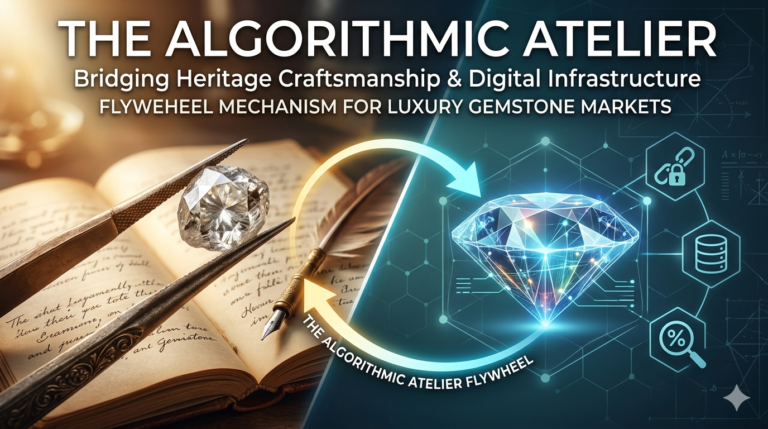
By using the Diamond Stack’s blockchain service log, we turn that unobservable effort into a reputational asset.
When an artisan logs a milestone—a specific heat treatment, a laser-welding sequence, or a stone-setting verification—they aren’t just “filling in a form.” They are creating an immutable record of their own mastery. This record is tied to their identity as a craftsman. Suddenly, the incentive shifts. They aren’t working because you are watching; they are working because the ledger is recording.
From Policeman to Steward
The goal of the CCF is the “Multiplier transition”: moving from Monitoring Mode to Stewardship Mode.
Monitoring is policing. It is reactive, exhausting, and it bottlenecks growth. Stewardship, as defined by Davis, Schoorman, and Donaldson, occurs when the artisan identifies so strongly with the organisation’s goals that they become a protector of the brand.
By automating the “verification” through a blockchain-backed Atelier Standard, the founder is finally fired from their role as the workshop policeman. You don’t need to choose between trusting and verifying because the system does both for you, silently and structurally.
As I look back at the mountain, I realize that the most valuable thing we can give a jewellery founder isn’t just more sales—it’s the “cognitive bandwidth” that returns when they stop being a policeman and start being an architect again.
The ledger tells the truth, so you don’t have to go looking for it.