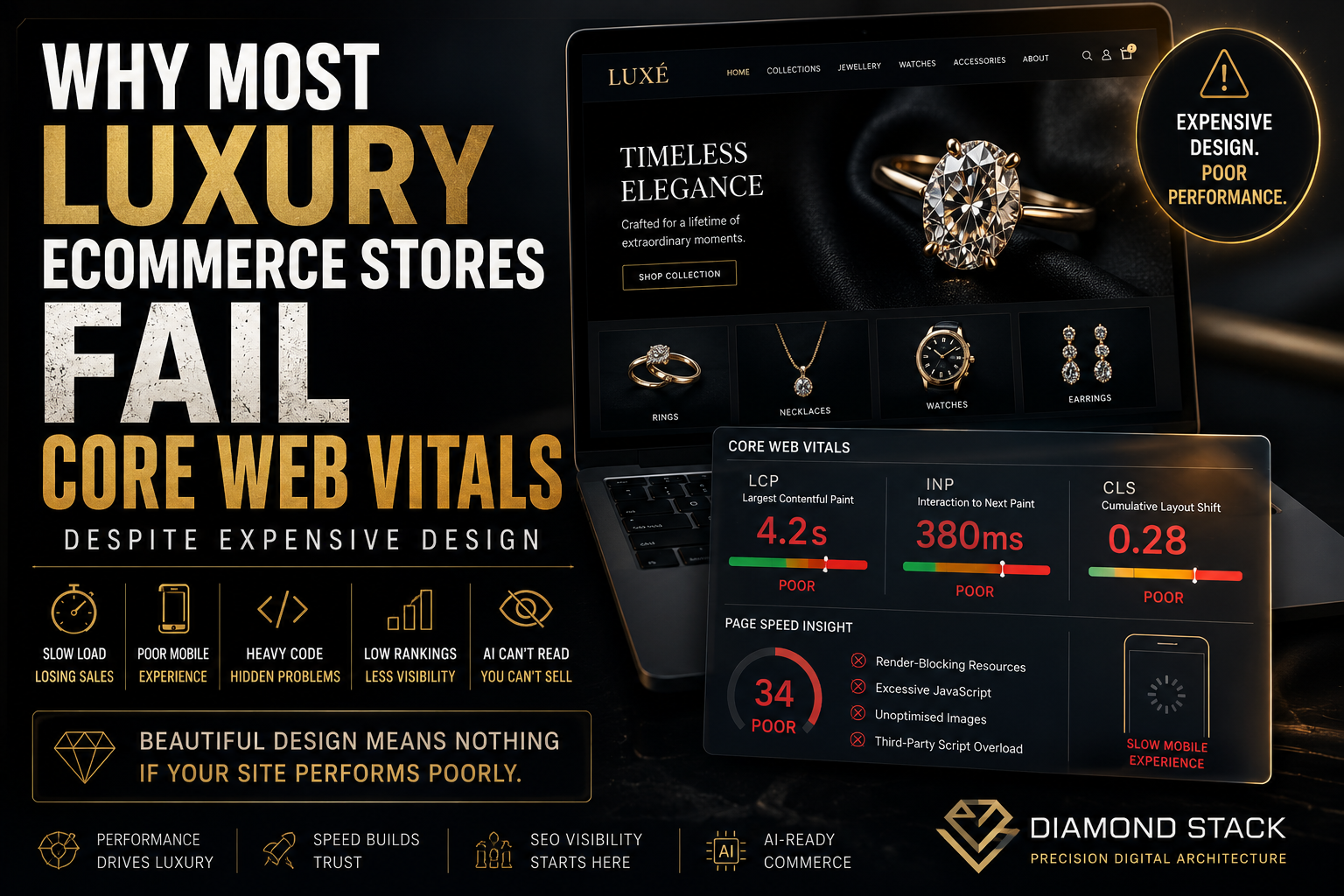
Why Most Luxury Ecommerce Stores Fail Core Web Vitals Despite Expensive Design
The modern luxury ecommerce experience often begins with spectacle.
A cinematic hero video fades into view.
Jewellery rotates beneath soft ambient lighting.
Parallax animations glide across the screen.
Typography floats elegantly over ultra-high-resolution imagery.
The website feels expensive.
But beneath the polished visual surface, the infrastructure is collapsing.
JavaScript execution stalls rendering pipelines.
Oversized media assets overwhelm mobile bandwidth.
Bloated page builders fragment the DOM.
Third-party scripts compete for processing priority.
Database queries multiply beneath decorative frontend layers.
The customer sees elegance.
Search engines see inefficiency.
AI retrieval systems see computational friction.
This is the hidden paradox of modern luxury ecommerce: many visually impressive online stores perform disastrously where it matters most.
Despite substantial investment in branding, design, photography, and creative direction, countless luxury ecommerce environments fail Core Web Vitals, struggle with crawl efficiency, underperform in mobile rendering, and silently lose visibility within modern search ecosystems.
The problem is not aesthetics.
The problem is architectural imbalance.
Luxury ecommerce brands frequently optimise for visual impact while neglecting the operational systems supporting discoverability, rendering efficiency, semantic clarity, and machine-readable performance.
In earlier eras of ecommerce, this imbalance could survive.
Today, it cannot.
Modern search systems increasingly evaluate:
- rendering performance,
- semantic accessibility,
- interaction responsiveness,
- structured data quality,
- and computational efficiency.
Users do the same.
A visually stunning website that loads slowly, shifts unpredictably, or delays interaction no longer communicates sophistication.
It communicates operational instability.
And in luxury commerce, perception is infrastructure.
The Illusion of Premium Design
Many luxury ecommerce brands confuse visual sophistication with digital sophistication.
This misunderstanding has become one of the defining infrastructure failures of premium online retail.
A website can:
- look expensive,
- feature award-winning design,
- use premium photography,
- and still perform catastrophically.
The issue lies in how many luxury ecommerce environments are constructed.
The Rise of Overdesigned Ecommerce
Luxury brands increasingly pursue immersive digital experiences:
- fullscreen video backgrounds,
- layered animations,
- dynamic transitions,
- oversized image carousels,
- interactive storytelling,
- and highly customised frontend frameworks.
These features are often implemented without regard for computational efficiency.
The result is frontend excess.
Modern WooCommerce ecosystems frequently accumulate:
- excessive JavaScript libraries,
- animation engines,
- page builder dependencies,
- third-party integrations,
- tracking scripts,
- and render-blocking assets.
Every additional visual layer increases computational cost.
Users experience this as:
- slower load times,
- delayed responsiveness,
- interaction lag,
- and unstable rendering.
Search systems experience it as crawl inefficiency.
Luxury Should Feel Effortless
True luxury is rarely loud.
The world’s finest luxury experiences are typically defined by:
- precision,
- refinement,
- seamlessness,
- and invisible operational excellence.
The same principle applies digitally.
High-performance luxury ecommerce should feel frictionless.
Pages should:
- render instantly,
- respond immediately,
- transition smoothly,
- and maintain structural stability.
The customer should never feel the infrastructure working.
That invisibility is the actual mark of premium engineering.
The Cost of Frontend Vanity
Many ecommerce agencies optimise for visual presentations rather than operational performance.
A homepage may appear impressive during desktop demonstrations on high-speed fibre connections.
But real-world performance tells a different story.
On mobile devices, under standard network conditions, the same website may:
- stall during rendering,
- delay interaction readiness,
- trigger layout instability,
- and overwhelm processing resources.
Luxury ecommerce performance collapses precisely where modern consumer behaviour dominates: mobile commerce.
Why Core Web Vitals Matter More Than Ever
Core Web Vitals are not merely technical metrics.
They are operational indicators of digital stability.
Google increasingly uses these signals to evaluate real-world user experience quality, while AI retrieval systems indirectly depend on similar performance conditions for efficient rendering and semantic extraction.
Luxury ecommerce brands ignoring these metrics are effectively degrading both discoverability and conversion performance simultaneously.
Largest Contentful Paint (LCP)
LCP measures how quickly the main visual content becomes visible.
For luxury ecommerce, this is critical because:
- visual storytelling drives emotional engagement,
- product imagery drives trust,
- and perceived speed influences brand perception.
Heavy hero images, cinematic videos, and oversized media assets frequently destroy LCP performance.
Customers begin forming trust judgements within seconds.
A delayed rendering experience immediately weakens perceived quality.
Interaction to Next Paint (INP)
INP measures interaction responsiveness.
Luxury consumers expect interfaces to feel immediate.
When:
- buttons lag,
- menus hesitate,
- filters stall,
- or product galleries delay interaction,
the digital experience begins feeling mechanically heavy.
High-net-worth consumers are often less tolerant of friction than mainstream users.
Digital hesitation damages perceived refinement.
Cumulative Layout Shift (CLS)
CLS measures visual stability.
Poorly engineered luxury websites often suffer from:
- shifting images,
- unstable product grids,
- jumping navigation,
- or delayed asset loading.
These disruptions create subconscious distrust.
Luxury ecommerce should feel structurally precise.
Visual instability undermines that perception immediately.
Search Systems Care About Stability
Search engines increasingly evaluate:
- rendering efficiency,
- interaction readiness,
- mobile usability,
- and layout stability.
Performance influences:
- crawl prioritisation,
- indexation quality,
- rendering allocation,
- and semantic accessibility.
Performance is no longer separate from SEO.
Performance is infrastructure SEO.
The Hidden Infrastructure Problems Behind Luxury Ecommerce
Most performance failures originate beneath the visible design layer.
The real problems are infrastructural.
Excessive JavaScript
Modern luxury ecommerce stores often rely heavily on JavaScript-driven frontend behaviour.
This creates:
- render delays,
- interaction latency,
- crawl inefficiency,
- and semantic extraction limitations.
Search engines must execute JavaScript to fully understand many modern ecommerce pages.
The more complex the rendering environment becomes, the more computational resources are required.
This increases crawl cost.
High crawl cost reduces crawl efficiency.
Bloated WooCommerce Themes
Many premium WooCommerce themes prioritise:
- visual flexibility,
- drag-and-drop functionality,
- and animation features.
But these themes frequently introduce:
- unnecessary code,
- excessive dependencies,
- large CSS payloads,
- redundant scripts,
- and inefficient rendering structures.
What appears visually premium often behaves operationally inefficiently.
Page Builder Overhead
Page builders create convenience.
They also create structural bloat.
Many luxury ecommerce stores use layered builder environments generating:
- deeply nested DOM structures,
- excessive inline styling,
- duplicate scripts,
- and inefficient rendering logic.
The result is frontend heaviness hidden beneath polished interfaces.
Plugin Accumulation
WooCommerce stores often accumulate plugins over time:
- review systems,
- visual enhancements,
- chat integrations,
- analytics layers,
- dynamic search tools,
- personalisation engines,
- marketing automation scripts.
Each plugin increases:
- database queries,
- asset loading,
- and execution overhead.
Technical debt compounds silently.
Weak Hosting Infrastructure
Luxury branding cannot compensate for poor hosting environments.
Many visually sophisticated ecommerce stores operate on:
- underpowered servers,
- shared hosting environments,
- weak database optimisation,
- or poorly configured caching systems.
The frontend appears luxurious.
The infrastructure behaves economically constrained.
Mobile Performance and the Luxury Conversion Problem
Luxury ecommerce is increasingly mobile-first.
Consumers discover, browse, compare, and purchase premium products through smartphones more than ever before.
Yet many luxury ecommerce stores remain structurally desktop-centric.
Mobile Rendering Is Brutal
Mobile devices operate under:
- weaker processing power,
- variable network conditions,
- and stricter rendering constraints.
Heavy ecommerce environments that perform adequately on desktop often collapse on mobile.
Common issues include:
- delayed image rendering,
- interaction lag,
- oversized media delivery,
- slow filtering systems,
- and unstable checkout flows.
Affluent Consumers Expect Precision
Luxury customers expect:
- immediacy,
- fluidity,
- and polish.
Digital friction damages emotional confidence quickly.
A slow-loading jewellery page does not feel luxurious.
A delayed checkout does not feel premium.
A lagging product gallery does not feel exclusive.
Luxury perception depends on invisible operational competence.
Checkout Friction Destroys Conversion
Many luxury WooCommerce environments unintentionally create checkout friction through:
- excessive scripts,
- fragmented payment integrations,
- weak mobile optimisation,
- and bloated checkout interfaces.
Performance degradation during checkout directly impacts revenue.
Especially within high-value purchasing journeys where confidence matters enormously.
AI Search Visibility and Performance Architecture
Search is becoming increasingly AI-mediated.
This changes the importance of ecommerce performance fundamentally.
Rendering Cost Influences Crawl Efficiency
Search engines allocate finite rendering resources.
Websites requiring:
- excessive JavaScript execution,
- complicated frontend rendering,
- or high computational overhead,
consume more crawl resources.
This affects:
- crawl frequency,
- indexation quality,
- and retrieval prioritisation.
Performance engineering is increasingly tied to search visibility.
AI Systems Prefer Structured Clarity
AI retrieval systems operate most effectively within environments that are:
- semantically clear,
- computationally efficient,
- structurally consistent,
- and machine-readable.
Heavy frontend complexity interferes with:
- semantic extraction,
- entity understanding,
- and structured interpretation.
A visually luxurious site may become semantically opaque.
Structured Data Accessibility Matters
Performance issues often delay or interfere with:
- schema rendering,
- semantic metadata visibility,
- and structured data extraction.
This weakens:
- product entity recognition,
- merchant understanding,
- and AI retrieval confidence.
Luxury ecommerce must now optimise for both:
- visual storytelling,
- and computational readability.
The Semantic Layer of Luxury Ecommerce
Modern luxury ecommerce requires more than aesthetics and speed.
It requires semantic intelligence.
Entity SEO for Luxury Brands
Search systems increasingly evaluate entities rather than isolated keywords.
Luxury ecommerce must establish:
- brand entities,
- product entities,
- material entities,
- collection relationships,
- and contextual semantic associations.
A diamond ring is no longer simply a product.
It exists within:
- material hierarchies,
- gemstone relationships,
- luxury positioning frameworks,
- and semantic commerce graphs.
Structured Data as Brand Infrastructure
Schema markup should be engineered strategically across:
- product pages,
- collections,
- FAQs,
- reviews,
- brand information,
- and merchant details.
Structured data reinforces:
- semantic consistency,
- AI understanding,
- and retrieval confidence.
Internal Linking as Relationship Architecture
Internal linking should guide:
- users,
- crawlers,
- and AI systems,
through coherent semantic pathways.
Well-engineered luxury ecommerce architecture reinforces:
- collection relationships,
- category hierarchies,
- product relevance,
- and contextual authority.
This improves both:
- discoverability,
- and retrieval precision.
Building a High-Performance Luxury Ecommerce Stack
Luxury ecommerce infrastructure must balance:
- aesthetics,
- speed,
- semantic clarity,
- and scalability.
Lightweight Frontend Architecture
Modern high-performance ecommerce environments prioritise:
- lean codebases,
- reduced dependencies,
- efficient rendering,
- and selective animation usage.
Sophisticated design should not require computational excess.
Image Optimisation
Luxury ecommerce depends heavily on imagery.
But images must be:
- compressed intelligently,
- delivered responsively,
- lazy-loaded strategically,
- and optimised for mobile rendering.
Visual quality and performance are not mutually exclusive.
Edge Caching and CDN Infrastructure
Global luxury audiences require:
- geographically distributed performance,
- rapid content delivery,
- and low-latency rendering.
Edge caching and CDN architecture dramatically improve:
- load times,
- rendering stability,
- and crawl responsiveness.
WooCommerce Database Optimisation
Many WooCommerce databases become bloated through:
- revisions,
- expired transients,
- plugin residue,
- orphaned metadata,
- and fragmented query structures.
Database hygiene directly affects:
- server responsiveness,
- rendering efficiency,
- and operational scalability.
Selective Plugin Governance
Not every feature deserves implementation.
Luxury ecommerce infrastructure requires disciplined plugin governance.
Every plugin should justify:
- its performance cost,
- operational value,
- semantic impact,
- and rendering overhead.
Structured Data Engineering
Structured data should be implemented systematically across:
- products,
- collections,
- brand entities,
- and informational content.
AI-ready ecommerce depends on semantic precision.
The Future of Luxury Ecommerce Infrastructure
Luxury ecommerce is entering a computational era.
The next generation of premium online commerce will increasingly depend on:
- AI retrieval systems,
- conversational commerce,
- semantic recommendation engines,
- and machine-mediated discovery.
Retrieval-First Ecommerce
Search visibility is shifting toward retrieval inclusion rather than simple rankings.
AI systems increasingly surface:
- structured entities,
- semantically clear products,
- and computationally trusted brands.
Luxury ecommerce infrastructure must support this transition.
Conversational Commerce
Consumers will increasingly discover products through:
- AI assistants,
- conversational search,
- voice interfaces,
- and semantic recommendation systems.
Machine-readable commerce becomes essential.
Computational Brand Trust
Performance increasingly functions as a trust signal.
Fast, stable, semantically coherent websites communicate:
- operational maturity,
- technical precision,
- and digital sophistication.
These qualities align directly with luxury brand positioning.
Conclusion
Most luxury ecommerce stores fail Core Web Vitals not because they lack investment.
They fail because they mistake visual complexity for digital sophistication.
True luxury ecommerce infrastructure is not defined by excessive animation, cinematic excess, or frontend spectacle.
It is defined by:
- precision,
- efficiency,
- semantic clarity,
- and invisible operational excellence.
Modern ecommerce performance now influences:
- brand perception,
- conversion behaviour,
- search visibility,
- crawl efficiency,
- and AI retrieval inclusion simultaneously.
Performance engineering is no longer a backend optimisation exercise.
It is luxury brand infrastructure.
At Diamond Stack, luxury ecommerce systems are engineered through the lens of:
- high-performance WooCommerce architecture,
- semantic commerce engineering,
- AI-ready infrastructure,
- crawl optimisation,
- and operational precision.
For premium brands, jewellery houses, luxury retailers, and high-end ecommerce operators, the future belongs to websites that communicate sophistication not only visually — but computationally.
Request a Luxury Ecommerce Performance Audit, AI Visibility Assessment, Core Web Vitals Infrastructure Review, or Technical WooCommerce Audit to identify where hidden infrastructure inefficiencies may already be undermining visibility, conversion performance, and digital brand perception.