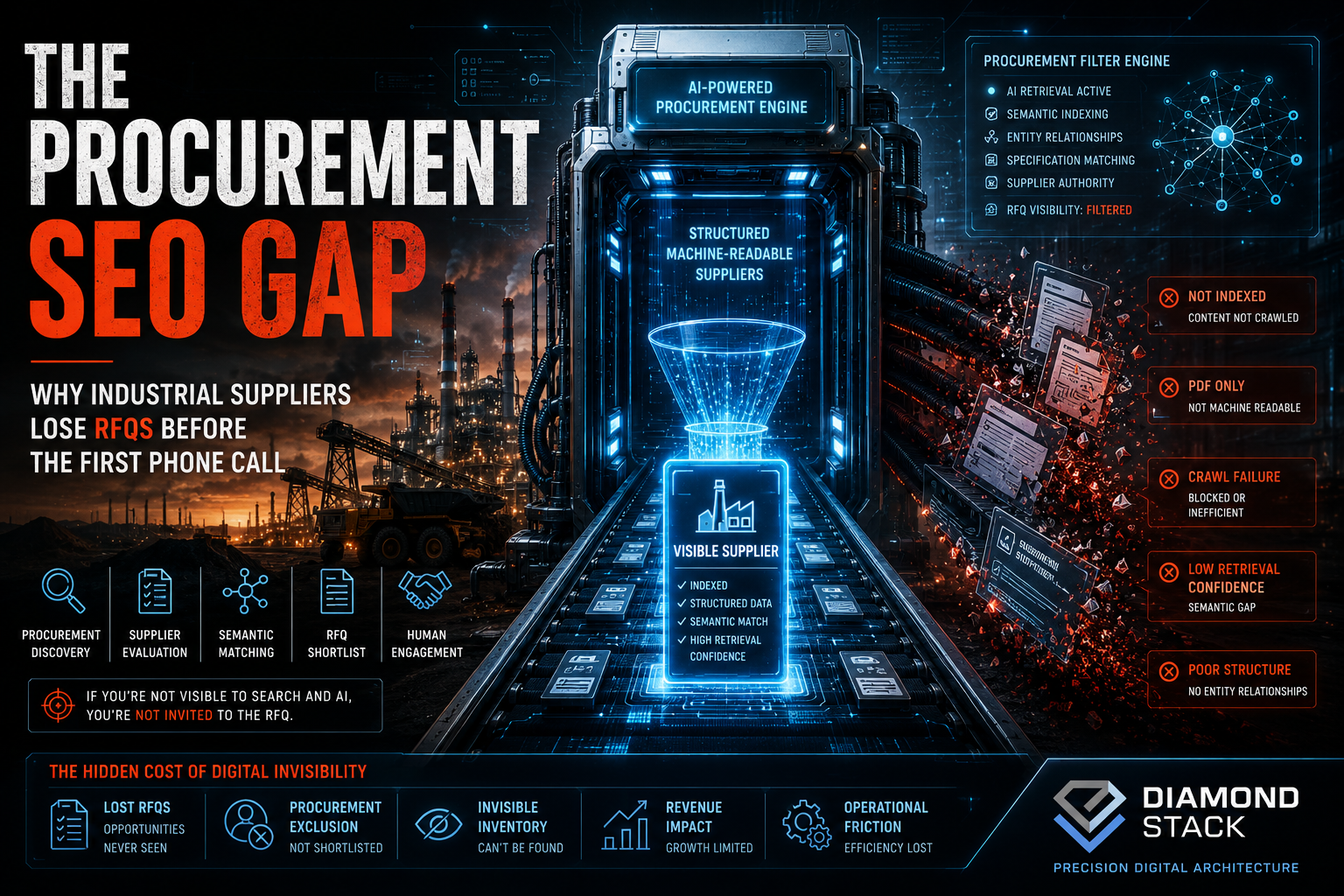
The Procurement SEO Gap: Why Industrial Suppliers Lose RFQs Before the First Phone Call
Most industrial suppliers believe they lose business because of pricing pressure, economic conditions, aggressive competitors, or shrinking procurement budgets.
In many cases, the real problem occurs much earlier.
Long before the first phone call.
Long before the first meeting.
Long before an RFQ is even issued.
The supplier is digitally eliminated.
Modern procurement increasingly happens inside invisible machine-mediated systems:
- search engines,
- procurement portals,
- AI retrieval layers,
- semantic indexing systems,
- and digital supplier evaluation workflows.
The traditional sales process has fundamentally changed. Procurement teams no longer begin with conversations. They begin with retrieval.
A sourcing manager searching for:
- stainless steel cable glands,
- perimeter security sensors,
- industrial flow meters,
- mining PPE suppliers,
- or hydraulic fittings,
is already filtering suppliers before human engagement begins.
If a supplier cannot be efficiently discovered, interpreted, indexed, and semantically understood by modern search systems, that supplier often never enters the procurement conversation at all.
This is the emerging Procurement SEO gap.
It is not a marketing problem.
It is an infrastructure visibility problem.
Across industrial sectors, thousands of technically competent businesses remain practically invisible online despite offering excellent products, decades of expertise, and highly competitive operational capabilities. Their inventory exists physically, but not semantically. Their products exist commercially, but not computationally.
To modern procurement systems, these suppliers barely exist.
This problem is intensifying as AI-driven retrieval systems increasingly mediate how buyers discover, compare, evaluate, and shortlist vendors.
Industrial businesses that continue relying on:
- PDF catalogues,
- fragmented websites,
- outdated ecommerce systems,
- image-based specifications,
- or weak technical architecture,
are gradually becoming excluded from modern procurement discovery layers.
The future of procurement visibility belongs to businesses whose infrastructure is machine-readable.
The Invisible Procurement Layer
Procurement has evolved into a digital filtration system.
Before a procurement officer speaks to a supplier, several invisible evaluation stages usually occur:
- search discovery,
- specification matching,
- supplier verification,
- inventory assessment,
- technical validation,
- and semantic relevance analysis.
Search engines increasingly function as procurement gateways.
When engineers, operations teams, and sourcing departments research suppliers, they typically search using highly technical language:
- voltage specifications,
- part numbers,
- compliance standards,
- dimensions,
- materials,
- tolerances,
- certifications,
- or compatibility requirements.
This search behaviour is highly structured.
Modern procurement discovery relies heavily on:
- indexed product data,
- crawlable specifications,
- semantic product relationships,
- structured categories,
- and machine-readable technical content.
If a supplier’s infrastructure fails to expose this information clearly, retrieval systems struggle to interpret inventory relevance.
The supplier disappears from procurement visibility.
This is particularly important within:
- mining,
- engineering,
- industrial manufacturing,
- security infrastructure,
- agricultural supply,
- electrical distribution,
- and wholesale technical sectors.
Procurement teams increasingly form supplier shortlists digitally before making contact.
The visible supplier receives the RFQ.
The invisible supplier never knows the opportunity existed.
Why Most Industrial Suppliers Are Invisible Online
Many industrial businesses still operate websites designed for an earlier internet.
A time when:
- search behaviour was simpler,
- AI retrieval did not exist,
- and procurement decisions relied more heavily on direct relationships.
Today, discoverability infrastructure matters enormously.
Unfortunately, many industrial supplier websites suffer from severe structural limitations.
PDF-Only Catalogues
One of the largest failures in industrial ecommerce architecture is excessive reliance on PDFs.
Many suppliers upload:
- product catalogues,
- specification sheets,
- manuals,
- compliance documents,
- and technical data,
as isolated PDFs rather than structured web content.
From a human perspective, this may seem acceptable.
From a retrieval perspective, it creates fragmentation.
Search systems struggle to:
- interpret relationships,
- extract structured meaning,
- connect specifications semantically,
- or prioritise inventory relevance effectively.
Critical product information becomes buried inside disconnected documents.
Poor Product Structures
Many supplier websites organise inventory poorly.
Common problems include:
- generic category labels,
- inconsistent product naming,
- weak hierarchy design,
- duplicate categories,
- shallow product descriptions,
- and broken internal search systems.
Procurement discovery depends heavily on structured information architecture.
If a sourcing manager searches for:
“IP66 outdoor perimeter beam sensor”
the system must understand:
- the product category,
- the environmental specification,
- the application context,
- the technical entity relationships,
- and supplier relevance.
Weak product architecture destroys semantic confidence.
Non-Indexable Product Data
A surprising number of industrial websites still present technical information through:
- image-based tables,
- JavaScript-heavy interfaces,
- downloadable spreadsheets,
- or inaccessible frontend systems.
Search systems cannot efficiently interpret non-readable data structures.
If crawlers cannot access the information cleanly, retrieval visibility declines.
Thin Product Pages
Many industrial product pages contain almost no contextual information beyond:
- a product title,
- an image,
- and a downloadable PDF.
This creates semantically weak pages with minimal retrieval value.
AI systems increasingly prioritise:
- context,
- clarity,
- specification detail,
- relational data,
- and structured semantic signals.
Thin pages reduce procurement visibility dramatically.
The Death of the PDF Catalogue
The PDF catalogue was once a practical operational tool.
Today, it increasingly functions as a discoverability bottleneck.
Procurement systems are shifting toward:
- searchable inventory,
- structured specification databases,
- semantic retrieval,
- AI-assisted sourcing,
- and machine-readable product ecosystems.
PDFs disrupt these systems.
PDFs Create Retrieval Fragmentation
A PDF is essentially an isolated information container.
Search engines may partially index its contents, but semantic relationship extraction remains limited compared to structured HTML environments.
For example:
- technical specifications inside PDFs are harder to associate with related products,
- internal linking relationships disappear,
- entity relationships weaken,
- crawl prioritisation declines,
- and structured data becomes limited.
The result is fragmented procurement visibility.
Procurement Teams Need Searchable Systems
Modern procurement workflows increasingly depend on speed.
Buyers need to:
- compare specifications,
- validate compatibility,
- identify alternatives,
- and shortlist vendors rapidly.
Searchable structured systems outperform static catalogues because they allow:
- semantic filtering,
- crawlable specifications,
- dynamic comparison,
- and AI retrieval compatibility.
Industrial businesses still relying heavily on PDFs are effectively operating inside legacy discoverability models.
AI Retrieval Systems Prefer Structured Information
Large language models and retrieval systems perform best when information is:
- hierarchical,
- contextual,
- semantically connected,
- and machine-readable.
Structured ecommerce environments provide:
- entity clarity,
- specification relationships,
- inventory associations,
- and contextual confidence.
PDF-heavy architectures create semantic isolation.
In the emerging AI procurement ecosystem, isolated information becomes invisible information.
Procurement SEO as Infrastructure Engineering
Most businesses misunderstand Procurement SEO.
They assume it means:
- writing blogs,
- adding keywords,
- or running advertising campaigns.
True Procurement SEO is far more operational.
It is infrastructure engineering for discoverability.
The objective is not merely traffic.
The objective is procurement inclusion.
Semantic Product Architecture
Industrial inventory must be organised according to:
- technical relationships,
- application context,
- specification hierarchy,
- compatibility logic,
- and semantic grouping.
This creates machine-readable procurement structures.
For example:
A perimeter security supplier should structure products around:
- detection technologies,
- environmental conditions,
- beam ranges,
- mounting applications,
- intrusion scenarios,
- and operational integrations.
Not merely generic product categories.
Semantic architecture improves:
- retrieval precision,
- procurement relevance,
- and AI interpretability.
Entity Relationships Matter
Modern search systems increasingly operate through entity understanding.
An industrial supplier must establish:
- clear product entities,
- supplier authority entities,
- brand relationships,
- specification relationships,
- and contextual industry associations.
Search systems increasingly model suppliers as knowledge graphs rather than simple websites.
Crawl Architecture Determines Visibility
Many industrial websites unintentionally generate crawl inefficiency through:
- duplicate URLs,
- weak taxonomy systems,
- fragmented category structures,
- broken pagination,
- and inaccessible product paths.
Procurement visibility depends heavily on crawl efficiency.
If search systems cannot efficiently understand inventory relationships, supplier discoverability weakens.
Internal Linking as Operational Logic
Internal linking should reinforce:
- category relationships,
- specification hierarchy,
- product compatibility,
- industry applications,
- and procurement intent.
Every internal link acts as a semantic signal.
Well-engineered linking systems help AI systems understand supplier relevance.
AI Search and Machine-Mediated Procurement
The next evolution of procurement is already underway.
AI systems increasingly influence:
- supplier discovery,
- vendor evaluation,
- product comparison,
- and sourcing recommendations.
Search itself is becoming machine-mediated.
AI Retrieval Systems Evaluate Structure
AI systems do not simply retrieve keywords.
They evaluate:
- contextual confidence,
- semantic consistency,
- structured relationships,
- crawl quality,
- and entity relevance.
This changes industrial SEO fundamentally.
A technically superior supplier may still lose visibility if their infrastructure lacks semantic clarity.
Procurement Agents and AI Assistants
Future procurement systems will increasingly involve:
- AI sourcing assistants,
- autonomous procurement agents,
- predictive supplier matching,
- and semantic inventory recommendation engines.
These systems require highly structured environments.
They depend on:
- clean product entities,
- machine-readable specifications,
- structured metadata,
- and contextual product relationships.
The supplier with better semantic infrastructure becomes more retrievable.
Supplier Authority Is Becoming Computational
Traditionally, supplier authority depended on:
- relationships,
- reputation,
- certifications,
- and sales networks.
Today, authority increasingly includes computational trust signals such as:
- structured data quality,
- semantic consistency,
- crawl efficiency,
- entity alignment,
- and machine-readable architecture.
Industrial businesses must now compete for retrieval confidence.
The Hidden Cost of Digital Invisibility
Most industrial businesses underestimate the financial consequences of poor discoverability infrastructure.
Digital invisibility creates operational damage long before revenue decline becomes obvious.
Lost RFQs
The most obvious consequence is silent RFQ loss.
If procurement teams cannot discover inventory effectively, the supplier never enters consideration.
No enquiry arrives.
No quote request appears.
No comparison opportunity exists.
The loss remains invisible.
Procurement Exclusion
Large procurement environments increasingly rely on:
- searchable vendor ecosystems,
- digital sourcing systems,
- structured supplier evaluation,
- and AI-assisted discovery.
Poor digital architecture creates supplier exclusion.
Even excellent businesses become operationally invisible.
Lower-Quality Leads
Suppliers with weak semantic visibility often rely heavily on:
- generic inbound enquiries,
- price-driven buyers,
- or low-intent traffic.
Strong Procurement SEO attracts:
- technically aligned buyers,
- specification-driven enquiries,
- and high-intent procurement opportunities.
Pricing Pressure
When discoverability weakens, differentiation weakens.
Businesses become trapped competing on:
- price,
- availability,
- or commoditised comparison.
Semantic authority creates procurement leverage.
Operational Scalability Declines
Poor infrastructure creates friction across:
- sales,
- procurement,
- support,
- inventory management,
- and supplier onboarding.
Discoverability infrastructure affects the entire commercial ecosystem.
Building an AI-Ready Procurement Architecture
Modern industrial suppliers require infrastructure designed for:
- humans,
- crawlers,
- procurement systems,
- and AI retrieval engines simultaneously.
Structured Product Data
Every product should include:
- crawlable specifications,
- searchable attributes,
- semantic categorisation,
- contextual descriptions,
- compatibility data,
- and structured metadata.
Technical information should exist directly within crawlable page architecture.
Not hidden inside disconnected documents.
Schema Engineering
Industrial websites should implement:
- Product schema,
- Organisation schema,
- FAQ schema,
- Breadcrumb schema,
- and specification metadata.
Structured data improves:
- entity clarity,
- retrieval confidence,
- and procurement discoverability.
Searchable Specifications
Technical specifications should be:
- structured,
- indexed,
- semantically grouped,
- and machine-readable.
This improves:
- procurement filtering,
- AI retrieval,
- and technical matching.
Crawl Path Optimisation
Suppliers must actively manage:
- indexable pages,
- taxonomy relationships,
- parameter handling,
- pagination systems,
- and crawl waste.
Efficient crawl architecture improves inventory visibility.
Lightweight Frontend Infrastructure
Industrial websites do not need excessive frontend complexity.
Heavy JavaScript environments often reduce:
- crawl efficiency,
- rendering performance,
- and semantic accessibility.
Lean infrastructure improves retrieval performance.
Semantic Hierarchy Engineering
Every category, specification, and product relationship should reinforce:
- procurement logic,
- industry relevance,
- and operational clarity.
The website should behave like a structured procurement system rather than a digital brochure.
The Future of Procurement Discovery
Procurement is evolving toward:
- semantic ecosystems,
- machine-mediated sourcing,
- AI-assisted supplier evaluation,
- and autonomous discovery systems.
The implications are enormous.
Search visibility will increasingly depend on:
- machine readability,
- semantic structure,
- crawl efficiency,
- and retrieval compatibility.
AI Procurement Assistants
Future procurement teams may rely on AI systems capable of:
- identifying suppliers automatically,
- validating technical compatibility,
- comparing specifications,
- and generating sourcing recommendations.
These systems will favour structured environments.
Machine-to-Machine Procurement
Industrial commerce is steadily moving toward:
- API-driven sourcing,
- automated procurement logic,
- and retrieval-first inventory systems.
Suppliers operating fragmented digital infrastructure may become increasingly disconnected from procurement ecosystems.
Semantic Supplier Networks
Search engines are evolving into relationship engines.
Suppliers with:
- clear entities,
- structured inventories,
- contextual authority,
- and strong semantic architecture,
will dominate future procurement discovery.
The industrial internet is becoming a machine-readable marketplace.
Conclusion
The Procurement SEO gap is not simply an SEO problem.
It is a structural visibility problem emerging from the evolution of modern procurement systems.
Industrial suppliers no longer compete only through:
- pricing,
- relationships,
- or operational capability.
They now compete through discoverability infrastructure.
Procurement decisions increasingly begin inside:
- search systems,
- AI retrieval layers,
- semantic evaluation models,
- and machine-readable supplier ecosystems.
Businesses operating outdated digital infrastructure risk becoming commercially invisible despite offering excellent products and services.
The future belongs to suppliers whose systems are:
- crawlable,
- semantically structured,
- AI-readable,
- and operationally coherent.
At Diamond Stack, Procurement SEO is approached as a systems engineering discipline — combining technical SEO, semantic product architecture, crawl optimisation, AI retrieval readiness, and operational ecommerce infrastructure into a unified procurement visibility framework.
For industrial businesses, wholesalers, manufacturers, security suppliers, and technical ecommerce operators, discoverability is no longer a marketing layer added after development.
It is foundational infrastructure.
Request a Procurement Visibility Audit, AI Search Readiness Assessment, Technical Infrastructure Review, or Crawl Architecture Analysis to identify where semantic fragmentation, crawl inefficiency, and retrieval limitations may already be restricting procurement visibility and RFQ acquisition.