
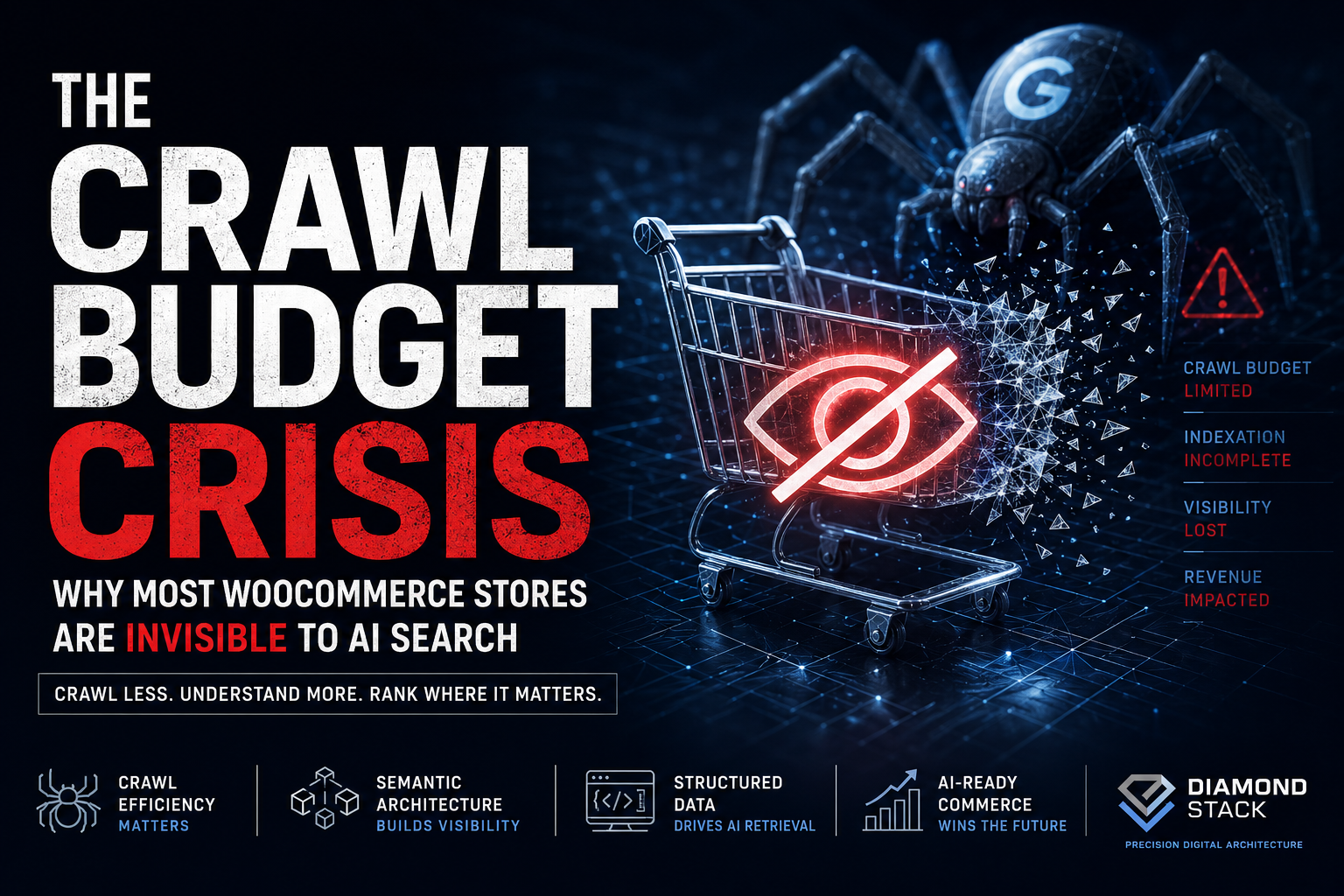
The Crawl Budget Crisis: Why Most WooCommerce Stores Are Invisible to AI Search
Most WooCommerce stores are not failing because of poor products, weak branding, or insufficient advertising budgets.
They are failing because modern search systems cannot efficiently understand them.
Beneath the polished homepage banners, optimised product photography, and carefully written product descriptions lies a structural problem that most ecommerce operators never see: crawl inefficiency. A silent infrastructure failure that slowly erodes visibility, indexation, discoverability, and ultimately revenue.
Google does not see the web the way humans do.
AI retrieval systems see it even less like humans.
Every ecommerce website exists within a finite computational economy. Search engines allocate limited resources to crawling, rendering, interpreting, and indexing websites. AI systems applying semantic retrieval models operate under even tighter efficiency constraints. The larger and more chaotic a WooCommerce environment becomes, the more likely it is that critical pages disappear into retrieval noise.
This is the emerging crawl budget crisis.
According to multiple large-scale SEO studies, a substantial percentage of ecommerce pages are either never indexed properly or are crawled so infrequently that their visibility deteriorates over time. Large WooCommerce stores often generate thousands — sometimes millions — of low-value URLs through faceted navigation, parameter combinations, duplicate taxonomies, thin archives, and plugin-generated endpoints.
To traditional search engines, this creates crawl waste.
To AI retrieval systems, it creates semantic confusion.
The result is operational invisibility.
This is no longer simply an SEO issue. It is an infrastructure engineering problem.
As AI-driven search evolves toward semantic retrieval, entity understanding, machine-mediated commerce, and computational prioritisation, ecommerce architecture itself becomes a strategic competitive advantage. Businesses with clean, machine-readable systems will dominate visibility. Businesses operating bloated, fragmented WooCommerce environments will steadily disappear from the discoverability layer of the modern internet.
The companies winning the next decade of ecommerce will not necessarily have the largest advertising budgets.
They will have the most understandable systems.
What Crawl Budget Actually Means
The term “crawl budget” is often oversimplified within the SEO industry.
In reality, crawl budget is a resource allocation framework used by search systems to determine how much computational attention a website deserves.
Every search engine crawler operates under constraints:
- bandwidth,
- processing power,
- rendering time,
- storage allocation,
- prioritisation models,
- and computational cost.
Googlebot does not infinitely crawl every URL on every website. It allocates resources selectively based on:
- domain authority,
- server responsiveness,
- content quality,
- historical crawl patterns,
- update frequency,
- and perceived information value.
For WooCommerce stores, this becomes critically important because ecommerce systems naturally generate enormous URL complexity.
A single product category can rapidly multiply into thousands of crawlable URLs through:
- filtered navigation,
- sorting parameters,
- layered taxonomy combinations,
- price filters,
- colour variants,
- pagination,
- tracking parameters,
- session identifiers,
- and dynamically generated archives.
From a human perspective, these pages may appear harmless.
From a crawler’s perspective, they create a maze.
Consider a jewellery ecommerce store selling engagement rings.
A single category page may generate URLs for:
- white gold rings,
- platinum rings,
- oval diamonds,
- round diamonds,
- halo settings,
- vintage styles,
- price ranges,
- availability filters,
- popularity sorting,
- pagination states.
Suddenly, one category becomes thousands of crawl permutations.
Most of these URLs provide little or no unique semantic value.
Yet search engines still spend resources crawling them.
This is crawl budget waste.
The problem compounds further when WooCommerce plugins generate:
- duplicate archives,
- thin search pages,
- dynamic filter URLs,
- unnecessary attachment pages,
- product tag archives,
- parameterised internal searches,
- or poorly canonicalised category structures.
The crawler begins spending more time processing low-value pages than discovering strategically important ones.
Eventually, search engines begin making prioritisation decisions.
Some pages get crawled less frequently.
Some pages become partially indexed.
Some disappear from the index entirely.
Others never meaningfully enter retrieval systems at all.
This is where ecommerce visibility quietly collapses.
The Difference Between Traditional Search and AI Retrieval
Traditional search engines primarily operated through keyword matching, hyperlink analysis, and document indexing.
Modern AI retrieval systems operate differently.
The emergence of:
- AI Overviews,
- semantic retrieval,
- vector databases,
- entity-based indexing,
- contextual ranking,
- and large language model retrieval layers,
has fundamentally changed how information is discovered.
AI systems do not simply look for matching keywords.
They attempt to understand relationships.
This shift is enormously important for ecommerce architecture.
A traditional search engine might tolerate structural inefficiencies if enough backlinks and keywords exist to compensate.
AI retrieval systems are far less forgiving.
Modern retrieval engines prefer environments that demonstrate:
- semantic clarity,
- hierarchical consistency,
- structured relationships,
- entity precision,
- contextual coherence,
- and machine-readable architecture.
In practical terms, AI systems reward websites that behave like organised information systems rather than chaotic collections of pages.
This is why WooCommerce architecture now matters far beyond conventional SEO.
AI retrieval layers increasingly rely on:
- structured product entities,
- schema relationships,
- internal semantic consistency,
- clean taxonomy design,
- contextual linking,
- and clearly defined informational hierarchies.
If an ecommerce website produces:
- contradictory metadata,
- fragmented taxonomies,
- duplicate content,
- inconsistent product relationships,
- or bloated crawl environments,
the AI system loses confidence in the information structure.
Retrieval visibility declines.
The emerging search ecosystem is moving away from raw indexing and toward probabilistic understanding.
Search engines are no longer simply storing pages.
They are modelling knowledge.
This creates a new competitive reality:
the websites most easily understood by machines will increasingly dominate search visibility.
Why WooCommerce Stores Generate Massive Crawl Waste
WooCommerce is extraordinarily flexible.
That flexibility is both its greatest strength and its greatest architectural weakness.
Out of the box, WooCommerce can scale effectively for small and medium ecommerce operations. However, most stores evolve through uncontrolled plugin expansion, layered customisations, theme complexity, and fragmented operational requirements.
Over time, the system accumulates structural entropy.
The result is crawler chaos.
Plugin Bloat
Many WooCommerce stores operate with:
- 40,
- 60,
- or even 100+ active plugins.
Each plugin potentially introduces:
- additional database queries,
- extra JavaScript payloads,
- dynamic endpoints,
- custom taxonomies,
- duplicate templates,
- unnecessary assets,
- and crawlable URLs.
Very few store owners evaluate plugins through the lens of crawl efficiency.
Yet every plugin potentially increases computational overhead for:
- users,
- servers,
- crawlers,
- and rendering systems.
Search engines increasingly evaluate rendering cost as part of crawl prioritisation.
Heavy frontend execution environments consume more resources to process.
The more expensive your site becomes to crawl, the less efficiently search systems allocate resources to it.
Faceted Navigation Traps
Faceted navigation is one of the largest causes of crawl waste in ecommerce.
Filters improve user experience.
But poorly controlled filter architectures create infinite URL states.
For example:
- /rings/?metal=gold
- /rings/?metal=gold&shape=oval
- /rings/?metal=gold&shape=oval&price=5000-10000
- /rings/?sort=popular
- /rings/page/2/
Each variation becomes another crawl path.
Without careful indexation governance, these combinations rapidly consume crawl allocation.
AI retrieval systems may interpret these URLs as redundant or low-confidence entities.
Duplicate Taxonomies
WooCommerce stores frequently create overlapping structures such as:
- categories,
- tags,
- brands,
- collections,
- attributes,
- and custom filters.
When poorly managed, these create semantically duplicated archives competing against one another.
Search engines struggle to determine:
- which page is authoritative,
- which page represents the primary entity,
- and which taxonomy relationship matters most.
This weakens semantic clarity.
Broken Canonicalisation
Canonical tags are intended to signal the preferred version of a page.
However, many WooCommerce environments contain:
- self-conflicting canonicals,
- parameter-based canonicals,
- inconsistent archive canonicals,
- or plugin conflicts overriding canonical logic.
This creates uncertainty within indexing systems.
Uncertainty reduces retrieval confidence.
JavaScript Rendering Overhead
Modern WooCommerce themes often prioritise visual design over structural efficiency.
Heavy animation libraries, visual builders, dynamic widgets, sliders, and frontend frameworks dramatically increase rendering complexity.
Search engines now render pages more extensively than before, but rendering still incurs computational cost.
AI retrieval systems are even less likely to invest resources into inefficient rendering environments.
A visually impressive website may be semantically invisible.
The Hidden Operational Cost of Crawl Inefficiency
Most businesses underestimate the operational consequences of poor crawl architecture.
They assume SEO issues only affect rankings.
In reality, crawl inefficiency impacts the entire commercial visibility layer of an ecommerce business.
Delayed Product Discovery
When search engines allocate crawl resources inefficiently, new products may take days or weeks to become fully discoverable.
For businesses operating:
- seasonal inventory,
- limited releases,
- procurement-driven stock cycles,
- or trend-sensitive products,
this delay directly affects revenue.
Inventory Invisibility
Many WooCommerce stores unintentionally bury important products beneath:
- excessive filtering systems,
- orphaned category structures,
- or weak internal linking.
Products technically exist on the site but remain practically invisible within retrieval systems.
This is particularly dangerous for:
- industrial suppliers,
- technical wholesalers,
- jewellery businesses,
- security equipment suppliers,
- and procurement-oriented ecommerce environments.
If search systems cannot efficiently understand inventory relationships, procurement discovery weakens.
Ranking Volatility
Crawl inefficiency destabilises indexation patterns.
Pages may:
- disappear temporarily,
- fluctuate in rankings,
- lose semantic authority,
- or experience inconsistent crawl frequency.
Businesses often blame algorithm updates when the underlying issue is architectural instability.
Wasted Server Resources
Poor crawl governance increases:
- unnecessary server requests,
- database load,
- rendering overhead,
- and cache inefficiency.
This creates operational costs far beyond SEO.
Infrastructure becomes more expensive to maintain while simultaneously becoming less visible.
AI Visibility Collapse
As AI-generated search experiences expand, retrieval systems increasingly prioritise:
- concise semantic relationships,
- structured information,
- and high-confidence entities.
Websites generating excessive low-value pages dilute semantic authority.
AI systems struggle to determine:
- what the business actually does,
- which products matter,
- and which entities deserve retrieval priority.
The business gradually disappears from machine-mediated commerce environments.
Entity SEO and Machine-Readable Commerce
Search is becoming entity-centric.
This represents one of the most significant transformations in digital visibility since the rise of mobile indexing.
An entity is not simply a keyword.
It is a recognised object with contextual relationships.
For ecommerce, this means:
- products,
- brands,
- materials,
- categories,
- suppliers,
- locations,
- and attributes,
must exist within clearly structured semantic systems.
Machine-readable commerce depends on these relationships being understandable at scale.
Structured Data as Infrastructure
Schema markup is often treated as a technical afterthought.
In reality, structured data is becoming foundational infrastructure for AI retrieval systems.
Effective WooCommerce architecture should implement:
- Product schema,
- Organisation schema,
- FAQ schema,
- Breadcrumb schema,
- Merchant listing data,
- Review schema,
- and availability metadata.
This creates semantic reinforcement across the entire ecommerce ecosystem.
AI systems increasingly rely on structured relationships to validate:
- product identity,
- pricing consistency,
- stock availability,
- brand relevance,
- and contextual associations.
Semantic Product Graphs
The future of ecommerce visibility lies in semantic product graphs.
This means:
- products connected to categories,
- categories connected to concepts,
- concepts connected to materials,
- materials connected to use cases,
- and all relationships structured coherently.
Search systems increasingly evaluate:
- contextual relevance,
- entity proximity,
- and semantic confidence.
The businesses winning AI retrieval visibility are building information systems, not merely websites.
Internal Linking as Semantic Reinforcement
Internal linking is no longer simply about navigation.
It is about relationship modelling.
Well-structured internal links help AI systems understand:
- hierarchy,
- topical relevance,
- product relationships,
- and authority distribution.
Every internal link acts as a semantic signal.
Poor internal architecture creates ambiguity.
Ambiguity weakens retrieval confidence.
Building an AI-Ready WooCommerce Architecture
The future of WooCommerce infrastructure requires deliberate engineering.
Not cosmetic optimisation.
Not plugin accumulation.
Not superficial SEO checklists.
True AI-ready ecommerce architecture demands systemic clarity.
Crawl Path Optimisation
Every crawl path should serve a purpose.
Businesses must actively govern:
- indexable URLs,
- filter logic,
- parameter handling,
- canonicalisation,
- pagination structures,
- and taxonomy relationships.
Crawl efficiency becomes a strategic resource allocation problem.
Taxonomy Consolidation
Overlapping categories weaken semantic clarity.
Modern WooCommerce architecture should minimise:
- duplicate taxonomies,
- unnecessary archives,
- fragmented category structures,
- and overlapping attribute systems.
Hierarchy matters.
Lightweight Frontend Stacks
The future belongs to lean infrastructure.
Efficient ecommerce systems prioritise:
- fast rendering,
- minimal JavaScript,
- optimised CSS delivery,
- reduced DOM complexity,
- edge caching,
- and streamlined frontend execution.
Performance is no longer merely a user experience metric.
It is a crawl efficiency metric.
Structured Data Engineering
Structured data should be engineered systematically rather than implemented sporadically.
This includes:
- entity consistency,
- schema validation,
- relationship mapping,
- and semantic alignment.
Machine-readable architecture becomes a competitive moat.
Database Optimisation
Many WooCommerce stores operate on fragmented databases burdened by:
- transients,
- revision bloat,
- orphaned metadata,
- expired sessions,
- and plugin residue.
Database efficiency directly affects:
- server response times,
- crawl stability,
- and rendering performance.
Infrastructure hygiene matters.
Indexation Governance
Not every page deserves indexation.
This is one of the most misunderstood concepts in ecommerce SEO.
High-performing ecommerce systems intentionally control:
- what gets crawled,
- what gets indexed,
- what gets rendered,
- and what remains operationally hidden.
Visibility requires selectivity.
The Future of Search Infrastructure
Search is entering a machine-mediated era.
The traditional concept of ranking blue links is steadily dissolving into:
- AI summaries,
- conversational retrieval,
- agent-based search,
- semantic recommendation systems,
- and predictive discovery models.
This fundamentally changes ecommerce strategy.
Businesses are no longer competing only for rankings.
They are competing for retrieval inclusion.
AI systems increasingly act as intermediaries between:
- buyers,
- procurement teams,
- consumers,
- and commercial decision-making processes.
These systems favour:
- trusted entities,
- clean architecture,
- semantic consistency,
- and machine-readable clarity.
The ecommerce stores dominating the next decade will behave less like websites and more like structured operational knowledge systems.
Search infrastructure is becoming computational infrastructure.
And computational infrastructure rewards efficiency.
The Emerging Divide Between Visible and Invisible Commerce
A divide is forming across ecommerce.
On one side:
- lean,
- semantically structured,
- AI-readable commerce systems.
On the other:
- bloated,
- fragmented,
- plugin-heavy environments generating retrieval confusion.
The difference between these two architectures will increasingly determine:
- visibility,
- discoverability,
- procurement access,
- and commercial growth.
This is not theoretical.
It is already happening.
AI retrieval systems are reshaping how information is selected, prioritised, and surfaced across the internet.
Businesses that fail to adapt their infrastructure risk gradual invisibility.
Not because their products lack value.
But because their systems lack clarity.
Conclusion
The crawl budget crisis is not an SEO trend.
It is an operational visibility crisis emerging from the collision between ecommerce complexity and machine-mediated search.
WooCommerce remains one of the most powerful ecommerce platforms available. But without deliberate infrastructure engineering, its flexibility can rapidly evolve into semantic chaos.
Modern ecommerce visibility now depends on:
- crawl efficiency,
- semantic clarity,
- entity consistency,
- structured relationships,
- and machine-readable architecture.
Businesses that continue treating SEO as a layer added after development will increasingly struggle within AI-driven retrieval systems.
The future belongs to businesses that engineer discoverability directly into their operational infrastructure.
At Diamond Stack, ecommerce architecture is approached as a systems engineering discipline — combining technical WooCommerce architecture, AI-ready semantic infrastructure, crawl optimisation, and operational visibility engineering into a unified digital framework.
For businesses operating complex WooCommerce environments, the next competitive advantage will not come from adding more plugins, more content, or more advertising spend.
It will come from building systems that machines can understand efficiently.
Request a crawl efficiency audit, AI visibility assessment, or technical infrastructure review to identify where semantic friction, crawl waste, and retrieval inefficiencies may already be limiting your ecommerce visibility.