Manufacturing Determines Survival: The 2026 Jewellery Production Pivot
For most of the past century, jewellery businesses competed primarily on design, gemstones, and brand reputation. Manufacturing was considered a backstage function—important, but rarely strategic.
That assumption is now obsolete.
In 2026, the global jewellery industry is undergoing a structural transformation where manufacturing methodology has become one of the most important determinants of profitability and survival.
For South African jewellers in particular, this shift is accelerating under a set of unique pressures:
- Rand volatility, which destabilises import costs
- Rising labour costs for master artisans
- A shrinking middle-class jewellery market
- Increasing global compliance requirements
- Growing demand for ethical sourcing and traceability
Historically, jewellery manufacturing was based on a simple retail logic:
Produce inventory → stock stores → sell gradually
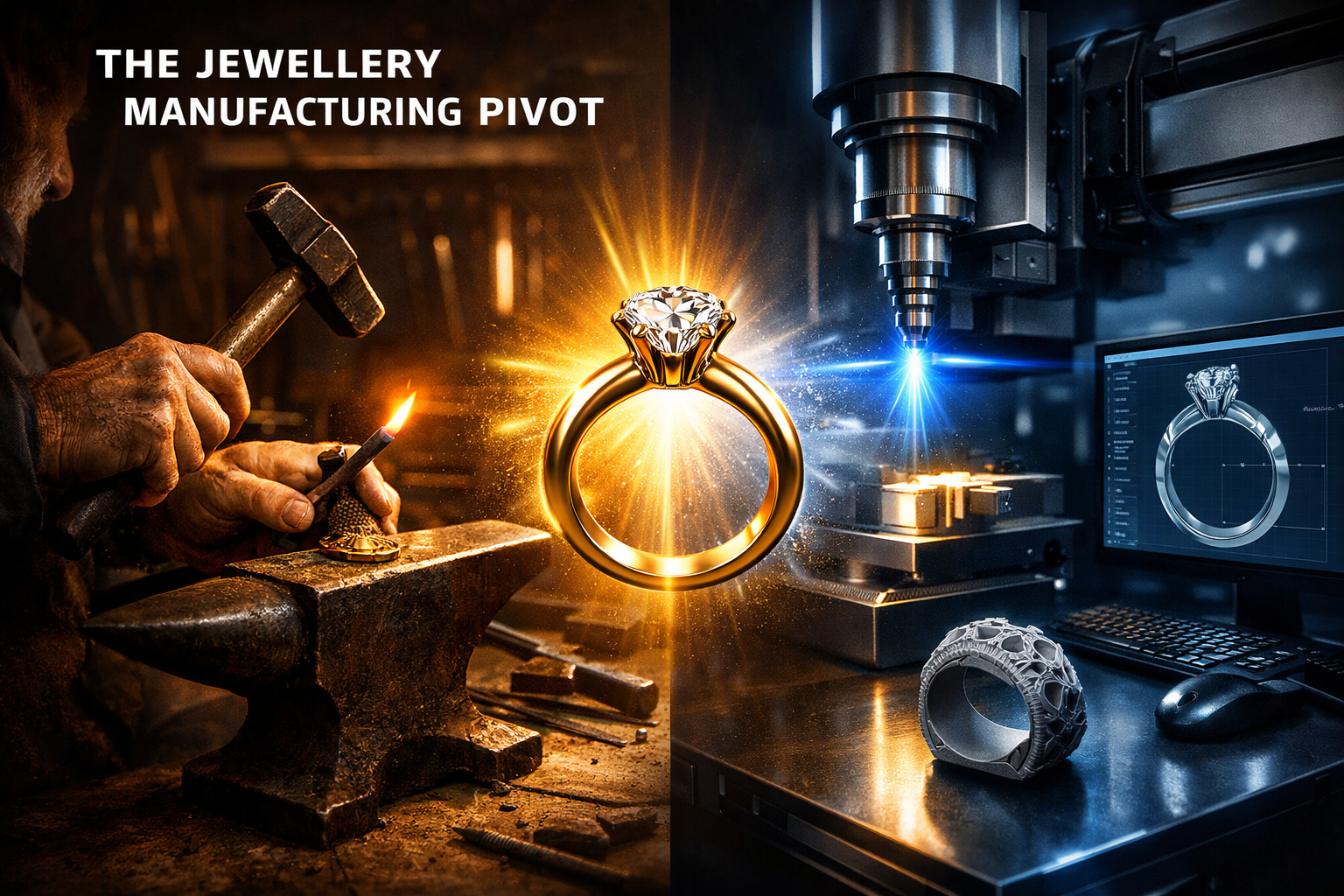
Today, that model is being replaced by a radically different system:
Design digitally → produce on demand → document provenance
This transformation represents a fundamental strategic pivot: the industry is moving from inventory-driven production to agile, digitally integrated manufacturing systems.
Understanding this shift requires examining the jewellery industry through a new framework.
The Manufacturing Reckoning
The modern jewellery economy has entered what can only be described as a manufacturing reckoning.
Across global markets, jewellers are discovering that traditional production models carry hidden financial risks that were previously masked by steady retail demand.
Three structural changes have exposed these weaknesses.
1. Inventory Has Become a Financial Liability
Traditional jewellery manufacturing relies heavily on batch casting.
A workshop produces dozens of pieces in advance, distributes them to stores, and sells them over time.
This model worked when:
- consumer demand was predictable
- jewellery trends changed slowly
- capital costs were manageable
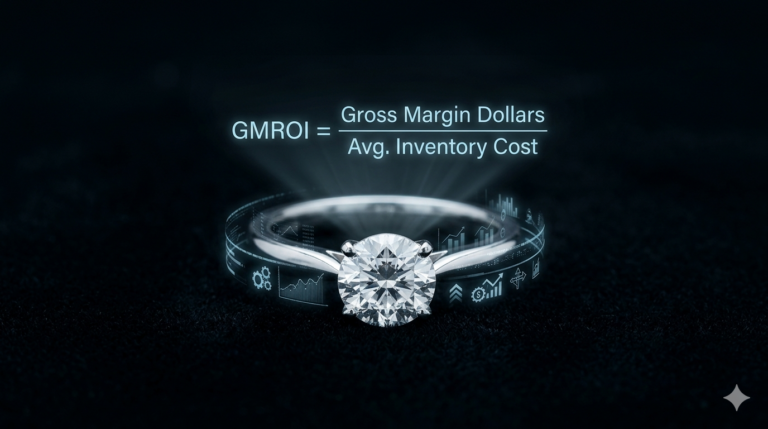
But in today’s environment, inventory represents trapped capital.
Unsold pieces tie up:
- precious metals
- labour costs
- production time
- working capital
When demand shifts—or when metal prices spike—this inventory quickly becomes a financial burden.
2. Currency Volatility Is Destroying Import Economics
South African jewellers importing mass-produced jewellery face increasing exposure to exchange rate fluctuations.
A weakening rand can instantly inflate:
- manufacturing costs
- shipping fees
- import duties
What once appeared to be inexpensive overseas production now carries significant financial risk.
3. Consumers Expect Customisation
Modern buyers increasingly seek:
- bespoke engagement rings
- personalised jewellery
- ethically sourced materials
Mass-produced designs struggle to meet these expectations.
This shift is fragmenting the jewellery market into four distinct economic sectors, each with its own manufacturing model.
Understanding these sectors reveals where the industry is heading.
Sector 1: The Fashion Segment (Low-End Costume Jewellery)
Manufacturing Battle
Mass Overseas Import vs Local Micro-Batch 3D Printing
The fashion jewellery segment operates on speed and trend responsiveness.
Retailers must react quickly to:
- social media trends
- seasonal styles
- influencer-driven demand
Historically, the dominant manufacturing strategy has been mass overseas imports.
Large quantities of inexpensive jewellery are produced in low-cost manufacturing hubs and shipped globally.
While this model offers extremely low per-unit costs, it introduces several operational risks.
Key Vulnerabilities of Import-Driven Manufacturing
Import-based jewellery supply chains expose retailers to:
- currency fluctuations
- shipping disruptions
- geopolitical trade issues
- long lead times
A fashion trend that emerges today may take three to six months to reach retail shelves.
By that time, the trend may already have passed.
The Alternative: Localised 3D Printing
Advances in additive manufacturing have created a compelling alternative: micro-batch local production.
Using modern 3D printers, jewellers can produce designs using:
- recycled plastics
- bio-resins
- alternative materials
This allows retailers to manufacture jewellery on demand in extremely small quantities.
SWOT: Fashion Segment Manufacturing
| Strengths | Weaknesses |
|---|---|
| Local 3D printing eliminates long supply chains | Initial investment in printers and materials |
| Micro-batch production enables rapid trend response | Higher unit cost compared to ultra-cheap imports |
| Sustainable materials appeal to eco-conscious consumers | Limited material options compared to metal jewellery |
| Opportunities | Threats |
|---|---|
| Sustainability branding using recycled materials | Global mass producers may still undercut prices |
| Hyper-fast product development cycles | Technology adoption barriers for small retailers |
| Reduced inventory risk | Cheap import competition remains intense |
Strategic Insight
Additive manufacturing allows fashion jewellery businesses to shift from inventory-heavy retail to responsive design manufacturing.
For small brands, this agility can become a powerful competitive advantage.
Sector 2: The Squeezed Middle (R15k–R40k Jewellery)
Manufacturing Battle
Traditional Batch Casting vs Just-In-Time CAD/CAM Production
The mid-market jewellery segment—particularly engagement rings—faces the greatest economic pressure.
Consumers want quality craftsmanship but remain price sensitive.
Unfortunately, traditional manufacturing methods create significant inefficiencies in this price range.
The Inventory Trap
Many jewellers still follow a familiar pattern:
- cast 20 rings
- sell 6
- melt the remaining 14 later
Each step consumes:
- labour
- precious metals
- workshop time
This cycle erodes margins and ties up capital.
The Rise of the Zero-Inventory Jewellery Model
Digital design tools now enable a radically different workflow.
Instead of manufacturing inventory upfront, jewellers produce pieces only after the client places an order.
Production flow:
- Customer consultation
- CAD design created
- Wax model printed via 3D printer
- Casting performed
- Final finishing and stone setting
This system eliminates inventory entirely.
SWOT: Mid-Market Manufacturing
| Strengths | Weaknesses |
|---|---|
| Zero inventory dramatically improves cash flow | Requires CAD expertise and digital workflows |
| On-demand production reduces metal waste | Production time slightly longer than stocked inventory |
| Personalisation increases perceived value | Technology training required for staff |
| Opportunities | Threats |
|---|---|
| Rising demand for custom engagement rings | Traditional jewellers may resist technology adoption |
| Improved margins through efficient production | Competitors adopting the same model |
| Reduced exposure to precious metal price swings | Software and equipment costs |
Strategic Insight
The mid-market jeweller of the future will operate less like a traditional workshop and more like a digital design studio with a manufacturing backend.
Sector 3: High-End Luxury (Investment Jewellery)
Manufacturing Battle
Traditional Hand-Forging vs Precision Milling and Laser Welding
Luxury jewellery has long relied on the skill of master goldsmiths.
These artisans possess extraordinary craftsmanship—but their numbers are declining.
South Africa faces a growing shortage of highly trained jewellery craftsmen.
This creates a production bottleneck.
The Artisanal Constraint
Hand-forged jewellery requires:
- years of training
- intensive labour
- slow production cycles
While these qualities contribute to prestige, they also limit scalability.
The Rise of Precision Manufacturing
Advanced jewellery workshops now integrate technologies such as:
- CNC milling machines
- precision laser welding
- high-resolution CAD modelling
These tools allow jewellers to produce exceptionally precise components, even in high-purity metals like 24K gold.
The result is not the elimination of craftsmanship, but its augmentation.
SWOT: Luxury Manufacturing
| Strengths | Weaknesses |
|---|---|
| Precision machinery allows exceptional detail | Equipment costs are high |
| Laser welding enables high-purity metal fabrication | Technical expertise required |
| Technology reduces production bottlenecks | Perception that machine-made equals lower craftsmanship |
| Opportunities | Threats |
|---|---|
| Increased production capacity without sacrificing quality | Loss of traditional artisan skills |
| Ability to produce ultra-high purity gold jewellery | High-end competitors investing in similar technologies |
| Combination of craftsmanship and technology | Technological dependency |
Strategic Insight
Technology does not replace craftsmanship—it scales it.
Master jewellers become design architects rather than production bottlenecks.
Sector 4: The Export Corridor
Manufacturing Battle
Opaque Sub-Contracting vs Blockchain-Integrated Workshops
Export markets are becoming increasingly regulated.
Governments and international institutions now demand transparency regarding:
- material sourcing
- labour practices
- environmental impact
Jewellery exports lacking proper documentation risk rejection in regulated markets.
The Compliance Challenge
Many jewellery supply chains remain opaque.
Pieces may pass through multiple subcontractors without a clear record of:
- metal origin
- refining processes
- manufacturing locations
This lack of transparency is becoming a serious barrier to international trade.
The Urban Mining and Digital Passport Model
Forward-thinking jewellery workshops are adopting a new approach:
Urban mining combined with blockchain traceability.
Urban mining refers to recovering precious metals from:
- recycled jewellery
- electronic waste
- industrial scrap
When this refining process occurs in-house, every step can be digitally recorded.
This data forms the foundation of a Digital Product Passport—a verifiable record of a piece’s entire lifecycle.
SWOT: Export Manufacturing
| Strengths | Weaknesses |
|---|---|
| Full traceability improves regulatory compliance | Technology infrastructure required |
| Urban mining reduces reliance on raw mining supply | Implementation complexity |
| Digital product passports enhance brand credibility | Requires industry-wide adoption |
| Opportunities | Threats |
|---|---|
| Access to premium international markets | Strict compliance standards |
| ESG-driven consumer demand | Regulatory changes |
| Sustainable production narratives | Competitive transparency |
Strategic Insight
Traceability is rapidly becoming a prerequisite for participation in global luxury markets.
The Global vs South African Manufacturing Gap
Globally, jewellery manufacturing is rapidly integrating:
- AI-driven CAD design
- additive manufacturing
- just-in-time production
- digital provenance tracking
Many South African workshops, however, still rely on:
- stock inventory production
- manual workflows
- fragmented supply chains
This gap presents both a major risk and a significant opportunity.
Jewellers who adopt modern manufacturing architecture early may capture disproportionate market share as the industry evolves.
The Strategic Directive: The Coetzee Convergence Framework
In the emerging jewellery economy, three systems must converge.
- Manufacturing Agility
On-demand production replacing stock inventory. - Financial Efficiency
Reduced capital tied up in unsold jewellery. - Digital Provenance
Transparent, verifiable supply chains.
This convergence defines the next generation jewellery business model.
The Final Thesis
The jewellery industry is undergoing a quiet but profound transformation.
The divide between successful and struggling jewellers is no longer based primarily on design, gemstones, or branding.
Instead, the decisive factor is manufacturing architecture.
In 2026, the jewellery industry is no longer divided by what it makes.
It is divided by how it makes it.