The Hidden SEO Problem With Live Diamond Inventory Feeds
Live diamond inventory systems transformed the jewellery industry.
A modern jeweller can now display tens of thousands of certified diamonds sourced globally in real time without physically holding the inventory themselves. Platforms like Nivoda and RapNet have fundamentally changed how online diamond retail operates, allowing jewellers to scale inventory access at unprecedented speed.
Operationally, this looks incredibly attractive.
More inventory.
More searchable products.
More long-tail keyword opportunities.
More potential organic traffic.
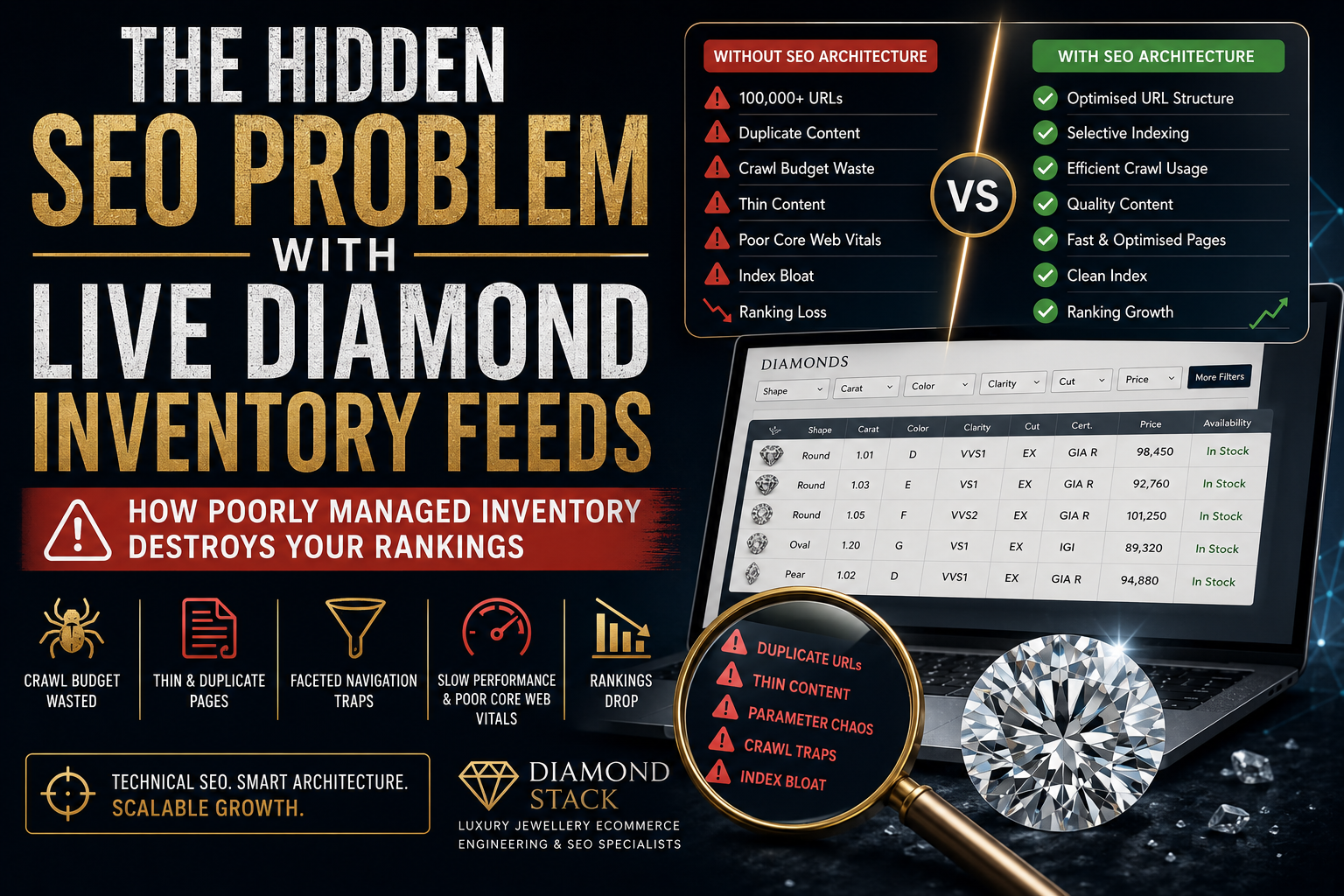
But beneath the surface, many jewellery websites are unknowingly creating severe technical SEO problems that silently destroy organic visibility over time.
Thousands of dynamically generated pages.
Near-duplicate inventory listings.
Exploding parameter URLs.
Thin product content.
Uncontrolled faceted navigation.
Crawl inefficiency.
Poor Core Web Vitals.
Massive index bloat.
The result is often catastrophic:
- declining rankings
- crawl budget exhaustion
- reduced indexation quality
- suppressed organic growth
- slower mobile performance
- weaker conversion rates
The dangerous part is that most jewellers never realise the inventory system itself is causing the problem.
They simply see rankings stagnate while competitors continue gaining visibility.
At Diamond Stack, live inventory architecture is engineered from an SEO-first infrastructure perspective. Because scaling inventory without technical SEO architecture does not create growth.
It creates technical chaos.
This article explores the hidden SEO problems caused by live diamond inventory feeds and how jewellery businesses can engineer scalable inventory systems without destroying search visibility.
Why Live Diamond Inventory Became Essential
The luxury jewellery industry has shifted dramatically over the past decade.
Customers now expect:
- instant inventory access
- real-time pricing
- extensive diamond selection
- advanced filtering
- certification transparency
- rapid fulfilment
Traditional jewellers holding small local inventories simply cannot compete digitally against businesses offering access to tens of thousands of diamonds globally.
The Rise of Virtual Inventory
Modern inventory platforms allow jewellers to access:
- supplier inventories
- international stone networks
- wholesale databases
- real-time availability systems
This enables businesses to scale product selection without:
- warehousing costs
- massive capital lockup
- physical inventory ownership
Systems Driving the Industry
Popular inventory systems include:
- Nivoda
- RapNet
- virtual diamond marketplaces
- custom supplier feeds
- ERP-connected inventory systems
Operationally, these systems are extremely powerful.
Technically, however, they introduce enormous SEO complexity.
The SEO Disaster Most Jewellers Never See
Many jewellers assume:
“More inventory equals more SEO traffic.”
This is only partially true.
Without proper SEO architecture, large inventory systems often reduce overall site quality rather than improve it.
Explosive URL Growth
A single diamond feed may generate:
- 10,000
- 50,000
- sometimes over 100,000 product URLs
Each product variation may create:
- filtered URLs
- parameter combinations
- category duplicates
- search-generated pages
This rapidly creates uncontrolled index expansion.
Near-Duplicate Pages
Most diamonds share extremely similar data:
- cut
- clarity
- carat
- certification
- shape
- pricing structures
This means many pages become semantically indistinguishable from Google’s perspective.
Minor specification changes do not automatically create unique content value.
Weak Quality Signals
Google increasingly evaluates:
- uniqueness
- semantic depth
- informational value
- engagement quality
Thousands of thin inventory pages dilute overall site quality signals.
This becomes especially dangerous when:
- descriptions are supplier-generated
- content is templated
- metadata is duplicated
- product pages contain minimal differentiation
Crawl Budget Exhaustion Explained
Crawl budget is one of the most misunderstood concepts in large-scale SEO.
Google allocates limited crawl resources to each website.
The larger and more inefficient the site becomes, the more carefully crawl management must be engineered.
What Happens on Poorly Managed Diamond Sites
Googlebot encounters:
- endless filter combinations
- parameter URLs
- duplicate product paths
- low-value inventory pages
- expired inventory
- dynamically generated URLs
The crawler wastes enormous resources on pages that should never be indexed.
Parameter URL Explosion
Jewellery filtering systems often generate URLs for:
- colour
- clarity
- shape
- certification
- fluorescence
- carat
- price ranges
- polish
- symmetry
This can create millions of crawlable URL variations.
Example:
- /diamonds?shape=round&clarity=vvs1&colour=d
- /diamonds?clarity=vvs1&shape=round&colour=d
- /diamonds?shape=round&colour=d&clarity=vvs1
Technically different URLs.
Practically identical pages.
Infinite Crawl Traps
Poorly engineered faceted navigation systems create infinite crawl spaces where Google continuously discovers:
- new parameter combinations
- endless pagination
- dynamically generated paths
This severely damages crawl efficiency.
Expired Inventory Problems
Live inventory changes constantly.
Diamonds sell quickly.
Without proper inventory lifecycle management:
- dead URLs accumulate
- redirects become chaotic
- orphaned pages increase
- crawl waste expands
Large jewellery sites can silently become technically toxic over time.
Thin Content Problems With Diamond Pages
Most inventory feeds supply:
- basic specifications
- generic descriptions
- templated metadata
This creates massive thin-content problems.
Supplier-Fed Duplication
Multiple jewellers often pull inventory from identical suppliers.
That means hundreds of websites may display:
- identical diamond specs
- identical descriptions
- identical certification data
Google has little incentive to rank duplicate inventory pages.
Low Semantic Differentiation
Changing:
- 1.01ct to 1.03ct
- VVS1 to VS1
- G colour to F colour
does not create meaningful semantic uniqueness automatically.
From Google’s perspective, many pages appear almost interchangeable.
Template Saturation
Many jewellery websites rely on:
- identical layouts
- duplicated schema
- repetitive metadata
- generic category text
At scale, this creates weak overall quality signals.
The Faceted Navigation Problem
Faceted navigation is one of the most technically dangerous components in jewellery SEO architecture.
It is also one of the most commonly mishandled.
Why Jewellery Filters Become Dangerous
Diamond filtering creates huge combinational complexity.
Users filter by:
- cut
- clarity
- colour
- shape
- certification
- fluorescence
- polish
- symmetry
- price
- carat
Every filter combination potentially creates a new crawlable URL.
Crawl Traps & Index Bloat
Without strict crawl controls:
- Google indexes useless filter combinations
- crawl budgets collapse
- internal linking becomes diluted
- low-value pages flood the index
This weakens ranking performance across the entire domain.
Internal Linking Dilution
Massive faceted systems spread link equity thinly across:
- duplicate collections
- low-value parameter pages
- endless filter states
This reduces authority concentration on valuable pages.
Canonicalization Failures
Many jewellers incorrectly rely on canonicals alone to solve faceted duplication.
This is dangerous.
Google may ignore canonicals when:
- signals conflict
- duplicate relationships are unclear
- internal linking reinforces alternate URLs
Canonicalization must be engineered carefully alongside:
- crawl controls
- noindex directives
- parameter handling
- sitemap architecture
Canonicalization Failures in Jewellery eCommerce
Canonical problems are extremely common on large inventory sites.
Self-Referencing Problems
Many inventory systems generate:
- inconsistent canonical paths
- conflicting canonicals
- dynamically changing references
This confuses indexation signals.
Collection Duplication
A single diamond may appear under:
- round diamonds
- engagement diamonds
- certified diamonds
- loose diamonds
- featured inventory
Without canonical discipline, duplicate indexing expands rapidly.
Filtered URL Canonicals
Poor implementations often canonicalize:
- parameter URLs
- paginated states
- filtered collections
incorrectly.
This weakens crawl clarity dramatically.
The Performance Cost of Live Inventory Systems
SEO problems extend far beyond indexing.
Large inventory systems also create major performance challenges.
API Latency
Many inventory systems depend on:
- live API requests
- real-time synchronization
- dynamic availability checks
This increases:
- server response times
- rendering delays
- frontend instability
Database Overhead
Large inventories create:
- complex database queries
- heavy filtering operations
- dynamic rendering loads
Without optimization:
- page generation slows
- caching efficiency declines
- mobile performance deteriorates
JavaScript Bloat
Many diamond systems rely heavily on JavaScript for:
- filtering
- rendering
- sorting
- inventory loading
This damages:
- Interaction to Next Paint (INP)
- mobile responsiveness
- crawl rendering efficiency
Core Web Vitals Degradation
Large inventory systems frequently fail:
- Largest Contentful Paint (LCP)
- Interaction to Next Paint (INP)
- Cumulative Layout Shift (CLS)
This directly impacts:
- rankings
- engagement
- conversion rates
Structured Data Problems With Diamond Feeds
Structured data becomes highly complicated at inventory scale.
Common Schema Problems
Many jewellery websites suffer from:
- missing Offer schema
- invalid availability states
- inconsistent pricing
- duplicated Product entities
- incomplete review markup
Inventory Synchronization Issues
Real-time pricing creates structured data instability when:
- frontend pricing differs from schema
- inventory availability changes rapidly
- cached pages serve outdated information
Google increasingly evaluates structured data accuracy aggressively.
Rich Result Instability
Poor schema implementation weakens:
- rich snippets
- product visibility
- SERP trust signals
This reduces click-through rates significantly.
Why Shopify Struggles With Large Diamond Inventories
Shopify works well for many standard eCommerce stores.
However, large diamond inventory systems expose significant limitations.
App Dependency
Most advanced inventory features require:
- third-party apps
- layered integrations
- external rendering systems
This increases:
- JavaScript overhead
- performance instability
- operational complexity
URL Structure Limitations
Shopify restricts:
- URL architecture
- crawl control
- faceted navigation engineering
- advanced SEO customization
For large-scale jewellery SEO, this becomes problematic.
Limited Backend Control
Jewellery inventory optimization often requires:
- advanced caching
- crawl management
- database optimization
- rendering control
Shopify limits access to many of these infrastructure layers.
How Diamond Stack Engineers SEO-Safe Diamond Inventory Systems
At Diamond Stack, inventory systems are engineered around:
- crawl efficiency
- performance architecture
- selective indexing
- scalable SEO infrastructure
rather than simply displaying more products.
Crawl Control Engineering
Advanced crawl management includes:
- parameter handling
- robots directives
- crawl prioritization
- noindex systems
- sitemap segmentation
Canonical Architecture
Canonical systems are engineered to:
- consolidate authority
- reduce duplication
- stabilize indexing
- improve crawl clarity
Inventory Indexing Strategy
Not every inventory page deserves indexing.
Diamond Stack engineers:
- selective indexing thresholds
- inventory pruning systems
- quality-based index inclusion
This dramatically improves overall site quality signals.
Faceted Navigation Optimization
Filtering systems are engineered to:
- preserve usability
- prevent crawl traps
- maintain internal linking integrity
- reduce index bloat
Dynamic Rendering Optimization
Large inventory systems require:
- intelligent caching
- render prioritization
- API efficiency
- CDN acceleration
This improves:
- Core Web Vitals
- crawl rendering
- mobile responsiveness
Best Practices for SEO-Friendly Live Inventory Architecture
Selective Indexing
Only high-value pages should enter the index.
Avoid indexing:
- weak filter combinations
- low-value inventory pages
- thin content variations
Dynamic Sitemap Management
Large inventory systems require:
- segmented sitemaps
- freshness prioritization
- inventory lifecycle management
Inventory Quality Thresholds
Pages should meet minimum quality standards before indexation.
This includes:
- unique content
- semantic differentiation
- performance quality
- structured data integrity
Internal Linking Discipline
Internal linking should prioritize:
- high-value categories
- strategic collections
- commercial landing pages
not endless filter states.
The Real Problem Is Not Inventory Scale
Large inventory itself is not the problem.
Poor technical architecture is.
The jewellery brands dominating organic search are not necessarily those with the largest inventories.
They are the brands with:
- disciplined crawl architecture
- selective indexing
- performance-first infrastructure
- technically engineered SEO systems
Live inventory can become an enormous competitive advantage.
Or it can silently destroy a website’s search visibility beneath layers of duplication, crawl inefficiency, and technical debt.
At Diamond Stack, live inventory systems are engineered specifically for:
- scalable SEO
- luxury eCommerce performance
- WooCommerce optimization
- crawl efficiency
- Core Web Vitals compliance
- inventory architecture stability
If your jewellery website relies on live diamond feeds and organic growth has stalled, the issue may not be your products.
It may be the technical architecture beneath the inventory itself.
Because in modern jewellery SEO, inventory scale without infrastructure discipline is not growth.
It is entropy.