The Low-End Engine: Building Cash Velocity Through Minimum Viable Transaction Loops
A Coetzee Convergence Framework Analysis of the Sub-R5,000 Jewellery Market
Introduction: The Low-End Paradox
The sub-R5,000 jewellery market represents the most strategically misunderstood segment in South African retail. Traditional independent jewellers either ignore this tier entirely—dismissing it as "costume jewellery" beneath their brand positioning—or approach it as a loss-leader traffic generator: low-margin inventory displayed prominently to drive showroom visits that theoretically convert to high-margin premium purchases.
Both approaches systematically surrender market share and profit opportunity to fast-fashion chains (Pandora, Swarovski, Mr Price), online aggregators (Takealot, Superbalist), and social commerce platforms (Instagram Shopping, TikTok Shop). These competitors understand what independents miss: the low-end is not a margin opportunity—it is a velocity opportunity. When architected correctly, sub-R5,000 inventory generates cash flow, brand awareness, and algorithmic authority that funds and amplifies premium operations.
The paradox is this: independent jewellers possess structural advantages in this segment that chain retailers and aggregators cannot replicate—intimate market knowledge, flexible sourcing, rapid trend adaptation, authentic storytelling capability—yet they systematically fail to deploy these advantages because they optimise for wrong metrics. They evaluate low-end performance using premium-tier metrics (gross margin percentage, transaction value, customer lifetime value) when the correct metrics are radically different (inventory turns, cash conversion cycle, customer acquisition cost, algorithmic visibility).
This essay examines the economic physics of low-end jewellery commerce, the psychological drivers of impulse purchasing behaviour, and the three-channel architecture that transforms the sub-R5,000 segment from ignored afterthought into cash generation and brand amplification engine. The thesis is unambiguous: independents who master Minimum Viable Transaction (MVT) loop optimisation will capture disproportionate volume velocity while building algorithmic distribution infrastructure that compounds into premium-tier competitive advantage.
The low-end is not where you make your margin—it is where you make your velocity. Understanding this distinction is the difference between treating sub-R5,000 inventory as charity and recognising it as strategic capital stock.
Part 1: The Economics of Volume Velocity
The Unit Economics Inversion
Low-end jewellery operates under fundamentally inverted economics relative to premium tiers. In premium segments (R50,000+ engagement rings, R100,000+ investment pieces), unit economics optimise for margin capture per transaction: you deploy R50,000 in capital to generate R50,000 in gross margin (100% markup), accepting 12-18 month inventory turn cycles because the absolute margin justifies capital lock-up.
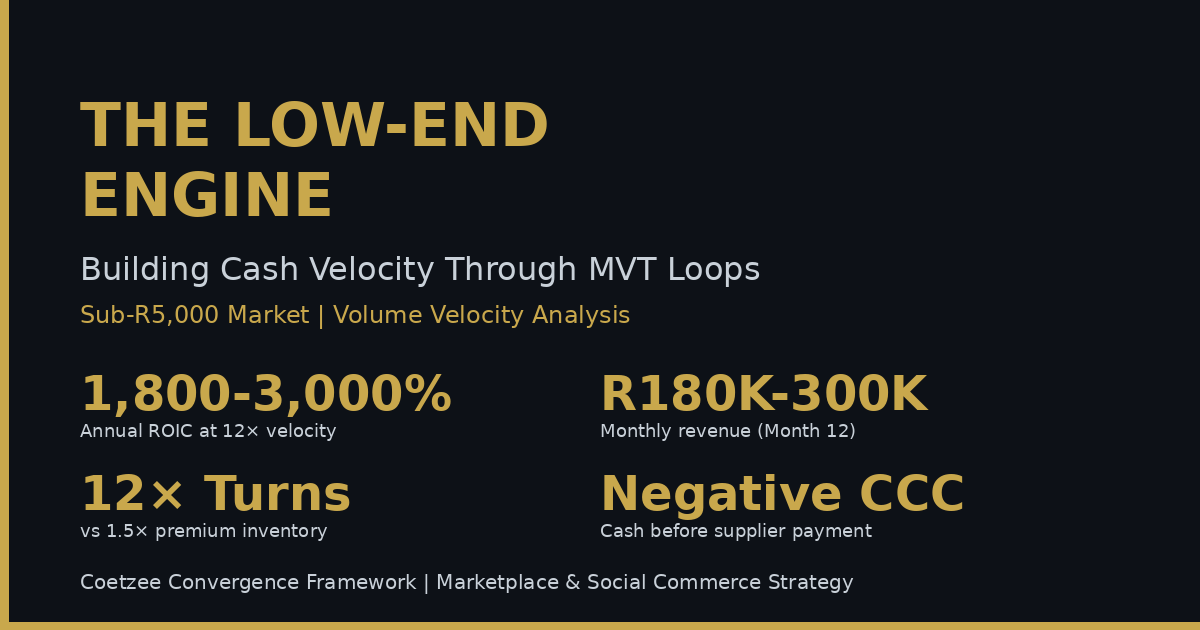
Low-end economics inverts this entirely. A R500 fashion ring generates R200-300 gross margin (40-60% markup). The transaction is economically insignificant in isolation. The strategic value emerges only through aggregation at velocity: 1,000 transactions generating R250 average margin equals R250,000 in gross profit. If this inventory turns 12× annually (monthly replenishment), the same capital deployed generates R3 million in annual gross profit.
The mathematics is precise:
Premium Tier Unit Economics (R50,000 Engagement Ring):
- Capital deployed: R25,000 (cost)
- Gross margin: R25,000 (100% markup)
- Inventory turn: 1.5× annually
- Annual gross profit per unit of capital: R37,500 (R25,000 × 1.5 turns)
Low-End Unit Economics (R500 Fashion Ring, 12× Annual Turns):
- Capital deployed: R250 (cost)
- Gross margin: R250 (100% markup)
- Inventory turn: 12× annually
- Annual gross profit per unit of capital: R3,000 (R250 × 12 turns)
The premium piece generates 12.5× the absolute margin per turn (R25,000 vs R2,000), but only 12.5× the annual margin when velocity is normalised (R37,500 vs R3,000). The critical insight: R1 million deployed into low-end inventory turning 12× annually generates equivalent gross profit to R1 million deployed into premium inventory turning 1.5× annually—approximately R3.6 million in both cases.
This equivalence is before accounting for three structural advantages of low-end velocity:
Advantage 1: Reduced Capital Risk Premium inventory carries catastrophic obsolescence risk. A R50,000 engagement ring that falls out of style (halo settings declining, three-stone rising) loses R25,000-40,000 in liquidation value. Low-end inventory obsolescence is trivial—a R500 ring that doesn't sell liquidates for R200-300, losing R200-250. The risk-adjusted return on low-end capital is superior because downside exposure is contained.
Advantage 2: Algorithmic Distribution Leverage Low-end inventory integrates seamlessly with marketplace platforms (Takealot, Superbalist) and social commerce (Instagram Shopping, TikTok Shop). These platforms provide algorithmic discovery at scale—your R500 ring appears in search results for 100,000 monthly searchers, not the 50 people who walk past your physical showroom. Premium inventory cannot leverage these channels effectively because luxury purchases require high-touch consultation that marketplaces don't support.
Advantage 3: Zero Customer Acquisition Cost Marketplace and social commerce platforms deliver pre-qualified traffic at zero acquisition cost. A customer searching "silver pendant under R500" on Takealot is expressing active purchase intent. You pay 15-20% platform commission only when they convert—this is performance-based customer acquisition at fractional cost compared to Google Ads (R50-200 per click) or Facebook advertising (R30-150 per click with 2-5% conversion rates).
When these advantages compound, the effective return on low-end capital often exceeds premium-tier capital even though absolute margin per transaction is lower. This is the unit economics inversion: the segment that appears least profitable in isolation becomes most profitable when systemic advantages are properly deployed.
The Cash Conversion Cycle Compression
The second economic advantage of low-end velocity is extreme cash conversion cycle (CCC) compression. Recall that CCC measures how long capital is locked in operations: Days Inventory Outstanding + Days Sales Outstanding - Days Payables Outstanding.
Premium Jewellery Typical CCC:
- Days Inventory Outstanding: 240 days (1.5× annual turn)
- Days Sales Outstanding: 14 days (credit card settlement)
- Days Payables Outstanding: 30 days (supplier payment terms)
- Net CCC: 224 days
Capital deployed into premium inventory takes 224 days to return as available cash. This constrains growth—you cannot reinvest returns until 7.5 months after deployment.
Low-End Jewellery Optimised CCC:
- Days Inventory Outstanding: 30 days (12× annual turn)
- Days Sales Outstanding: 7 days (marketplace platform settlement)
- Days Payables Outstanding: 45 days (extended terms on high-volume basics)
- Net CCC: -8 days
This is negative CCC—you collect cash from customers before paying suppliers. This is the holy grail of retail economics: you are generating profit using other people's capital. The mechanism:
Day 0: List R10,000 in low-end inventory on Takealot (sourced from supplier on 45-day payment terms) Days 1-7: Inventory sells, generating R16,000 in revenue (60% markup) Day 7: Takealot settles R16,000 to your account (minus 18% commission = R13,120 net) Day 45: Pay supplier R10,000 for original inventory Net result: You held customer cash for 38 days before deploying capital to supplier
During those 38 days, the R13,120 is available for redeployment into additional inventory, creating compounding velocity. This is how high-velocity retailers achieve exponential scale—they turn negative CCC into perpetual growth machine.
The mathematics of negative CCC creates self-funding growth:
Month 1: Deploy R50,000 into low-end inventory Month 1 End: Collect R80,000 in revenue (60% markup, monthly turn) Month 1 End: Net R30,000 in gross profit + R50,000 original capital = R80,000 available Month 2: Redeploy R80,000 into inventory (60% increase in scale with zero additional capital injection) Month 2 End: Collect R128,000 in revenue [Compounding continues...]
Within 12 months, the original R50,000 compounds to R500,000+ in deployable capital purely through reinvested cash flow—assuming no profit extraction and 100% reinvestment. This is exponential growth mechanics impossible in premium tiers where capital locks for 6-12 months per cycle.
The Margin Rate vs. Margin Dollars Fallacy
The psychological barrier preventing independents from embracing low-end velocity is margin rate fixation: the belief that 40-60% markup (low-end typical) is inherently inferior to 100-150% markup (premium typical). This confuses margin rate (percentage) with margin dollars (absolute profit).
Consider two inventory deployment scenarios with identical R100,000 capital:
Scenario A: Premium Focus (100% Markup, 1.5× Annual Turn)
- Capital deployed: R100,000
- Inventory at cost: R100,000
- Selling price: R200,000
- Annual turns: 1.5×
- Annual revenue: R300,000
- Annual gross margin: R150,000
- Margin rate: 100%
Scenario B: Low-End Focus (50% Markup, 12× Annual Turn)
- Capital deployed: R100,000
- Inventory at cost: R100,000
- Selling price: R150,000
- Annual turns: 12×
- Annual revenue: R1,800,000
- Annual gross margin: R600,000
- Margin rate: 50%
Scenario B generates 4× the annual gross margin (R600,000 vs R150,000) despite half the margin rate (50% vs 100%). The delta is velocity multiplication—12× turns versus 1.5× turns creates 8× more transaction opportunities, more than offsetting the margin rate reduction.
Yet most independents psychologically reject Scenario B because they are anchored to margin rate as the primary performance metric. They perceive 50% margin as "inferior" to 100% margin without computing the velocity-adjusted outcome. This is the margin rate fallacy—optimising for percentage at the expense of absolute dollars.
The correction requires reframing the optimisation function from "What margin rate can I achieve?" to "What margin dollars can I generate per rand of deployed capital per year?" This shift in mental model unlocks low-end velocity opportunity.
War Room Directives (Part 1):
- Calculate velocity-adjusted margin per rand of capital: Compare your premium and low-end inventory using the formula (Margin Rate × Annual Turn Rate) to identify which generates superior returns when velocity is normalised
- Measure your cash conversion cycle: Quantify how long capital is locked in each tier—premium likely shows 180-240 day CCC, low-end should target sub-30 days
- Audit margin rate vs. margin dollar performance: Identify whether you are rejecting high-velocity opportunities because of margin rate anchoring
- Model negative CCC scenarios: Calculate what supplier payment terms combined with inventory velocity would create negative CCC—this becomes your negotiation target
Part 2: The Psychology of Impulse Commerce
The Emotional Trigger Architecture
Low-end jewellery purchasing behaviour operates under entirely different psychological drivers than premium-tier transactions. Premium purchases (engagement rings, anniversary pieces, investment jewellery) are high-consideration, high-stakes decisions characterised by:
- Extended research periods (days to weeks)
- Multiple touchpoint interactions (showroom visits, website browsing, review reading)
- Significant emotional weight (symbolising commitment, celebrating milestones, preserving wealth)
- Budget planning and financing consideration
- Social validation seeking (opinions from friends, family, online communities)
Low-end purchases invert every dimension:
- Impulse-driven: Decision made in seconds to minutes, not days
- Single-touchpoint: Discovery and purchase occur in same session
- Low emotional stakes: Fun, fashion-forward, experimental rather than life-defining
- Discretionary budget: Purchased from "fun money," not planned expenditure
- Social signal broadcasting: Purchased to share on social media, not for enduring symbolism
This psychological profile creates distinct optimisation requirements. You cannot market low-end inventory using premium-tier tactics (emotional storytelling about heritage, detailed product specifications, white-glove consultation offers). The customer is not seeking depth—they are seeking friction-minimised instant gratification.
The emotional triggers that drive low-end conversion:
Trigger 1: Visual Aesthetics The product must be immediately appealing in thumbnail images. Low-end customers scroll through dozens of options rapidly, making snap judgments based on visual appeal. If your product images are poorly lit, poorly styled, or poorly composed, the customer scrolls past in 0.5 seconds. Premium customers will tolerate mediocre images because they are researching specifications; low-end customers will not.
Trigger 2: Social Proof Density Low-end customers rely heavily on aggregated social proof (review counts, ratings, "bestseller" badges) rather than reading individual reviews. A product with 500 reviews averaging 4.3 stars converts better than a product with 10 reviews averaging 4.8 stars—the volume signal matters more than the quality delta because it suggests "safe choice, many people bought this."
Trigger 3: Scarcity & Urgency Low-end impulse purchases spike when artificial scarcity is introduced ("Only 3 left in stock!" or "Flash sale ends in 4 hours"). Premium customers are suspicious of these tactics (luxury scarcity is intrinsic, not manufactured), but low-end customers respond positively because the stakes are low—if they regret the purchase, it's R500, not R50,000.
Trigger 4: Frictionless Transaction Every additional click, form field, or decision point in the checkout flow reduces low-end conversion by 10-20%. Premium customers tolerate complex checkout (detailed shipping preferences, gift message options, consultation scheduling) because the transaction value justifies the effort. Low-end customers abandon carts if checkout requires more than 3 clicks.
Trigger 5: Instant Gratification Expectation Low-end customers expect immediate or near-immediate delivery (same-day, next-day, 2-3 day maximum). They are purchasing on impulse for near-term use (weekend event, upcoming birthday, social media content creation). Delivery timelines beyond 5 days are psychologically equivalent to "not available"—the impulse has passed.
The successful low-end operator architects their entire system around these triggers, not around the consultation-heavy, specification-focused, relationship-building tactics that work in premium tiers.
The Social Commerce Amplification Loop
The most profound shift in low-end jewellery commerce between 2020-2026 is the emergence of social commerce—purchasing directly within social media platforms rather than clicking through to external websites. Instagram Shopping, TikTok Shop, Facebook Marketplace, and Pinterest Shopping have transformed social media from discovery channels into complete transaction environments.
This creates an amplification loop impossible in premium tiers:
Stage 1: Content Creation Customer purchases R500 pendant, receives it, wears it, photographs it for Instagram post or TikTok video. The content is authentic user-generated material, not brand advertising.
Stage 2: Algorithmic Distribution Instagram/TikTok algorithms surface this content to the creator's followers and to lookalike audiences (people with similar interests/demographics). A single post reaches 500-5,000 impressions organically.
Stage 3: Product Tagging & Discovery If the creator has tagged the product using Instagram Shopping or TikTok Shop, viewers can click through to purchase directly without leaving the platform. Friction is minimal—they are two clicks from checkout.
Stage 4: Conversion & Repeat A percentage of viewers (1-5%) convert to purchasers, receive the product, create their own content, and the loop repeats. Each cycle expands reach geometrically.
The mathematics of this loop are exponential:
Cycle 1: 100 initial customers create content, reaching 200,000 aggregate impressions, generating 2,000 new customers (1% conversion) Cycle 2: 2,000 customers create content, reaching 4,000,000 impressions, generating 40,000 new customers Cycle 3: 40,000 customers create content, reaching 80,000,000 impressions...
This is network effect marketing where each customer becomes a distribution node. Premium jewellery cannot leverage this loop effectively because:
- Customers purchasing R50,000 engagement rings do not broadcast their purchases on TikTok (privacy, security, social norms around wealth display)
- The audience reached is not in-market for R50,000 purchases (low conversion rates)
- Impulse conversion does not occur at premium price points (high-consideration purchases require different pathways)
Low-end jewellery is uniquely positioned to exploit social commerce loops because the purchase stakes are low enough for spontaneous conversion while the aesthetic appeal is high enough for content creation. A R500 trendy pendant is perfect TikTok content ("Look what I just bought! Link in bio"). A R50,000 engagement ring is not.
The Micro-Moment Capture Strategy
Google's research on consumer behaviour identifies micro-moments: brief windows of high purchase intent triggered by specific contexts. In jewellery:
- I-want-to-buy moments: Customer actively searching "silver necklace under R500"
- I-want-to-know moments: Customer researching "how to style layered necklaces"
- I-want-to-go moments: Customer seeking "jewellery shops near me"
Low-end velocity depends on micro-moment capture efficiency—being present with the right offer at the exact moment of intent. This requires three capabilities:
Capability 1: Algorithmic Omnipresence Your products must be indexed and discoverable across all platforms where micro-moments occur: Google Shopping, Takealot search, Instagram Shopping, TikTok Shop, Pinterest boards, Facebook Marketplace. Omnipresence creates maximum surface area for capture.
Capability 2: Instant Answer Format Your product listings must immediately answer the intent query. If someone searches "rose gold bracelet R400," your listing must appear with clear rose gold imagery, prominent R399 price, and "In Stock, Ships Today" messaging. Any ambiguity (Is this rose gold? Is it in stock? What's the price?) causes the customer to move to the next listing.
Capability 3: Zero-Friction Conversion From micro-moment to checkout completion must be under 60 seconds. Every additional step (account creation, shipping preference selection, payment method entry) gives the impulse time to fade. Platform-native checkout (Instagram Checkout, TikTok Shop, Takealot One-Click) eliminates friction.
The independents who master micro-moment capture achieve 3-5× higher conversion rates than those optimising for traditional browsing behaviour (long site visits, multiple page views, extended consideration). In low-end commerce, fast micro-conversions beat deep engagement.
War Room Directives (Part 2):
- Audit your visual assets: Ensure every product has professional, high-resolution images optimised for mobile thumbnail display—mediocre photography is terminal in impulse commerce
- Build social proof density: If launching new low-end SKUs, seed initial purchases to friends/family/micro-influencers to generate 50-100 reviews quickly—volume matters more than perfection
- Map your platform omnipresence: Verify that your low-end inventory is discoverable on Google Shopping, Takealot, Instagram Shopping, and TikTok Shop—missing platforms are missed micro-moments
- Measure checkout friction: Calculate how many clicks/form fields separate product discovery from purchase completion—target 3 clicks maximum
Part 3: The Three-Channel Architecture
Channel 1: Marketplace Integration as Primary Distribution
The foundational channel for low-end velocity is marketplace integration—listing inventory on established platforms (Takealot, Superbalist, OneDayOnly, Bash) that aggregate demand and provide transaction infrastructure. This is not supplemental distribution; it is primary distribution for low-end tiers.
The economic logic is irrefutable:
Traditional Direct-to-Consumer (DTC) Model:
- Customer acquisition cost: R50-200 per customer (Google Ads, Facebook Ads)
- Conversion rate: 2-5% (95-98% of traffic does not purchase)
- Infrastructure cost: Website hosting (R500-2,000/month), payment processing (2.5-3.5% per transaction), logistics integration, customer service systems
- Marketing effort: Continuous content creation, SEO optimisation, social media management
- Effective cost per sale: R150-400 including acquisition and infrastructure
Marketplace Integration Model:
- Customer acquisition cost: R0 (marketplace owns traffic acquisition)
- Conversion rate: 8-15% (marketplace pre-qualifies traffic through search/browse behaviour)
- Infrastructure cost: R0 (marketplace provides hosting, payment, logistics, customer service)
- Marketing effort: Minimal (optimise product listings, respond to reviews)
- Effective cost per sale: 15-20% platform commission only
A R500 product sold through marketplace generates R425-450 net after commission. The same product sold through DTC generates R350-400 net after customer acquisition and infrastructure costs. The marketplace model is economically superior despite surrendering 15-20% commission.
The strategic advantages compound:
Advantage 1: Instant Traffic Access Takealot receives 10+ million monthly visits. Superbalist serves 2+ million monthly shoppers. OneDayOnly delivers 500,000+ daily email impressions. When you list on these platforms, you access this traffic immediately without building your own audience.
Advantage 2: Algorithmic Discovery Marketplace search algorithms surface your products to in-market shoppers based on search queries, browsing history, and purchase patterns. A customer searching "silver pendant under R500" sees your product alongside 200 competitors—but they see it, which would not occur if you were operating standalone DTC.
Advantage 3: Trust Transfer Customers trust marketplace purchase protection policies (returns, refunds, dispute resolution) more than individual retailer promises. This trust transfer increases conversion rates—a customer might hesitate to purchase from "Unknown Jeweller Ltd" but readily purchases from "Unknown Jeweller Ltd on Takealot."
Advantage 4: Logistics Automation Takealot Fulfilment by Takealot (FBT), Superbalist warehousing, and OneDayOnly logistics handle storage, picking, packing, and shipping. You deliver inventory in bulk to their warehouses; they handle individual customer fulfilment. This eliminates logistics overhead for low-value transactions where fulfilment cost can exceed margin.
The implementation protocol:
Step 1: Platform Selection & Onboarding Priority platforms for South African low-end jewellery: Takealot (general marketplace, highest traffic), Superbalist (fashion focus, younger demographic), OneDayOnly (deal-seekers, high email engagement), Bash (daily deals, price-sensitive shoppers). Apply for seller accounts, complete onboarding requirements (tax registration, banking details, product category approval).
Step 2: Inventory Curation for Platform Fit Not all low-end inventory performs equally across platforms. Takealot favours functional basics (wedding bands, simple studs, classic chains). Superbalist favours fashion-forward trendy pieces (layering necklaces, statement rings, ear cuffs). OneDayOnly favours high-perceived-value items with significant discounting (R999 "retail" offered at R499). Bash favours gift-appropriate sets (pendant + earring sets, bracelet + necklace combos).
Step 3: Listing Optimisation Marketplace success depends on listing quality:
- Title: Front-load keywords ("Sterling Silver Heart Pendant Necklace 45cm Chain" not "Beautiful Pendant")
- Images: Minimum 5 high-resolution images (hero shot, detail shots, lifestyle images, size reference)
- Description: Bullet-point format highlighting material, dimensions, features, care instructions
- Pricing: Research competitor pricing, position slightly below average to capture "sort by price" traffic while maintaining margin
Step 4: Inventory Management & Replenishment Marketplaces penalise out-of-stock items (algorithm deprioritises listings with frequent stockouts). Establish automated replenishment: when inventory drops below 5 units, reorder 20 units. This prevents revenue interruption.
Step 5: Performance Monitoring & Optimisation Track platform-specific metrics: conversion rate (views to purchases), return rate, review rating, search ranking for key terms. Underperforming listings get rotated out, high-performing listings get inventory allocation increases.
The expected outcome: within 3-6 months of marketplace integration, low-end revenue increases 200-400% as platform traffic compounds owned distribution.
Channel 2: Micro-Influencer Affiliate Networks
The second channel is micro-influencer affiliate partnerships—collaborations with content creators who have 5,000-50,000 followers in lifestyle, fashion, beauty, and gifting niches. These creators operate at a scale where partnerships are accessible (they do not command the R50,000+ fees that macro-influencers require) while still delivering meaningful reach.
The affiliate model structure:
Partnership Terms:
- Commission: 10-15% of attributed sales (tracked via unique discount codes or affiliate links)
- Discount codes: Influencer receives personalised code offering followers 10% discount ("Use code SARAH10 for 10% off")
- Free product: Influencer receives 2-3 pieces free to create content showcasing the products
- Exclusivity: None—influencers can partner with multiple brands simultaneously
- Payment: Monthly via bank transfer for prior month's attributed sales
The Value Exchange: For the influencer: commission income from their audience, free product for personal use/content creation, brand partnership they can feature in media kits.
For the retailer: authentic content creation, audience access, performance-based customer acquisition (you pay commission only on completed sales, not on impressions or clicks).
The Implementation Protocol:
Phase 1: Influencer Identification (Week 1-2) Use Instagram search to identify micro-influencers in target niches:
- Search hashtags: #safashion, #southafricanfashion, #capetownstyle, #ootdsa
- Filter by follower count: 5,000-50,000 (micro-influencer sweet spot)
- Evaluate engagement rate: Comments + Likes ÷ Followers (target >3%)
- Assess content quality: professional photography, consistent aesthetic, authentic voice
- Build prospecting list of 100-200 potential partners
Phase 2: Outreach & Onboarding (Week 3-4) Send personalised direct messages:
"Hi [Name], I've been following your content and love your [specific compliment about their style/aesthetic]. We're a South African jewellery brand specialising in affordable, trend-forward pieces (R200-800 range). We'd love to partner with you through our affiliate programme: you receive 2-3 pieces free, earn 15% commission on sales using your code, and your followers get 10% off. Would you be interested?"
Expected response rate: 20-30%. Target: onboard 20-30 active partners from initial outreach.
Phase 3: Product Selection & Shipping (Week 5) Allow influencers to select 2-3 pieces from your low-end catalogue that align with their aesthetic. Ship with personalised note, discount code card, and branded packaging optimised for unboxing content.
Phase 4: Content Creation & Promotion (Ongoing) Influencers create content (Instagram posts, Stories, Reels, TikTok videos) featuring the products organically. They tag your brand, use the discount code, and direct followers to your sales channels (marketplace listings, website, Instagram Shop).
Phase 5: Performance Tracking & Optimisation (Monthly) Track attributed sales by discount code. Calculate ROI per influencer:
- Influencer A: R3,000 attributed sales, R450 commission paid, R500 product cost = R2,050 net profit (68% margin)
- Influencer B: R800 attributed sales, R120 commission paid, R500 product cost = R180 net profit (22% margin)
Reinvest in high-performing partnerships (send additional products, offer higher commission tiers, feature in brand content). Phase out low-performing partnerships.
The compounding effect: influencer content remains discoverable indefinitely (Instagram posts live permanently, TikTok videos resurface in recommendations). A single post created in Month 1 continues generating sales in Months 2, 3, 4+ through evergreen discovery. The content investment compounds.
The expected outcome: 20-30 active micro-influencer partnerships generate 500-2,000 monthly sales (depending on product-influencer fit and influencer engagement rates) at customer acquisition costs of R20-50 per customer—10× more efficient than paid advertising.
Channel 3: Zero-Touch Dropship Expansion
The third channel is zero-touch dropshipping—partnering with overseas suppliers who handle inventory storage and fulfilment while you manage brand, marketing, and customer relationships. This enables catalogue expansion into categories where owned inventory would destroy capital efficiency.
The dropship model operates as follows:
Supplier Partnership: You identify overseas suppliers (typically China, Thailand, India via Alibaba, AliExpress, or specialist jewellery wholesalers) offering low-end jewellery at extreme wholesale prices (R50-150 for items that retail at R300-800 in South Africa).
Catalogue Integration: You list these products on your owned channels (website, marketplace accounts, social commerce) using supplier-provided images and descriptions. The customer perceives these as your products.
Order Fulfilment: When a customer purchases, you forward the order to the supplier with delivery details. The supplier ships directly to the customer. You never touch the physical inventory.
Margin Capture: You purchase from supplier at R80, sell to customer at R400, capture R320 margin (400% markup). The supplier handles all inventory risk, storage costs, and fulfilment logistics.
The Economic Advantages:
- Infinite inventory breadth: You can offer 500+ SKUs without deploying capital into inventory
- Zero inventory risk: If an item doesn't sell, you simply delist it—no liquidation losses
- Instant trend adaptation: When new trends emerge (ear cuffs, chunky chains, coloured stones), you add supplier SKUs immediately without waiting for inventory procurement
- Geographic market expansion: Serve customers nationally (or internationally) without establishing logistics infrastructure—supplier handles shipping
The Operational Challenges:
- Delivery timelines: Overseas shipping typically requires 2-4 weeks, which conflicts with instant gratification expectations
- Quality inconsistency: Supplier product quality can vary from images/descriptions, creating return/refund exposure
- Customer service complexity: You manage customer relationships but cannot control fulfilment quality
- Margin compression: Marketplace commission (15-20%) + payment processing (3%) + returns (5-10%) can consume most margin
The Strategic Implementation:
Use Case 1: Testing Market Demand Before committing capital to owned inventory in new categories (men's jewellery, body jewellery, hair accessories), test via dropship. If products achieve 50+ monthly sales via dropship, graduate them to owned inventory for margin expansion.
Use Case 2: Long-Tail Expansion Offer 200-300 long-tail SKUs (unusual sizes, niche styles, experimental trends) via dropship to capture search traffic and expand algorithmic visibility without inventory commitment. The 90% that underperform get delisted at zero cost; the 10% that succeed graduate to owned inventory.
Use Case 3: Seasonal Inventory Valentine's Day, Mother's Day, Christmas create temporary demand spikes. Rather than over-purchasing seasonal inventory that becomes obsolete post-event, use dropship to expand catalogue during peak periods, then contract post-peak.
The implementation protocol:
Step 1: Supplier Vetting (Week 1-2) Identify 5-10 potential dropship suppliers via Alibaba, AliExpress, or specialist platforms. Order sample products to test quality, packaging, delivery timeline, and communication responsiveness. Select 2-3 suppliers who meet quality thresholds.
Step 2: Catalogue Selection (Week 3) Choose 50-100 initial SKUs that complement (not compete with) your owned inventory. Focus on styles adjacent to your bestsellers: if chunky gold chains sell well in owned inventory, add chunky gold bracelet and anklet variations via dropship.
Step 3: Listing Creation & Platform Integration (Week 4) Create optimised listings using supplier images, your brand messaging, and transparent delivery timeline communication ("Please allow 2-3 weeks for delivery as this item ships from our international partner").
Step 4: Order Processing Automation (Week 5) Establish automated order forwarding: when customer purchases on your platform, system automatically generates purchase order to supplier with customer delivery details. This eliminates manual processing overhead.
Step 5: Performance Monitoring & Graduation (Ongoing) Track dropship SKU performance monthly. Items achieving 20+ monthly sales with <5% return rates become candidates for graduation to owned inventory (purchase 100-200 units at wholesale to capture full margin and improve delivery timelines).
The expected outcome: dropship expansion adds R50,000-200,000 in monthly incremental revenue with minimal operational overhead, while providing market intelligence on which categories justify owned inventory investment.
War Room Directives (Part 3):
- Execute marketplace onboarding within 30 days: Apply to Takealot, Superbalist, and OneDayOnly simultaneously—approval timelines are 2-4 weeks, so parallel processing is critical
- Build micro-influencer pipeline: Identify and outreach to 100 potential partners per month until you have 20-30 active partnerships generating consistent attributed sales
- Test dropship with 50 SKUs: Select a focused category (men's, body jewellery, hair accessories) and implement dropship test—measure conversion rates and return rates to validate model fit
- Create platform-specific performance dashboards: Track conversion rate, return rate, review rating, and search visibility separately for each channel—optimise tactics by platform rather than applying one-size-fits-all strategy
Part 4: Implementation & Scale Dynamics
Phase 1: Baseline Establishment (Month 1)
Low-end velocity optimisation begins with brutal honesty about current state. Most independents who dabble in sub-R5,000 inventory do so ineffectively: they stock 20-30 miscellaneous fashion pieces, display them in a corner of the showroom, and wait for customers to discover them. This generates R5,000-15,000 in monthly revenue—economically irrelevant relative to R200,000-500,000 in total monthly revenue.
Baseline Diagnostic Actions:
- Audit current low-end inventory: Count SKUs, calculate total capital deployed, measure turn rates (likely <3× annually)
- Calculate low-end revenue contribution: As percentage of total revenue (likely <5%)
- Assess channel presence: Verify whether low-end inventory is listed on marketplaces (likely not), integrated with social commerce (likely not), or distributed through affiliates (likely not)
- Measure profitability: Calculate true net margin after fulfilment costs, overhead allocation, and opportunity cost—likely breakeven or negative
The typical baseline reveals:
- R30,000-50,000 capital locked in slow-turn low-end inventory (<3× annually)
- <5% of total revenue from low-end segment
- Zero marketplace or social commerce integration
- Negative net margin when true costs are allocated
This baseline quantifies the opportunity cost of current approach. The R30,000-50,000 in capital could generate R360,000-600,000 in annual gross margin if redeployed into 12× turn velocity model. The failure to integrate marketplaces and social commerce is surrendering R100,000-500,000 in annual revenue to competitors who have.
Phase 2: Channel Infrastructure Build (Months 2-3)
Month 2 Focus: Marketplace Integration
Week 1-2: Complete Takealot, Superbalist, OneDayOnly seller applications Week 3: While waiting for approvals (2-4 weeks typical), prepare inventory:
- Professional product photography (50-100 SKUs)
- Keyword-optimised titles and descriptions
- Competitive pricing research
- Stock level verification (minimum 10 units per SKU to avoid stockouts)
Week 4: Upon approval, upload product catalogues to all platforms simultaneously
Month 3 Focus: Micro-Influencer Network
Week 1-2: Identify 100 potential micro-influencer partners using Instagram hashtag and engagement research Week 3: Execute personalised outreach to all 100 (target 20-30 positive responses) Week 4: Ship product packages to accepted partners with branded materials and discount codes
Parallel Activity: Dropship supplier vetting and initial SKU selection (50-100 products)
The expected outcome after Month 3:
- Live listings on 3+ major marketplaces
- 20-30 active micro-influencer partnerships
- 50-100 dropship SKUs integrated into catalogue
- Infrastructure established for all three channels
Phase 3: Velocity Acceleration (Months 4-6)
With infrastructure established, focus shifts to volume acceleration through optimisation cycles:
Marketplace Optimisation Cycle (Weekly):
- Review conversion rates by SKU (views to purchases)
- Identify underperforming listings (high views, low conversions)
- Test listing improvements (new images, revised titles, price adjustments)
- Monitor search ranking for key terms ("silver necklace," "gold bracelet," etc.)
- Reallocate inventory capital from low-performers to high-performers
Influencer Performance Cycle (Monthly):
- Calculate ROI per influencer (attributed sales minus commission and product costs)
- Send additional products to top 20% performers
- Execute outreach to new prospects to replace bottom 20% non-performers
- Feature high-performing influencer content on owned channels for social proof
Dropship Validation Cycle (Monthly):
- Identify dropship SKUs achieving 20+ monthly sales
- Graduate these to owned inventory (bulk purchase at improved wholesale pricing)
- Delist dropship SKUs with <5 monthly sales
- Add new dropship SKUs in adjacent categories to tested successes
The compounding effect: each optimisation cycle incrementally improves conversion rates, reduces customer acquisition costs, and increases inventory velocity. Month 4 conversion rates of 5% become Month 6 rates of 8-10% through systematic testing.
Expected Revenue Trajectory:
- Month 4: R50,000-80,000 (2-3× baseline, marketplace traffic ramping)
- Month 5: R80,000-120,000 (influencer content compounding, repeat customers emerging)
- Month 6: R120,000-180,000 (optimisation improvements, seasonal peaks)
Phase 4: Scale Consolidation (Months 7-12)
By Month 7, clear performance patterns emerge across channels and SKUs. The consolidation phase focuses on doubling down on proven winners while systematically eliminating underperformers.
Inventory Rationalisation:
- Identify top 20 SKUs by revenue and velocity (likely generating 60-80% of total low-end revenue)
- Increase inventory depth on these winners (from 10 units to 50+ units to prevent stockouts)
- Eliminate bottom 40% of SKUs (low velocity, high return rates, margin compression)
- The result: catalogue contracts from 100 SKUs to 60 SKUs, but those 60 turn 15-20× annually instead of 6-8×
Channel Allocation Optimisation:
- Measure customer acquisition cost and lifetime value by channel
- Reallocate marketing effort to highest-ROI channels (typically influencer and marketplace organic, away from paid advertising)
- Potentially add 4th channel: TikTok Shop or Pinterest Shopping if early tests show traction
Operational Leverage:
- Implement automation: inventory management software with auto-reorder triggers, review request automation, customer service chatbots for FAQs
- Negotiate improved supplier terms: 60-day payment terms on high-volume basics (from initial 30-45 day terms)
- Explore fulfilment partnerships: Takealot FBT or third-party fulfilment to eliminate manual packing/shipping
Expected Steady-State Performance (Month 12):
- Monthly revenue: R180,000-300,000 (6-10× baseline)
- Inventory deployed: R40,000-60,000 (similar or lower than baseline due to velocity improvements)
- Gross margin rate: 50-60% (blended across owned inventory and dropship)
- Annual gross margin: R1.08M-1.8M (from R40,000-60,000 deployed capital)
- Effective ROIC: 1,800-3,000% annually
The Strategic Reinvestment Decision
At Month 12, the low-end engine generates R90,000-150,000 in monthly gross margin. The critical strategic decision: how to deploy this cash flow?
Option 1: Reinvest in Low-End Scale Deploy margin back into expanded low-end inventory, additional marketplace channels, larger influencer networks. This compounds low-end velocity toward R500,000-1M monthly revenue—building a volume-focused business.
Option 2: Fund Premium Tier Transition Use low-end cash flow to fund the premium-tier corrections outlined in "The Squeezed Middle" essay: build-to-order infrastructure, inventory rationalisation, transparent pricing transition. The low-end becomes the cash engine that funds strategic pivot in higher-margin tiers.
Option 3: Export Corridor Investment Deploy cash flow into international marketplace integration (Etsy, eBay, Amazon) and export-focused marketing. The low-end demonstrates marketplace mechanics and algorithmic optimisation capabilities that transfer to international markets.
Option 4: Hybrid Allocation Split cash flow 50/50: half reinvested in low-end expansion, half deployed to strategic priorities in other tiers. This balances growth in the proven channel while building capabilities elsewhere.
The correct choice depends on operator strengths and market position:
- Operators with deep supply chain relationships and fulfilment capabilities should reinvest in low-end scale
- Operators with premium brand equity should fund premium tier transition
- Operators with international network access should pursue export corridor
- Operators uncertain about strategic direction should choose hybrid allocation
The key insight: low-end velocity is not the destination—it is the engine. The segment generates cash flow and operational capability that fund strategic optionality. Independents who view low-end as "beneath their brand" are rejecting the fuel that powers transformation.
War Room Directives (Part 4):
- Execute baseline diagnostic in Week 1: Quantify current low-end contribution, capital deployment, channel presence, and true profitability—you cannot improve what you do not measure
- Commit to 12-month implementation timeline: Low-end velocity requires consistent effort across quarters to achieve compound effects—3-month tests are insufficient to validate model
- Track weekly performance metrics: Conversion rate, inventory turns, customer acquisition cost by channel—optimisation requires granular visibility
- Make strategic reinvestment decision at Month 12: Evaluate whether to double down on low-end, fund premium transition, pursue export, or hybrid allocation—this choice determines 2027-2030 trajectory
Conclusion: The Cash Engine Imperative
The sub-R5,000 jewellery market is not a charity project, a brand-dilution risk, or a distraction from "real" jewellery business. It is the highest-velocity cash generation mechanism available to independent retailers when architected correctly through marketplace integration, micro-influencer networks, and dropship expansion.
The independents who dismiss low-end opportunity because "the margins are too low" or "it's not our brand positioning" are committing the cardinal error of capital-constrained businesses: optimising for margin rate at the expense of margin velocity. They are rejecting 1,800-3,000% ROIC because it comes packaged in R500 transactions rather than R50,000 transactions.
The mathematics are irrefutable:
- R50,000 deployed capital at 12× annual turn and 50% margin generates R300,000 annual gross margin
- R50,000 deployed capital at 1.5× annual turn and 100% margin generates R75,000 annual gross margin
- The low-end velocity model generates 4× the cash flow from identical capital
This cash flow funds everything else: premium tier inventory rationalisation, build-to-order infrastructure, export corridor market entry, cultural transformation initiatives, brand marketing. The low-end is not competing with premium operations—it is subsidising premium operations while building algorithmic distribution infrastructure that compounds across all tiers.
The 2026 imperative is recognising that independent jewellers possess structural advantages in low-end velocity that chains and aggregators cannot replicate:
- Flexible sourcing: You can test new suppliers, categories, and styles weekly; chains are locked into 6-12 month buying cycles
- Authentic storytelling: Your micro-influencer partnerships feature real relationships; chain influencer campaigns are obviously transactional
- Rapid adaptation: You can respond to TikTok trends within days; chains require months to adjust assortments
- Local market knowledge: You understand Cape Town fashion preferences, Johannesburg gift-giving occasions, Durban seasonal demand patterns in ways national aggregators cannot
These advantages only matter if you deploy them through proper channels. A R500 fashion ring sitting in your Sandton showroom waiting for foot traffic is strategically worthless. The same ring listed on Takealot, featured by 30 micro-influencers, and available via dropship from complementary suppliers becomes a cash generation and brand amplification asset.
The studios that master Minimum Viable Transaction loop optimisation will achieve:
- Financial sovereignty: Cash flow independent of premium-tier transaction volatility
- Algorithmic authority: Platform visibility that compounds across all price tiers
- Strategic optionality: Capital reserves that fund transformation initiatives
- Brand democratisation: Awareness among mass-market audiences who later graduate to premium purchases
The low-end is not where you make your reputation—it is where you make your runway. The velocity funds the vision.
The question is not whether low-end opportunity exists—the R180,000-300,000 monthly revenue potential is mathematically demonstrable. The question is whether you will execute the three-channel architecture with the discipline required to capture it, or whether you will continue surrendering this segment to competitors who understand that velocity beats margin in capital-constrained environments.
The cash engine awaits. Implementation begins now.