What Makes a Fast Jewellery Website? A Forensic Benchmark of South African Luxury Jewellers
The Most Beautiful Luxury Jewellery Website Is Not Always the Most Effective
A visually stunning luxury jewellery website can still underperform commercially.
This is one of the least discussed realities in premium retail.
Luxury brands frequently invest heavily in elegant typography, cinematic photography, bespoke branding, immersive product imagery, and high-end visual presentation. Yet beneath the surface, hidden technical friction quietly undermines search visibility, buyer trust, enquiry quality, and conversion performance.
In many cases, a slower, less technically mature luxury jewellery website feels premium — but performs poorly.
The uncomfortable truth is that aesthetics alone do not guarantee commercial performance.
A website may appear sophisticated while suffering from:
- slow product rendering
- weak mobile browsing experiences
- broken structured data
- poor internal linking
- conversion friction
- technical SEO decay
- unstable WooCommerce architecture
- weak trust signalling during high-value purchase decisions
In luxury retail, technical quality affects perception.
A customer researching an engagement ring worth R80,000 is not behaving like someone purchasing everyday consumer goods.
The emotional stakes are higher.
Trust requirements are stronger.
Patience is lower.
Confidence matters more.
Even small moments of friction become commercially meaningful.
A delayed gallery load.
A frustrating filter.
A clumsy quote request form.
A missing trust signal.
A slow mobile interaction.
These moments accumulate.
Over time, technical friction compounds into measurable revenue drag.
This raises an important strategic question:
What actually makes a luxury jewellery website perform well?
This benchmark attempts to answer that question.
Rather than evaluating websites through aesthetics alone, this report applies a forensic lens to technical maturity, luxury UX continuity, discoverability, performance engineering, and conversion readiness.
The goal is not criticism.
The goal is understanding.
Because the difference between looking premium and performing premium is often technical.
Why Luxury Jewellery Websites Underperform
Luxury retail websites fail differently from ordinary eCommerce environments.
In mainstream retail, consumers tolerate moderate friction.
In Jewellery eCommerce, friction creates hesitation.
And hesitation damages trust.
This matters because luxury jewellery purchasing involves unusually high emotional and psychological complexity.
Customers purchasing:
- engagement rings
- wedding bands
- bespoke jewellery
- anniversary gifts
- investment diamonds
- heirloom redesigns
rarely make impulsive decisions.
Their purchase journey often involves:
- emotional research
- repeated site visits
- mobile and desktop switching
- partner consultation
- trust verification
- comparison behaviour
- certification research
- craftsmanship evaluation
This means luxury websites are judged differently.
A luxury jewellery website is not merely an online catalogue.
It functions as:
- a trust platform
- a sales consultant
- a credibility signal
- a digital showroom
- a reassurance system
The challenge?
Many luxury retailers optimise visual sophistication while underinvesting in technical maturity.
The result:
beautiful websites with hidden commercial inefficiencies.
Common performance problems include:
Slow visual delivery
Luxury imagery overwhelms rendering performance.
Weak mobile browsing continuity
Engagement ring discovery feels frustrating.
Semantic SEO weaknesses
Search systems struggle to interpret product meaning.
Poor conversion engineering
Quote requests feel transactional instead of consultative.
Technical debt
WooCommerce ecosystems accumulate unnecessary complexity.
None of these failures appear dramatic.
That is precisely why they are dangerous.
Luxury websites rarely collapse.
They decay.
Slowly.
Quietly.
Commercially.
The Diamond Stack Luxury Commerce Benchmark Framework™
To evaluate a luxury jewellery website properly, aesthetics alone are insufficient.
A consulting-grade assessment requires multidimensional analysis.
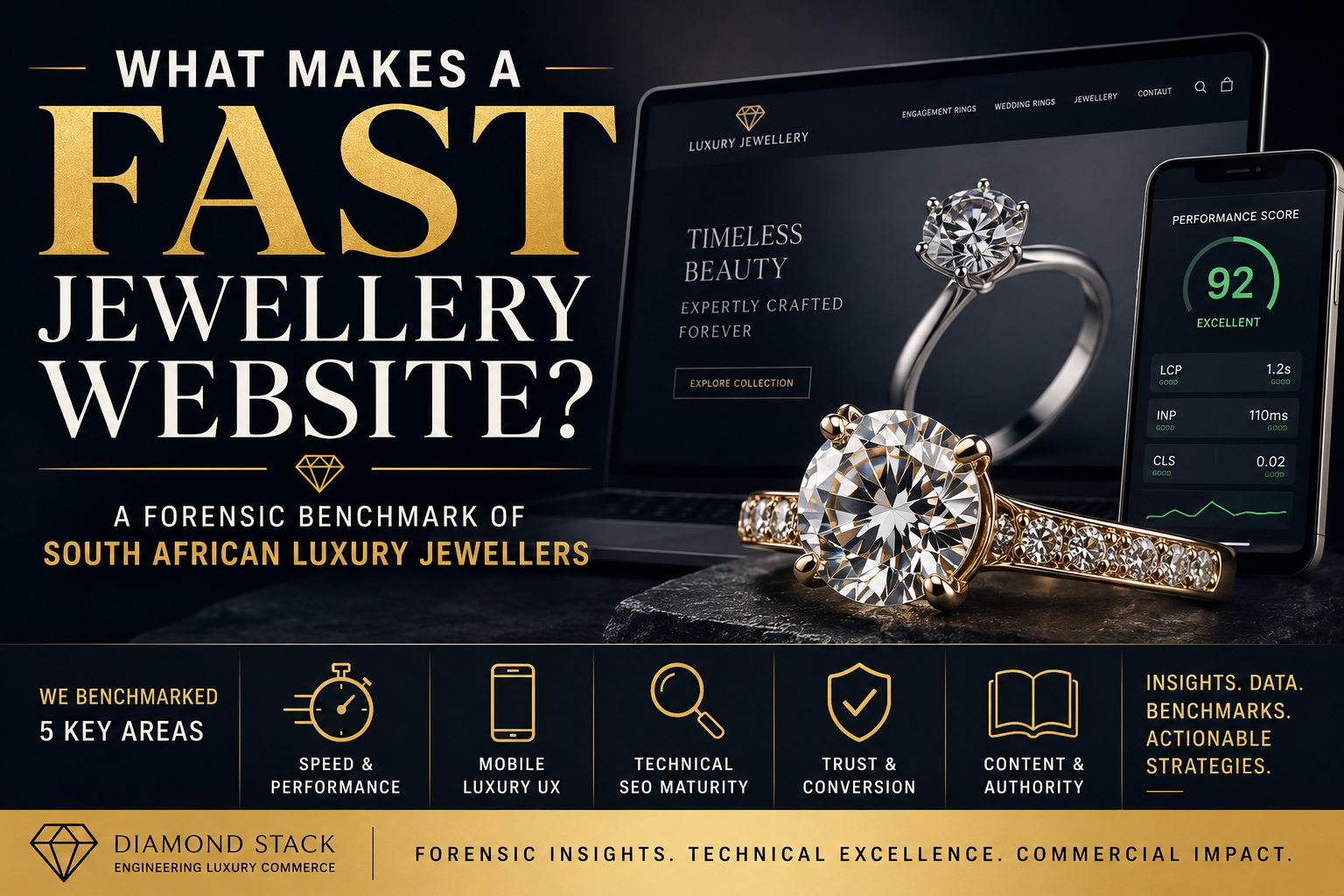
Diamond Stack evaluates luxury retail performance through five forensic dimensions:
1. Speed & Performance Engineering
Question:
Does the website feel technically premium?
We evaluate:
- perceived speed
- product rendering performance
- page responsiveness
- image delivery efficiency
- mobile performance
- infrastructure maturity
- JavaScript overhead
- loading continuity
Because luxury trust deteriorates quickly under friction.
2. Mobile Luxury UX
Question:
Can someone confidently browse an engagement ring on mobile?
We evaluate:
- engagement ring browsing continuity
- filtering usability
- zoom interactions
- mobile navigation
- tap friction
- quote request accessibility
- visual confidence
Luxury browsing should feel effortless.
Not exhausting.
3. Technical SEO Maturity
Question:
Does search infrastructure support discoverability?
We evaluate:
- schema maturity
- internal linking systems
- semantic architecture
- crawlability
- faceted navigation behaviour
- category hierarchy
- indexation discipline
Because search visibility in Jewellery eCommerce is earned structurally.
4. Trust & Conversion Engineering
Question:
Does the website reinforce confidence?
We evaluate:
- reassurance architecture
- trust signals
- consultation workflows
- quote request maturity
- payment confidence
- credibility reinforcement
Luxury conversion depends heavily on psychological safety.
5. Content & Semantic Authority
Question:
Does the website educate while selling?
We evaluate:
- buying guides
- educational content
- diamond knowledge systems
- engagement ring resources
- semantic internal linking
- expertise positioning
Luxury jewellery purchases involve research.
Authority matters.
Benchmark Methodology
This benchmark applies a consulting-style evaluation framework.
Importantly:
This is not a ranking exercise.
Nor is it criticism.
Observable technical and UX characteristics are analysed through a forensic performance lens.
The objective is to understand:
what appears to support stronger luxury commerce performance.
Each luxury jewellery website is evaluated against observable signals across five categories.
Benchmark Categories
Speed & Performance
Evaluation criteria include:
- perceived load speed
- product gallery responsiveness
- image optimisation behaviour
- mobile rendering continuity
- JavaScript complexity
- page responsiveness
Mobile Luxury UX
Evaluation criteria include:
- navigation clarity
- browsing continuity
- product filtering behaviour
- visual confidence
- quote request usability
- mobile interaction smoothness
Technical SEO Maturity
Evaluation criteria include:
- information architecture
- schema implementation signals
- category structure
- crawl behaviour indicators
- semantic consistency
- internal linking maturity
Trust & Conversion Engineering
Evaluation criteria include:
- consultation pathways
- premium reassurance signals
- credibility communication
- conversion continuity
- friction reduction
Content & Semantic Authority
Evaluation criteria include:
- educational depth
- buying assistance
- diamond education maturity
- topical authority signals
Benchmark Analysis of South African Luxury Jewellers
The following observations are neutral and consultative.
The intention is not judgement.
Rather:
forensic interpretation of observable characteristics.
Shimansky
Brand Overview
Shimansky projects strong luxury positioning through visual refinement, premium product imagery, and established brand authority.
The experience appears intentionally premium and globally orientated.
The website strongly communicates:
- heritage
- exclusivity
- craftsmanship
- premium positioning
What Appears Strong
Potential strengths include:
- luxury presentation quality
- strong visual merchandising
- aspirational storytelling
- premium product photography
- brand consistency
The experience appears emotionally aligned with luxury retail expectations.
Potential Friction Points
Luxury-first design occasionally risks:
- heavier rendering demands
- larger imagery payloads
- increased mobile latency
- navigation complexity
In premium retail environments, visual sophistication must coexist with technical responsiveness.
UX Observations
The browsing experience appears confidence-oriented.
Product presentation supports perceived value.
However, engagement ring exploration experiences always benefit from friction audits.
Questions worth asking:
- How many interactions are required to shortlist products?
- How smoothly does filtering perform on mobile?
- Does comparison behaviour feel intuitive?
Technical SEO Maturity Observations
Premium brands sometimes underutilise semantic depth.
Opportunities often include:
- educational content expansion
- stronger contextual linking
- category authority reinforcement
- structured content relationships
Conversion Readiness
Luxury trust appears strong.
Consultative pathways remain especially important in high-ticket retail.
Quote journeys, reassurance signals, and trust continuity heavily influence outcomes.
Diamond Stack Insight
Strong luxury positioning benefits enormously from technical discipline.
When premium storytelling is supported by fast rendering and semantic maturity:
conversion confidence compounds.
Prins & Prins
Brand Overview
Prins & Prins presents a distinctive blend of education, craftsmanship, heritage, and destination retail positioning.
The experience appears especially aligned with trust-building.
Educational positioning may support confidence during complex jewellery purchases.
What Appears Strong
Potential strengths include:
- credibility signals
- educational orientation
- diamond authority positioning
- heritage communication
- reassurance through expertise
Luxury customers frequently reward perceived expertise.
Especially during engagement-ring decision-making.
Potential Friction Points
Education-heavy websites occasionally risk:
- navigational complexity
- diluted commercial pathways
- inconsistent internal architecture
- discovery friction
The challenge becomes:
balancing authority with simplicity.
UX Observations
Luxury buyers benefit when educational resources naturally support product exploration.
For example:
Engagement ring browsing should seamlessly connect to:
- certification education
- metal comparisons
- diamond cut guidance
- consultation pathways
Continuity matters.
Technical SEO Maturity Observations
Semantic authority appears especially important in educational luxury environments.
Potential opportunities may include:
- stronger topical clustering
- refined internal linking
- schema enrichment
- clearer category relationships
Conversion Readiness
Trust architecture appears naturally reinforced through expertise positioning.
The opportunity lies in reducing friction between:
learning and action.
A confident buyer should easily progress toward enquiry.
Diamond Stack Insight
Luxury trust grows when education supports momentum rather than distraction.
A technically mature authority ecosystem improves both:
- discoverability
- conversion confidence
The Diamond Stack Luxury Commerce Model™
The benchmark reveals a recurring industry misconception:
Many luxury retailers believe premium design alone creates premium performance.
It does not.
The highest-performing luxury jewellery websites are rarely defined by aesthetics in isolation.
Instead, they combine:
trust + speed + technical maturity + emotional continuity + semantic authority.
At Diamond Stack, this can be framed through a practical operating model for Jewellery eCommerce performance.
We call this:
The Diamond Stack Luxury Commerce Model™
The model evaluates performance across six interdependent pillars.
Failure in one area weakens the others.
Strength compounds.
1. Speed Creates Confidence
Luxury buyers notice friction immediately.
Not analytically.
Emotionally.
A delayed interaction subtly undermines trust.
A slow-loading engagement ring gallery weakens anticipation.
A laggy mobile experience introduces hesitation.
In Jewellery eCommerce:
speed influences perceived professionalism.
Strong Performance Indicators
- fast perceived rendering
- smooth product galleries
- responsive mobile interaction
- optimised imagery
- stable Core Web Vitals
- reduced JavaScript overhead
Strategic Principle
Performance should feel invisible.
The website should disappear.
The jewellery should remain.
Diagnostic Question
Does the website feel effortless?
Or merely attractive?
2. Luxury UX Must Reduce Cognitive Load
Luxury browsing should feel calming.
Not demanding.
This matters because jewellery shopping often occurs during emotionally significant moments:
- proposal planning
- anniversaries
- milestone celebrations
- inheritance purchases
- bespoke design journeys
Customers are not simply browsing.
They are evaluating emotional certainty.
The strongest luxury UX environments reduce friction through:
- intuitive filtering
- elegant navigation
- calm visual hierarchy
- fast product discovery
- confidence-oriented browsing
Strong Performance Indicators
- intuitive mobile exploration
- clear progression pathways
- effortless category discovery
- smooth quote requests
- elegant filtering systems
Strategic Principle
Luxury UX should feel:
guided, reassuring, emotionally frictionless.
Diagnostic Question
Does browsing create confidence?
Or cognitive fatigue?
3. Technical SEO Is Luxury Discoverability Infrastructure
Many jewellery retailers treat SEO as marketing.
Technically:
SEO is infrastructure.
Search systems reward:
- semantic clarity
- structured relationships
- crawl efficiency
- authority depth
- content architecture
A beautiful luxury jewellery website that search systems struggle to understand becomes commercially invisible.
Strong Performance Indicators
- structured schema maturity
- intentional category hierarchy
- contextual internal linking
- buying-guide ecosystems
- crawl discipline
- semantic topic clusters
Strategic Principle
Discoverability should be engineered.
Not improvised.
Diagnostic Question
Would search systems understand why this brand deserves authority?
4. Trust Is Conversion Architecture
Luxury conversion rarely behaves like traditional eCommerce.
High-value purchases require emotional reassurance.
Buyers ask silent questions:
Is this jeweller credible?
Can I trust product quality?
Will I receive guidance?
Is this purchase safe?
What happens if something goes wrong?
The strongest-performing luxury jewellery websites proactively answer hesitation.
Strong Performance Indicators
- consultation pathways
- craftsmanship evidence
- certification clarity
- transparent policies
- reassurance messaging
- premium support signals
Strategic Principle
Luxury conversion should feel:
consultative, reassuring, calm.
Diagnostic Question
Does the website reduce uncertainty?
Or increase it?
5. Educational Authority Compounds Trust
Luxury customers research extensively.
Especially engagement ring buyers.
They want clarity regarding:
- diamond shapes
- certification
- ring sizing
- metal comparisons
- proposal planning
- gemstone quality
- customisation possibilities
Educational ecosystems strengthen:
- trust
- SEO authority
- conversion readiness
- perceived expertise
Strong Performance Indicators
- buying guides
- educational depth
- contextual linking
- structured learning pathways
- semantic authority clusters
Strategic Principle
Authority should support decisions.
Not overwhelm them.
Diagnostic Question
Does expertise accelerate confidence?
Or create complexity?
6. Monitoring Protects Revenue
Many luxury websites degrade quietly after launch.
The assumption:
“The website is complete.”
Technically:
launch is merely operational commencement.
Over time:
- plugins update
- schema breaks
- performance degrades
- crawl behaviour shifts
- conversion friction increases
The strongest brands monitor intentionally.
Strong Performance Indicators
- Core Web Vitals monitoring
- regression testing
- schema validation
- UX audits
- crawl reviews
- performance benchmarking
Strategic Principle
Luxury performance requires maintenance discipline.
Diagnostic Question
What has degraded since deployment?
A Practical Luxury Jewellery Website Audit Checklist
The following forensic checklist can help identify hidden friction inside a luxury jewellery website.
Speed & Performance Audit
- Do product pages load quickly on mobile?
- Are product images optimised without sacrificing visual quality?
- Are galleries responsive and fast?
- Does zoom interaction feel immediate?
- Is JavaScript slowing page rendering?
- Is page responsiveness smooth?
- Does the website feel fast under poor mobile connectivity?
- Are Core Web Vitals stable?
- Are assets compressed intelligently?
- Is hosting infrastructure appropriate for luxury commerce?
Mobile UX Audit
- Can someone shortlist an engagement ring within minutes?
- Does filtering feel intuitive?
- Are tap targets comfortable?
- Is navigation cognitively simple?
- Does browsing feel calm?
- Is quote functionality accessible on mobile?
- Is scrolling behaviour manageable?
- Are product comparisons easy?
- Does mobile browsing feel premium?
- Does interaction feel effortless?
Technical SEO Audit
- Is product schema implemented correctly?
- Are FAQs structured properly?
- Does internal linking reinforce authority?
- Are category relationships semantically clear?
- Is faceted navigation controlled?
- Are crawl inefficiencies monitored?
- Are orphaned pages eliminated?
- Are buying guides integrated contextually?
- Does category architecture support discoverability?
- Are structured data regressions monitored?
Trust & Conversion Audit
- Do consultation pathways feel premium?
- Does the website proactively reduce hesitation?
- Are trust signals visible?
- Is certification explained clearly?
- Are delivery expectations transparent?
- Does enquiry feel consultative rather than transactional?
- Is reassurance visible throughout the purchase journey?
- Does checkout create confidence?
Content & Authority Audit
- Does educational content support commercial decisions?
- Is expertise easy to discover?
- Are buying guides connected to products?
- Does internal linking support learning pathways?
- Does content reduce anxiety?
Infrastructure & Monitoring Audit
- Is performance monitored monthly?
- Are schema errors audited?
- Are Core Web Vitals tracked?
- Are technical regressions tested after updates?
- Is WooCommerce plugin bloat controlled?
- Are conversion journeys audited regularly?
- Is infrastructure treated as revenue architecture?
The Difference Between Looking Premium and Performing Premium
The most visually elegant luxury jewellery website is not always the strongest commercial performer.
This benchmark reveals a recurring truth:
Luxury websites frequently overinvest in appearance while underinvesting in technical maturity.
Yet Jewellery eCommerce performance is cumulative.
Fast rendering builds trust.
Semantic clarity improves discoverability.
Educational authority strengthens confidence.
Luxury UX reduces hesitation.
Technical governance protects consistency.
The strongest-performing luxury jewellery website is rarely the flashiest.
It is the one that feels:
effortless.
Because effortless experiences are engineered.
Not accidental.
The difference between looking premium and performing premium often comes down to operational discipline.
A beautiful website may impress.
A technically mature luxury commerce system converts.
A Final Question
If your website were benchmarked today:
Would it merely look premium — or genuinely perform premium?
Diamond Stack approaches Jewellery eCommerce differently.
Through forensic benchmarking, technical SEO intelligence, luxury conversion optimisation, and WooCommerce performance engineering, we help premium jewellery retailers uncover the hidden friction limiting growth.
Because in luxury commerce:
trust is engineered, performance compounds, and technical precision matters.