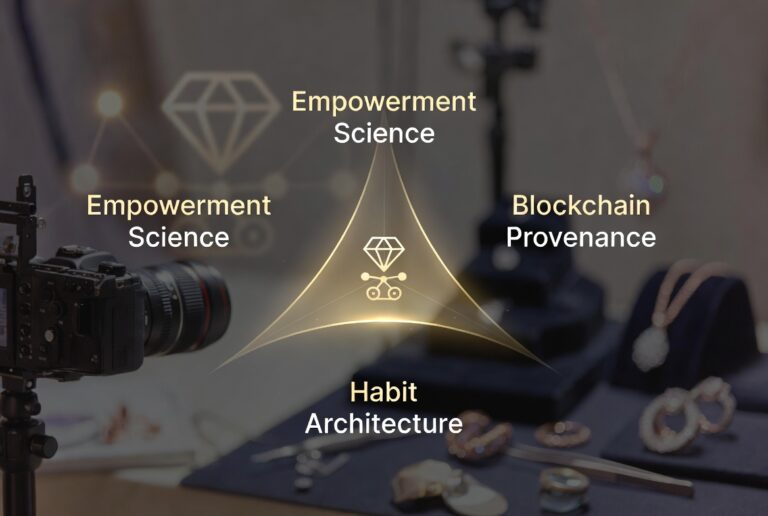

Encoding Empowerment: A Design Science Approach to Blockchain-Verified Organisational Routines
Target Journals: MIS Quarterly, Journal of the Association for Information Systems (JAIS), Information Systems Research
Abstract
This paper follows a Design Science Research (DSR) methodology to address the “Founder Bottleneck”—a persistent organizational challenge where micro-enterprise growth is constrained by the founder’s inability to delegate high-stakes tacit knowledge. We propose and evaluate the Diamond Stack Passport, a blockchain-based sociotechnical artifact designed to encode Empowering Leadership behaviors into verifiable Organizational Routines. Drawing on Sociotechnical Systems Theory and Self-Determination Theory (SDT), we demonstrate how smart contract architecture can serve as a “structural surrogate” for institutional trust. The research contributes a Type 2 (Exaptation) DSR contribution, showing how decentralized ledger technology can be repurposed to institutionalize psychological empowerment in high-precision craft sectors.
Keywords: Design Science Research, Blockchain Governance, Organizational Routines, Sociotechnical Systems, Empowerment, Micro-enterprise.
I. Problem Definition: The Founder Bottleneck
In artisan micro-enterprises, quality is often tethered to the founder’s physical presence. Traditional IT solutions focus on supply chain traceability but fail to address the internal organizational friction of delegation. The research problem is defined as: How can an IT artifact be designed to facilitate the transition from personal agency to organizational architecture without eroding craft integrity?
II. Theoretical Foundations & Design Principles
The artifact is grounded in two primary theoretical kernels:
- Sociotechnical Systems (STS) (Trist & Bamforth, 1951): Joint optimization of the technical (Blockchain/Solidity) and social (Artisan habits) subsystems.
- Structuration Theory (Orlikowski, 1992): The smart contract is viewed as a Sociomaterial Artefact that is both constituted by and constitutive of the artisan’s daily routines.
Design Principles (DP):
- DP1 (Verification): Use immutable ledgers to provide a “safety net” for delegation.
- DP2 (Codification): Map the “ostensive” aspects of routines into smart contract logic (e.g.,
require()statements as quality gates). - DP3 (Autonomy): Utilize Role-Based Access Control (RBAC) to instantiate SDT-based autonomy.
III. Artifact Description: The Diamond Stack Passport
The artifact consists of a Solidity-based state machine that records “Micro-Foundations” of organizational habits. Unlike standard provenance tools, the Passport records:
- The Actor: (Validating competence/role).
- The Routine: (Verifying adherence to the “Habit Architecture”).
- The Consensus: (Institutional trust verified by the system, not the founder).
IV. Evaluation: Utility and Fidelity
Following Hevner et al. (2004), the artifact is evaluated based on its Utility.
- Field Demonstration: Preliminary deployment in a high-precision jewelry studio (Cape Town, SA) showed a significant reduction in “Founder Intervention Frequency.”
- Socio-Technical Alignment: Qualitative feedback indicates that the “Digital Artifact” provides the psychological safety required for artisans to accept higher levels of agency in a High Power Distance context.
V. Discussion & Contribution
This research provides a Type 2 DSR contribution (Gregor & Hevner, 2013). We extend the blockchain governance literature (Beck et al., 2018) by introducing a Psychological Design Layer. We argue that “Code is Culture”—that smart contracts can be intentionally designed to instantiate specific organizational theories (Empowerment/SDT), providing a new pathway for SME professionalization.
Key DSR References
- Bostrom, R. P., & Heinen, J. S. (1977). “MIS Problems and Failures: A Socio-Technical Perspective.” MIS Quarterly.
- Gregor, S., & Hevner, A. R. (2013). “Positioning Design Science Research for Maximum Impact.” MIS Quarterly.
- Hevner, A. R., et al. (2004). “Design Science in Information Systems Research.” MIS Quarterly.
- Orlikowski, W. J. (1992). “The Duality of Technology: Rethinking the Concept of Technology in Organizations.” Organization Science.
- Peffers, K., et al. (2007). “A Methodology for Design Science Research in Information Systems.” Journal of Management Information Systems.
- Sein, M. K., et al. (2011). “Action Design Research.” MIS Quarterly.
- Zucker, L. G. (1986). “Production of Trust: Institutional Sources of Economic Structure.” Research in Organizational Behavior.