From WhatsApp Enquiry to Final Sale: The Modern Jewellery Sales Pipeline Explained
From WhatsApp Enquiry to Final Sale: The Modern Jewellery Sales Pipeline Explained
It usually starts the same way.
A WhatsApp message. An Instagram DM. A walk-in client asking, “Do you do custom rings?”
You reply when you can. You ask a few questions. The conversation goes back and forth. Then it slows down. Sometimes it stops completely.
No quote accepted. No sale closed. No clear reason why.
This isn’t a marketing problem. It’s not even a pricing problem.
It’s a pipeline problem.
Most jewellers don’t lack leads — they lack a jewellery sales pipeline. Without a structured system, enquiries are handled inconsistently, follow-ups are missed, and conversions become unpredictable.
The jewellers who scale are not just better at selling — they are better at managing the journey from enquiry to sale.
This article breaks down exactly how that journey works.
What Is a Jewellery Sales Pipeline?
A jewellery sales pipeline is a structured system that tracks and manages every potential sale from initial enquiry through to final conversion and post-sale follow-up.
Instead of treating each enquiry as a one-off interaction, a pipeline organises leads into defined stages, each with a clear purpose and next step.
Random Enquiries vs Structured Pipeline
- Random: Conversations scattered across WhatsApp, email, and memory
- Pipeline: Every lead tracked, managed, and progressed intentionally
Without a pipeline, you’re guessing. With one, you’re in control.
Where Most Jewellery Leads Are Lost
No Lead Capture System
Enquiries come in, but no structured data is captured. Key details disappear in chat threads.
Slow Response Times
Speed matters. The longer you take to reply, the colder the lead becomes.
No Follow-Up Process
Most sales happen after multiple touchpoints — yet most jewellers stop after one or two.
Poor Tracking
There’s no clear view of which leads are active, stalled, or lost.
No Pipeline Visibility
If you can’t see your pipeline, you can’t manage it — and you definitely can’t optimise it.
The Modern Jewellery Sales Pipeline (Step-by-Step)
Stage 1: Lead Capture
This is where control begins.
- Capture enquiries from all channels (WhatsApp, website, social media, walk-ins)
- Collect structured data (name, budget, timeline, product interest)
- Centralise everything into one system
Key Insight: Unstructured leads are difficult to convert.
Stage 2: Lead Qualification
Not all leads are equal.
- Identify serious buyers vs casual browsers
- Assess budget alignment
- Understand urgency and intent
Outcome: Focus your time where it matters most.
Stage 3: Consultation
This is where trust is built.
- Understand the client’s vision
- Ask structured questions
- Capture detailed requirements
Principle: The quality of your consultation determines the quality of your conversion.
Stage 4: Quoting & Proposal
This is a critical moment in the pipeline.
- Deliver quotes quickly
- Present them professionally
- Make pricing clear and easy to understand
Conversion Insight: Speed and clarity outperform perfection.
Stage 5: Follow-Up & Nurturing
Most jewellers underperform here.
- Follow up consistently
- Use reminders and automation
- Address objections proactively
Reality: The sale often happens in the follow-up — not the first interaction.
Stage 6: Conversion (Closing the Sale)
- Remove friction from decision-making
- Provide clear next steps
- Simplify payment and confirmation
Goal: Make saying “yes” easy.
Stage 7: Post-Sale Relationship
The pipeline doesn’t end at the sale.
- Request reviews
- Encourage referrals
- Offer complementary products
Missed Opportunity: Many jewellers ignore the most profitable stage — retention.
The Speed Factor: Why Time Kills Sales
Speed is one of the most underrated competitive advantages in the jewellery industry.
- Faster responses = higher engagement
- Shorter quote times = higher conversion rates
- Quick follow-ups = maintained momentum
The first jeweller to respond professionally often wins — not because they are cheaper, but because they are present.
How a CRM Pipeline Changes Everything
- Centralised Data: Every lead in one place
- Clear Stages: Know exactly where each deal stands
- Automated Follow-Ups: No missed opportunities
- Forecasting: Predict revenue based on pipeline activity
A CRM pipeline doesn’t just organise your sales — it transforms them into a system.
Before vs After: No Pipeline vs Structured Pipeline
- Lead Handling: Reactive → Proactive
- Conversion Rate: Inconsistent → Predictable
- Revenue: Volatile → Stable growth
- Stress Levels: High → Controlled
Real-World Example: WhatsApp Lead to Closed Sale
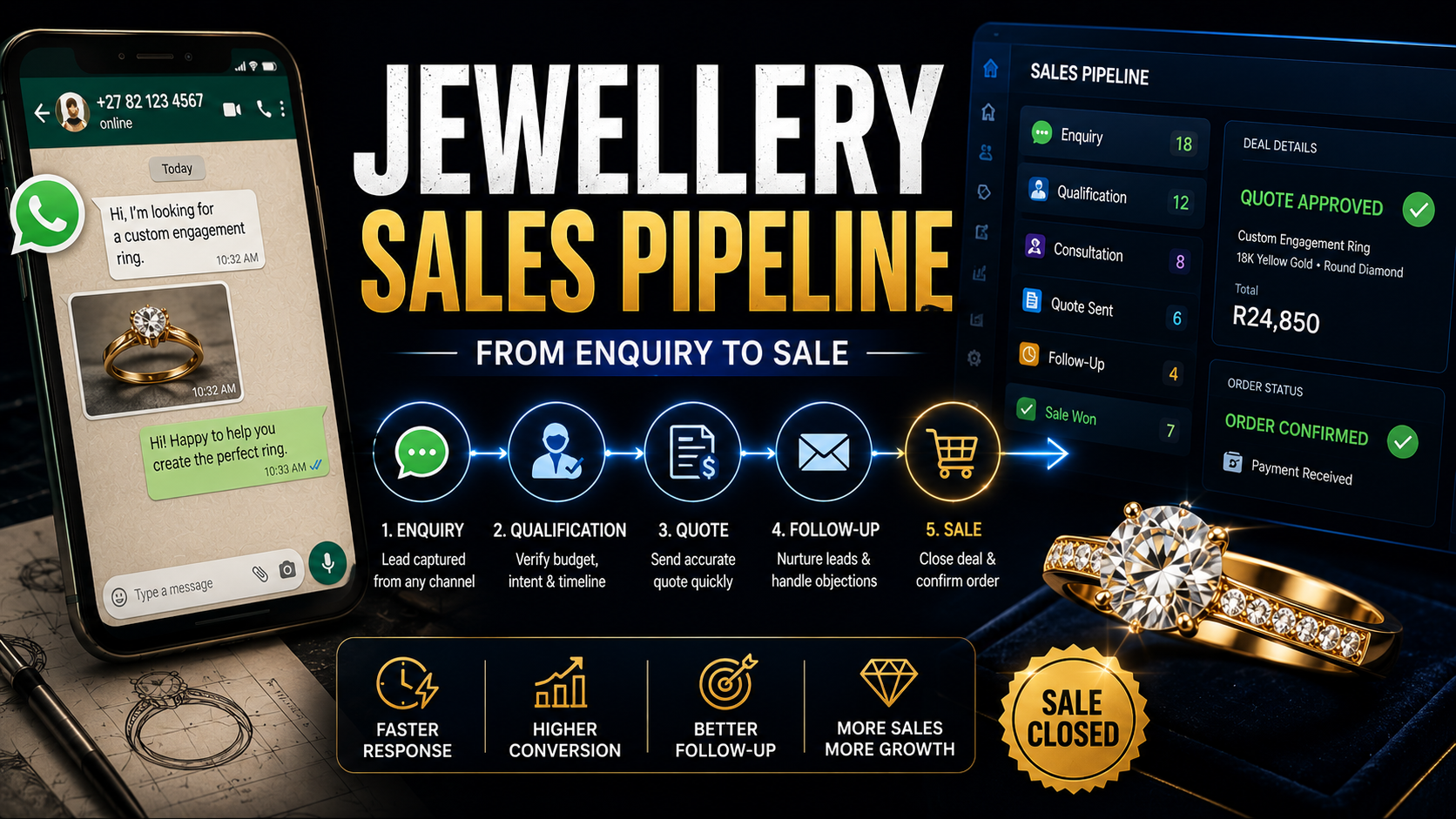
Scenario: A client sends a WhatsApp message asking about a custom engagement ring.
- Step 1: Lead captured with structured details
- Step 2: Qualification identifies budget and urgency
- Step 3: Consultation clarifies design preferences
- Step 4: Quote delivered within 24–48 hours
- Step 5: Follow-up reminders ensure engagement
- Step 6: Sale closed with clear next steps
Result: Faster conversion, better experience, higher likelihood of referral.
How to Build Your Jewellery Sales Pipeline
Define Your Stages
Map your process from enquiry to sale.
Standardise Actions
Ensure every lead is handled consistently.
Implement Tools
Use CRM and workflow systems to manage the pipeline.
Train Your Team
Consistency comes from execution, not intention.
Common Sales Pipeline Mistakes
- Treating all leads the same
- Not following up
- Lack of urgency
- No structured system
Why Diamond Stack Powers the Modern Jewellery Pipeline
Generic systems don’t understand how jewellers actually sell.
- Built around real jewellery sales workflows
- Integrates lead capture, CRM, quoting, and follow-ups
- Designed to reduce friction and increase conversion
It’s not just about managing leads — it’s about turning them into revenue.
Key Takeaways
- Leads are not the problem — conversion is
- A structured pipeline creates predictability
- Speed and follow-up are critical to closing sales
- Systems outperform effort in the long run
Conclusion
The jewellery industry is built on relationships, but relationships need structure to scale.
Without a pipeline, every sale is uncertain. With one, every lead has a clear path forward.
The difference between struggling jewellers and scaling jewellers is not demand — it’s control.
If you want consistent growth, you need a system that turns enquiries into predictable revenue.
FAQ
What is a jewellery sales pipeline?
A structured system that manages leads from initial enquiry through to final sale and follow-up.
How do jewellers convert leads?
By responding quickly, qualifying leads, providing clear quotes, and following up consistently.
Why are jewellery leads lost?
Due to slow responses, poor follow-up, lack of structure, and no tracking system.
What CRM should jewellers use?
A CRM designed for jewellery workflows, including custom orders and high-value client tracking.
How important is follow-up in jewellery sales?
Critical — many sales happen after multiple follow-ups.
Can small jewellers use a sales pipeline?
Yes, even simple pipelines can significantly improve conversion rates.