
Best Software for Jewellers i. South Africa (2026): What You Actually Need and How to Integrate It
Best Software for Jewellers in South Africa (2026): What You Actually Need and How to Integrate It
If you’ve started looking into software for your jewellery business, you’ve probably run into the same problem most jewellers face:
- Too many tools
- Too many conflicting recommendations
- No clear idea what actually works together
One platform promises better sales. Another promises better inventory control. A third focuses on marketing. Before long, you’re paying for multiple systems — and still dealing with the same operational issues.
The problem isn’t a lack of tools. It’s a lack of structure.
Most jewellers approach technology by asking: “What’s the best software?”
The better question is: “What system does my business actually need?”
This article breaks that down — clearly, practically, and specifically for the South African jewellery market.
What Software Do Jewellers Actually Need?
A modern jewellery business doesn’t run on a single tool. It runs on a connected set of systems, each solving a specific operational function.
At a minimum, most jewellers need:
- eCommerce platform – to showcase and sell products online
- CRM system – to manage leads and customer relationships
- Inventory management – to track stock and materials
- Quoting system – especially for custom jewellery
- Marketing tools – to generate leads and drive traffic
- Automation tools – to reduce manual admin
The mistake is thinking these operate independently. In reality, they must function as a system.
The Biggest Mistake: Choosing Tools Instead of Systems
Most jewellers build their tech stack reactively:
- “We need a website” → install eCommerce
- “We need better follow-up” → add a CRM
- “We need stock control” → add inventory software
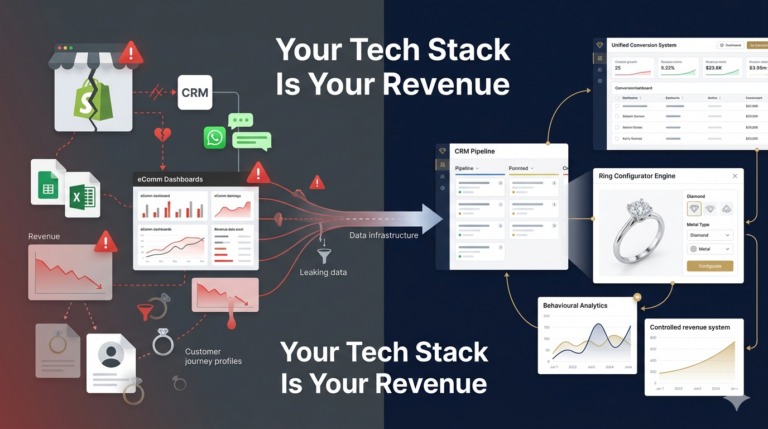
Each decision makes sense individually. But together, they often create:
- Disconnected systems
- Duplicate data entry
- Operational inefficiencies
- Higher long-term costs
Result: More software, more complexity — but no real improvement in performance.
The shift is simple but powerful:
Stop thinking in tools. Start thinking in systems.
Core Software Categories Explained
1. eCommerce Platforms
Your eCommerce platform is more than a website — it’s your primary sales engine.
Jewellers have unique requirements:
- High-quality product presentation
- Detailed specifications (metal, stones, sizing)
- Custom product workflows
Generic setups often fall short when handling bespoke or high-value items.
2. CRM Systems
A CRM (Customer Relationship Management system) is where your sales pipeline lives.
- Track every enquiry
- Manage consultations
- Monitor deal progress
In jewellery, where transactions are high-value and relationship-driven, a CRM is not optional — it’s essential.
3. Inventory & Product Management
Inventory in jewellery is complex:
- Finished pieces
- Loose stones
- Raw materials
Without proper tracking, you risk:
- Stock discrepancies
- Tied-up capital
- Delayed fulfilment
4. Quoting & Custom Order Tools
Custom work is where many jewellers generate the highest margins — but also where inefficiencies are greatest.
- Manual pricing slows down response time
- Inconsistent quotes reduce trust
- No tracking leads to missed opportunities
A structured quoting system solves all three.
5. Marketing & Lead Generation Tools
Software alone doesn’t generate revenue — leads do.
- SEO to attract organic traffic
- Paid ads for immediate visibility
- Email marketing for retention
These tools must connect directly into your CRM pipeline.
6. Automation Tools
Automation is where efficiency is unlocked.
- Follow-up reminders
- Order status updates
- Internal task triggers
Without automation, growth increases workload. With it, growth becomes scalable.
How These Tools Should Work Together (Integration Explained)
This is where most jewellers struggle — and where the biggest opportunity exists.
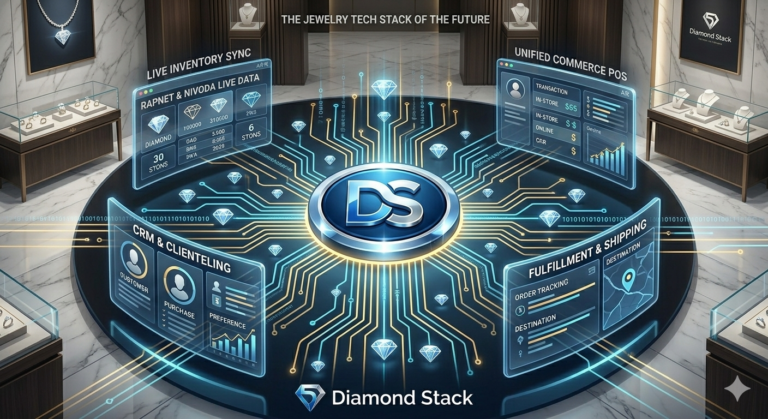
A properly integrated system looks like this:
- Lead enters via website or WhatsApp
- Data flows into CRM
- Quote is generated within system
- Order is created upon approval
- Production is tracked
- Delivery is completed and logged
No duplication. No confusion. No gaps.
What Happens Without Integration?
- Manual data entry between systems
- Missed follow-ups
- Inconsistent client experience
- Operational bottlenecks
Integration is not a luxury — it’s the difference between chaos and control.
Recommended Tech Stack Configurations
Small Jewellery Business
- Basic eCommerce platform
- Simple CRM
- Manual but structured quoting
Focus: Simplicity and affordability
Growing Custom Jeweller
- Integrated CRM + quoting system
- Inventory tracking
- Marketing automation
Focus: Efficiency and conversion
Established Jewellery Brand
- Full-stack system
- Advanced automation
- Detailed analytics
Focus: Scale and optimisation
Software Costs vs ROI
Most jewellers think about cost incorrectly.
- Overspending: Paying for too many tools
- Underspending: Avoiding systems that drive revenue
A properly designed system:
- Increases conversion rates
- Reduces admin time
- Improves customer experience
ROI is not just about saving money — it’s about generating more of it.
Common Software Mistakes
- Using too many disconnected tools
- Ignoring integration
- Not training staff properly
- Choosing generic systems instead of industry-specific ones
How to Choose the Right Software (Decision Framework)
1. Understand Your Business Model
Retail, custom, or hybrid?
2. Define Your Volume
More orders require more structure.
3. Prioritise Integration
Choose systems that work together.
4. Consider Scalability
Will this system still work in 2–3 years?
Why Diamond Stack Solves the Integration Problem
Most software forces jewellers to piece together their own systems.
Diamond Stack takes a different approach:
- Built specifically for jewellery businesses
- Designed around real workflows (sales, quoting, production)
- Integration-first architecture
Instead of managing multiple disconnected tools, you operate within a single, structured system.
Key Takeaways
- Jewellers don’t need more tools — they need better systems
- Integration is more important than individual features
- A structured tech stack improves efficiency and revenue
- Choosing the right system is a long-term competitive advantage
Conclusion
The jewellery industry is evolving. Customer expectations are rising, competition is increasing, and operational complexity is growing.
In this environment, software decisions are no longer optional — they are strategic.
But success doesn’t come from choosing the “best” tools.
It comes from building the right system.
If you want to scale your jewellery business, start by fixing the foundation — your tech stack.
FAQ
What software do jewellers need?
Jewellers typically need eCommerce platforms, CRM systems, inventory management, quoting tools, and marketing automation.
What is the best CRM for jewellers in South Africa?
The best CRM is one designed for jewellery workflows, including custom orders and high-value client tracking.
How much does jewellery software cost?
Costs vary widely, but investing in an integrated system often delivers higher ROI than using multiple disconnected tools.
Do I need an integrated system?
Yes. Integration reduces inefficiencies, improves accuracy, and enables scalability.
Can small jewellers benefit from software?
Absolutely. Even simple systems can significantly improve efficiency and sales performance.