
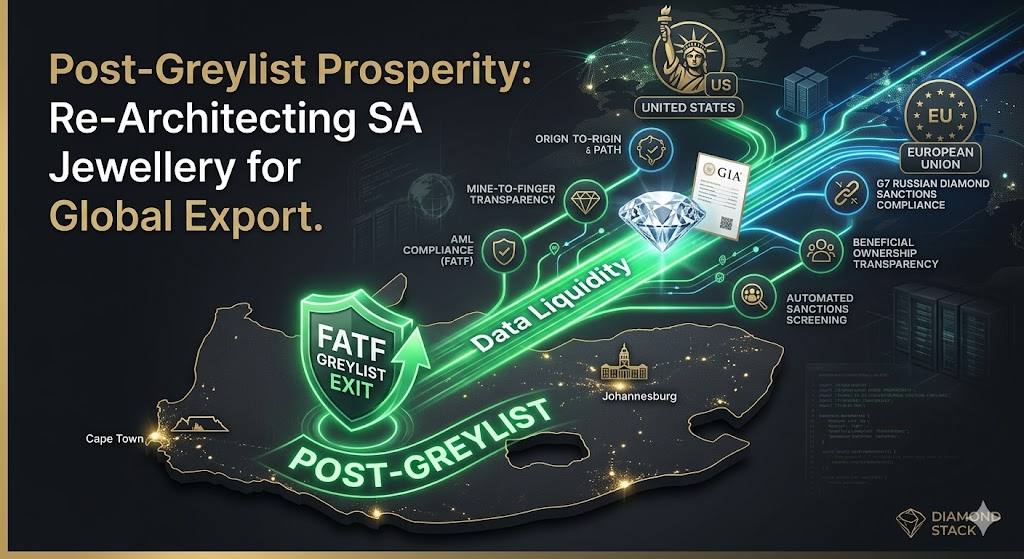
Post-Greylist Prosperity: Re-Architecting SA Jewellery for Global Export
On 24 October 2025, South Africa achieved a critical milestone: formal removal from the FATF “Greylist.” While the banking sector breathed a sigh of relief, the most profound impact is being felt in the high-value jewellery export corridors. As of January 2026, the European Union and the UK have officially delisted South Africa from their “High-Risk Third Country” registers, effectively dismantling the “Enhanced Due Diligence” (EDD) barriers that have throttled local studios for nearly three years.
Under CCF Pillar I: The Resonance Protocol, the goal is no longer just “compliance.” It is about leveraging this new-found transparency to dominate the US and EU markets through Data Liquidity.
The Export Renaissance: From Friction to Flow
For three years, South African diamond exports were treated with systemic suspicion. International counterparties faced prohibitive compliance costs, and simple shipments often languished in customs due to manual AML (Anti-Money Laundering) checks.
With the greylist exit, we are entering an era of “Mine-to-Finger” dominance. The 2026 global buyer—particularly in the US and EU—demands more than a GIA certificate; they demand an unbroken digital biography of the stone.
Technical Requirements: AML Compliance in the Digital Feed
In 2026, AML compliance has moved from a paper-based “Know Your Customer” (KYC) check to a Real-Time Transactional Audit. To export effectively, your WooCommerce feed must be re-architected to support Surgical Metadata Injection:
- G7 Russian Diamond Sanctions Compliance: As of 1 January 2026, the EU mandates a “Due Diligence Statement on Diamond Origin” for all polished stones over 0.5ct. Your product feed must programmatically inject this origin data directly into the customs declaration layer.
- Beneficial Ownership Transparency: Under the new SARS “Traveller Management System,” export data must align with the official beneficial ownership registries. Your site’s backend must serve as a “Single Source of Truth,” linking the physical SKU to the legal entity owning the stock.
- Automated Sanctions Screening: Integrating an agentic AI layer (like those we built in the Liquidity Protocol) allows your store to pre-screen international buyers against global watchlists before the transaction is processed, preventing costly legal “Signal Contradictions.”
Data Liquidity: The Customs Shortcut
Under the Coetzee Liquidity Protocol (CLP), we define “Data Liquidity” as the ease with which your product information can be reused across different international platforms.
By building Digital Data Assets (DDAs) instead of static product pages, you simplify international trade:
- The Electronic Data Pipeline: By feeding accurate, structured JSON-LD data into the global customs “pipeline” upstream, you allow EU and US customs agents to pre-clear shipments.
- Seamless Duty Calculation: Liquid feeds allow for sub-second calculation of VAT and import duties, providing the international buyer with a “Landed Cost” at checkout. This transparency is the ultimate trust signal in Pillar I.
Conclusion: Reclaiming the Global Throne
The FATF exit is not a finish line; it is a green light. South African jewellery has always had the craftsmanship; now, it has the regulatory “Clean Signal” to match. By re-architecting your feeds for AML transparency and data liquidity, you move from being a “High-Risk” vendor to a Preferred Global Partner.
In the 2026 export market, the studio with the most liquid data wins the most lucrative contracts.