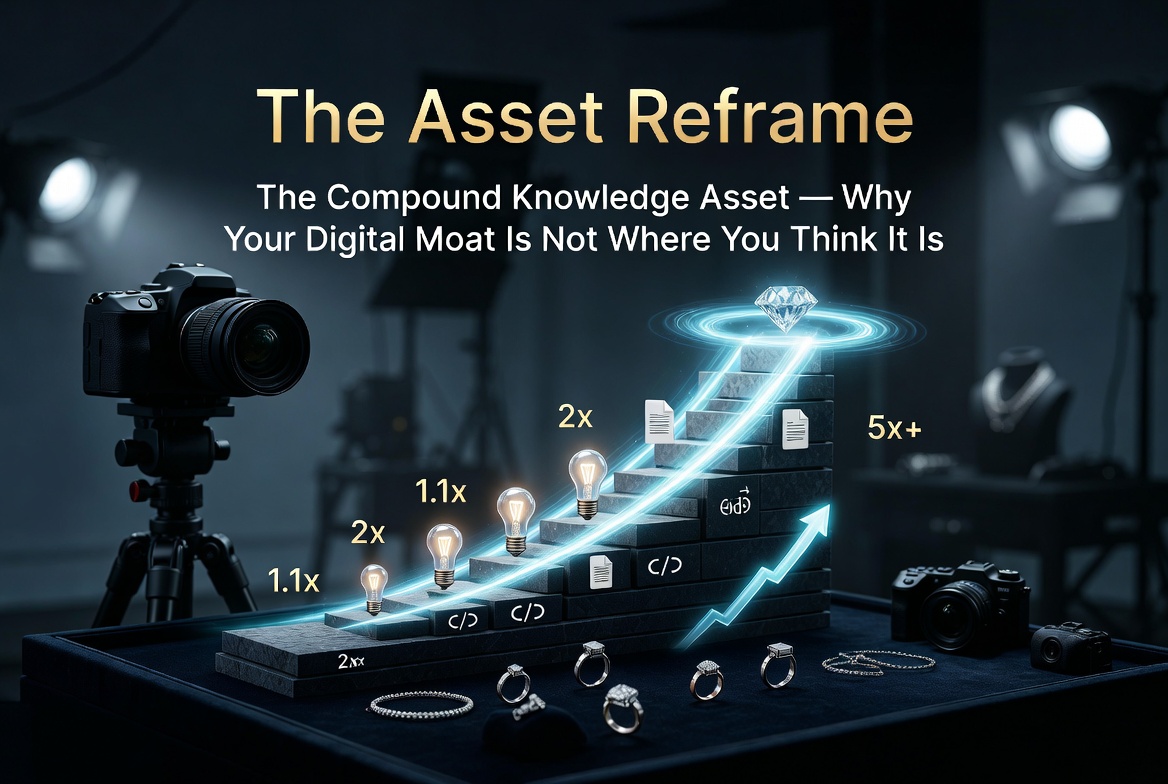
The Asset Reframe The Compound Knowledge Asset: Why Your Digital Moat Is Not Where You Think It Is
SEO and JSON-LD are publicly documented W3C standards — they fail Barney’s VRIN test at the Rare criterion. The durable competitive advantage in digital strategy is not the tools. It is the Compound Knowledge Asset: the intersection of the founder’s inimitable tacit knowledge, a path-dependent provenance record, and Digital Absorptive Capacity. Here is the 30-year evidence base — and the three corrections Diamond Stack is making to how we describe our own competitive advantage.
The Moat You Think You Have
A castle moat works because you cannot move it. The water is fixed to the geography. The cost of bridging it is visible and high. The attacker knows, before they begin, what the crossing will require. That is what makes a moat a moat: not the water, but the structural conditions that make the water difficult to circumvent.
A digital moat built entirely from publicly documented W3C standards is not a moat. It is a public road with a toll booth you forgot to install. The JSON-LD specification is free, comprehensively documented, and supported by hundreds of open-source libraries. The WordPress architecture that hosts it is used by 43% of all websites on the internet. Any competitor with a competent developer, a reasonable budget, and three weeks of focused work can reproduce the infrastructure you spent eighteen months building. The tools are commodity. They have been commodity since the day they were released.
This is the third post in a series that has established a pattern of correcting its own claims when the evidence demands it. Post 1 revised the “25% ceiling” to the accurate 19.4% variance explained by Seibert et al. (2011). Post 2 applied Altman’s (1968) own validation caveats to show why the Z-Score requires significant adaptation before it is useful for jewellery micro-enterprises. This post applies Barney’s (1991) Resource-Based View to the “Quantitative Moat” claim — and the test returns a result that requires three specific corrections.
The corrections are not a weakening of the underlying framework. They are a sharpening of the claims to match the evidence. And as the series has demonstrated, claims that survive their own stress tests are more valuable in credence goods markets than claims that have never been examined. By the end of this article, the moat will still be real. It will just be located in the right place.
Section 1: The VRIN Test — What a Moat Actually Requires
Barney (1991), writing in the Journal of Strategic Management in a paper that has accumulated over 50,000 citations across the management literature, established the conditions under which a firm resource creates sustained competitive advantage. The framework is known by its acronym: VRIN. A resource must be Valuable — it must enable the firm to create value that a competitor without it cannot. It must be Rare — not widely held by current or potential competitors. It must be Inimitable — costly to copy, either because of its path-dependent history, causal ambiguity about what makes it work, or social complexity that resists replication. And it must be Non-substitutable — no strategically equivalent alternative exists. All four conditions are required. Failing any single one degrades the competitive advantage from sustained to temporary, or eliminates it entirely.
Let us apply the test systematically to the components of what Diamond Stack has been calling its digital moat.
Search Engine Optimisation. Valuable: yes, unambiguously. Improved discoverability in organic search creates genuine value for clients and for Diamond Stack’s own positioning. Rare: no. Every digital marketing agency, every WordPress developer, every business owner who has spent forty minutes reading a Google Search Central blog post has access to the same SEO principles. Inimitable: no. The techniques are not just publicly documented — they are the subject of thousands of free courses, open-source plugins, and now AI tools that automate the implementation entirely. Non-substitutable: no. Paid search, social proof platforms, referral networks, and industry directory listings all provide strategic substitutes for organic discoverability. VRIN score: 1 out of 4. Table stakes, not moat.
JSON-LD structured data. The verdict is identical. Valuable — structured data improves how search engines understand and surface content, and the evidence for its effectiveness in e-commerce and local business contexts is solid. Rare — it is a W3C open standard, freely available to any competitor who can follow a specification document. Newbert (2008), in a meta-analysis of the RBV literature published in the Strategic Management Journal, confirmed that generic digital tools are “commodity-like” and reach competitive parity rapidly once adoption begins. Inimitable — tools such as Schema App and RankMath generate compliant JSON-LD automatically; AI assistants will write it from a plain-language description in under a minute. Non-substitutable — voice search optimisation, structured content management systems, and proprietary platform APIs all provide alternatives. VRIN score: 1 out of 4. The same verdict.
Blockchain provenance infrastructure. Here the test returns a materially different result. Valuable — yes, and robustly so: a blockchain-based provenance record directly addresses Akerlof’s (1970) information asymmetry problem, which Dulleck and Kerschbamer (2006) identified as the primary market failure in credence goods categories. Rare — currently yes. Industry adoption in the South African jewellery sector is in the low single-digit percentages. The competitive landscape has not yet caught up with the technology. Inimitable — partially. The smart contract architecture can be replicated by any competent Solidity developer. But the provenance record encoded within it — the specific chain of custody, the artisan signatures, the timestamped service history — cannot be manufactured retrospectively. A competitor who implements blockchain provenance tomorrow cannot produce three years of authentic records tonight. Non-substitutable — partially. No other mechanism provides immutable, timestamped, artisan-level chain-of-custody data that is independently verifiable on a public ledger. Paper certificates and private databases both allow post-hoc modification; the blockchain does not. VRIN score: 3 to 4 out of 4, but with a critical contingency that Section 4 addresses.
Barney’s own 2001 revision to the framework added a dimension that matters significantly here. In his Academy of Management Review response to critics, Barney acknowledged that dynamic capabilities — the organisational ability to build, integrate, and reconfigure resources — are often more strategically significant than the resources themselves. A firm that is structurally capable of continuously sensing market shifts and reconfiguring its asset base will, over time, out-compete a firm that holds superior static resources but cannot adapt them. This sets up the argument of Sections 2 and 3.
One further point deserves direct statement: a competitor who has been selling “digital moat” promises faces a structural problem when a client encounters the VRIN analysis above. The response options are limited. Dispute the framework? Barney (1991) has 50,000 citations — the dispute would need to be very well-resourced. Accept the framework and revise the claim? That requires acknowledging that prior promises were not grounded in the standard strategic analysis any MBA-trained client would apply. Ignore it? That works until Johan, or someone in Johan’s network who has read this post, raises the test in a proposal meeting. The VRIN framework is not exotic or obscure. It is standard curriculum. The question is not whether someone will apply it — the question is whether you have already applied it to yourself before they do.
Section 2: Dynamic Capabilities in the 8–25 Person Atelier — What the Research Actually Shows
Teece, Pisano, and Shuen (1997), in a paper that has become one of the most-cited works in strategic management, defined dynamic capabilities as the firm’s ability to sense emerging market opportunities, seize them through rapid resource reconfiguration, and reconfigure the organisation’s structure when the environment shifts. The framework was built on analysis of large firms — Intel, Hewlett-Packard, IBM — with dedicated R&D functions, formal sensing processes, and the organisational slack to fund reconfiguration without disrupting core operations.
The question the CCF must answer is whether dynamic capabilities theory travels to a fourteen-person Cape Town atelier where the founder is simultaneously the head designer, the primary client relationship manager, the workshop supervisor, and the person who last replaced the security system batteries.
The South African SME literature answers this question with qualified optimism. Research on dynamic capabilities in South African small firms confirms that sensing and integrative capabilities are present and significantly impact competitive advantage even at small scale — but with a structural modification that matters. In micro-enterprises, dynamic capabilities are not institutionalised in formal R&D processes or strategic planning teams. They operate through what the literature calls Entrepreneurial Management: the owner’s personal cognitive ability to scan the environment, pattern-match against prior experience, and make reconfiguration decisions. The “capability” is not organisational. It is personal.
Winter (2003), writing a follow-up to the Teece et al. framework in the Strategic Management Journal, identified what he called the “rustiness problem”: dynamic capabilities must be exercised regularly to remain sharp. Unlike ordinary operational capabilities, which improve through repetition, dynamic capabilities degrade when unused. A firm that reconfigures its strategy once every three years has a rusty sensing capability — it exists in theory, but the cognitive and organisational mechanisms required to act on it have atrophied. For a small team with constrained bandwidth, the frequency required to keep dynamic capabilities active is genuinely difficult to maintain.
The Key Person Risk is the structural vulnerability that follows directly. If Johan carries the firm’s sensing and seizing capability in his head — if the dynamic capability is essentially his pattern-recognition and decision-making capacity, accumulated over 22 years in the industry — then the firm’s strategic advantage exits the building when he does. This is not an abstract concern. It is the primary reason that artisan businesses trade at discounted multiples: the tacit knowledge that creates the value and the tacit knowledge that manages the value are concentrated in a single person who is mortal and will eventually either retire, sell, or be incapacitated.
The CCF’s architectural response to this problem is worth making explicit. Habit-based externalisation — Pillar 2 of the framework, grounded in Gersick and Hackman’s (1990) group habit theory and Feldman and Pentland’s (2003) routines research — is designed specifically to convert founder cognitive capability into documented organisational routine. The CCF does not try to replicate Johan’s tacit knowledge in a procedure manual. It builds the habit structures that allow his team to perform reliably without requiring his constant mediation. The blockchain provenance record — Pillar 3 — is the mechanism for making artisan-level tacit knowledge legible, timestamped, and transferable to a future owner who never met the original craftsperson.
Reframed: the CCF is not primarily a digital strategy. It is a Dynamic Capability preservation system — designed specifically to address the two failure modes that Winter (2003) and the SA SME literature identify as most damaging in micro-enterprises. The rustiness problem is addressed through the CCF’s structured habit protocols, which build the frequency of digital capability exercise into the daily operational rhythm. The Key Person Risk is addressed through the combination of habit externalisation and blockchain provenance, which progressively transfer strategic knowledge from the founder’s head into the organisation’s documented systems.
Digital tools do not create Dynamic Capabilities. They create the conditions under which existing Dynamic Capabilities can be exercised, documented, and — critically — transferred from founder to organisation. This distinction is the difference between a digital strategy and a succession strategy. The CCF is both.
Section 3: Absorptive Capacity — Why Johan Cannot Buy This Capability
Cohen and Levinthal (1990), writing in the Administrative Science Quarterly in a paper that remains foundational across innovation management, organisational learning, and strategic management literatures, defined Absorptive Capacity as the ability to recognise the value of new external information, assimilate it, and apply it commercially. The critical mechanism in their model is the requirement for prior related knowledge: you cannot absorb what you have no foundation to interpret. A firm with no background in chemistry cannot rapidly assimilate advances in materials science. A firm with no background in analytics cannot rapidly assimilate insights from digital data, regardless of how much of it arrives.
Craft sectors face a specific version of this problem that the general AC literature does not always foreground. Jewellery ateliers are history-dependent organisations: their competitive identity, their reputation, and frequently their primary asset (the founder’s tacit skill) rests on decades of investment in manual, analogue craft. That investment is real and valuable — it is the inimitable foundation of the Compound Knowledge Asset this article ultimately argues for. But it also creates a knowledge base that is deep in one dimension and narrow in others. When digital knowledge becomes strategically relevant, the artisan founder is not starting from a position of cognitive neutrality. They are starting from a position of strong prior investment in a different domain, which creates both a translation challenge and, in some cases, an identity threat.
The research game conducted for this article surfaced three specific barriers that the empirical AC literature documents in craft and traditional manufacturing sectors. The first is cognitive overload. Artisan teams often lack the shared digital vocabulary required to interpret complex data signals without mediation. When a Google Search Console report flags a Core Web Vitals issue, a team whose collective expertise lies in stone-setting and wax carving does not automatically know what that means, why it matters, or what the response should be. The information arrives but cannot be assimilated because the prior knowledge required to make it interpretable is absent.
The second barrier is the cost of learning in difficult environments. Cohen and Levinthal noted that in fields where knowledge is advancing rapidly, the cost of maintaining AC — the ongoing investment required to keep pace — can exceed the market benefit for small firms operating under resource constraints. A sole-focus artisan studio has a finite cognitive and financial bandwidth. The opportunity cost of redirecting it toward digital capability development is not zero: every hour Johan spends in a Google Analytics training session is an hour not spent on client relationships, design development, or workshop supervision.
The third barrier is the asset-capability confusion, and it is the most common failure mode in practice. Most studios respond to a recognised digital capability deficit by purchasing software. They buy a CRM, subscribe to an analytics platform, install a schema plugin. This is asset-buying, not capability-building. The software sits unused, or used at 10% of its potential, because the human cognitive capacity required to extract value from it has not been developed. The AC literature is explicit on this point: the resource and the capability to use the resource are distinct constructs, and investment in the former does not automatically produce the latter.
This is where the competitive moat implication becomes concrete. Lally and colleagues (2010), in the most rigorous empirical study of habit formation published in the European Journal of Social Psychology, found that the time required for a new behaviour to become automatic ranges from 18 to 254 days, with a mean of 66 days. Digital Absorptive Capacity is not a switch that flips when software is installed. It is a capability that develops through sustained, structured practice over a minimum of several months and, for meaningful integration into organisational routine, more likely 12 to 18 months.
A studio that has developed Digital AC over 18 months of structured CCF habit protocols has a resource that a late-moving competitor cannot replicate in less time regardless of budget. There is no shortcut. The cognitive and procedural learning embedded in a team that has been practising digital interpretation, structured data maintenance, and blockchain documentation as daily habit is a time-compressed resource in Dierickx and Cool’s (1989) precise sense: it was built in real time and can only be rebuilt in real time. This is where the inimitability actually resides — not in the tools, but in the team’s hard-won capacity to use them productively, accurately, and consistently under the conditions of a working jewellery studio.
Digital Absorptive Capacity is the actual moat. The tools are commodities. The capacity to use them faster, smarter, and more continuously than competitors — developed through structured habit protocols rather than software procurement — is the inimitable resource that Barney’s framework requires.
Section 4: The Stiglitz Trap and the First-Mover Window
Joseph Stiglitz, in his 2001 Nobel Prize lecture published in the American Economic Review, argued that information transparency technologies, once widely adopted, do not create premiums — they create entry requirements. The mechanism is straightforward: when a quality signal is rare, it differentiates. When it becomes ubiquitous, it becomes a hygiene factor. Its absence is penalised; its presence is expected. The premium evaporates not because the signal stopped working but because it stopped being rare.
The Fair Trade certification case illustrates the timing precisely. In 2001, a fair-trade label on a coffee product was a genuine differentiator that commanded a measurable premium in speciality retail. By 2015, it was expected in the category. By 2020, its absence was a negative signal in premium channels. The certification went from differentiator to table stake in approximately fifteen years — roughly one Rogers (1962) diffusion cycle from early majority adoption to late majority normalisation.
This is Proposition P3, stated explicitly: the blockchain provenance premium constitutes a first-mover advantage with a defined expiry contingent on industry adoption rate. The premium window is open now. It closes when blockchain provenance crosses the early majority adoption threshold in the South African luxury jewellery sector — estimated, based on Rogers’ Diffusion of Innovation curve, at somewhere between 15% and 20% of studios implementing comparable systems. At current adoption rates, that window is likely between three and eight years. That is not an argument against implementing; it is an argument for implementing before the window closes, not after.
The research game produced a resolution to the Stiglitz trap that the standard commoditisation literature does not always surface. Transparency creates premiums under asymmetric information conditions specifically when the transparency mechanism encodes something irreducibly individual. This is the distinction between certification and provenance. A certification says: this product meets a defined standard. It is binary — pass or fail — and once enough producers pass, the premium disappears into the standard. A provenance record says: this specific piece was created by this specific artisan, on these specific dates, using these specific materials, according to this specific chain of custody. It is unique to each item and each maker. It cannot be commoditised because the content of each record is non-fungible.
Hobbs (2004), examining agricultural traceability systems in the Journal of International Food and Agribusiness Marketing, documented exactly this distinction in premium food markets. Producers who embedded provenance in their individual farm identity — not generic organic certification but the specific story of a named farm, a named farmer, a specific harvest — maintained pricing premiums even after organic certification became standard in their category. The specificity of the signal determined its longevity. The same mechanism applies to the Diamond Stack Digital Passport: its strategic value rests not on being a trust badge but on being an irreducibly specific record of a named artisan’s documented craft history.
Three failure modes remain live and must be acknowledged. The Average Trap activates if consumers cannot distinguish between different blockchain-certified ateliers — if all certified studios are perceived as equivalent, price defaults to the lowest available. The CCF’s response is the CEO Diaries framework and the transparent narrative strategy, which creates a qualitative differentiation layer that blockchain documentation cannot provide alone. The Verification Cost problem — audit and maintenance costs eating the transparency premium — is mitigated by the Polygon Layer 2 architecture that reduces per-transaction costs to negligible levels relative to the provenance premium being created. And Signal Noise — consumer fatigue from an overabundance of trust signals — is addressed by the irreducible specificity of the Digital Passport record, which is not a badge applied to a product category but a queryable history attached to a specific, named, dated object.
The strategic imperative is therefore not whether to implement blockchain provenance but when. The Stiglitz trap is real. The timeline is defined. The window closes as industry adoption increases, not as the technology matures. Studios that implement during the current low-adoption period capture the full premium cycle. Studios that implement when the early majority has already moved inherit a table stake at the cost of a differentiator.
Section 5: Path Dependency and What Actually Compounds
Dierickx and Cool (1989), writing in Management Science, identified a class of strategic resources distinguished by what they called Time Compression Diseconomies: the property that certain assets accumulate at a rate determined by real-world processes that cannot be accelerated by increasing investment. You cannot become a master jeweller faster by spending three times as much on training. The skill accumulates through practice, and practice has a minimum time requirement that money cannot compress. A competitor who wants to replicate your twenty-year craft knowledge base cannot purchase it. They must grow it — and growing it takes twenty years.
The strategic question is which components of Diamond Stack’s digital architecture actually meet this criterion. Not all of them do, and the distinction matters.
The SEO and structured data archive does not qualify as a path-dependent resource in Dierickx and Cool’s sense. Platform risk is material: a Google Core Algorithm Update can reduce the search value of a carefully constructed five-year archive to near zero in a single release cycle. The March 2024 Google Helpful Content Update, for example, significantly devalued large volumes of structured, keyword-optimised content that had previously ranked well. AI scraping is the second failure mode: public SEO archives are fully synthesisable by AI tools at negligible cost, which means the information value that required years to accumulate can be extracted and repurposed by a competitor in hours. Digital decay is the third: market relevance shifts faster than content refresh cycles, and a multi-year content archive can become strategically inert if its thematic focus no longer matches current search intent or consumer language. The SEO archive is a useful operational asset. It is not a moat.
The provenance record does qualify, but with a precision that the prior framing of the moat claim obscured. The immutable blockchain data — each timestamped entry, each artisan signature, each recorded transaction — meets the path-dependency criterion exactly. It cannot be backdated. It cannot be manufactured retrospectively. Its value accumulates with each additional authentic record, and no late-mover can produce a three-year authentic history tonight regardless of budget. The record is not the infrastructure that hosts it; it is the authenticated content that the infrastructure has made permanent. This distinction is the correction the article’s Round 8 verdict produced: the blockchain is the Proof. The Knowledge is the Moat.
The team’s Digital Absorptive Capacity also qualifies. As Section 3 argued, the cognitive and procedural learning embedded in a team that has operated structured digital protocols over 18 months cannot be purchased or compressed. It was built in real time. The habits documented by Lally et al. (2010) have a minimum formation timeline that money cannot shorten. The shared digital vocabulary, the interpretive frameworks, the confidence with analytics tools and blockchain interfaces — these accumulate through practice and cannot be transferred by training a new hire to the same level in a short period.
This brings us to the Compound Knowledge Asset — the article’s central reframe of the moat claim. The moat is not any single component. It is the intersection of three elements, each of which individually meets the inimitability criterion, and which together create a reinforcing system where each component increases the strategic value of the others.
The founder’s tacit knowledge is inimitable by nature: it is the accumulated product of twenty-plus years of specific, embodied practice in a specific craft domain, and it cannot be transferred except through the founder’s deliberate externalisation choices. The provenance record is inimitable by path-dependency: it is the authenticated history of that tacit knowledge in action, timestamped and immutable, and it can only be accumulated forward from the point of implementation. The team’s Digital AC is inimitable by time-compression: it is the organisational capacity to use the provenance infrastructure productively, developed through structured practice over a minimum of 12 to 18 months and not available for purchase at any price.
Each element reinforces the others. The tacit knowledge gives the provenance record its qualitative depth — it is not merely a chain of custody but a documented record of specific craft decisions made by a specific named artisan with a specific reputation. The provenance record makes the tacit knowledge transferable beyond the founder’s working lifetime — it encodes what would otherwise leave the building with its creator. And the Digital AC enables the team to use both productively: to interpret what the data means, to maintain the record accurately, to surface the narrative for clients who need to understand it.
Remove any one of the three and the compound effect degrades. A studio with tacit knowledge and Digital AC but no provenance record has inimitable capability that is not documented and therefore not transferable. A studio with tacit knowledge and a provenance record but no Digital AC has a system it cannot operate reliably without the founder’s constant mediation — which means the Key Person Risk remains live. A studio with a provenance record and Digital AC but no deep tacit knowledge has operational capability without the content that makes the system meaningful. The intersection is the moat. The components are the prerequisites.
Section 6: What This Means for Valuation — Honest Arithmetic for Exit Planning
The South African SME valuation literature is unambiguous on a point that deserves direct acknowledgement: there is no peer-reviewed evidence supporting tech-style 30 to 50 times EBITDA multiples for artisan micro-enterprises through digital transformation. The claim that digital infrastructure can move a jewellery studio from a standard artisan multiple to a technology-company multiple conflates two different things — the digital tools a business uses and the business model characteristics that drive technology valuations — and the conflation does not survive scrutiny.
Three structural caps operate in the South African artisan business valuation context. The illiquidity discount is the first: private small firms trade at a meaningful discount to theoretical intrinsic value because the buyer pool is small, the transaction process is slow, and the exit options are limited. Digital capability does not eliminate this discount. The sector cap is the second: investors and acquirers in the South African market price jewellery businesses as lifestyle businesses unless management independence from the founder is demonstrable at the point of sale. A studio where the founder is the primary designer, the primary client relationship holder, and the holder of the key supplier relationships will not trade at a growth company multiple regardless of its schema markup quality. The exit barrier is the third: the difficulty of transferring tacit knowledge during a business sale is a well-documented depressant of final valuations in craft sectors. The buyer must discount for the risk that the thing they are acquiring — the quality and reputation — may not survive the transfer.
Proposition P1, stated explicitly: digital maturity in jewellery micro-enterprises acts as a valuation floor, not a multiple multiplier. The correct framing of the value proposition is not “we will take you from 3x to 30x.” It is “we will protect your floor and remove the discount factors that drag a well-run business to the bottom of its natural sector range.”
Three specific discount factors are addressable through the CCF implementation. Management independence — the largest single discount in artisan valuations — is addressed by the CCF’s habit externalisation protocols, which progressively convert founder-dependent operations into documented team capability. A buyer evaluating a studio whose procedures are running in the team’s habits, not only in the founder’s head, is buying a lower-risk transfer. Provenance record quality addresses information risk: blockchain documentation of inventory, chain of custody, and artisan certification creates an auditable asset register that reduces the information asymmetry a buyer faces when pricing a creative business with intangible assets. Digital Absorptive Capacity addresses the transferability risk: a team that has demonstrated the ability to operate digital systems independently is more readily transferred than one whose digital operations require founder mediation at every step.
The honest valuation range that results from addressing these three discount factors: a well-executed CCF implementation over 24 to 36 months can improve an artisan studio’s exit multiple from the bottom of its natural sector range — typically 2.5 to 3 times EBITDA for a founder-dependent creative micro-enterprise — to the top of that range — typically 5 to 6 times EBITDA for a professionally managed, management-independent atelier with documented systems and auditable assets. That is a 67% to 100% improvement in enterprise value. In rand terms, for a studio generating R1.5 million EBITDA, the difference between a 2.5x and a 5.5x exit is R4.5 million. That is real, significant, and deliverable through the mechanisms the CCF actually operates. It is not 10x. It is not a technology multiple. But it is defensible, honest, and — for a studio owner who has spent twenty years building something — genuinely meaningful.
Section 7: The Corrected Claim — What Diamond Stack Actually Promises
Three corrections follow from the analysis above. They are stated without defensive framing, in the same register as the prior corrections in this series.
Correction 1: “Quantitative Moat” is replaced by “Compound Knowledge Asset.” The digital infrastructure — the WordPress architecture, the JSON-LD schema, the structured data — is table-stakes positioning, not competitive advantage. It enables discoverability. It does not create a moat. The moat is the intersection of the founder’s inimitable tacit knowledge, the path-dependent provenance record, and the team’s Digital Absorptive Capacity. These three elements, built and compounded over the implementation timeline, are what Barney’s VRIN framework actually validates.
Correction 2: Blockchain’s strategic role is reframed from “source of moat” to “proof mechanism.” The blockchain does not create the competitive advantage. It makes the competitive advantage legible, verifiable, and transferable. Johan’s craft knowledge has always been inimitable; the blockchain makes it auditable. The team’s accumulated practice record has always been path-dependent; the blockchain makes it permanent. Spence’s (1973) signalling framework is the correct lens: the blockchain is the costly signal that makes the underlying quality observable to buyers, investors, and acquirers who cannot directly inspect the tacit knowledge it documents.
Correction 3: The valuation claim is reframed from “multiple multiplier” to “floor protection and discount removal.” The realistic improvement is 67% to 100% of enterprise value over 24 to 36 months, achieved by addressing the three structural discount factors — management independence, information risk, and transferability — that prevent well-run artisan businesses from trading at fair value in the South African exit market.
What remains unchanged is the underlying theoretical architecture. Spreitzer’s (1995) psychological empowerment science, with Seibert et al.’s (2011) meta-analytic validation at ρ = .44, remains the evidential foundation for Pillar 1. Gersick and Hackman’s (1990) group habit theory, Feldman and Pentland’s (2003) routines framework, and Lally et al.’s (2010) habit formation data remain the foundation for Pillar 2. The blockchain provenance architecture, grounded in Trist and Bamforth’s (1951) sociotechnical systems theory and Zucker’s (1986) institutional trust framework, remains the foundation for Pillar 3. The 10-round Librarian verdict — a “Qualified Yes” backed by approximately 30,000 combined citations across the most rigorous journals in management science — stands. The corrections sharpen the claims to match the evidence. They do not weaken the framework.
Proposition P2 completes the picture: ateliers with higher Digital Absorptive Capacity recover faster from architectural shocks — algorithm updates, platform changes, technology disruptions — than those without it. This is a testable prediction, not a confirmed finding. It requires empirical validation in the jewellery context. It is offered as a theoretical proposition, labelled as such, in the tradition of middle-range theory building that Merton (1968) described as the most honest and ultimately most productive mode of practitioner-scholar contribution.
The competitive advantage of intellectual honesty in credence goods markets is a theme this series has developed across three posts. A strategist who corrects their own claims in public — reducing a figure from 25% to 19.4%, acknowledging the Altman Z-Score’s micro-enterprise limitations, applying Barney’s VRIN test to their own moat claim — is demonstrating, in real time, the Digital Absorptive Capacity they are selling. The recognition of new information, the assimilation of the VRIN analysis, the commercial application in a revised value proposition: this is Cohen and Levinthal’s (1990) mechanism operating in front of the reader. The Compound Knowledge Asset is being built here, in this post, as the reader watches. That is not a coincidence.
Closing: The Castle Is Yours
Return to the castle moat. The water is not the moat. The moat is the decision, made years before the siege arrived, to build the castle on ground that made a water defence structurally possible — the topography, the proximity to a reliable source, the engineering knowledge to manage the flow. The water can be drained, diverted, or bridged. The decision that created the conditions for it cannot be retroactively unmade by a competitor who is only now realising the castle exists.
Diamond Stack’s competitive architecture follows the same logic. The tools — the WordPress stack, the JSON-LD, the schema markup — are the water. Publicly available, reproducible, subject to evaporation if the conditions change. The Compound Knowledge Asset is the topography: the founder’s inimitable craft knowledge, accumulated over decades of specific practice; the provenance record, timestamped and immutable, which no late-mover can manufacture retroactively; and the team’s Digital Absorptive Capacity, built through structured habit practice over 12 to 18 months, which cannot be purchased at any price.
Dierickx and Cool (1989) called it Time Compression Diseconomies. The castle builders who understood medieval fortification called it choosing the right hill. The principle is the same across eight centuries: the resource that cannot be assembled faster than its natural rate of accumulation, regardless of how much the attacker spends, is the resource that creates durable advantage.
The tools are commodity. The castle — built from Johan’s 22 years of irreplaceable craft knowledge, documented in an immutable provenance record, operated by a team whose Digital Absorptive Capacity has been developing through structured habit protocols since the engagement began — is his. No competitor can take the hill he is already standing on. They can only begin, today, the slow work of building their own. And today, in this specific market, at this specific moment of low blockchain adoption and high information asymmetry, is exactly when that hill is worth standing on.
Frequently Asked Questions
What is the VRIN framework and why does it matter for digital strategy?
Barney’s (1991) VRIN framework establishes four conditions a resource must meet to generate sustained competitive advantage: Valuable, Rare, Inimitable, and Non-substitutable. Failing any single condition degrades the advantage. Most digital infrastructure — SEO, structured data, content management systems — meets the Valuable criterion but fails Rare and Inimitable, because the tools are publicly documented and widely available. This means digital tools are table-stakes infrastructure, not competitive moats, unless bundled with resources that do meet all four criteria.
What is the Compound Knowledge Asset?
The Compound Knowledge Asset is the intersection of three inimitable resources: the founder’s tacit craft knowledge (inimitable by nature), the path-dependent blockchain provenance record (inimitable by the Time Compression Diseconomy described by Dierickx and Cool, 1989), and the team’s Digital Absorptive Capacity (inimitable because it is built through sustained practice and cannot be purchased or compressed). Each element increases the strategic value of the others. Together they constitute the durable competitive advantage that the VRIN framework requires and that generic digital infrastructure alone cannot provide.
What is Digital Absorptive Capacity and how is it built?
Digital Absorptive Capacity (based on Cohen and Levinthal’s 1990 framework) is the organisational ability to recognise, assimilate, and apply digital information commercially. It requires prior related knowledge and cannot be developed by purchasing software — it is a capability, not an asset. Lally et al. (2010) found that habit formation takes between 18 and 254 days. Building meaningful Digital AC in an artisan team requires 12 to 18 months of structured, guided practice through protocols such as the CCF’s habit-based externalisation framework.
What is the Stiglitz Trap and does it apply to blockchain provenance?
Stiglitz (2001) argued that once transparency tools are widely adopted, they become entry requirements rather than differentiators — the premium flattens as the signal becomes ubiquitous. This risk is real for blockchain provenance. The premium window is currently open because fewer than 5% of South African luxury jewellery studios have comparable systems. When adoption crosses the early majority threshold, the blockchain provenance signal shifts from differentiator to table stake. Studios that implement now capture the full premium cycle. Personalised, artisan-specific provenance records are more resistant to this flattening than generic certification, because each record is unique to a named piece and a named maker.
What does digital transformation realistically do to a jewellery studio’s exit valuation?
No peer-reviewed evidence supports tech-style 30 to 50 times EBITDA multiples for artisan micro-enterprises through digital transformation. The evidence supports Proposition P1: digital maturity acts as a valuation floor, not a multiple multiplier. A well-executed CCF implementation over 24 to 36 months addresses three specific discount factors — management independence, information risk, and transferability — and can improve an artisan studio’s exit multiple from the bottom of its natural sector range (2.5 to 3 times EBITDA) to the top (5 to 6 times EBITDA). This represents a 67% to 100% improvement in enterprise value, which is real and significant without requiring claims the South African SME literature cannot support.
Why does Diamond Stack publicly correct its own claims?
In credence goods markets — where quality cannot be fully evaluated even after consumption — the most credible signal a provider can send is voluntary self-correction: reducing a claim when the evidence does not support it. Post 1 corrected the “25% ceiling” to 19.4%. Post 2 acknowledged the Altman Z-Score’s micro-enterprise limitations. Post 3 applies the VRIN test to the moat claim. Each correction demonstrates, in real time, the Digital Absorptive Capacity that the CCF is designed to build in client organisations: the ability to recognise new information, assimilate it honestly, and apply it commercially. The correction is the credential.
References
Akerlof, G. A. (1970). The market for “lemons”: Quality uncertainty and the market mechanism. Quarterly Journal of Economics, 84(3), 488–500. https://doi.org/10.2307/1879431
Barney, J. (1991). Firm resources and sustained competitive advantage. Journal of Strategic Management, 17(1), 99–120. https://doi.org/10.1177/014920639101700108
Barney, J. (2001). Is the resource-based view a useful perspective for strategic management research? Yes. Academy of Management Review, 26(1), 41–56. https://doi.org/10.5465/amr.2001.4011960
Cohen, W. M., & Levinthal, D. A. (1990). Absorptive capacity: A new perspective on learning and innovation. Administrative Science Quarterly, 35(1), 128–152. https://doi.org/10.2307/2393553
Dierickx, I., & Cool, K. (1989). Asset stock accumulation and sustainability of competitive advantage. Management Science, 35(12), 1504–1511. https://doi.org/10.1287/mnsc.35.12.1504
Dulleck, U., & Kerschbamer, R. (2006). On doctors, mechanics, and computer specialists: The economics of credence goods. Journal of Economic Literature, 44(1), 5–42. https://doi.org/10.1257/002205106776162717
Feldman, M. S., & Pentland, B. T. (2003). Reconceptualizing organizational routines as a source of flexibility and change. Administrative Science Quarterly, 48(1), 94–118. https://doi.org/10.2307/3556620
Gersick, C. J. G., & Hackman, J. R. (1990). Habitual routines in task-performing groups. Organizational Behavior and Human Decision Processes, 47(1), 65–97. https://doi.org/10.1016/0749-5978(90)90047-D
Hobbs, J. E. (2004). Information asymmetry and the role of traceability systems. Agribusiness, 20(4), 397–415. https://doi.org/10.1002/agr.20020
Lally, P., van Jaarsveld, C. H. M., Potts, H. W. W., & Wardle, J. (2010). How are habits formed: Modelling habit formation in the real world. European Journal of Social Psychology, 40(6), 998–1009. https://doi.org/10.1002/ejsp.674
Merton, R. K. (1968). Social theory and social structure. Free Press.
Mitrega, M., & Pfajfar, G. (2015). Business relationship process management as company dynamic capability improving firm performance. Industrial Marketing Management, 46, 193–203. https://doi.org/10.1016/j.indmarman.2015.02.028
Newbert, S. L. (2008). Value, rareness, competitive advantage, and performance: A conceptual-level empirical investigation of the resource-based view of the firm. Strategic Management Journal, 29(7), 745–768. https://doi.org/10.1002/smj.686
Rogers, E. M. (1962). Diffusion of innovations. Free Press.
Seibert, S. E., Wang, G., & Courtright, S. H. (2011). Antecedents and consequences of psychological and team empowerment in organizations: A meta-analytic review. Journal of Applied Psychology, 96(5), 981–1003. https://doi.org/10.1037/a0022676
Spence, M. (1973). Job market signaling. Quarterly Journal of Economics, 87(3), 355–374. https://doi.org/10.2307/1882010
Spreitzer, G. M. (1995). Psychological empowerment in the workplace: Dimensions, measurement, and validation. Academy of Management Journal, 38(5), 1442–1465. https://doi.org/10.5465/256865
Stiglitz, J. E. (2001). Information and the change in the paradigm in economics. American Economic Review, 92(3), 460–501. https://doi.org/10.1257/000282802320189401
Teece, D. J., Pisano, G., & Shuen, A. (1997). Dynamic capabilities and strategic management. Strategic Management Journal, 18(7), 509–533. https://doi.org/10.1002/(SICI)1097-0266(199708)18:7<509::AID-SMJ882>3.0.CO;2-Z
Trist, E. L., & Bamforth, K. W. (1951). Some social and psychological consequences of the longwall method of coal-getting. Human Relations, 4(1), 3–38. https://doi.org/10.1177/001872675100400101
Winter, S. G. (2003). Understanding dynamic capabilities. Strategic Management Journal, 24(10), 991–995. https://doi.org/10.1002/smj.318
Zucker, L. G. (1986). Production of trust: Institutional sources of economic structure, 1840–1920. Research in Organizational Behavior, 8, 53–111.