The 3-Minute Audit: Why Your Jewellery Site’s “Bounce Rate” is Actually a “Trust Gap”
In the high-end jewellery sector, we often treat “Bounce Rate” as a technical nuisance—a metric to be optimized through faster server response times or minified CSS. We obsess over Core Web Vitals, striving for that “Good” score in Google Search Console, believing that if we shave 500 milliseconds off our Largest Contentful Paint (LCP), the sales will follow.
But here is the hard truth: If your jewellery site is fast but untrustworthy, you haven’t solved the problem. You’ve simply allowed the customer to realize they don’t trust you faster.
In the luxury market, a high bounce rate is rarely a technical failure. It is a Trust Gap.
The Psychology of the Luxury Bounce
When a potential client arrives at a jewellery site, they aren’t just looking for a product. They are conducting a subconscious risk assessment. They are looking for reasons to trust a brand with a significant financial outlay.
When that assessment fails, they leave. If your site doesn’t immediately communicate authority, authenticity, and provenance, the visitor’s brain flags the interaction as “risky” and initiates an exit.
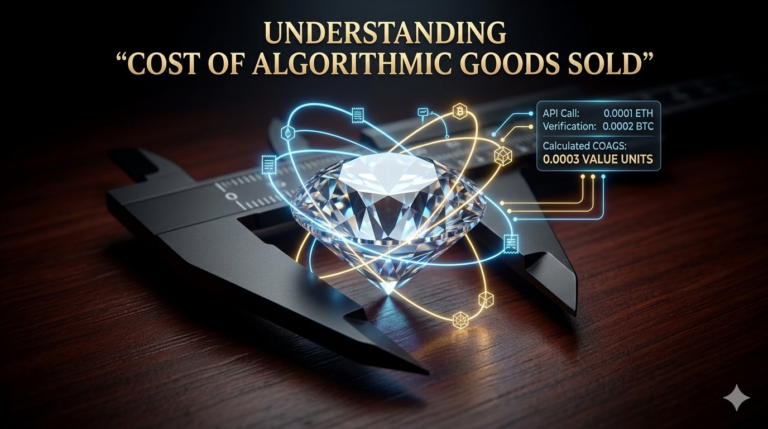
From a business perspective, this isn’t just a lost click; it is a direct hit to your Gross Margin Return on Investment (GMROI). If you are paying for traffic—via PPC, social ads, or SEO efforts—every bounce is a leak in your unit-level economics. You are paying to acquire a lead, only to have them evaporate because your digital storefront failed to project the same level of prestige as a brick-and-mortar boutique.
The “Trust Gap” and the AI Era
The stakes for this “Trust Gap” are higher than ever because of Generative Engine Optimization (GEO).
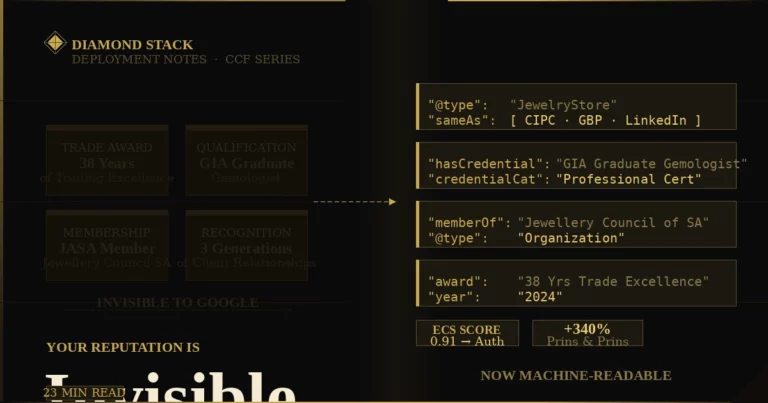
Modern AI assistants—like Gemini, Claude, and Perplexity—don’t just scan for keywords. They evaluate the entity authority of your site. If your product pages are generic, lacking clear entity data, and failing to provide verifiable information about your certifications (e.g., GIA reports), the AI will struggle to cite your brand as a trusted source.
If an AI cannot confidently confirm your authority, it won’t recommend you to the user. You become invisible in the very conversations that now drive high-intent luxury discovery. By failing to structure your site for machines, you are effectively choosing to remain anonymous to the future of search.
The 3-Minute Self-Audit
Take three minutes and look at your primary product page on your mobile device. If you cannot check all four boxes below, you have a Trust Gap:
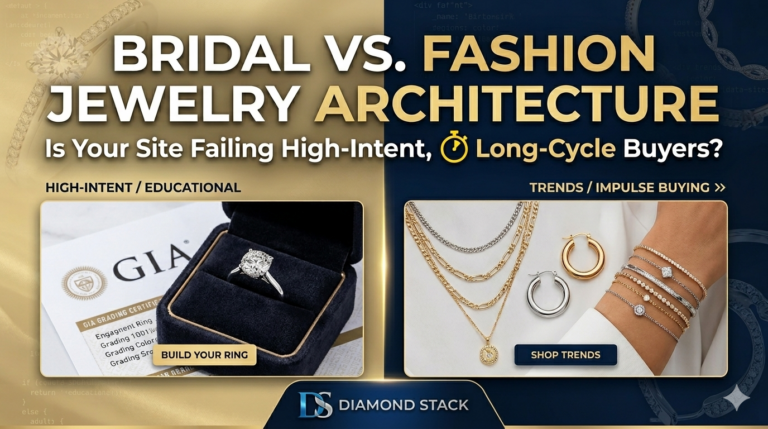
- The Certification Check: Are GIA/certifying body links or logos immediately visible, or are they buried in a “Specifications” tab that requires a click? If the AI can’t parse it, the customer likely won’t find it.
- The “Ruggedized” Entity Check: Does your JSON-LD schema explicitly define the item as a product with specific properties like diamondClarity, diamondColor, and caratWeight? Or are you relying on the AI to “guess” your product details from plain text?
- The Narrative Bridge: Does your product description explain why the craftsmanship matters, or is it a generic copy-paste from a supplier feed? Luxury requires context.
- The Speed-to-Elegance Ratio: Does your site load high-resolution imagery fast enough to remain engaging? If your cinematic video banner takes six seconds to load, you aren’t being “luxurious”—you are being a barrier to the sale.
Bridging the Gap
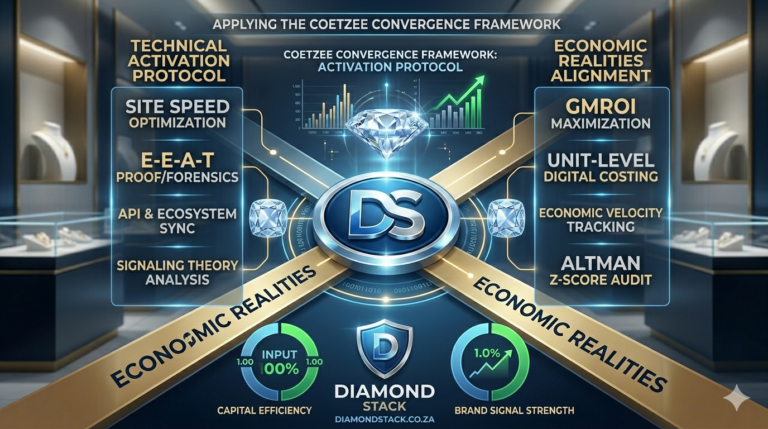
At Diamond Stack, we specialize in closing this gap. We don’t just optimize for search engines; we optimize for the entire digital experience—ensuring your technical architecture supports the prestige of your brand and the rigorous requirements of AI engines.
If you are ready to move beyond basic performance metrics and start building a digital infrastructure that actually converts, it’s time for a professional audit.
[Contact us today to review your technical infrastructure and start building for sustainable, high-authority growth.]