Beyond Traffic: Applying the Coetzee Convergence Framework to Your Jewelry Business
In the contemporary retail environment, the distinction between a thriving jewelry brand and one in a state of terminal decline often comes down to a single failure: the inability to align digital output with fundamental business economics. Most jewelry businesses obsess over vanity metrics—page views, impressions, and clicks—while ignoring the economic metrics that determine solvency and long-term viability.
To transition from a struggling entity to a market leader, you must move beyond tactical “web development” and adopt a strategic system for technical and economic alignment. This is the core premise of the Coetzee Convergence Framework.
The Framework: Technical and Economic Alignment
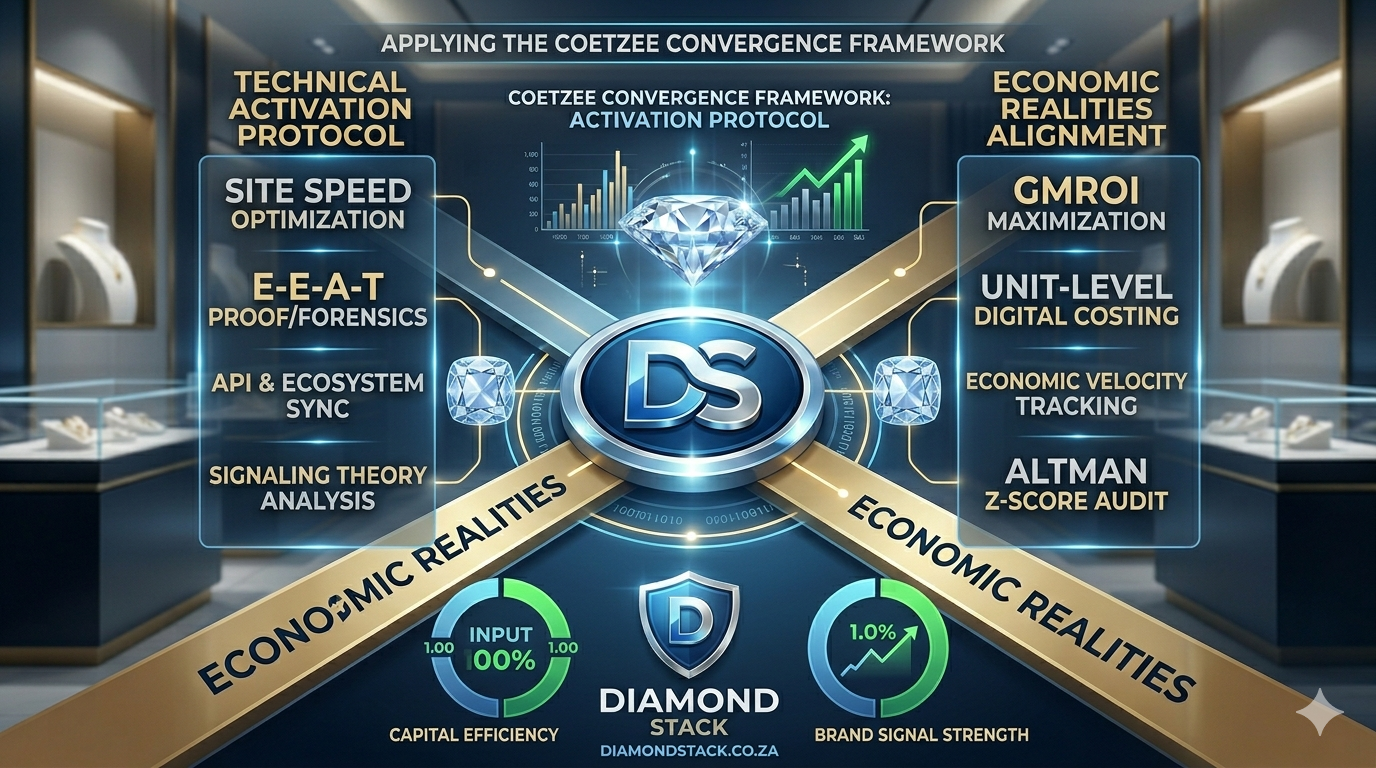
The Coetzee Convergence Framework is an activation protocol designed to bridge the gap between digital asset performance and core business management science. It treats your website not as a marketing expense, but as a core economic engine that must be calibrated to maximize capital efficiency and brand signal strength.
By integrating management science concepts—such as the Altman Z-Score for financial health and Gross Margin Return on Investment (GMROI)—into your digital operations, you transform your website from a passive display into a predictive growth machine.
The Core Pillars of Economic Velocity
To achieve true scale, the framework operates on three foundational pillars that govern how your digital assets interact with your market position:
- Signaling Theory: Your digital presence acts as a high-fidelity signal to the market. When your technical stack, E-E-A-T markers, and luxury positioning are misaligned, you send “low-trust” signals that damage your brand equity.
- Unit-Level Digital Costing: True growth is impossible without knowing the exact cost to acquire a customer in a specific category, such as bridal versus fashion, and understanding the lifetime value of that specific unit of business.
- Economic Velocity: This is the rate at which your assets—whether physical inventory or digital content—convert into realized cash flow. The framework optimizes for the fastest path between investment and liquidity.
The Strategic Advantage: Converting Assets into Drivers
Why should a jeweler care about the Altman Z-Score or complex unit-level costing? Because applying these metrics to your digital strategy allows you to build a “Brand Moat” that competitors cannot easily copy. It shifts the focus from “getting more traffic” to “maximizing the efficiency of every session.” When you treat your website as an economic driver governed by management science, you stop competing on price and start competing on business architecture.
Implementing the Framework
Your digital presence is a technical manifestation of your business’s economic health. If your systems are disconnected or your metrics are focused on the wrong objectives, you are effectively running your business blind.
At Diamond Stack, we utilize the Coetzee Convergence Framework to assist directors and stakeholders in aligning their technical infrastructure with their broader financial goals. We don’t just optimize for search; we optimize for economic survival and aggressive growth.
Is your jewelry brand’s digital infrastructure driving your financial bottom line?
Let’s initiate a Strategic Alignment Consultation to determine if your operations are positioned to leverage the Coetzee Convergence Framework for maximum capital efficiency. Click here to schedule your session with Diamond Stack.