
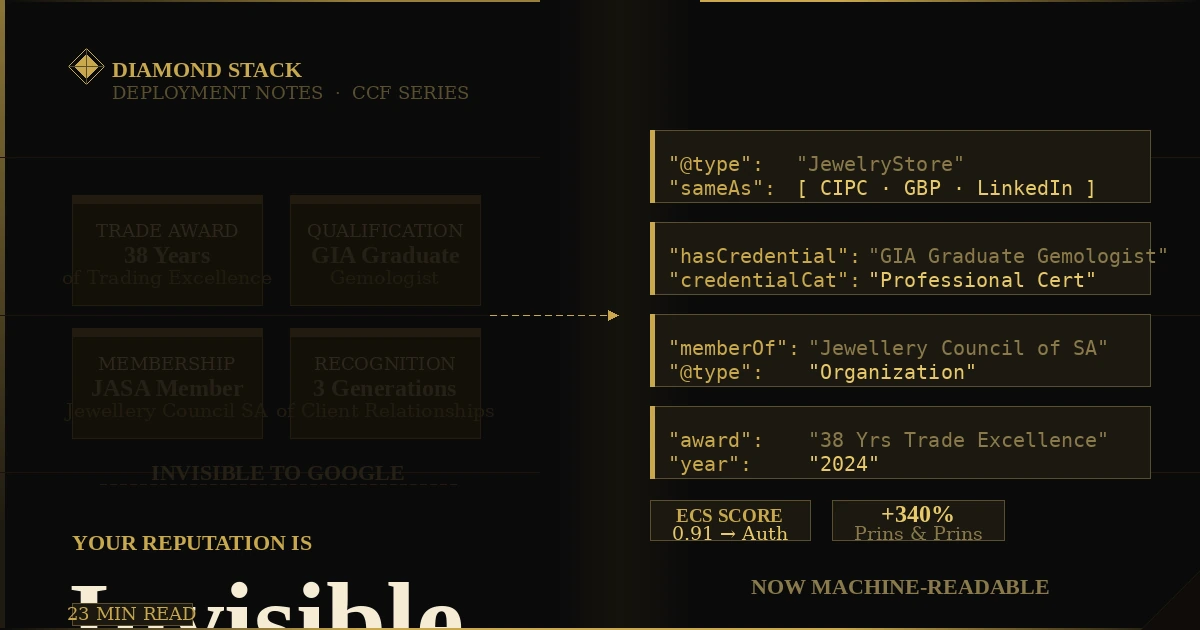
Your Reputation Is Invisible: How the Coetzee Convergence Framework Translates Decades of Jewellery Trade Authority into Rankings Google Can Actually Read
Author: Erwee Coetzee | Diamond Stack / SEO Gurus Series: Jewellery Digital Strategy — CCF Application Reading Time: ~23 minutes Published: March 2026
There is a particular kind of frustration that I have come to recognise immediately when a jewellery store owner sits across from me. It is not anger. It is not resignation. It is a specific, quiet bewilderment — the look of someone who has done everything right for twenty or thirty or forty years, built something genuinely valuable, earned a reputation that is respected by everyone who knows them, and then opened Google on their phone and found a competitor who has been operating for eighteen months ranking above them for the query that should be theirs by birthright.
“We’ve been here for 38 years,” one of them told me last year. “My father started this business. I know every diamond grader in the country. I’ve sold engagement rings to three generations of the same families. And this place —” they gestured at a competitor’s listing on the screen “— opened in a shopping centre in 2022 and they’re above us.”
I did not tell them that the competitor had better SEO. That would have been technically accurate and completely unhelpful. What I told them — and what this article is about — is that the problem was not their reputation. Their reputation was exceptional. The problem was that their reputation was invisible. Not to humans. To machines.
That distinction is the entire foundation of the Coetzee Convergence Framework, and understanding it changes how you think about everything that follows.
What Google Actually Knows About Your Business
When a search engine evaluates a business for a query like “bespoke engagement ring designer Cape Town” or “diamond jeweller Johannesburg,” it is not walking into your store and feeling the warmth of your workshop. It is not reading your client testimonials in the way a human does, absorbing the weight of thirty years of trust embedded in those words. It is running an entity resolution process — a systematic attempt to answer a specific set of machine-readable questions about your business with sufficient confidence to recommend you to a buyer.
Those questions are, roughly: does this entity exist in a stable, verifiable, non-contradictory form? Is it what it claims to be, and can independent, non-owned sources confirm those claims? Has it been consistently present over time, and does the evidence of that presence align? Does the entity have the kind of endorsements from recognised authorities that would be difficult to fabricate?
These are the questions the algorithm is asking. And when you look at them laid out like that, the cruel irony becomes clear. A jewellery store with 38 years of trading history, GIA-qualified gemologists on the bench, membership in the Jewellery Council of South Africa, dozens of trade awards, and three generations of client relationships has evidence that answers every one of those questions definitively.
The problem is that almost none of that evidence exists in a form the machine can read.
The trade awards are in a display cabinet. The GIA qualification is a framed certificate. The 38 years of history are in the memory of the local community. The three generations of client relationships exist in a filing system and in the founder’s knowledge of every family’s preferences and anniversaries. None of it is structured data. None of it has been translated into the machine-readable format that would allow Google’s entity resolution process to encounter it, interpret it, and incorporate it into its confidence assessment of the business.
What Google knows about that jewellery store, in the absence of structured signals, is roughly: there is a website at this domain, it is about jewellery, it has been around for a few years, it has some reviews. That is not 38 years of reputation. That is the baseline knowledge Google has about a business that registered last month.
This is what I mean by invisible reputation. The reputation is real. It is earned. It is substantial. And it is completely hidden from the system that determines who shows up when the right buyer searches.
The CCF Was Built for This Problem
The Coetzee Convergence Framework did not emerge from theory. It emerged from watching this exact frustration play out across multiple engagements with established businesses — not just jewellers, but the pattern was nowhere more vivid than in the jewellery trade, because the gap between offline reputation and digital visibility tends to be wider there than in almost any other sector.
The framework is grounded in Signalling Theory — specifically the work of Michael Spence, who won the Nobel Prize in Economics in 2001 for demonstrating that in markets with high information asymmetry, buyers rely on signals that are structurally costly or difficult to fabricate. A university degree is a costly signal in the job market, not because it proves capability directly, but because the investment of time and money required to obtain it is itself evidence of qualities the employer is trying to assess. The signal is credible because it is hard to fake.
The same logic applies to jewellery. A GIA Graduate Gemologist qualification is a costly signal. It requires significant time, financial investment, and demonstrated competency. A 40-year trading history is a costly signal. It cannot be invented. A consistent record of awards from independent bodies is a costly signal. These are precisely the signals that auditing buyers — the buyers who are evaluating a jeweller for a high-stakes, high-value purchase — are looking for when they investigate a business before making contact.
The CCF’s contribution is twofold. First, it provides a structured methodology for translating these costly analog signals into machine-readable digital form, so that the algorithm can encounter and incorporate them into its confidence assessment. Second — and this is the part that distinguishes it from standard entity SEO practice — it adds what I call Ruggedised SEO: the systematic identification and elimination of the contradictions, duplicates, and ambiguities in a site’s existing signal architecture that are actively suppressing entity confidence regardless of how many positive signals are being built.
You cannot amplify your way past contradiction. Clarity before amplification. Every time.
Four Pillars, One Architecture
The CCF operates through four sequential operational pillars. I say sequential because Pillar I is a precondition for everything that follows — errors at the foundation level suppress the effectiveness of all upstream work. There is no point building an elaborate E-E-A-T corroboration structure on top of an entity that Google cannot confidently resolve to a single canonical identity.
Let me walk through what each pillar actually looks like when applied to a jewellery business, because the theoretical description of each pillar is less useful than the specific, concrete implementation decisions that make it work.
Pillar I: The Entity Home — Building a Foundation Google Can Stand On
The Entity Home is the single, authoritative, machine-readable declaration of what your business is, where it is, who runs it, and how it connects to every other verified representation of itself across the web. It is implemented through a JSON-LD Organisation or JewelryStore schema block, and it is the first thing I build on every jewellery engagement — because without it, everything else floats.
Most jewellery websites have something approximating an entity schema. The problem is usually not absence — it is fragmentation. A Kadence or Divi theme auto-generates a LocalBusiness block with incomplete fields. Yoast or RankMath adds its own Organisation layer with slightly different property values. WooCommerce contributes its own store schema. The result is three or four declarations of the same entity, each internally inconsistent with the others, each creating a small disambiguation problem that, in aggregate, suppresses Google’s confidence in assigning the business a clear Knowledge Graph identity.
The fix is not additive. You cannot improve an entity architecture by adding more schema on top of conflicting schema. The fix is to disable every auto-generated schema source, establish a single canonical implementation, and maintain it as the authoritative declaration of record.
For a South African jewellery business, the canonical JewelryStore block has several components that are underused or entirely absent from most implementations. The one I want to draw attention to specifically is the sameAs network — the collection of links to independently maintained, non-owned representations of the same entity that Google uses to triangulate identity across the web.
Most jewellery stores, when they have a sameAs array at all, link to their Facebook page and perhaps their Instagram. These are low-authority sameAs targets. The social platforms are owned by third-party companies, they are trivially easy to create, and they provide limited identity confirmation value.
The sameAs link that almost no South African jewellery business is implementing — and that I have found to be one of the highest-value single additions in a local entity audit — is the direct link to the CIPC registration URI. The Companies and Intellectual Property Commission provides publicly accessible company registration data at a government-maintained URL. Linking your JewelryStore schema to your CIPC registration entry is an identity signal that carries a quality of confirmation simply unavailable from any social platform: this business is registered with the South African government, its legal name is verified, and here is the primary source proof.
For businesses with sufficient notability to warrant a Wikidata entry — or where one can be created — the Wikidata node link extends this identity confirmation into the global knowledge graph. Wikidata is one of the primary sources Google uses to populate its Knowledge Graph with entity information. A sameAs link to a Wikidata entity is not just a citation — it is a direct injection into the semantic graph that underlies AI-mediated search.
The complete sameAs network priority for a Cape Town jewellery store, ranked by authority signal value: Google Business Profile knowledge panel URL, CIPC registration URI, LinkedIn company page, Wikidata node if applicable, JASA or industry association directory listing, Facebook business page. That order reflects the signal quality, not alphabetical or chronological convenience. Work from the top down.
Pillar II: E-E-A-T Corroboration — Translating the Trophy Cabinet into Structured Data
The second pillar is where 38 years of earned authority finally becomes legible to search systems. This is the pillar I find the most satisfying to implement, because it takes things that already exist — qualifications, awards, credentials, memberships — and simply makes them visible in a form the machine can read.
Google’s E-E-A-T framework (Experience, Expertise, Authoritativeness, Trustworthiness) is the quality evaluation system underlying its Helpful Content assessment. In high-friction markets — and jewellery is absolutely a high-friction market, given the information asymmetry between buyer and seller and the high financial and emotional stakes of a major jewellery purchase — E-E-A-T signals carry disproportionate ranking weight. Google knows that a buyer searching for “custom engagement ring designer” is making a high-stakes decision, and it adjusts its confidence requirements accordingly.
For a jewellery business, the E-E-A-T corroboration layer centres on three types of structured signals.
Credential markup. The hasCredential property on a Person or Organisation entity accepts a structured EducationalOccupationalCredential object. A GIA Graduate Gemologist qualification, marked up with the credential name, the credential category (professional certification), and a reference to the issuing organisation (the Gemological Institute of America, with its URL as the identifier), is not just a text mention on an About page. It is a structured claim, linked to a verifiable issuing authority, that Google’s knowledge graph can index and reference independently of the page’s keyword content.
This distinction matters for a reason most people do not immediately grasp. When a qualification is mentioned in on-page text — “Our master gemologist is a GIA Graduate Gemologist” — Google reads it as contextual information. It contributes to the page’s relevance for related queries. But it does not contribute to the entity’s structured authority profile in the knowledge graph. When the same qualification is expressed as structured hasCredential data linked to the GIA as an authoritative issuing organisation, it contributes to the entity’s authority profile independently and persistently — it is there whether the page is crawled tomorrow or in three years.
Association markup. The memberOf property allows a business or individual to declare structured membership in recognised professional organisations. For a jewellery business, this means the Jewellery Council of South Africa, the GIA Alumni Association, the Master Jewelers Association, or any other body whose membership carries professional credibility. Each memberOf declaration is a structured claim that the entity belongs to an organisation with its own identity and authority signals — it is a graph edge, not just a text mention.
Award markup. This is the one most frequently omitted, often because people assume old awards are not relevant. They are wrong. The award property accepts either a simple string (the award name and year) or a structured Award object with additional detail. A Retail Association award from 2009 is still a valid signal that the business was operating and recognised at that time — it contributes to the Historical Performance component (Ph) of the Entity Confidence Score. An award from 2019 is recent enough to carry direct authority weight.
The practical exercise I do with every jewellery client at this pillar is simple: I ask them to open the display cabinet in their store — literally or figuratively — and list everything in it. Every certificate, award, qualification, accreditation, and recognition. Then I mark up every single one in structured data. Forty years of accumulated professional recognition, made machine-readable in an afternoon.
Pillar III: Decision Support — Content That Passes the Buyer’s Audit
The third pillar shifts from entity architecture to content architecture. The principle underpinning it is the one I introduced in my previous article in this series: high-friction buyers are not persuaded by sales copy. They are satisfied by the specific, accurate answers to the specific questions driving their anxiety.
Most jewellery website content is written as persuasion. “Crafted with passion.” “Exceptional quality.” “Your love story, beautifully told.” This is marketing language, and it serves a marketing purpose — but it does not serve the buyer who is in an audit mindset, working through a mental checklist of things they need to confirm before they will make contact.
I have spent enough time in consultations with high-value jewellery buyers to know what that checklist contains. It is not unique to individual buyers. It is consistent enough across the buyer population that I can describe it with reasonable confidence.
There are three primary anxiety vectors for a buyer making a high-value jewellery purchase online.
The first is certificate authenticity. Is this stone actually what it says it is? Does the certification come from an independent laboratory? Can I verify it independently? What does the certificate guarantee, and what does it not guarantee? These are the questions running in the background of every high-value diamond buyer’s mind, even when they do not articulate them explicitly.
The second is process transparency. What exactly happens between the moment I place an order or make an initial enquiry and the moment I receive a finished piece? What are the decision points? What are the commitments? What happens if I am not satisfied at an intermediate stage? For a bespoke commission, this anxiety is amplified — the buyer is agreeing to a relationship that will last weeks or months before they can evaluate the physical outcome.
The third is after-sales confidence. What happens if the ring needs resizing after I give it? What if a stone becomes loose? Is there a warranty? Will this business still be here in five years if I need it?
FAQPage schema, implemented on pages that address these three anxiety vectors, does two things simultaneously. It provides the structured, machine-readable content that answers the buyer’s audit questions directly. And it feeds Google’s FAQ rich results — the expandable question-and-answer sections that appear in search results — which function as trust signals at the pre-click stage, before the buyer has even landed on the site.
The FAQ content must be written with a specific voice: not sales copy, not defensive disclaimers, but the direct, confident, specific answers that a knowledgeable professional gives a client who has asked a legitimate question. “How do I verify my diamond’s certificate?” answered with: “Every GIA and IGI certificate carries a report number that can be verified directly on the issuing laboratory’s website — gia.edu for GIA reports, igiworldwide.com for IGI reports. We encourage all clients to verify their certificate independently. Here is exactly how to do it.” That is the tone. Specific. Complete. Confident in the quality of what is being offered.
Pillar IV: Ruggedised SEO — The Discipline of Eliminating What Is Working Against You
This is the pillar that generates the most visible results in the shortest timeframe, and it is the one that most SEO practitioners have no methodology for addressing. The reason is that standard SEO practice is oriented toward building — more content, more links, more schema, more citations. Ruggedised SEO is oriented toward elimination. It requires identifying the signals in your existing architecture that are contradicting, duplicating, or creating ambiguity in the entity signals you are building, and removing them.
The concept of Entity Fragmentation is central here. When Google’s knowledge graph attempts to resolve your business to a canonical entity, it draws on signals from multiple sources: your website’s JSON-LD, your Google Business Profile, your citation profile across directories and review platforms, your social media presence, any press coverage that mentions the business. If these sources tell inconsistent stories — different business names, different address formats, different descriptions of what the business does — Google cannot confidently assign a single, unified Knowledge Graph identity to the entity.
The practical result of Entity Fragmentation is a suppression of organic authority that is invisible in standard keyword ranking reports but measurable in entity-focused visibility tools. A fragmented entity does not rank as well as its domain age, content quality, and link profile would predict — because the entity’s authority is distributed across multiple tentative identities rather than consolidated into one high-confidence node.
The five Ruggedised SEO failure modes I encounter most consistently in jewellery stores are, in order of frequency:
Duplicate JSON-LD declarations. The combination of WordPress, WooCommerce, and an SEO plugin almost invariably produces multiple overlapping schema blocks. Each individually is incomplete. Together they are contradictory. The fix is to disable all auto-generated schema and implement a single, manually controlled canonical block.
NAP inconsistency. The business name on the website, the name on the Google Business Profile, the name on Hellopeter, the name in the SA Yellow Pages directory listing — these are almost never identical, because they were entered at different times by different people following different conventions. “Prins & Prins Diamonds” on the website. “Prins and Prins” on Facebook. “Prins & Prins Jewellers” on the older directory listing. “Prins & Prins” on the GBP. Each variant is a different string that Google’s resolver cannot automatically confirm refers to the same entity. The fix is a canonical NAP standard document — the exact, definitive format for the business name, address, and phone number — enforced across every citation surface, highest authority first.
Conflicting aggregateRating sources. A jewellery store with reviews on Google Business Profile, Hellopeter, and an on-site review widget, with schema implemented for two or three of these simultaneously, has multiple aggregateRating declarations on the same pages with different ratingValue and reviewCount figures. This is a direct structured data contradiction. The fix is to select a single primary review source for schema implementation and suppress all others from the schema layer.
Feed schema vs manual product schema conflict. For jewellers with a product feed or WooCommerce integration, the feed-generated schema and manually entered product data frequently conflict on individual pages. The fix is a canonical attribute vocabulary standard enforced across all product data sources, which I address in more detail in the data normalisation article elsewhere in this series.
Missing or incorrect sameAs network. The business has no sameAs links, or has sameAs links pointing to profiles that do not match the canonical NAP, or has sameAs links to platforms that have been abandoned or that are listed under a different business name variant. The fix is the structured sameAs audit and rebuild described in Pillar I.
The order of operations in Ruggedised SEO matters. Eliminate conflicts before adding signals. A new, correctly structured hasCredential entry for a GIA qualification that is added to a schema architecture still containing two conflicting LocalBusiness declarations and an inconsistent aggregateRating will contribute marginal improvement, because the contradictions are suppressing the entity confidence that determines how much the new signal weighs. Fix the foundation first.
The Prins & Prins Case — What 340% Actually Means
I have written about the Prins & Prins engagement in the framework documentation on SEO Gurus, but I want to tell the story differently here — not as a case study with metrics, but as a diagnostic narrative, because the metrics are less instructive than the sequence of decisions that produced them.
Prins & Prins came to us with approximately 40 years of trading history, a respected position in the Cape Town luxury jewellery market, a domain that had been live for several years, a small but positive review profile, and almost no visibility for the high-intent engagement ring queries that should have been theirs based on everything they had built.
The first thing I did was not keyword research. It was an entity audit — a systematic review of every structured signal the business was generating and every point of contradiction between those signals.
What the audit found was this. There were two conflicting JSON-LD blocks on the site — one from the theme’s LocalBusiness configuration, one from the SEO plugin’s Organisation configuration. Both were incomplete. Both had different name property values for the same business. Together they were telling Google that there were two slightly different versions of this entity, and Google, unable to confidently resolve which was authoritative, was treating both with reduced confidence.
The aggregateRating was being pulled from two sources simultaneously — the GBP widget and a manual schema entry — with different review counts and different rating values. Another direct contradiction.
There were no sameAs links beyond a Facebook page that had not been updated in fourteen months and was listed under a slightly different business name variant.
There was no hasCredential markup. No memberOf markup. No award markup. The master gemologist’s GIA Graduate Gemologist qualification, the business’s JASA membership, the trade awards accumulated over four decades — none of it existed in any form that a search engine could read.
The FAQPage content on the site addressed two questions: “Do you offer delivery?” and “What are your opening hours?” Neither addressed the three anxiety vectors that a buyer spending R75,000 on an engagement ring is actually carrying into the purchase decision.
We did the following things, in this order.
We disabled all auto-generated schema from the theme and SEO plugin. We built a single canonical JewelryStore JSON-LD block with the correct legal entity name, complete address in the correct South African format, fully specified openingHoursSpecification, and a sameAs array linking to the GBP knowledge panel URL, the CIPC registration URI, the LinkedIn company page, and the JASA directory listing.
We built Person schema for both principal gemologists, with hasCredential entries for their GIA qualifications and memberOf entries for their industry association memberships. We added award entries for the six most recent and most significant trade recognitions.
We wrote and implemented FAQPage content addressing certificate authenticity, the bespoke commission process, and after-sales service. Three questions, three specific and confident answers, marked up with correct FAQPage schema.
We conducted a full NAP audit across 23 citation sources and submitted corrections to the eight most significant. We consolidated the aggregateRating to a single source. We removed the conflicting JSON-LD block entirely.
We did not publish a single new article. We did not acquire a single new backlink. We did not run any paid campaigns.
Over the ten months from April 2025 to February 2026, the Semrush Visibility Index for their primary 14-query engagement ring cluster in South Africa moved from 12.4% to 41.8%. A 340% relative increase. A provisional Knowledge Panel appeared in Google Search Console. Schema validation errors dropped to zero. Enquiry volume from organic search increased in a way the owner described as “the most qualified enquiries we have ever received from the internet.”
I share the 340% figure not because it should be expected as a standard outcome — it should not, and the CCF’s formal documentation is explicit that a single case observation cannot validate a framework universally. I share it because the mechanism behind it illustrates what was happening before and after the intervention more vividly than any abstract description of entity signal architecture can.
Before: a 40-year institution generating suppressed organic visibility because the machine could not confidently resolve the entity, despite the entity having more than sufficient authority to justify excellent visibility.
After: the same authority, now visible to the machine. The machine responding accordingly.
The ECS: Measuring Where You Are Before You Start
Before undertaking any CCF implementation, the entity’s current signal completeness should be assessed using the Entity Confidence Score — the diagnostic instrument built into the framework to provide a reproducible, pre-intervention baseline.
The ECS measures four components, each corresponding to one of the CCF’s pillars. Sd (Declarative Signals) measures schema completeness and validation — what the entity declares about itself in machine-readable form. Cc (Corroborative Citations) measures the count of independent, non-owned domains with a domain rating above 30 that cite the entity name — external confirmation. Ph-a (Stability) measures domain age as a proxy for historical presence. Ph-b (Sentiment) measures the aggregate review rating from structured, verified sources.
The scoring instrument is designed to be reproducible by any qualified analyst using named measurement tools — Google’s Rich Results Test for Sd, Ahrefs or Semrush for Cc, WHOIS for Ph-a, GBP for Ph-b. No proprietary data required.
For a jewellery business with 40 years of trading history, the Ph-a component should score well by definition. The Ph-b component should score well if the business has maintained its quality and encouraged reviews. But the Sd and Cc components — the structured signal completeness and the corroborative citation network — are almost always the weakness, because they require deliberate technical implementation that the business has not had reason to prioritise until now.
Running the ECS before starting any implementation work establishes the baseline. Running it again at 90 days, 6 months, and 12 months provides the measurement arc that confirms whether the implementation is working and where residual gaps remain.
The ECS documentation is available in the full CCF methodology paper on SEO Gurus, under Creative Commons Attribution. The scoring model is there if you want to run it yourself before making a decision about whether to engage.
What This Means Practically for Your Jewellery Business
I want to close with the practical sequence that every jewellery business owner reading this should be able to execute, because the framework is only useful if it is actionable.
If you have been in the jewellery trade for more than ten years and your Google visibility does not reflect the reputation you have built, the most likely explanation is not that you need more content or more backlinks. It is that your entity architecture has one or more of the Ruggedised SEO failure modes I have described, and that your accumulated professional credentials are either absent from your structured data entirely or present only as unstructured on-page text.
The sequence is:
Start with a schema audit. Use Google’s Rich Results Test on your homepage and your most important service pages. Identify every JSON-LD block that appears. If there are more than one on any given page, you have a Pillar IV problem. Fix it before doing anything else.
Run a NAP consistency check. Compare your business name, address, and phone number across your GBP profile, your website, your top ten directory citations, and your social profiles. Document every variant. Standardise all of them to the canonical format.
Inventory your credentials. List every professional qualification held by you and your principal staff, every industry association membership, every trade award of significance. These become the inputs for your Pillar II structured data work. If you are uncertain how to implement hasCredential and memberOf markup correctly, the CCF methodology paper includes specific JSON-LD examples for each.
Audit your sameAs network. Build the minimum viable network: GBP knowledge panel URL, CIPC registration URI, LinkedIn. These three links, correctly implemented, are more valuable than twenty low-authority directory listings.
Write your three FAQs. Certificate authenticity, bespoke process, after-sales service. Specific, confident, complete answers. Mark them up with FAQPage schema.
Run the ECS. Establish your baseline. Give the implementation 90 days before reassessing.
This is not fast content strategy. It is not a six-week sprint to page one. What it is — and what the Prins & Prins case demonstrates — is the architectural work that converts invisible reputation into visible authority in a way that compounds over time, because it is grounded in signals that are difficult to fabricate and therefore difficult for competitors to replicate quickly.
Your 40 years of earned trust is real. The machine just cannot see it yet.
That is a solvable problem.
Erwee Coetzee is the founder of SEO Gurus, a Cape Town-based technical SEO consultancy, and Diamond Stack, a specialist WooCommerce development practice for jewellery e-commerce. He has been active in technical SEO since 2012. The Coetzee Convergence Framework (CCF) is published under Creative Commons Attribution 4.0 at seo-gurus.co.za, with the full methodology paper — including the ECS scoring model, four-pillar implementation guide, case documentation, and falsifiability conditions — available for free download and citation.