The AI Agent Is Already Buying Diamonds: What Live Feed Operators Need to Know Before the Human Gets Involved
Author: Erwee Coetzee | Diamond Stack / SEO Gurus Series: Diamond Feed Integration — CLP Application Reading Time: ~23 minutes Published: March 2026
There is a moment in every diamond retailer’s first feed integration that feels like a triumph. The Nivoda connection is live. The stones are populating. Forty thousand carats of inventory, updating every four hours, sitting on a WooCommerce storefront that two weeks ago was showing a handful of manually entered products. The developer sends a final sign-off email. The store owner refreshes the catalogue page and watches the diamonds load.
It feels, in that moment, like the hard work is done.
I have been in enough of those conversations, and enough of the conversations that follow six months later, to know that the hard work has barely started. The feed being connected is not the architecture being correct. The diamonds being visible is not the same as the diamonds being discoverable. And discoverable in 2026 does not mean the same thing it meant in 2022.
Something has changed in how buyers find and select diamonds online. It has been changing gradually for two years, and it is now changing fast enough that the diamond retailers who are not building for it are already losing transactions they do not know they have lost. The change is this: an increasing proportion of diamond purchase journeys now involve an AI layer that executes part of the search and selection process before the human buyer consciously makes a comparison.
This article is about what that means for your feed integration, why most integrations are structurally unequipped for it, and what the correct architecture looks like when you build for the way diamond commerce actually works in 2026 rather than the way it worked in 2020.
The Buyer Who Is Not Browsing
Let me describe a buyer journey that is becoming more common, not less, with each month that passes.
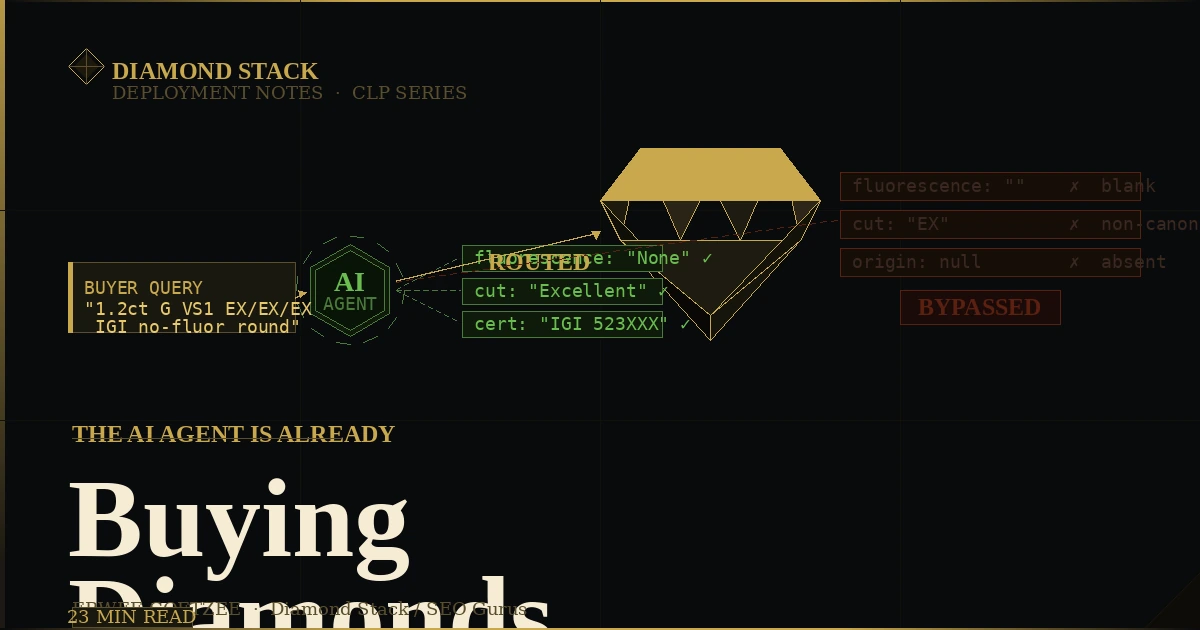
A buyer has done their research. They know what they want: a round brilliant, somewhere around 1.2 carats, G colour, VS1 clarity, excellent cut, no fluorescence, IGI certified. They have a budget. They have a deadline — a proposal planned for the end of the month. They open an AI-assisted search interface and they type, or they speak, something like: “Find me a round 1.2 carat G VS1 excellent cut IGI diamond with no fluorescence, in stock, delivery to Johannesburg within a week.”
They are not browsing. They are not beginning a research journey. They are issuing a structured query against the world’s available inventory, and they expect a structured answer. They want to know which merchants can fulfil this specification, at what price, and with what delivery confidence.
In a world where search is still primarily blue links and product carousels, this query would surface a set of results that the buyer would then evaluate manually. They would click through. They would compare. They would read descriptions. The ranking algorithm would determine whose inventory appeared at the top.
In a world where search is increasingly mediated by AI agents — and we are now in that world, earlier than most people expected — this query is being partially or wholly resolved by a system that does not browse. It evaluates structured data. It assesses attribute completeness. It ranks merchants not by their keyword relevance or their domain authority but by the confidence with which their inventory data answers the specific, Boolean questions embedded in the query.
Does this diamond exist? Is it the right cut? Is the colour confirmed as G? Is the clarity confirmed as VS1? Is the fluorescence confirmed as none — not assumed, not implied, but explicitly stated? Is it in stock right now? Can it be delivered to Johannesburg within seven days?
Every one of those questions is a Boolean gate. The answer is either a confirmed True, a confirmed False, or an ambiguous Unknown. And the system routing the buyer’s query treats Unknown the same way a cautious buyer treats it — as a reason to consider the next option.
This is the operating environment that the Coetzee Liquidity Protocol was built for. And it is the operating environment that most diamond feed integrations, built under the assumptions of two or three years ago, are not equipped to compete in.
Why Your Feed Is Not Saying What You Think It Is
I want to be specific about the mechanism of failure, because it is not the obvious one. Most diamond retailers looking at their feed integration think the question is: are my diamonds appearing in search? And the answer, for most of them, is yes — the diamonds are appearing. The Shopping feed is running. Google is indexing the products. Traffic is arriving.
The question they are not asking is: when my inventory appears in a structured data evaluation, how many of my diamonds return a confirmed True on every attribute that a specific buyer might use to filter their search?
The answer, for almost every integration I have audited, is: far fewer than the operator believes.
Here is why. When a diamond feed from Nivoda or RapNet populates a WooCommerce store through a standard integration, it pushes product data into WordPress’s native database structure — the wp_posts table for the product record and the wp_postmeta table for product attributes. Each attribute — cut grade, colour, clarity, fluorescence, table percentage, depth percentage, certificate number, and so on — is stored as a key-value pair in wp_postmeta. One row per attribute per product.
The problem begins with the data that is present in the feed itself. Live diamond feeds are not uniformly complete. Fluorescence is one of the most commonly absent attributes — some stones in the Nivoda catalogue have fluorescence graded, some do not. When the attribute is absent in the feed, the standard integration stores nothing. The wp_postmeta row for fluorescence does not exist for that stone. The product page has no fluorescence data. The Product schema on that page has no fluorescence property.
When an AI agent evaluating that product page asks “does this diamond have no fluorescence?”, the answer it receives is not “no fluorescence.” It is silence. And silence, in a structured data evaluation, is not the same as “none.” Silence means the attribute is unknown. Unknown means the agent cannot confirm a Boolean True on a query that specified no fluorescence. The agent routes to a competitor whose fluorescence field explicitly says “None.”
That competitor may have fewer diamonds. They may have higher prices. They may have a less established brand. But they answered the question. And in a routing environment, answering the question beats everything else.
The Vector Distance Problem
I want to explain the underlying mechanism in more depth, because understanding it changes how you think about data completeness from a nice-to-have into a hard commercial requirement.
Large language models — the AI systems that underpin the search agents, AI Overviews, and shopping assistants that are increasingly mediating buyer journeys — do not evaluate product pages the way a human reader does. They convert the content of every page they encounter into a mathematical representation called a vector embedding. Think of this as placing each page at a specific location in an enormous multidimensional space, where the position of the page reflects its semantic content across hundreds or thousands of dimensions simultaneously.
When a buyer’s query arrives — “1.2 carat G VS1 excellent cut IGI no fluorescence round diamond” — the system converts that query into its own vector representation and then measures the distance between the query vector and every product page vector in its index. Pages that are semantically close to the query — pages whose content closely matches what the query is asking for — are ranked as high-confidence matches. Pages that are semantically distant are ranked lower or excluded entirely.
Here is the crucial point: a blank fluorescence attribute does not produce a neutral distance from “no fluorescence.” It produces a greater distance than an explicit “None” value would produce. This is because the semantic model, trained on vast amounts of human-generated text, understands that an absent attribute represents genuine uncertainty — and it places uncertainty at a greater semantic distance from a specific, explicit attribute value than it places an explicit negative confirmation.
In plain terms: a product page that explicitly says “Fluorescence: None” is closer, in vector space, to the query “no fluorescence diamond” than a product page that says nothing about fluorescence at all. Both pages might have identical diamonds. But the one that answered the question is semantically closer to the query that asked it. It wins the routing decision not because it has a better diamond, but because it has better data about the same diamond.
Multiply this across 22 attributes for 40,000 stones and the commercial consequences become significant. A store with 92% attribute completeness — which sounds excellent — has approximately 3,200 stones with at least one blank attribute. Those 3,200 stones are each, on at least one attribute, returning an uncertain response to queries that specify that attribute. At a conversion rate of even 0.5% and an average order value of R80,000, the revenue impact of that 8% incompleteness compounds rapidly.
The Resilience Floor: The Question Nobody Asks Until the Feed Goes Down
In February 2026, Google Merchant Centre experienced a disruption that affected feed processing for an extended period — for some merchants, this extended to approximately eleven days. Diamond retailers whose only path to inventory discoverability was through the Shopping feed discovered that their visibility did not decline gradually. It fell off a cliff. Diamonds that had been appearing in Shopping results, in AI-mediated search responses, and in price comparison surfaces simply disappeared from those surfaces for the duration of the disruption.
The merchants who survived this without material revenue impact were the ones who had built what I call a Crawlable Shadow — a complete, independently maintained structured data layer on every product detail page that mirrored all feed attributes as Schema.org Product markup, rendered in the initial HTML response so that Google’s organic crawler could index it independently of the Shopping feed infrastructure.
When the feed went dark and buyers reverted to organic search — typing specification queries into Google’s standard search interface rather than using Shopping or AI-mediated discovery — these merchants’ product pages appeared in organic results because their structured data was complete and indexed. The organic specification query traffic for many of them increased by approximately 300% during the disruption, as users who found Shopping surfaces empty discovered that organic blue-link results were still returning relevant product pages.
The merchants without a Crawlable Shadow saw their organic specification query traffic remain essentially flat during the same period, because their product pages had no independently indexed structured data that could satisfy a specification query. The organic crawler had nothing to work with.
This experience is what I call the Resilience Floor test — and it is the first gate in the Coetzee Liquidity Protocol’s Search Confidence formula. The formula is: if the Resilience Floor equals one, Search Confidence equals the product of Liquidity, Attribute Certainty, and Trust Floor, multiplied by Buyer-Goal Fit and Economic Viability. If the Resilience Floor equals zero, Search Confidence equals zero. The whole formula collapses to nothing.
The Resilience Floor is binary. You have it or you do not. And you will not know whether you have it until the feed goes down.
Building the Crawlable Shadow: What It Actually Requires
The Crawlable Shadow sounds straightforward. Build complete Product schema on every diamond PDP and make sure Google indexes it. The implementation is more specific than it sounds, and two details in particular are the difference between a Crawlable Shadow that works and one that merely appears to exist.
The first detail is render timing. Schema injected via JavaScript — added to the page by a script that executes after the initial HTML response is delivered — does not contribute reliably to Google’s crawled understanding of the page. Googlebot’s crawler operates a two-pass system: a fast first pass that captures the initial HTML response, and a slower second pass that executes JavaScript for pages that warrant it. The fast first pass is what determines whether a page’s structured data is included in Google’s index for specification query matching. If the Product schema only appears after JavaScript execution, it may or may not be captured in the fast first pass. It may or may not be indexed. You cannot rely on it for Crawlable Shadow purposes.
The correct implementation is server-side schema generation — the full JSON-LD block for every diamond PDP is written into the initial HTML response by PHP before the page is served to any requester, including Googlebot. This requires a custom schema template that reads from the diamond’s database record at page render time and outputs the complete structured data block as part of the page’s HTML, not as a post-load script injection.
The second detail is the database architecture that makes this possible at scale. Standard WooCommerce diamond feed integrations push all product data into the wp_postmeta table. At 40,000 diamonds with 20-plus attributes each, this creates upwards of 800,000 rows in wp_postmeta. When PHP needs to read all the attribute data for a specific diamond to generate the Crawlable Shadow schema at page render time, it is running a query against a table with 800,000 rows using a key-value lookup structure that was not designed for this query pattern.
The result is a Time to First Byte — the time from when a browser or crawler requests a page to when the first byte of the response is delivered — that routinely exceeds two, three, or four seconds on diamond product pages under these conditions. Googlebot’s crawler has a patience threshold of approximately five seconds for most pages. A page that consistently takes three to four seconds to respond is right on the edge of that threshold, and under load — when multiple crawlers or real users are simultaneously requesting pages — it will frequently exceed it. The crawler abandons the request. The page is not crawled. The Crawlable Shadow is not built.
The architectural solution is to bypass wp_postmeta entirely for diamond data, implementing a custom database table with dedicated columns for each diamond attribute and appropriate indexes on the most frequently queried columns. A query against a dedicated, properly indexed table with 40,000 rows returns in under 50 milliseconds on modest hardware. TTFB on diamond product pages drops below 200 milliseconds. The crawler completes every request. The Crawlable Shadow is built reliably and completely. This is not a performance optimisation in the conventional sense — it is the architectural precondition for the Resilience Floor to function.
The 22 Attributes: What Boolean True Actually Requires
The attribute completeness standard that I apply to every diamond feed integration audit is built around 22 properties that a buyer — or an AI agent acting on a buyer’s behalf — might use to filter or confirm a diamond selection. The standard Schema.org vocabulary does not have native properties for most of these attributes. The correct implementation uses the additionalProperty and PropertyValue pattern to inject them as structured, machine-readable data regardless of whether Schema.org has a dedicated property for them.
The 22 attributes are: carat weight, cut grade, colour grade, clarity grade, polish, symmetry, fluorescence, table percentage, depth percentage, culet, girdle description, length in millimetres, width in millimetres, depth in millimetres, length-to-width ratio, certificate laboratory, certificate number, country of origin, conflict-free status, laboratory-grown declaration where applicable, 360-degree video availability, and image count.
Every single one of these must return an explicit, confirmed value — or an explicit “None” or “Not Applicable” where the attribute does not apply — for the stone to pass what I call the Boolean True standard. An absent attribute fails the standard. An ambiguous or inconsistent value fails the standard. The stone is not invisible — it exists in the index — but it is not confidently routable for queries that specify that attribute.
Two of these deserve specific attention because they are the most frequently problematic.
Fluorescence, as I have already described, is the most commonly absent attribute in live diamond feeds. But the solution is not simply to add a fluorescence field and populate it with whatever the feed says. The solution requires understanding what “None” actually means in the context of diamond grading. For a GIA-graded natural diamond, fluorescence is always assessed and always reported. If the GIA certificate shows no fluorescence grade, it means the stone was assessed and found to have no fluorescence. The correct value to store and display is “None” — explicitly — not a blank field. The blank field says the assessment was not done. The explicit “None” says it was done and the answer is confirmed absence.
The laboratory-grown declaration is the second critical attribute, and it has a compliance dimension beyond its commercial importance. The United States Federal Trade Commission’s updated guidelines require that laboratory-grown diamonds be clearly identified as laboratory-grown, laboratory-created, or man-made. This requirement applies to product pages. Many LGD stores have this disclosure in on-page text but absent from their Product schema — meaning the structured data representation of the product, which is what AI systems read, does not confirm the laboratory-grown status. A buyer using an AI agent to search for “lab grown 1.2 carat G VS1” will not receive a high-confidence match from a product whose schema describes it only as “1.2 Carat G VS1 Round Diamond” without the laboratory-grown declaration as a structured attribute. The schema and the page copy must agree, and both must be explicit.
The Moving Taxonomy: Staying Ahead of What Marketplaces Will Standardise Next
One of the most underappreciated competitive dynamics in diamond e-commerce is the relationship between independent specialists and large marketplace platforms on the question of attribute standards. When a niche attribute — one that sophisticated buyers use to filter but that no feed standard yet mandates — becomes common enough that marketplace analytics teams can see it driving transaction behaviour, those teams begin adding it to their category schema. Within twelve to eighteen months of that detection, the attribute is standardised across the marketplace’s product data requirements. At that point, the attribute ceases to be a differentiator and becomes table stakes.
The Coetzee Liquidity Protocol calls this the entropy signal — the observable indication that a niche attribute is being absorbed into mainstream commerce infrastructure. The response it prescribes is the Moving Taxonomy: the discipline of continuously extending attribute depth faster than marketplaces can standardise the attributes you have already implemented.
In diamond commerce in early 2026, the attributes that are currently in the moving frontier — present in the inventory data of the most sophisticated independent retailers but not yet standardised in any major feed schema requirement — are primarily light performance data. ASET (Angular Spectrum Evaluation Tool) scores, Hearts and Arrows patterning documentation, and Ideal-Scope imagery are all attributes that a small but growing segment of the most technically informed diamond buyers use to evaluate cut quality beyond the standard GIA cut grade.
A round diamond graded “Excellent” by GIA spans a range of actual light performance. Within the “Excellent” grade, stones vary meaningfully in the degree to which they return light, minimise light leakage, and display the optical symmetry patterns that indicate a truly ideal cut. Buyers who understand this — and there are more of them every year, educated partly by the content that stores like Brian Gavin Diamonds and Whiteflash have published over many years — are searching not just for “Excellent cut” but for “Hearts and Arrows” or “ASET verified” or “ideal light performance.”
No major diamond marketplace currently requires ASET data or Hearts and Arrows documentation as part of their product schema. A specialist independent retailer who implements these as additionalProperty values on their diamond PDPs right now is building attribute depth that no marketplace listing can match for the next twelve to eighteen months. When a buyer or an AI agent searches for “Hearts and Arrows 1.2 carat G VS1 round,” only the retailers who have that attribute explicitly in their structured data will return a Boolean True.
The Moving Taxonomy is not about inventing attributes that buyers do not care about. It is about implementing, ahead of standardisation, the attributes that the most informed and highest-value buyers already use in their selection process. These are the buyers with the largest budgets and the highest conversion intent. They are the ones worth building for.
The Data Normalisation Problem That Sits Below All of This
Everything I have described — Boolean True requirements, Crawlable Shadow implementation, Moving Taxonomy — depends on the underlying data being consistent. And consistency is not the default state of a live diamond feed integration. It is something that has to be engineered deliberately, because the feeds themselves are not consistent.
Nivoda, RapNet, and VDB use different vocabulary for the same attributes. Cut grades are a clear example: Nivoda returns “Excellent,” RapNet returns “EX” for some stones and “Excellent” for others, and occasional legacy records in older feed systems use numeric scale values. When these different vocabulary representations populate the same WooCommerce store without normalisation, the Product schema on different product pages uses different values for the same GIA cut grade. An AI agent evaluating two different diamonds on the same store may find that one says “Excellent” and one says “EX” and treat them as different attributes — because in a vector embedding, “Excellent” and “EX” are not semantically identical strings.
The normalisation mapping is therefore not an administrative housekeeping exercise. It is the data layer on which the entire Attribute Certainty architecture depends. Every attribute value entering the system from every feed source must pass through a normalisation step that maps it to a single canonical vocabulary before it is stored. The canonical vocabulary I use, and that I recommend as the standard for any WooCommerce diamond integration, follows the GIA grading terminology — “Excellent,” “Very Good,” “Good,” “Fair,” “Poor” for cut grades, the GIA letter scale for colour, the GIA clarity grade abbreviations for clarity, and so on — because GIA terminology is the most widely recognised in the consumer market and the most semantically stable in AI-mediated search.
Certificate laboratory names require the same treatment. “GIA,” “G.I.A.,” “Gemological Institute of America,” and “GIA Certified” are four different strings that represent the same issuing authority. Without normalisation, a buyer searching for “GIA certified” may not confidently match a stone whose schema says “Gemological Institute of America.” Standardise to the official abbreviated form: GIA, IGI, GCAL, AGS, HRD. Every record, every feed source, every schema output.
Carat weight precision is a subtler issue but one with real consequences. A stone stored as 1.2 carats and displayed as “1.20ct” has a content-schema mismatch — the page says one thing and the schema says another. Google’s content-schema alignment check will flag this as a data quality inconsistency. The fix is trivially simple: store all carat weights with two decimal places in the database and output them with two decimal places in both the product schema and the displayed product content. But it requires that the database column definition uses the correct data type — DECIMAL(5,2) in MySQL — and that the normalisation mapping enforces two-decimal precision on every inbound carat weight value regardless of what precision the feed delivers.
These normalisation details are unglamorous. They are the kind of work that does not appear in a development brief because nobody thinks to include them, and they do not appear in a standard QA process because no QA checklist addresses diamond data vocabulary standards. But they are the foundation on which the entire Attribute Certainty architecture stands, and without them, the architecture is a veneer over data inconsistency that an AI agent’s evaluation process will see straight through.
The February Outage Lesson, Revisited
I want to return to the February 2026 Merchant Centre disruption one more time, not to belabour the point but because it illustrates something about the relationship between the Resilience Floor and the overall Search Confidence formula that I think is worth stating explicitly.
The Resilience Floor is a precondition, not a pillar. The formula’s design — if Rf equals zero, SC equals zero — is deliberate. It reflects the operational reality that a feed-dependent store without organic fallback is not merely vulnerable to disruption. It is structurally dependent on an infrastructure it does not control, operated by a company whose interests and operations are independent of its own. That dependency makes everything else in the architecture conditional. The best attribute data in the industry, the most complete Crawlable Shadow, the deepest Moving Taxonomy implementation — all of it becomes unavailable to buyers the moment the feed platform experiences a disruption.
The merchants who had the Resilience Floor in place before February 2026 did not build it because they predicted the disruption. They built it because the CLP’s architecture logic required it as a foundation. And when the disruption arrived, the foundation held.
The merchants who are building it now, after the disruption, are building it reactively. That is better than not building it at all. But the lesson I want the forward-looking diamond retailer to take from this is that the Resilience Floor is not an insurance policy against a known risk. It is the architectural decision that makes everything else you build on top of it reliable. Build it first. Then build everything else on it.
What the Correct Architecture Looks Like
Let me describe the complete architecture in sequence, because I think it is useful to see all the components together.
The foundation is the custom database layer. Diamond inventory data does not belong in wp_postmeta at any meaningful scale. A dedicated MySQL table with columns for every diamond attribute, indexed appropriately, is the infrastructure on which all other components depend. This is where the normalisation mapping lives — every incoming feed record is processed through the normalisation logic before it is written to the custom table. The result is a database of diamond inventory in which every record is in canonical vocabulary, every attribute is explicitly valued or explicitly null, and every query against it returns in under 50 milliseconds.
Above this sits the Crawlable Shadow layer. Every diamond PDP reads from the custom table at render time and outputs a complete JSON-LD block in the initial HTML response. The block includes all 22 standard attributes as additionalProperty values. It includes the Moving Taxonomy attributes — ASET data, Hearts and Arrows documentation — where the stone has them. It includes explicit “None” values where the graded attribute is confirmed absent. This block is served to every requester, including Googlebot, as part of the page’s initial HTML. It does not depend on JavaScript execution.
Above this sits the feed synchronisation layer. The Merchant Centre feed pulls from the same custom database table that the Crawlable Shadow uses. Feed attributes and on-page schema attributes are therefore identical, drawn from the same normalised source. There is no discrepancy between what the Shopping feed says about a diamond and what the PDP’s schema says. This is the condition that eliminates the content-schema mismatch failures I documented in my previous article on Ruggedised SEO.
Above this sits the user-facing filter interface. This is the component that most developers spend the most time on — the faceted search that lets buyers filter by cut, colour, clarity, carat, fluorescence, and certificate. It matters significantly for conversion. But it is the topmost layer of the architecture, and its performance depends entirely on the layers below it. A beautiful filter interface over a degraded wp_postmeta database will feel responsive in testing and collapse under real load. The same interface over a properly indexed custom table will maintain sub-100 millisecond query response times at 40,000 SKUs under simultaneous user load.
The architecture does not have to be built all at once. The sequence that I recommend is: custom database table first, then Crawlable Shadow, then feed normalisation, then filter interface. Each layer delivers compounding value as the next one is added. And the first layer — the custom database table — delivers immediate, measurable value in TTFB reduction even before the Crawlable Shadow is complete.
The Commercial Case, Made Simply
I am aware that this article has covered a significant amount of technical architecture. I want to close by translating it into the commercial terms that ultimately determine whether any of this gets built.
A diamond retailer with a correctly architected integration — custom database layer, complete Crawlable Shadow, normalised attribute data, Moving Taxonomy implementation — is operating with the following structural advantages over a competitor with a standard feed integration.
Their product pages load faster, which directly improves conversion rate and Google’s Core Web Vitals assessment of the site. Their attribute data is complete, which means more of their diamonds return Boolean True responses on specific buyer queries and AI agent evaluations. Their Crawlable Shadow provides organic search fallback that is independent of Shopping feed availability. Their normalised data produces consistent schema across every product, which eliminates the Ruggedised SEO failure modes that suppress entity confidence. And their Moving Taxonomy implementation gives them a window — twelve to eighteen months on current evidence — in which they are returning Boolean True responses on high-performance cut queries that no marketplace competitor can match.
None of this requires a larger diamond inventory. None of it requires lower prices. None of it requires a more recognisable brand. It requires better data architecture. And in a routing environment — where the first decision is made by a system that evaluates data quality before a human ever sees a result — better data architecture is the competitive moat that compounds while everything else stays the same.
The AI agent is already buying diamonds. The question is which stores it is buying them from.
Erwee Coetzee is the founder of SEO Gurus, a Cape Town-based technical SEO consultancy, and Diamond Stack, a specialist WooCommerce development practice for jewellery e-commerce. He has been active in technical SEO since 2012. The Coetzee Liquidity Protocol (CLP) is published under Creative Commons Attribution 4.0 at seo-gurus.co.za, with the full methodology paper — including the SC formula, five-pillar implementation guide, Specificity Threshold assessment, and Entropy Signal table — available for free download and citation. Diamond Stack’s live diamond inventory integration service is available at diamondstack.co.za.