
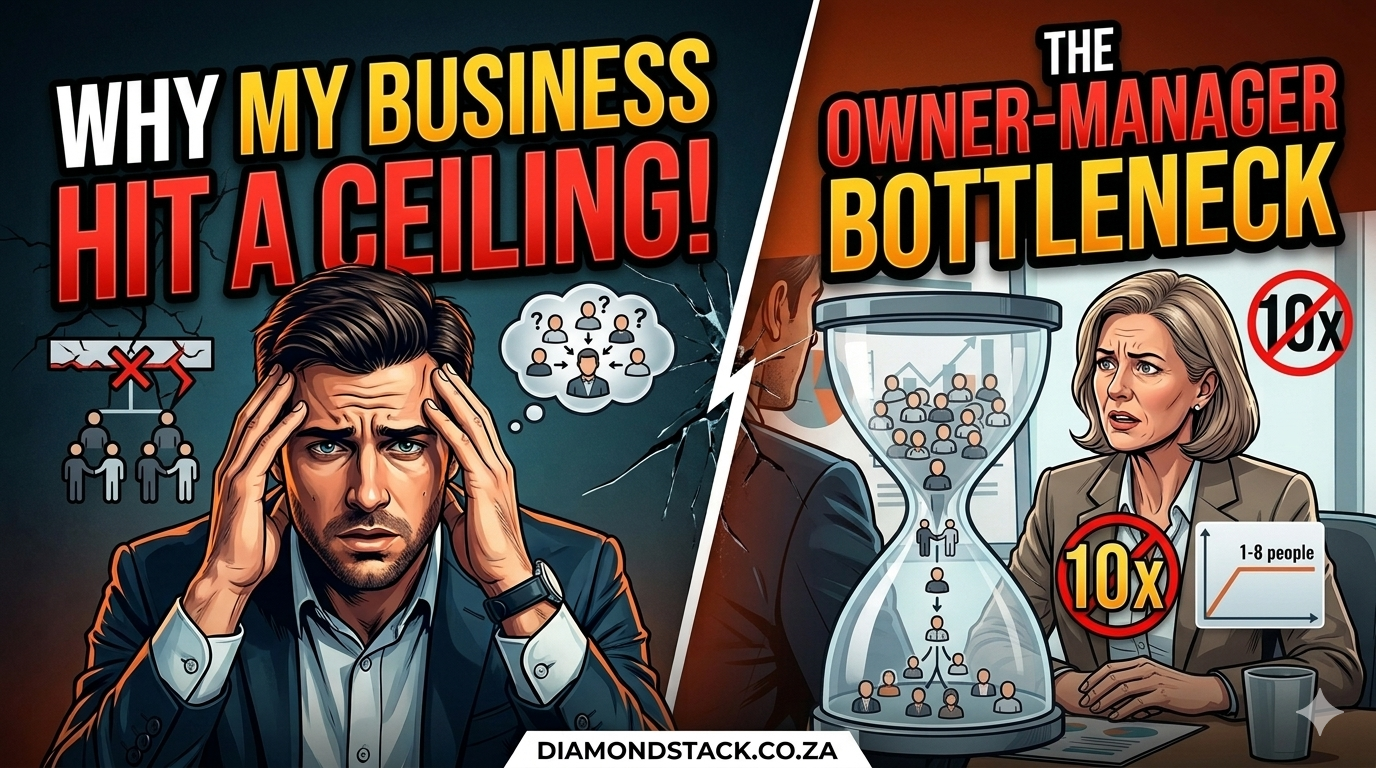
The Owner-Manager Bottleneck — Why Your Business Hits a Ceiling at 8 People (And It’s Not Your Fault)
Erwee Coetzee
Diamond Stack
Cape Town, South Africa
You’ve built something real.
A three-person team became five. Five became eight. For a few glorious months, you felt like you’d finally cracked the code. More hands. More capacity. More revenue.
Then the wheels fell off.
Decisions got slower. Quality started to slip. Your team looked to you for approval on everything—the sourcing, the design direction, the pricing, the customer relationships. You found yourself saying yes to more meetings, more approvals, more bottlenecks. The 12-hour days came back. The stress returned. And weirdly, the revenue didn’t keep climbing. It plateaued.
You started asking yourself: Is this as big as my business can get?
Most jewellery studio owners I talk to hit this moment around 8 people.
Eight. Not seven. Not nine. Eight.
And the first thing they tell me is: “It’s my fault. I’m not a good enough leader. I should have delegated earlier. I should have trained people better.”
I’m here to tell you: it’s not your fault. It’s not a leadership failure. It’s physics.
The Owner-Manager Central Bottleneck Factor
Mikael Pasanen, a researcher at Turku School of Economics, spent years studying why micro-enterprises—businesses under 10 people—hit growth ceilings (Pasanen, 2003). His conclusion was stark and structural: the owner-manager becomes a central bottleneck factor.
Here’s what he found. In a three-person jewellery studio, the founder makes maybe 20–30 significant decisions per day. Those decisions flow through a single brain. That brain can handle it. Barely, but it can.
At eight people, the decision load doesn’t double. It quadruples. Now the founder is making 80–120 decisions per day. Who sources the stones? How do we price this piece? What do we do about the apprentice who’s underperforming? Should we take this custom order? What’s our cash position? Which pieces should we feature on Instagram?
Every. Single. Decision. Flows. Through. You.
And here’s the cruel part: your team wants to make decisions. They’re waiting for permission. They see a problem and they think, “I should ask Johan.” Not because they’re lazy. Because the business has been structured—without you meaning to structure it this way—so that the founder is the central node through which all authority flows.
This is what Pasanen called the structural bottleneck. Not a personality flaw. Not a skill gap. A structural inevitability.
Beckhard and Harris (1987), two organisational change experts, called this the “complexity ceiling”—the predictable point where an organisation hits a wall because its decision-making architecture can’t scale beyond the founder’s cognitive capacity. It’s not a problem with the founder. It’s a problem with the system.
Why It’s Not Your Intelligence
Here’s what makes this worse: you’re probably smarter than your team about the business. You have 20 years of intuition. You can see a stone and know its market value. You can sense when a design will sell. You can read customer hesitation in a conversation.
So when you try to empower your team to make decisions, they often make different choices than you would. Slower sourcing. Different design directions. Different customer conversations. And because they’re different, not wrong, you second-guess yourself. Did I delegate wrong? Should I redo this? Should I have just decided myself?
The result: you start taking decisions back. And the bottleneck gets worse.
But here’s the thing that Pasanen’s research showed: the bottleneck isn’t solved by you making better decisions. It’s solved by you making fewer decisions.
Not fewer decisions about quality. Fewer decisions about process.
The Insight That Changes Everything
Here’s where it gets interesting. Pasanen noticed something about the businesses that did break through the eight-person ceiling. They didn’t hire a superhuman founder. They didn’t replace the founder with someone more delegative. They did something different.
They changed what kind of decisions the founder had to make.
Instead of deciding every step of the process, the founder decided the parameters of the process. Instead of approving each stone selection, the founder created a framework for how stones should be selected. Instead of directing each artisan’s work, the founder defined what quality looks like and let the team achieve it their own way.
The decision load didn’t drop to zero. But it shifted from 120 operational decisions per day to maybe 10 strategic decisions per week.
That’s manageable. That’s scalable. That’s where the leverage is.
And here’s the psychological piece: your team doesn’t feel less empowered. They feel more empowered. Because now they’re operating within a clear framework, and they understand the logic behind it. They know why stones are selected the way they are. They know what quality means. And they can make decisions within that framework without waiting for you.
Why This Is Actually Good News
You’re reading this and thinking: “Great, so I’m structurally trapped. That’s depressing.”
But here’s why this is actually the best news you could get: the bottleneck is also where all the leverage lives.
Right now, you’re the only person in your business who understands the full system. The sourcing logic, the quality standards, the market positioning, the customer psychology. All of that lives in your head.
If you can take that knowledge and externalize it—put it into processes, frameworks, and decision structures—then suddenly your team can execute it. Not as well as you would. But well enough. And with 8 people executing something that’s 85% as good as you would do it, you get more throughput than when 1 person executes something that’s 100% perfect.
That’s the leverage point. That’s where growth lives.
Pasanen found that businesses that successfully scaled past the eight-person ceiling didn’t do it by replacing the founder. They did it by changing what the founder spends time on. Instead of being the person who approves every decision, the founder became the person who designs the decision-making system itself.
From doer to designer. From executor to architect.
What This Means for the Next 14 Posts
Post 1 gave you the foundation: intellectual honesty as credibility. You now know that the real moat isn’t your promises—it’s your willingness to tell the truth about what you know and don’t know.
Post 2 (this one) gives you permission: your bottleneck is structural, not personal. You’re not a bad leader. Your business isn’t broken. You’ve just hit the natural ceiling of a founder-dependent system.
Posts 3–4 will show you the specific pain points of this ceiling: how it manifests in decision-making, how it shows up in team dynamics, and what happens if you try to ignore it.
Posts 5–8 will show you how to solve it: not by becoming a better delegator, but by becoming a framework designer. How to externalize your knowledge. How to build habits and systems that let your team operate independently.
Posts 9–12 will show you how to think about your team differently: not as people who need to be managed, but as cognitive complements to your own strengths and weaknesses.
And Posts 13–16 will bring it all together into a unified system—the Coetzee Convergence Framework—where empowerment, habit, and whole-brain cognition activate as one integrated mechanism.
The Question for This Week
Post 1 asked you: If your business could run without you making every decision, what would you do with that time?
Now I want you to sit with a different question:
What decisions are you making today that could actually be made by your team if they had the right framework?
Not all decisions. Just the ones that feel repetitive. The ones where you find yourself saying the same things over and over. The ones where you know the logic, but your team hasn’t quite internalised it yet.
Those decisions are the leverage points. That’s where the system breaks down. And that’s exactly where we’ll focus in Post 3.
Research & References
Pasanen, M. (2003). In search of the factors affecting the early growth of microenterprises. In E. Autio (Ed.), New firms as agents of growth (pp. 113–132). Routledge.
The foundational study identifying the owner-manager central bottleneck factor as a structural constraint on micro-enterprise growth. Confirms that the ceiling at 8–10 people is not a leadership failure but a systems design issue.
Beckhard, R., & Harris, R. T. (1987). Organizational transitions: Managing complex change (2nd ed.). Addison-Wesley.
Introduces the concept of the “complexity ceiling”—the predictable point where an organisation’s existing decision-making architecture can no longer scale beyond the founder’s cognitive capacity.
Nonaka, I., & Takeuchi, H. (1995). The knowledge-creating company: How Japanese companies create the dynamics of innovation. Oxford University Press.
On tacit vs. explicit knowledge. Provides the theoretical foundation for understanding why founder knowledge is hard to scale and how to externalize it.